- English
- ePUB (mobile friendly)
- Available on iOS & Android
eBook - ePub
About this book
The world is changing. Human population is surging towards 10 billion, food, water, climate and energy security are all at risk. Nitrogen could be our life raft in this global 'perfect storm'. Get it right and it can help to feed billions, fuel our cars and put a dent in global warming. Get it wrong and it will make things a whole lot worse.
Information
Topic
Sciences biologiquesSubtopic
Économie de l'environnement1
A Brief History of Nitrogen
It has been 100 years since a German scientist named Fritz Haber came up with a large-scale way to convert more of the sea of nitrogen gas around us into a usable form1. Before then, how much food we could produce from the fields was largely down to how well we recycled manure and made use of the nitrogen-fixing magic produced by plants like peas and beans. Haber’s invention has allowed us to green the world’s increasingly exhausted fields and put food on the table of billions. A staggering two out of every five people alive today are thought to owe their continued existence to his process2, yet millions still go hungry, and producing enough food for the burgeoning human population of the 21st century will test how well we manage the limit for the use of this precious substance. To date, our record is not a good one.
We have been criminally wasteful in super-charging the fields of the world. The rich doses of nitrogen intended to grow more crops have instead served to contaminate drinking water and power huge blooms of harmful algae in our lakes and seas3. In the air, the deliberate enrichment of the land has ramped up levels of the powerful greenhouse gas nitrous oxide4, while the noxious emissions that are belched from countless power stations, factories and vehicles around the world threaten ever more people with respiratory diseases5. For humankind, nitrogen is truly two-faced.
Haber himself may be viewed either as the saviour of billions or as a nationalistic monster whose inventions prolonged the bloodiest of world wars and whose legacy included chemical warfare and Hitler’s gas chambers6. To tell the true story of nitrogen then is to gaze on both faces of this Janus element – the brutal and the beneficent. It is an integral part of my life, your life and every life on Earth. From food and anaesthesia to space exploration and cryopreservation, from shellfish poisoning and blue baby syndrome, to war, famine and terrorism, its reach is global and yet so often overlooked. Ultimately, whether Haber’s gift to the world ends up being a blessing or a curse for future generations will depend on just how well we learn from the past, and that means looking back a very long way indeed.
Little green men
Each molecule of the trillions of tonnes of nitrogen gas that makes up most of the air we breathe has two atoms. These atoms share a triple bond that is one of the strongest found in nature and, for the first billion or so years of our planet’s existence, only nature’s most powerful atmospheric sledgehammer could break it. Travelling at speeds of up to 10,000 miles per hour and heating the air around it to an air-splitting 25,000°C, the raw energy of lightning is able to tear apart the powerfully bound pairs of nitrogen atoms and combine them with oxygen to form reactive nitrogen oxides7. Much of this then ends up dissolved in rainfall, sprinkling usable nitrogen back over the surface of the Earth8 (Figure 1.1).
For the very first life-forms drifting in the sparse oceans of almost four billion years ago, the nitrogen supplied by lightning was a crucial handhold on existence. Their numbers grew and the grip of life on Earth became more tenacious, but as they used up more and more of the nitrogen supplied by lightning the handhold it provided began to crumble. As demand increased, the supply faltered. The Earth’s atmosphere was changing, with concentrations of carbon dioxide in the atmosphere dropping as increasing amounts were locked away in freshly exposed surface layers, and life on Earth placed its first flagella-prints on the climate. By using artificial lightning – super-heated plasma produced with a laser – we now know that in this changing atmosphere, lightning strikes would have produced less and less reactive nitrogen9. The earliest life on Earth, it seems, was at risk of tripping over itself in the dash for continued existence.
Competing for a diminishing supply of usable nitrogen and faced with an apparently insurmountable limit to expansion, the niche for organisms able to use nitrogen directly from the atmosphere became a yawning chasm. Evolution, that greatest filler of gaps, did not disappoint. In relatively short order the pocket battleships of life on Earth – the cyanobacteria – had arrived. Cyanobacteria (also known as blue-green algae) may be tiny, but the impact these early photosynthesis-endowed microbes have had on our planet is hard to overstate. These microorganisms were able to convert the inert nitrogen gas into a usable form, to ‘fix’ it and produce the reactive nitrogen all life on Earth requires10. With nitrogen fixation came a nutrient supply to hold together the lengthening global food chain, and with their ability to photosynthesise came the oxygen that would poison many of the earliest forms of life, yet power the evolutionary engine to breathtaking complexity.
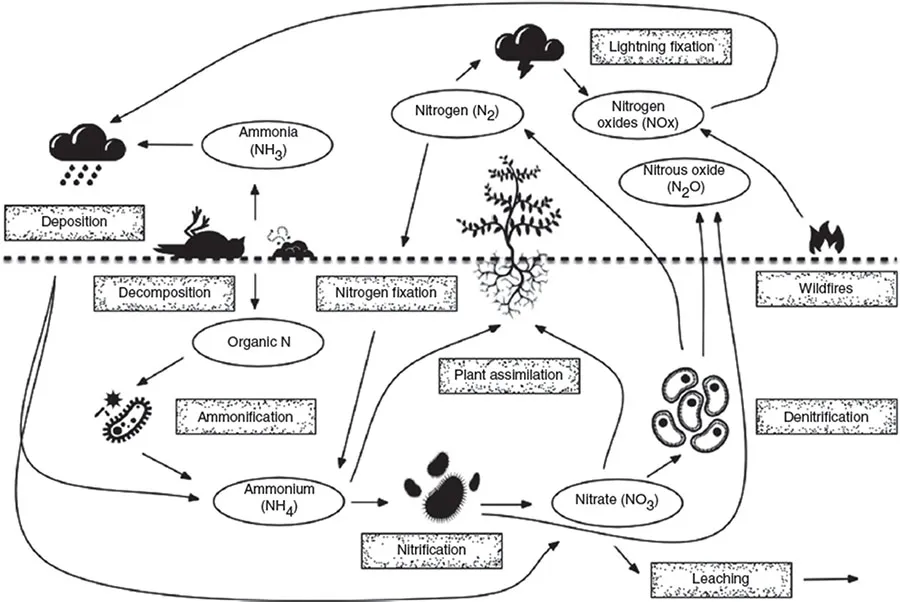
Figure 1.1 The natural terrestrial nitrogen cycle
The dotted line represents the land surface with the boxes showing the key processes by which nitrogen is cycled and the ovals showing the changing form of nitrogen as it undergoes these processes.
Source: Dave Reay
Over the three billion or so years that cyanobacteria have been around, they have successfully survived in just about every home and lifestyle going. In the driest, the coldest, the most barren corners of the planet, look for them and they will be there. Build a new house and cyanobacteria will be first to move in. Splash in a newly formed puddle of rainwater and it is cyanobacteria that will swirl around your feet. As pioneers they are peerless, colonising everything from deserts and coral reefs to the shaggy coats of ponderous sloths and the boiling-hot springs of Yellowstone11.
Millennia before either Scott or Amundsen first set foot on Antarctica, cyanobacteria had made the frozen continent their home. In its apparently lifeless Dry Valleys – a freezing desert of wind-blasted rocks under an ozone-thin atmosphere – cyanobacteria are everywhere12. This, most inhospitable of environments, hides its living secret within the rocks themselves. Beneath the porous rock surface, escaping the scouring desiccation outside, cyanobacteria carve out an existence. Here they receive enough light for photosynthesis while shaded from the DNA-bending doses of ultraviolet radiation on the surface. In the parched streambeds that snake between the rocks yet more cyanobacteria lie waiting, the first drops of moisture bringing them back to full nitrogen-fixing life. They are there even in the shifting snow and in ice-filled lakes. As Captain Scott and his men trudged across the Beardmore Glacier on their one-way trip to the South Pole, countless billions of cyanobacteria lay beneath their frostbitten feet.
They are incredible survivors. In cell-bursting saltpans, acid lakes and soils heavy with toxic metals, they thrive where other life-forms falter. In one test of their hardiness, cyanobacteria were cooled to a temperature of minus 196°C13. They still clung on to life. Unsurprisingly, when biologists look for evidence of alien life it is to the Mars-like desolation of Antarctica’s Dry Valleys to which they turn for parallels14. If we are not alone in this universe, then cyanobacteria are top contenders as the littlest of little green men.
Pre-industrial nitrogen and humankind
If all plants could pull off the same nitrogen-fixing trick as cyanobacteria, then many of the famines and food shortages that have peppered human history may never have happened. Unfortunately, very few of them can. Staple food crops like wheat, rice and maize are actually very nitrogen-hungry and, with each successive harvest, a portion of the much-fought-over available nitrogen in the soil is removed. Keep this up for long enough and the soil’s reserves become so depleted that the crops start to suffer, their growth becoming stunted and the harvests getting progressively smaller. When the early humans first started to swap a life of hunting and gathering for a more sedentary existence, they neatly side-stepped this problem by continually shifting their fields from place to place15. This allowed the crops to make use of a new stock of soil nitrogen each year and left the old fields to gradually recharge their stores. It was only when such wandering farming gave way to the sessile version familiar today that the need to somehow put nitrogen back into the soil came to the fore.
One obvi...
Table of contents
- Cover Page
- Half Title Page
- Title Page
- Copyright
- Dedication
- Contents
- List of Table, Figures and Boxes
- Preface – Wonderstuff
- Acknowledgements
- Introduction
- 1 A Brief History of Nitrogen
- 2 Nitrogen and the Anthropocene
- 3 Nitrous Oxide as a Driver of Climate Change
- 4 Nitrous Oxide Sources
- 5 Airborne Nitrogen and Climate Change
- 6 Terrestrial Nitrogen and Climate Change
- 7 Freshwater Nitrogen and Climate Change
- 8 Marine Nitrogen and Climate Change
- 9 Agricultural Nitrogen and Climate Change Mitigation
- 10 Nitrogen in Food and Climate Change Mitigation
- 11 Nitrogen and Biofuels
- 12 Nitrogen and Geoengineering
- 13 Nitrogen and Climate Change Adaptation
- Conclusion
- Recommended Reading
- Index
Trusted by 375,005 students
Access to over 1.5 million titles for a fair monthly price.
Study more efficiently using our study tools.
Frequently asked questions
Yes, you can cancel anytime from the Subscription tab in your account settings on the Perlego website. Your subscription will stay active until the end of your current billing period. Learn how to cancel your subscription
No, books cannot be downloaded as external files, such as PDFs, for use outside of Perlego. However, you can download books within the Perlego app for offline reading on mobile or tablet. Learn how to download books offline
Perlego offers two plans: Essential and Complete
- Essential is ideal for learners and professionals who enjoy exploring a wide range of subjects. Access the Essential Library with 800,000+ trusted titles and best-sellers across business, personal growth, and the humanities. Includes unlimited reading time and Standard Read Aloud voice.
- Complete: Perfect for advanced learners and researchers needing full, unrestricted access. Unlock 1.5M+ books across hundreds of subjects, including academic and specialized titles. The Complete Plan also includes advanced features like Premium Read Aloud and Research Assistant.
We are an online textbook subscription service, where you can get access to an entire online library for less than the price of a single book per month. With over 1.5 million books across 990+ topics, we’ve got you covered! Learn about our mission
Look out for the read-aloud symbol on your next book to see if you can listen to it. The read-aloud tool reads text aloud for you, highlighting the text as it is being read. You can pause it, speed it up and slow it down. Learn more about Read Aloud
Yes! You can use the Perlego app on both iOS and Android devices to read anytime, anywhere — even offline. Perfect for commutes or when you’re on the go.
Please note we cannot support devices running on iOS 13 and Android 7 or earlier. Learn more about using the app
Please note we cannot support devices running on iOS 13 and Android 7 or earlier. Learn more about using the app
Yes, you can access Nitrogen and Climate Change by D. Reay in PDF and/or ePUB format, as well as other popular books in Sciences biologiques & Économie de l'environnement. We have over 1.5 million books available in our catalogue for you to explore.