- English
- ePUB (mobile friendly)
- Available on iOS & Android
eBook - ePub
About this book
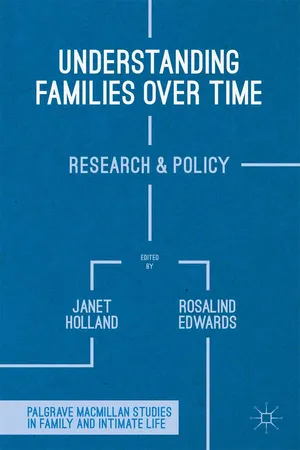
Drawing on research from the Timescapes Study, this volume discusses the life chances and experiences of children and young people, parents and older generations. A unique qualitative longitudinal study forms the basis for the chapter contributions, delivering policy-relevant findings to address individual and family lives over time.
Information
1
Introduction to Timescapes: Changing Relationships and Identities Over the Life Course1
What is qualitative longitudinal research?
At the heart of qualitative longitudinal research (QLR) is the desire to explore what social change through the passage of time means to those who experience it, and how people understand processes of change in their own lives in the context of broader social shifts. The method has recently undergone a resurgence of interest and adoption with some arguing that as a distinctive way of knowing and understanding the social world it is a methodology whose time has come (Thomson et al. 2003, Corden and Millar 2007). But there is nothing new about qualitative enquiry conducted through and in relation to time in the social sciences. It is part of a rich ethnographic tradition that spans fields as diverse as social anthropology, psychology, sociology and its multiple sub-disciplines, oral history and theatre studies (Walkerdine et al. 2001, Kemper and Peterson Royce 2002, Saldana 2003, Holland et al. 2006, Bornat and Diamond 2007, Henderson et al. 2007, Crow 2008). This disciplinary range is exemplified in the Timescapes projects that have contributed to this collection and enriched the work of the Timescapes study.
QLR is open-ended and intentional, involving a dynamic research process where research design and research process grow ever closer. The amount of time covered can vary with different disciplinary approaches and practical considerations, anthropological studies for example tend historically to have a commitment to spending a long time in the field using ethnography, itself a multi-method approach to data generation (Peterson Royce 2011). The Harvard Chiapas Project (Vogt 2002)2 for example was driven by intellectual projects, which could change over the years as new researchers came into the team bringing new theoretical concerns and insights. In community studies, QLR can involve visits and revisits to key research sites by the initial and subsequent researchers. A famous in-depth sociological study of Middletown, US, seen by the researchers as an average or typical American small city (Lynd and Lynd 1929), ‘became a sociological reference point’ (Bell and Newby 1971: 82) that was revisited by the Lynds themselves during the Depression (1937) and many others subsequently (Caplow 1984, Smith 1984, Caccamo 2000).
Given the range of disciplines that employ QLR, specific definitions vary with disciplinary, theoretical and methodological focus. Amidst many insights, Johnny Saldana suggests that ‘Longitudinal means a lonnnnnnnng time’ (Saldana 2003: 1) emphasizing duration, time and change, as basic principles. He also extols the virtue of flexibility in the research process, a key aspect of QLR:
I feel we should be flexible and allow a definition of change to emerge as a study proceeds and its data are analysed. Ironically yet fittingly, we should permit ourselves to change our meaning of change as a study progresses.
(Saldana 2003: 12)
QLR is then an enduring tradition adopted in a range of social science and related disciplines, and has provided a wealth of theoretical, methodological and substantive contributions to social science. Qualitative longitudinal (QL) methods can offer fresh perspectives into established arenas of social enquiry, drawing attention to the psychological and biographical processes of lived experience through which social outcomes are generated and mediated. In this way it can illuminate important micro-social processes, for example how people subjectively negotiate changes occurring in their lives at times of personal life transition (to work or parenthood for example) and combine a concern for these micro as well as macro social processes and practices (Henwood and Lang 2005, Neale et al. 2012). The chapters in this book each describe the value and advantages afforded by QLR and provide excellent examples of these perspectives and insights.
In this chapter, we will describe the unique and innovative nature of the practice of QLR in Timescapes. We will outline the nine projects, seven empirical covering the life course and two that deal with secondary analysis/reuse and archiving, that together form the core of Timescapes, all of which are represented in this volume. We will address the conceptualization of the study with its emphasis on biographical, historical and generational timescapes or flows of time, all laced through the chapters in the book, and we will explore the potential for the enhancement of policy in a range of areas that QLR and Timescapes offer. We will indicate the specific contributions of the chapters in this volume to family and related social policies, drawing out the policy implications, and illustrating the integrated and intersecting nature of the Timescapes study.
The Timescapes approach
The Timescapes’ programme of research examines relationships and identities through the life course and has been carried out by a network of researchers from five universities in the UK (Leeds, London South Bank, The Open, Cardiff and Edinburgh) working in different disciplinary traditions that are sometimes combined in a multidisciplinary approach (sociology, social psychology, social policy, oral history, gerontology, health studies and cultural studies). The seven empirical projects in the study span the life course, from toddlers who were born in the course of a project on first motherhood and became participants, to grandparents over 75 years old. Together they investigate: siblings and friends, lateral relationships in childhood and youth; the unfolding lives of young people; the dynamics of motherhood; masculinities, identities, men as fathers; work–life balance in families with young children; grandparents and social exclusion; and the experiences of the oldest generation. Two further projects play a major part in the integration of the study: ‘Making the long view’ (Chapter 3) and the Timescapes secondary analysis project (Chapter 9; www.timescapes.leeds.ac.uk).
The projects
Here is a brief description of each of the projects:
‘Siblings and friends: The changing nature of children’s lateral relationships’ Rosalind Edwards and Susie Weller at London South Bank University
The working title for this project was ‘Your space: siblings and friends’. Building on three previous studies the project followed a nationwide (UK) sample of circa 50 children and young people (aged 6 and 13 in 2002–2005, 10–17 in 2007 and 12–19 in 2009) living in a variety of family circumstances with three waves of interviews over eight years. The aim was to document the meanings, experiences and flows of their prescribed (sibling) and chosen (friendship) relationships, and explore how these were connected to their sense of self as their individual and family biographies unfolded over time.
‘Young lives and times: The crafting of young people’s relationships’ Bren Neale, Anna Bagnoli/Sarah Finney/ Carmen Lau and Sarah Irwin at Leeds University
Building on an earlier study, the project followed a birth cohort of 30 young people with two further waves of interviews to chart the dynamics of their intimate, social and familial relationships. It explored their cumulative experiences and ‘turning points’ in their biographies and changing sources of morality as they constructed their identities. Further supplementary samples of young men and young fathers were also recruited in the second phase of the study. In this volume, Chapter 4 draws on three rounds of interviews with these young fathers.
‘The dynamics of motherhood: An intergenerational project’ Rachel Thomson, Mary Kehily, Lucy Hadfield and Sue Sharpe at The Open University
In ‘The making of modern motherhood’ (2005–2007), on which this project builds, a diverse sample of 62 pregnant women were interviewed before and after the birth of their first child to explore how women make sense of the meaning of first-time motherhood and the transition to a maternal subjectivity. Twelve intergenerational case studies (based on interviews with mother, grandmothers and a significant other, plus further methods) were constructed to examine the intergenerational processes involved. In the current project, the investigation of six of these case studies was extended to explore how mothers and families negotiate the arrival of a new generation.
‘Masculinities, identities and risk: Long-term transitions in the lives of men and fathers’ Karen Henwood, Mark Finn/Fiona Shirani at Cardiff University
‘Men as fathers’ (working title) draws on and extends a study of 30 fathers in East Anglia (1999–2000) interviewed up to three times before and after the birth of their first child. Nineteen of these men were interviewed again in 2008 and a further similar sample of 16 fathers was recruited in Cardiff (2008) to provide two geographically, socially and culturally diverse cohorts of first-time fathers. The studies examine how men narrate and account for their experiences of becoming a father, examining critical turning points in their life histories and how they make meaning of a significant biographical change. Through comparisons in and through time, the study examines the ruptures and uncertainties in people’s relationships and lives flowing from the dynamics of socio-cultural change, and the making of paternal subjectivity.
‘Work and family lives: The changing experiences of “young families” ’ Kathryn Backett-Milburn, Alice MacLean, Sarah Cunningham-Burley, Lynn Jamieson, Jeni Harden and Sarah Morton at Edinburgh University
The study followed a sample of 14 families in differing socio-economic and labour-market conditions (22 parents and 15 children aged 9–12) with one group (family) and two individual interviews from October 2007 to 2010. The study aimed to explore how families reconcile work and family life over time in an effort to achieve a balance between competing responsibilities. The focus was on processes of negotiation and children’s experiences, everyday family practices and the impact of changes in work and family circumstances including employment/unemployment.
‘Intergenerational exchange: Grandparents, social exclusion and health’ Kahryn Hughes, Nick Emmel and Lou Hemmerman at Leeds University
Intergenerational Exchange is nested in a ten-year programme of research that examines change and continuity in relationships across generations amongst hard to reach people in an estate in a northern city in the UK. The project deals with the experiences of grandparents aged 35–55 whose families are part of what has been called ‘the precariat’ – people whose lives are characterized by little in the way of stable income and social protection (Standing 2011) and described as vulnerable by service providers in the area, with whom the researchers also had ongoing relationships. The sample included 12 grandparents from eight families and retrospective life history accounts were drawn in the early interviews. Three further interviews both added to these accounts and generated prospective data on their ongoing lives and experiences. A visual family tree method tracked 319 immediate family members and significant others, with whom interviews were undertaken, and provided a prompt for highlighting relationships in the later interviews. The ethnographic approach also included formal and informal interviews with service providers associated with the estate who were also gatekeepers and facilitators of the research.
‘The oldest generation: Marking time, relationships and identities in old age’ Joanna Bornat and Bill Bytheway at The Open University
Like project 6, this study involved retrospective life history data from grandparents, with a focus on intergenerational relationships, and prospective tracking of their lives, this time for 18 months. Twelve families (UK nationwide, maximizing geographic and socio-economic diversity) were involved, with a Senior (aged over 75) interviewed twice and a Recorder – a family member who kept a diary of the Senior’s day-to-day life, took photographs and made contact with the project on a monthly basis. The aim was to explore the dynamic nature of older people’s relationships and identities in the context of changing structures of intergenerational support, and how families manage and account for time and change in the context of age and ageing.
‘Making the long view: Sharing the “Inventing adulthoods” project’ Sheila Henderson, Janet Holland, Sheena McGrellis and Sue Sharpe at South Bank University and Rachel Thomson at The Open University
The ‘Inventing adulthoods’ (IA) project had followed the lives of 100 young people in five socio-economically and geographically contrasting sites (urban/rural, inner city/leafy suburb) with up to six biographical interviews since 1996 (aged 11–18), and begun to archive the data. ‘Making the long view’ provided a model of archiving practice for Timescapes and continued archiving IA data, developed a method of (long) case history analysis, and here contributes an empirical chapter on young people in Northern Ireland revisited in 2008–2010.
The Timescapes secondary analysis project, Sarah Irwin and Mandy Winterton at Leeds University
The project involved cross-cutting work both across and within the Timescapes empirical projects to demonstrate and advance the potential for reuse of the data. Activities included conceptual and methodological work, analysis of responses to a small set of questions asked across all Timescapes projects and developing a methodological strategy to work across a subset of Timescapes data sets (described in Chapter 8), as well as in-depth analysis of single project data (from ‘Young lives and times’). Close collaboration and considerable trust was required between this team of researchers and the researchers on other Timescapes projects who enabled them to access data while projects were still ongoing.
These descriptions indicate the commonalities and differences between the projects and suggest the core around which they coalesce, described shortly. Collectively the projects have followed the lives of over 300 individuals in varied families and diverse communities throughout the UK. The samples reflect the key social identifiers of gender, social class, race and ethnicity, cultural and geographical heritages, and locality. Each of these produces multiple intersections in the varied identities and life experiences of the participants. The projects use a range of methods, such as in-depth interviews, ethnographic techniques, visual methods, diaries, life histories and case studies, to capture the inner logic of people’s lives as they unfold. QLR needs time for the full value of the method to be realized, so that the effects of changes and the existence of continuities can be seen in the accumulating data, and the complexity of the intersections and interrelationships can become more apparent. As you see from the descriptions above, in our research design six of the projects build on and incorporate data gathered from separately funded earlier phases of the specific research, which we have called heritage data. This extends their timescale to before the Timescapes five-year funded period. Further, some projects have successfully bid for additional funding to extend their work (projects 1, 2 and 3). These pre- and post-Timescapes extensions increase the longitudinal and historical reach of the work, and add time and value to Timescapes itself.
In QLR, as in any research, methods need to be tailored to specific research questions, samples and disciplinary concerns, and each of the Timescapes’ projects stands alone with its own substantive and disciplinary focus, methodological approach and contribution to scholarship. But the common elements that they have all adopted and work within blend them together to produce a whole that is greater than the sum of its parts, the Timescapes study.
All of the projects pursue the major objective and theme of Timescapes: the dynamics of personal, intimate and family relationships, the identities that flow from these relationships and how they are worked out across the life course and within different generations. These processes are happening against a backdrop of widespread and significant changes in family and domestic life and intimacy. But as Timescapes itself demonstrates, such changes are accompanied by the continuing importance to people of relationality, and in particular relationships of intimacy, love and care over the life course and within and across familial and cohort generations. These changes in families themselves are taking place in the context of a changing economic situation following the near collapse of the world banking system and the subsequent economic austerity measures pursued by national governments that took place during the period of research (2008 and beyond). These economic and social upheavals have a negative effect on housing and welfare policies and conditions in general for already stretched families (Edwards and Irwin 2010).
All projects share the conceptual and methodological concerns that are the backbone of Timescapes, employing and elaborating three different timescapes: biographical, generational and historical. The inspiration for this approach comes from C. Wright Mills, who argued that we cannot h...
Table of contents
- Cover
- Title Page
- Copyright
- Contents
- List of Tables
- Series Editors’ Preface
- Notes on Contributors
- 1. Introduction to Timescapes: Changing Relationships and Identities Over the Life Course
- Part I: Relationships and Life Chances of Children and Young People
- Part II: Parenting and Family Life
- Part III: Older Lives and Times
- Index
Trusted by 375,005 students
Access to over 1.5 million titles for a fair monthly price.
Study more efficiently using our study tools.
Frequently asked questions
Yes, you can cancel anytime from the Subscription tab in your account settings on the Perlego website. Your subscription will stay active until the end of your current billing period. Learn how to cancel your subscription
No, books cannot be downloaded as external files, such as PDFs, for use outside of Perlego. However, you can download books within the Perlego app for offline reading on mobile or tablet. Learn how to download books offline
Perlego offers two plans: Essential and Complete
- Essential is ideal for learners and professionals who enjoy exploring a wide range of subjects. Access the Essential Library with 800,000+ trusted titles and best-sellers across business, personal growth, and the humanities. Includes unlimited reading time and Standard Read Aloud voice.
- Complete: Perfect for advanced learners and researchers needing full, unrestricted access. Unlock 1.5M+ books across hundreds of subjects, including academic and specialized titles. The Complete Plan also includes advanced features like Premium Read Aloud and Research Assistant.
We are an online textbook subscription service, where you can get access to an entire online library for less than the price of a single book per month. With over 1.5 million books across 990+ topics, we’ve got you covered! Learn about our mission
Look out for the read-aloud symbol on your next book to see if you can listen to it. The read-aloud tool reads text aloud for you, highlighting the text as it is being read. You can pause it, speed it up and slow it down. Learn more about Read Aloud
Yes! You can use the Perlego app on both iOS and Android devices to read anytime, anywhere — even offline. Perfect for commutes or when you’re on the go.
Please note we cannot support devices running on iOS 13 and Android 7 or earlier. Learn more about using the app
Please note we cannot support devices running on iOS 13 and Android 7 or earlier. Learn more about using the app
Yes, you can access Understanding Families Over Time by Rosalind Edwards, J. Holland in PDF and/or ePUB format, as well as other popular books in Politics & International Relations & Social Policy. We have over 1.5 million books available in our catalogue for you to explore.