- English
- ePUB (mobile friendly)
- Available on iOS & Android
eBook - ePub
About this book
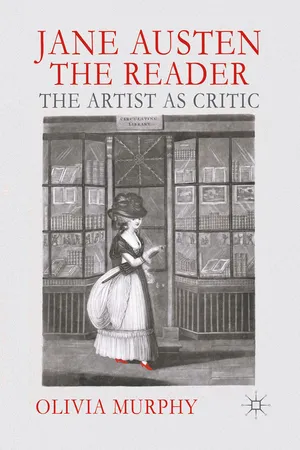
Jane Austen the Reader explains Austen's excellence and endurance by showing how her writing developed as a response to the writing of others: as parody, satire, criticism and even, on occasion, homage. Seeing Austen as a critic offers new insights into her creativity, and new interpretations of her novels.
Information
Topic
LiteraturSubtopic
Europäische Literaturkritik1
‘From Reading to Writing It Is But One Step’: Jane Austen, Criticism and the Novel in the Eighteenth and Early Nineteenth Centuries
– Alexander Pope
The Critick’s judgment may be right, or it may be wrong; his taste good or bad: there is no greater probability, that an unknown person, who gives his opinion upon books once a month, or once a quarter, should be right, than that any other unknown person should be so, who delivers his in a parlour
– Anna Laetitia Barbauld2
Alas! if the heroine of one novel be not patronized by the heroine of another, from whom can she expect protection and regard? … Let us leave it to the Reviewers to abuse such effusions of fancy at their leisure, and over every new novel to talk in threadbare strains of the trash with which the press now groans. Let us not desert one another; we are an injured body.
(NA, 37)
Frances Burney’s hugely successful first novel Evelina (1778) opens with an anonymous, ironic appeal to ‘the authors of the Monthly and Critical Reviews’, for ‘protection’, addressing them as ‘Magistrates of the press, and Censors for the Public’ – ‘those who publicly profess themselves Inspectors of all literary performances’.3 In a book published 40 years later, the narrator of Jane Austen’s Northanger Abbey is still voicing objections to the reviewers’ treatment of novels. Evelina’s mocking dedication to its reviewers and the dismissive account of their successors in Northanger Abbey’s polemic provide us with synecdochic evidence of the ongoing conflict between novelists and reviewers, and the ‘threadbare strains’ in which the quarrel was conducted.
At the heart of this dispute was the issue of the novel’s status – as a literary genre; as a transmitter of virtue or immorality; and as a repository and refractor of cultural anxieties – a dispute that was played out not only in the reviews or in the first extended attempts at novelistic criticism, but also on the pages of novels themselves and, ultimately, in the minds of novel writers and readers. Mikhail Bakhtin has warned that
The study of the novel as a genre is distinguished by peculiar difficulties. This is due to the unique nature of the object itself: the novel is the sole genre that continues to develop, that is as yet uncompleted. The forces that define it as a genre are at work before our very eyes: the birth and development of the novel as a genre takes place in the full light of the historical day.4
Exploring the early reception of novels is crucial to understanding the genre. The processes of creation and criticism are, in this period, inextricably linked, and while the relationship between author and reviewer, or novel and novelistic criticism, continued to be a troubled one throughout the period of the novel’s development in the eighteenth century and into the nineteenth, it was a relationship that was nevertheless enduring and indissoluble.
In the eighteenth and early nineteenth centuries, the development of the novel as a genre was complemented and – as I shall argue throughout this book – influenced by the inception and development of criticism of the novel. During this period criticism, whether explicit or implicit, emerges in a number of printed sources. Reviews and periodicals, along with prefaces and collections of novels, inform and support each other. Each of them performs the dual tasks that occupy critics of the novel: identification (what is a novel?) and evaluation (what is a good novel?). The first project, of identification, or definition, contributes to the stabilisation of the novel as a genre leading into the nineteenth century, while the second project of evaluation initiates the approval and canonisation of some novels and the relegation of others to comparative critical and historical oblivion. This process is remarkably deliberate on the part of eighteenth-century critics and also evinces a surprising degree of concordance between different writers in different formats and in different decades.
The ‘Monthly and Critical Reviews’ named by Burney were, until the nineteenth century, the two most important organs in Britain for the record and assessment of contemporary publications, both fiction and non-fiction. The Monthly, the most successful eighteenth-century review, achieved a circulation of 5000 copies in the 1790s.5 Despite the obvious antagonism towards the reviewers evinced by Burney and many of her fellow novelists, the reviews’ readers generally commended their judgment and impartiality. Derek Roper quotes the ‘Whig Johnson’, Samuel Parr:
There is no one Review in this country, but what is conducted with a considerable degree of ability; and though I decline the task of deciding upon their comparative excellence, I have no hesitation in saying that all of them deserve encouragement from learned men. They much oftener assist than retard the circulation of good books – they rarely prostitute commendation upon such as are notoriously bad.
The principal attribute distinguishing the reviews of the eighteenth century from nineteenth-century publications like The Edinburgh and The Quarterly was their attempt to review, or at least take notice of, every new publication. As Roper writes, this was the result of a fundamentally different ethos held by the earlier reviews, one that was itself typical of Enlightenment philosophy:
Superficial comparisons with later Reviews tend to obscure the real character of these eighteenth-century journals. Numbers of the Monthly and the Critical were not meant to be read for entertainment and thrown away. They were conceived as instalments of a continuous encyclopaedia, recording the advance of knowledge in every field of human enterprise … All the researches, speculations, discoveries, and achievements of that age of progress were recorded in these journals by means of a systematic review of as many new publications as possible – ideally, of all. To comment on the latest poems and novels was a small part of the reviewer’s task.6
Although reviewers often complained about the magnitude and tedium of their assignments, the reviews’ attempt to provide notice of all publications had important benefits for women novelists, and for the novel as a genre. As Laura Runge points out,
Like every other author whose books were sold to the public, female novelists saw their works reviewed by comprehensive journals that strove for both objectivity and universal coverage. The comprehensive project obliged reviewers to criticize novels by women however their own literary tastes or gendered ideologies might operate; so despite cultural imperatives for gallant condescension to women or assumptions about the catastrophic effects of novel reading, reviewers were bound to assess novels by women.7
It may be necessary to point out that most novels of the period, particularly first novels, were published anonymously, so identifying the sex of an author is no simple task. Nevertheless, studies do bear out the large number of women writers.8 ‘Significantly,’ Runge adds, ‘the number of novels by women increased at the same time that book reviewing became widespread,’ and that fact alone suggests that any ‘abuse’ meted out by critics was unlikely to stanch the flow of literary ‘effusions of fancy’.9
Not all of the fiction consumed by the eighteenth-century reading public was reviewed, however, or even named in the ‘Catalogues’ in which many novels were mentioned with only a brief description, or with no description at all. Robert Mayo points out that ‘there is a considerable repository of prose fiction which seldom figured in the publishers’ lists and which was rarely mentioned in the reviews, but which nevertheless enjoyed a wide currency’: that is, the fiction (usually short ‘tales’ and ‘histories’) that was published in periodicals and magazines. Mayo writes that fiction ‘of some sort was found in four hundred and seventy different periodicals published between 1740 and 1815’.10 That Austen, like many among her contemporaries, read and responded to these stories, some of which were contributed by amateurs, and some by novelists as well established as Tobias Smollett, is confirmed by Edward Copeland in his study ‘Money Talks: Jane Austen and the Lady’s Magazine’. Copeland notes echoes of fiction published in the Lady’s – appropriated names, and even elements of plot – in Austen’s juvenilia and in Sense and Sensibility.11
The literary culture of the late eighteenth century was made up of amateurs and professionals, contributing as both readers and writers in a number of genres and formats. In some cases the work of amateurs was regarded above that of the ‘hacks’ – Smollett’s character Tim Cropdale ‘had made shift to live many years by writing novels, at the rate of five pounds a volume; but that branch of business is now engrossed by female authors’. These women, Smollett continues, ‘publish merely for the propagation of virtue, with so much ease and spirit, and delicacy … that the reader is not only enchanted by their genius, but reformed by their morality’.12 While a young fellow at St John’s College, Oxford, Austen’s brother James created The Loiterer, a weekly periodical conceived along the lines of Johnson’s Idler, which was sustained through 60 issues, beginning in 1789 and ending in March 1790. In his first paper, the eponymous Loiterer – employing the editorial plural – offers an account of the reciprocity of contemporary literary practices:
But if from reading to writing it is but one step, from writing to publishing it is less – and finding in course of time our works swell upon our hands, after a decent struggle between fear and vanity, we at length agreed that to keep our talent any longer wrapt in the napkin would be equal injustice to our writings, the world, and ourselves. (TL, 4)
Like Johnson’s Rambler and Idler, or The Spectator of Joseph Addison and Richard Steele, The Loiterer employed a number of different narratorial voices, moved between the epistolary and the essay mode, and included contributions by different authors. Most of the issues offer little more than a tired pastiche of Johnsonian moralising, although those which contain ‘a rough, but not entirely inaccurate sketch of the character, the manners, and the amusements of Oxford, at the close of the eighteenth century’ evince greater originality and interest, and – along with the contemporary rage for periodicals – justify The Loiterer’s wide distribution and its early (pirated) reprinting in volume form (TL, 367). The 17-year-old Henry Austen, at the time a student at St John’s, contributed several essays to what may have been developed as a joint enterprise by the two brothers, and there were contributions from other members of the college and the university. Some of the contributors were not identified, and remain anonymous.
The true identity of the contributor to the ninth issue remains indeterminate. The Loiterer for Saturday, 28 March 1789 begins with a facetious apology on the part of the editors for their ‘past neglect’ of the ‘fair sex’, before printing a letter from ‘Sophia Sentiment’, a young lady well read in both novelistic and periodical fiction. Sophia declares herself – using a label Elizabeth Bennet will later disclaim – to be ‘a great reader’; explaining that besides ‘some hundred volumes of novels and plays’, she has, ‘in the last two summers, actually got through all the entertaining papers of our most celebrated periodical writers, from the Tatler and Spectator to the Microcosm and the Olla Podrida. Indeed,’ Sophia continues, ‘I love a periodical work beyond any thing, especially those in which one meets with a great many stories, and where the papers are not too long’ (TL,50). Sophia declares The Loiterer ‘the stupidest work of the kind I ever saw’, because in eight issues she has found ‘not one sentimental story about love and honour, and all that’. She complains that ‘not even an allegory or dream have yet made their appearance in the Loiterer’ (TL, 51). Sophia offers a number of suggestive possibilities for fiction to spice up the periodical, in the hope of seeing
some nice affecting stories, relating the misfortunes of two lovers, who died suddenly, just as they were going to church. Let the lover be killed in a duel, or lost at sea, or you may make him shoot himself, just as you please; and as for his mistress, she will of course go mad; or if you will, you may kill the lady, and let the lover run mad; only remember, whatever you do, that your hero and heroine must possess a great deal of feeling, and have very pretty names. (TL, 52)13
Sophia’s letter serves as a starting point for The Loiterer to engage in the sort of sexist condescension to ‘our fair country-women’ that was a convention of masculine literary language in the eighteenth century (TL, 52).14 Part of this convention is an insistence that the editors are ‘not yet old enough, either as authors or men, to be indifferent to’ the ‘smiles’ of women – making it clear that women’s opinions of literature and of literary merit are of concern only insofar that they influence their facial expressions. The chief object of the issue, however, is The Loiterer’s claim to literary seriousness (echoing Johnson in The Rambler No. 1), which the author attempts to prove through a dismissive critique of periodical and magazine fiction. About half of the issue is devoted to this posturing criticism, conducted in the usual tone employed by James Austen in The Loiterer, and signed with one of his pseudonymous ciphers.
The inset letter, however, is written in a very different tone, which, along with its content, has led critics to speculate that ‘Sophia Sentiment’ is an early nom de plume of Jane Austen.15 Peter Sabor, for one, puts forward this view in his introduction to the recent Cambridge edition of Austen’s juvenilia, stating that ‘the overall case for Austen’s authorship of the letter is strong’, while on the other hand Claire Tomalin concludes that Sophia Sentiment ‘is more likely to have been a transvestite, Henry or James’.16 Li-Ping Geng argues that The Loiterer and the ‘literary collaboration between Jane Austen and her Oxford brothers’ had important consequences for Austen’s future literary career, but falls short of suggesting that theirs was a true, bilateral collaboration, arguing instead that James and Henry ‘may have had a large share in shaping their sister’s literary identity’ and providing her with ‘inspiration’.17 By 1789, however, Austen had already finished many of the stories which she would eventually include in Volume the First, the first of three volumes of her juvenilia which she preserved, and in some cases reworked, into adulthood. As Margaret Doody has written, ‘Jane Austen was not a child as a writer when she wrote these early pieces. She possessed a sophistication rarely matched in viewing and using her own medium.’18 Austen is known to have shared these pieces with her family, and most of them carry comically overblown dedications to family members and friends, arguing for a cu...
Table of contents
- Title
- Copyright
- Contents
- List of Illustrations
- Acknowledgements
- List of Abbreviations
- Introduction
- 1 ‘From Reading to Writing It Is But One Step’: Jane Austen, Criticism and the Novel in the Eighteenth and Early Nineteenth Centuries
- 2 What’s Not in Austen?: Critical Quixotry in ‘Love and Freindship’ and Northanger Abbey
- 3 Texts and Pretexts: Sense and Sensibility and Pride and Prejudice
- 4 ‘A Good Spot for Fault-Finding’: Reading Criticism in Mansfield Park
- 5 ‘Hints from Various Quarters’: Emma and the ‘Plan of a Novel’
- 6 ‘Bad Morality to Conclude With’: Persuasion and the Last Works
- Appendix: What Happened to Jane Austen’s Books?
- Notes
- Bibliography
- index
Trusted by 375,005 students
Access to over 1.5 million titles for a fair monthly price.
Study more efficiently using our study tools.
Frequently asked questions
Yes, you can cancel anytime from the Subscription tab in your account settings on the Perlego website. Your subscription will stay active until the end of your current billing period. Learn how to cancel your subscription
No, books cannot be downloaded as external files, such as PDFs, for use outside of Perlego. However, you can download books within the Perlego app for offline reading on mobile or tablet. Learn how to download books offline
Perlego offers two plans: Essential and Complete
- Essential is ideal for learners and professionals who enjoy exploring a wide range of subjects. Access the Essential Library with 800,000+ trusted titles and best-sellers across business, personal growth, and the humanities. Includes unlimited reading time and Standard Read Aloud voice.
- Complete: Perfect for advanced learners and researchers needing full, unrestricted access. Unlock 1.5M+ books across hundreds of subjects, including academic and specialized titles. The Complete Plan also includes advanced features like Premium Read Aloud and Research Assistant.
We are an online textbook subscription service, where you can get access to an entire online library for less than the price of a single book per month. With over 1.5 million books across 990+ topics, we’ve got you covered! Learn about our mission
Look out for the read-aloud symbol on your next book to see if you can listen to it. The read-aloud tool reads text aloud for you, highlighting the text as it is being read. You can pause it, speed it up and slow it down. Learn more about Read Aloud
Yes! You can use the Perlego app on both iOS and Android devices to read anytime, anywhere — even offline. Perfect for commutes or when you’re on the go.
Please note we cannot support devices running on iOS 13 and Android 7 or earlier. Learn more about using the app
Please note we cannot support devices running on iOS 13 and Android 7 or earlier. Learn more about using the app
Yes, you can access Jane Austen the Reader by O. Murphy in PDF and/or ePUB format, as well as other popular books in Literatur & Europäische Literaturkritik. We have over 1.5 million books available in our catalogue for you to explore.
But are not critics to their judgment too?