Too many decisions are taken too slowly or not at all because of the dithering behavior of our leaders, often leading to failure of the project, or worse, the organization. See how procrastination has led to major contemporary leadership failures and learn how to recognize and resolve the problem in yourself and others.
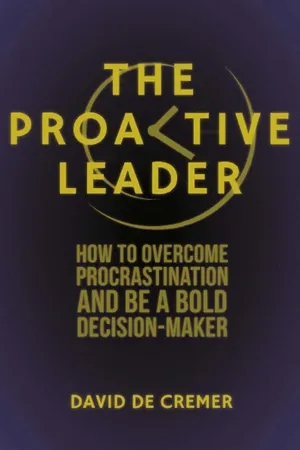
eBook - ePub
The Proactive Leader
How To Overcome Procrastination And Be A Bold Decision-Maker
- English
- ePUB (mobile friendly)
- Available on iOS & Android
eBook - ePub
The Proactive Leader
How To Overcome Procrastination And Be A Bold Decision-Maker
About this book
Information
CHAPTER 1
Introduction
There is no subject about which so much has been written so often as leadership.1 Notwithstanding the enormous number of books on this theme, there is still an air of mystique surrounding our leaders. Perhaps for this reason, the concept of leadership is still imperfectly understood, so that new and deeper perspectives are put forward at regular intervals in the hope of better explaining this key social phenomenon. Of course, relationships between people and, above all, the social dynamic that those relationships entail are by no means a simple matter. Quite the reverse, in fact. The existence of a multiplicity of theoretical analyses is therefore not necessarily a bad thing. Even when you have managed to get to grips with a social phenomenon such as leadership, it is still important to further broaden your understanding. And to help you find your way through this plethora of different viewpoints, it can do no harm to be aware that – in my opinion, at least – leadership has two dominant perspectives: the perspective of the leader and the perspective of the follower.2
Leadership can only exist if there are other people prepared to follow. And of course, it is not enough simply to put on a hat with the word ‘leader’ on it, in the hope that everyone will then accept your leadership. If people do not follow you, you will not be a leader – no matter what hat you are wearing. Followers are therefore indispensable to the concept of leadership. If you were to put Bill Clinton – one of the most charismatic and natural leader types of modern times – on a desert island, he would automatically lose his charisma and his other leadership qualities. These qualities can only exist when they are given to him by others – his followers. And the reverse is also true: followers can only exist if they have a leader figure – a person who belongs to the group but who is also sufficiently different from the others, so that he/she stands out in contrast to the background of followers.3 The most interesting aspect of this dual perspective is that it allows the easy identification of problems relating to leadership. If both sides – the leading and the led – look at things the same way, then everything is hunky-dory! But if the leader and the followers look at something in a different way, then there is a problem. It is my conviction that by using this bifocal approach it must be possible not only to facilitate but also to optimise the flow of social and work traffic between leaders and followers – both in theoretical terms and in day-to-day practice.
In this book we will therefore use these bifocal glasses to look more closely at one of the key problems of contemporary leadership: the procrastination of leaders. If you listen carefully to the signals coming from the worlds of politics, business and finance, one of the most common complaints you will hear is that too many decisions are taken too slowly or not at all, because of the dithering behaviour of our leaders. In this context, it is important to note that the avoidance of decision-making is not the same as laissez-faire leadership, where more often than not the leader is simply absent.4 No, the problem to which I refer here is the problem of leaders who either lack the necessary decisiveness and direction and thus take half-baked decisions or who simply postpone the ultimate decision that needs to be taken – in short, half-hearted leadership. The delaying of decisions in this manner is something with which we will all be familiar: from the simple postponing of your annual appraisal review to the sidelining of strategic plans and visions that were launched with such enthusiasm at the beginning of the year. For many of us, some forms of procrastination are acceptable – or at least help to make things manageable. Having said this, in many other circumstances procrastination can have serious consequences for individuals, organisations and society at large. For this reason, it is important to acquire insights into a phenomenon that has become so widespread that it even has its own special day. The French writer David d’Equainville proclaimed 26 March 2011 as ‘International Procrastination Day’. A day on which everyone was allowed to take things easy and not rush into any decisions. A running joke on the Internet was, however, that the Frenchman originally scheduled this day on 25 March 2011 – completely in line with the habits of a procrastinator.
In outlining the problem of procrastination, I will highlight several key aspects of what leadership actually is all about. Put briefly, the following takeaways are essential to define leadership as it is used in this book (Table 1).
TABLE 1 Leadership takeaways
What leadership is about
Leadership is a two-way street:
Leaders only exist when there are people who will follow. In this way, leadership is different from management as leaders have followers whereas managers have subordinates.
Followers can only be there when someone is able to lead. Being a follower implies a comparative process where the more powerful leads and the less powerful complies.
Many people like being a leader, but prefer to do this from the perspective of a follower position:
Basically, people do have a desire to be able to influence others and set directions, but only a few people are also in the game to take the risks and responsibilities associated with the job of being a leader. Thus, being formally appointed as the leader but not taking too many risks (and as we will later in this book see important decisions) is the situation that most of our leaders prefer. The heroic view of leaders taking the lead without fear has gradually disappeared in our contemporary society.
Leadership is a social process in which one individual is able to influence the others to promote the collective welfare:
This definition is used in many textbooks and points out the collective responsibilities that the one in charge carries with him or her. Nevertheless, sometimes this social burden may prove too difficult for many of our leaders, thereby instigating processes of procrastination.
Action defines the heart of leadership:
Leadership entails giving direction and guidance when striving for positive change aimed at promoting the collective welfare. In this process it is no surprise that the one in charge undertakes action to shape this change in visionary ways that appeal to the followers. In this stage, leaders take decisions that shape how they can lead by example.
At the end of the day someone has to make the decision:
Leaders define the vision that collectives pursue and motivate followers to contribute to this process. One significant and important way that leaders use to involve followers is by consulting the others. A transparent and fair decision-making process is characterised by means of giving voice to the ones being led. The problem of many contemporary leaders is that as little responsibility is taken the decision-making process is slowed down considerably. Many leaders often forget that fair decision-making also implies that after the consultation phase the one in charge actually makes a decision.
Leadership and the problem of procrastination
One of the most interesting aspects of the assertion that many leaders are prone to procrastinate is the fact that the problem is recognised by both sides of our perspective. Many leaders are well aware that the acceptance of responsibility and the taking of decisions are not getting any easier in a world that is becoming ever smaller and more complex. On the other side, followers are becoming ever-more impatient for the decisions that can bring about real change. The fact that people are happier to adopt a follower’s role, so that they can more easily criticise a lack of leadership, suggests that the role of a leader is not always an enviable or desirable one. On the contrary, in our complex modern world leaders seem to be facing an increasingly Herculean task, where they are happy to accept the benefits of leadership (power and influence) but are not so keen (or able) to deal with the burden it entails (accepting responsibility and taking hard decisions). Viewed in this light, it is easier to understand the growing calls for a decentralised decision-making structure and ‘leaderless teams’.5 The basic idea seems to be to make everyone a leader, but to allow them to exercise their leadership function from within their safer role as follower.
There are numerous contemporary examples where leadership and procrastination go hand in hand. The indecisive behaviour in recent times of many of Europe’s political leaders is a classic instance. The end of 2011 was marked by near chaos in the European Union, with urgent measures necessary to save the European currency. (In 2013 the danger to the euro has still not disappeared entirely.) The solutions put forward by Merkozy (het duo Merkel–Sarkozy) and the European President Herman Van Rompuy all had one thing in common: they seemed to push the problem further and further into the future. Each European summit produced another series of half-hearted (and some would say half-baked) proposals that were little more than stopgap measures, postponing a decision on the real problem to the next summit (or the one after that). All that this achieved was to give the political leaders a degree of breathing space, but they failed to use this respite to take a clear line that demonstrated the necessary will and decisiveness to tackle the crisis head on. Not surprisingly, this led to accusations of weak leadership on all sides and risked making Europe an easy prey for the sharks of the financial markets. In this respect, the Eurocrisis is indeed a textbook example of leaders who are not capable of taking the hard decisions that are so often required in difficult circumstances, which in this instance should have meant dealing with the Greece problem as quickly as possible, so that the focus could be reset on the need for all-important growth in the European economy. Commentators were quick to recall the doom scenario that devastated the Japanese economy at the beginning of the 1990s, when the Japanese leaders of the day were also blamed for taking too little action much too late, with severe consequences (low growth and a high rate of debts) that are still being felt today.
Unfortunately, the situation was not much better on the other side of the Atlantic Ocean. In the United States, President Obama was branded in 2011 as a ‘weak’ leader, particularly so by his Republican opponents. In the opinion of his detractors, it had become increasingly obvious that Obama displayed a tendency to prolong discussions and negotiations unnecessarily, sometimes even pointlessly, in the hope of reaching a political consensus. This idea of getting everyone ‘on board’ is nice in theory but is always likely to be punished in practice. It required Obama to steer an almost neutral course – in the hope of charming the majority of neutral, middle-ground voters, whose support he would need to be re-elected in 2012 – his re-election did happen and the middle-ground voters were persuaded, particularly the minority voters. But on the reverse side of the coin it made him very vulnerable to criticism that he had no clearly defined vision for the future. The signals that came out of the White House in 2011 were viewed as lacking purpose and direction, which were clear indicators of growing uncertainty. The Republicans, in particular, smelled blood at that time and did everything possible to drive the President into a corner. The fact that many crucial decisions were taken only at the very last moment illustrates that Obama’s fear of being labelled as someone with strong prejudices had actually paralysed his decision-making process.
Leadership and how decisions are taken
The above examples paint a pretty poor picture of the decision-making capabilities of the Western world’s current batch of political leaders. In fact, it is no exaggeration to argue that the putting off of decisions – or even an outright refusal to make them – is the most important problem in modern-day leadership.6 This is not to say that leaders are not entitled to delay decisions for good reasons. Rather, the major problem that we nowadays face is that many of our leaders simply refrain from making a decision at all, which in a way makes them more or less invisible to the ones they are supposed to be leading.
It is vital that this problem should be recognised (and quickly), since the taking of decisions is universally regarded as a crucial element of effective leadership. Making decisions and initiating action on the basis of those decisions are part of the job description of every leader and are essential if you want to bring about change. This idea underlines the comment once made by the former US President Harry S. Truman: ‘Progress occurs when courageous, skilful leaders seize the opportunity to change things for the better.’ To support the noble arts of decision-making and action-taking, it is useful (and interesting)...
Table of contents
- Cover
- Title Page
- Copyright
- Contents
- List of Figures and Tables
- Chapter 1. Introduction
- Chapter 2. The psychology of the leader
- Chapter 3. The psychology of the situation
- Chapter 4. Culture, global leadership and procrastination
- Chapter 5. The consequences of delaying decisions
- Chapter 6. Leader perceptions and procrastination
- Chapter 7. An interactive model
- Chapter 8. What to do?
- Chapter 9. The ‘Leadership on Hold’ – Survey ©
- References
- Index
Trusted by 375,005 students
Access to over 1.5 million titles for a fair monthly price.
Study more efficiently using our study tools.
Frequently asked questions
Yes, you can cancel anytime from the Subscription tab in your account settings on the Perlego website. Your subscription will stay active until the end of your current billing period. Learn how to cancel your subscription
No, books cannot be downloaded as external files, such as PDFs, for use outside of Perlego. However, you can download books within the Perlego app for offline reading on mobile or tablet. Learn how to download books offline
Perlego offers two plans: Essential and Complete
- Essential is ideal for learners and professionals who enjoy exploring a wide range of subjects. Access the Essential Library with 800,000+ trusted titles and best-sellers across business, personal growth, and the humanities. Includes unlimited reading time and Standard Read Aloud voice.
- Complete: Perfect for advanced learners and researchers needing full, unrestricted access. Unlock 1.5M+ books across hundreds of subjects, including academic and specialized titles. The Complete Plan also includes advanced features like Premium Read Aloud and Research Assistant.
We are an online textbook subscription service, where you can get access to an entire online library for less than the price of a single book per month. With over 1.5 million books across 990+ topics, we’ve got you covered! Learn about our mission
Look out for the read-aloud symbol on your next book to see if you can listen to it. The read-aloud tool reads text aloud for you, highlighting the text as it is being read. You can pause it, speed it up and slow it down. Learn more about Read Aloud
Yes! You can use the Perlego app on both iOS and Android devices to read anytime, anywhere — even offline. Perfect for commutes or when you’re on the go.
Please note we cannot support devices running on iOS 13 and Android 7 or earlier. Learn more about using the app
Please note we cannot support devices running on iOS 13 and Android 7 or earlier. Learn more about using the app
Yes, you can access The Proactive Leader by Kenneth A. Loparo,David De Cremer in PDF and/or ePUB format, as well as other popular books in Business & Business Strategy. We have over 1.5 million books available in our catalogue for you to explore.