- English
- ePUB (mobile friendly)
- Available on iOS & Android
eBook - ePub
New Documentaries in Latin America
About this book
Examining the vast breadth and diversity of contemporary documentary production, while also situating nonfiction film and video within the cultural, political, and socio-economic history of the region, this book addresses topics such as documentary aesthetics, indigenous media, and transnational filmmaking, among others.
Information
Subtopic
Art GeneralPart I
Aesthetics and Politics
1
A Poetics of the Trace
Ana M. López
Emblazoned across the top of his personal web site, Chilean documentary filmmaker Patricio Guzmán welcomes visitors with the statement “Un país sin cine documental es como una familia sin álbum de fotografías” (A country without documentaries is like a family without a photo album), which succinctly articulates the work of the documentary in contemporary Latin America. Without questioning the documentary mission, Guzmán also asserts its affective charge: like a photo album, the documentary is a medium of history, but also, in a more complicated fashion, a medium of memory, emotion, and affect. Like the photo album, the documentary holds (or pretends to hold on to) an indexical charge—the photographic trace that Bazin, Barthes, Sontag, and so many others have eloquently written about—while emotionally working on very different and much more complex levels. The documentary—photo album—is also a palimpsest through which the personal and public interface, the traces of which serve to haunt our identities and politics in the present.
In 1990, Julianne Burton and the other contributors to the collection The Social Documentary in Latin America persuasively argued that the documentary in Latin America was essentially a practice aligned with the political and socio-cultural struggles of the continent, that is to say, a practice firmly planted in and aligned with the public sphere. Jean-Claude Bernardet (1985) astutely dubbed this documentary work sociological, highlighting a focus on collective issues even when individuals and/or communities were at the forefront. By the late 1960s and 1970s, as the cinema was theorized as an instrument for Latin American concientización (consciousness-raising) and transformation, documentary “realism” became intertwined with increasingly more complex fictional representational strategies in the effort to generate a different mode of cinematic address more directly associated with social change and ongoing revolutionary processes.1 In this context, filmmakers like Fernando Solanas, Patricio Guzmán and Santiago Álvarez remained committed to a political agenda—and the production of specific meanings/messages— while engaging that agenda through increasingly more complex personal documentary poetics.
Through the late 1970s and 1980s (and in the context of failed revolutions and military dictatorships), the Latin American documentary began to lose its attachment to explanatory/demonstrative models and to develop other discursive modalities increasingly more reflexive and subjective. In this respect, Eduardo Coutinho’s Cabra marcado para morrer (Twenty Years After, 1984) is a “hinge” film not only for Brazilian documentary cinema but also for documentary filmmaking in the continent. Returning to the site and subjects of a “sociological” documentary project he had been forced to shelve for 20 years because of the military dictatorship, Coutinho deconstructed the traditional model of the social documentary of the 1960s and opened up important new directions. When the widow of the slain peasant leader appears on camera to retake her real name, Elizabeth Teixeira, among her friends and family, we witness her transformation and reinvention through the excavation of the fragments of her life in clandestinity and her interactions with the filmmaker and crew. This, in a nutshell, will become the nexus of the affectivity articulated by the Latin American documentary of the twenty-first century.2
As we look at contemporary documentary production throughout the continent, it is abundantly clear that there remain areas and sites where the documentary continues to be taken up in a direct relationship with specific socio-political struggles (the cine piquetero and Fernando Solanas’s ongoing oeuvre in Argentina, for example). As Michael Chanan argues in The Politics of Documentary, it would seem that documentary “has politics in its genes” (2008, 16). Yet, scanning the documentary work of Latin American filmmakers over the past two decades suggests that, in addition to its political inflections, the documentary has begun to adopt and to intensify an appeal to the subjective as a fertile realm of exploration and social intervention. Beyond self-reflexivity, the directorial self appears in contemporary documentaries throughout the region in a complicated relationship to the subject(s), as an integral part of what we may call the affective realm of the documentary that exceeds and reasserts the indexical status of nonfiction footage.
In this chapter I outline this shift to the personal, local, and domestic in Latin American documentary practice, with a specific focus on issues of subjectivity, affect, emotion, and indeterminacy. Looking at Santiago (Brazil, 2007) by João Moreira Salles, Jogo de cena (Playing, Brazil, 2007) by Eduardo Coutinho, and Alamar (Mexico, 2009) by Pedro González-Rubio, this chapter analyzes how these films produce a complicated poetics of the trace through their exploration of the dialectics among image, history, performance, and time and how this practice shifts the ground of documentary spectatorship from “knowledge” or “consciousness” to emotion and affect. In this analysis, the term “trace” stands in for the testimonial function and historical value of the film image as an archive of memory rather than for the materiality of the image imprint.3 It does not refer to the truth-status of the source material per se but to the representation and production of symbolic and affective experiences. Thus I will outline how these films use different discursive modalities—ranging from the subjective (a use of the first person in which the film “speaks” from the point of view of a filmmaker who acknowledges his subjectivity) to “conversations” and self-erasure—to question the very possibility of any “documentary” certainty outside of the affective. I will also unravel how this affective realm is textually set in motion, emphasizing the by now well-known distinction between affect and emotion articulated by Brian Massumi (1996): affect is prior to emotions, an embodied intensity, while emotions are subjective contents, qualified intensities. Documentary affect is, after all, less about how texts are read by spectators than about the multiple relationalities and lines of connectivity established among them.
Santiago: Othering the Self and Exposing the Process
The premise of Santiago is deceptively simple. Not unlike what happened with Cabra marcado para morrer, filmmaker João Moreira Salles returns to an unfinished documentary project about 13 years later. Yet the reasons for the shelving of the original project and the outcome of the return could not be more different or more indicative of the profound transformation of the documentary in Brazil since 1984.
In 1992 João Moreira Salles had already directed two documentaries (America in 1989 had been particularly well received) and ran a production house, VideoFilmes, with his brother filmmaker Walter Salles. Because of the precipitous decline of support for film production in the early years of the Collor presidency, he was also working in advertising.4 Using left-over film stock from a commercial shoot, he gathered a small crew and decided to make a documentary about Santiago Badariotti Merlo, an Argentine who had been his family’s butler for over 30 years at their mansion in the chic Gávea neighborhood and who was now retired and living in a small apartment in Leblon. The five-day shoot generated about nine hours of material that Moreira Salles later abandoned in the editing process:
I tried to edit it but I couldn’t do it. The film was to be all about Santiago as an exotic character … a character that already existed before being filmed, I mean, he existed in my head more than anything. I just wasn’t prepared to take in whatever Santiago had to tell me. I had preconceived ideas. (2011)
Thirteen, fourteen years later the material called out to him again and the final film produces a complex commentary on the original footage and the filmmaker’s intentions and how the ethics of documentary filmmaking have changed, but also, more importantly, on the work of memory, the radical instability of the documentary, and the importance of affect for contemporary practice.
Santiago begins with three hauntingly beautiful images that echo each other: the camera approaches a framed photograph on a table of the outside of a house, then a photo of a room with an empty bed, and finally a third photo of a chair in an otherwise empty veranda. During this third shot, the voice-over narration that will guide, comment and question throughout the rest of the film begins: “Thirteen years ago, when I filmed these images, I thought the film would begin like this … ” Immediately establishing the multiple temporal and historical displacements that the film will have to navigate, this voice-over introduces the “I” and situates memory, or rather, the remembered and forgotten, as the central axis of the film, with the added layering of the fact that the voice we hear is not the filmmaker’s but that of his older brother Fernando. The 1992 project, the unfinished documentary about the family butler, will now become multiple narratives: there is still the story of the character Santiago, but there’s also a sharing of family histories, an essay on how (not) to make documentaries and a heartfelt homage to the person Santiago, who passed away a few years after the filming. And the film also gains the telling subtitle, “Uma reflexão sobre o material bruto” (A reflection about the raw material). The film operates at three levels: what would have been the documentary that Moreira Salles never finished in 1992 (evidenced by its script, editing storyboards, and one short edited sequence), the character of Santiago, and the footage that never would have been included in the 1992 film, the excess that would have been edited out and that now reveals the most.
The photographs of the empty house, immediately revisited as filmed sequences with graceful and measured camera movements, also begin the film with an important void, an emptiness and attendant melancholia that the filmmaker will struggle to fill. The Gávea mansion is, in Pierre Nora’s terms, a lieux de mémoire, a site of memory, but an imperfect one, pointing to emptiness rather than a plenitude of symbolic meaning for the “I” of the film. The house remains, but it has lost its history (and its place in History). Santiago is an effort to decipher the traces of that lost world (the filmmaker’s childhood, the haute bourgeoisie of the Brazilian developmentalist boom of the 1950s, the splendor of Rio de Janeiro as Brazil’s capital) and the character Santiago, with his prodigious memory that seems to frighten the filmmaker (Não te espanta? [Doesn’t it frighten you?], he asks Santiago several times over), and who is the key to that process.
The former butler of the Moreira Salles family is indeed a character. Santiago can discourse with great erudition about the arts in several languages and has translated his passion for the nobility and aristocracy into the lifelong task of documenting it: 30,000 pages of transcriptions held together with red ribbons imported from Paris. The film presents him in his home—a tiny apartment replete with bric-a-brac and papers— where he is tightly, obsessively framed and constrained by the film and the filmmaker. Whether photographed in the back of his kitchen, his body partially blocked by a typewriter and a door knob in the foreground, in his bedroom, next to his carefully wrapped typescripts and the edge of an alarm clock in the foreground of the image, or, most remarkably, sitting on the edge of his tub with the doorway and sink in the foreground, Santiago is visually and verbally imprisoned. The filmmaker yells out commands from offscreen, prods him to speak, to repeat, to go faster, to not look at the camera, relentlessly and almost cruelly. Never filmed in close-up, he is distant and distanced; blocked by objects, his body always cut off at the knees. The static framing—especially when compared to the camera movements in the shots of the house—stresses the length of the moment, the sense of time itself passing, and underlines Santiago’s awkwardness (Figure 1.1).
As Moreira Salles comments toward the end of the film, Santiago’s discomfort, he realizes, was due to the fact that “he wasn’t only a character and I wasn’t only a documentary filmmaker. During the five days of filming I never stopped being the son of the owner of the house and he never stopped being the butler.” With a singular self-awareness, Moreira Salles discloses, comments upon, and lets us see his own distance from Santiago and how he imposed his own vision and failed to capture perhaps what was most important.
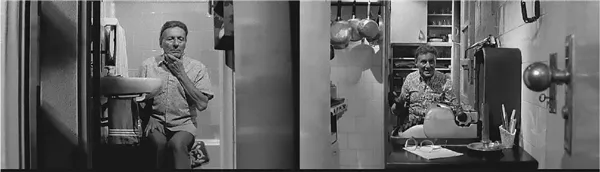
Figure 1.1 The static, distant framing in Santiago (2007)
Yet, despite these constraints, in those off moments that would have ended up in the cutting room floor of the original film, we see the edges of a certain subaltern picaresque that evidences Santiago’s own agency and self-recognition. As Moreira Salles comments, citing Werner Herzog, what is most interesting of a take is “what occurs gratuitously before and after the action.” For example, when asked to talk about the fabulous parties that were held at the Gávea house, Santiago manages to slip in a veiled critique. Describing a party for 200 with 25 waiters, he adds: “and I had to deal with all that.” Throughout the film Santiago obediently repeats scenes over and over, but he never lets the camera forget that he is performing. Whenever he finishes a scene, he makes faces at the camera, waves his hands around and even exclaims in exasperation “C’est tout!” These are all moments in which Santiago’s performativity punctures the deep melancholia of the “I” that comments upon the image, almost making us smile. At the end of the film (which coincides with the end of the filming), he even goes so far as to throw his cane to the ground in a decidedly diva-like fashion. Furthermore, there is one crucial scene in which we can glimpse and revel in the exuberance of Santiago. Filmed in one take and, at Santiago’s insistence, focusing only on his hands, the almost five-minute long sequence of Santiago “exercising” his hands, as if they were ballerinas, is not only of singular visual beauty but paradoxically tells us more about the spirit of Santiago than any close-up of his face could ever convey. The ballet of Santiago’s hands is an affect machine emblematic of the overall work of the film, simultaneously adrift from meaning-making and sensuously evocative, painfully beautiful and profoundly sad. It is not only what the hands “do” but what the camera, the film, does with them: with no camera movement, as in most images of Santiago, and no editing, this sequence shot generates a different relationship between temporality and affect and a climactic emotional durée (Figure 1.2).
Beyond the filmmaker’s somewhat confessional self-reflexivity, the film also highlights Santiago’s 30,000-page accounting of the world’s nobility (which in 1992 had not been of any interest whatsoever to the filmmaker), as if looking for evidence that the original footage failed to capture some essential trait or information. Filming fragments of pages, random phrases, the most “sonorous” names of the catalogue, Moreira Salles excavates Santiago’s collection, remembering Santiago’s favorites, finding fragments of poetry and random annotations. Like Santiago, who explains the catalogue as his effort to keep these people alive by speaking about them and speaking to them—“The past passes. Things go past. Things are lost”—Moreira Salles struggles to keep Santiago and, through him and his things, his own memories, alive. Like Santiago’s hands, the manuscript’s pages captured in close-ups acquire an enchanting life of their own: typed words on their way to becoming affective relations.

Figure 1.2 Santiago exercising his hands (Santiago, 2007)
Toward the end of the film, Moreira Salles introduces a moving segment of audio material. After he turns off the camera, Santiago continues speaking: “Listen, Joãozinho, Joãozinho, there is a short sonnet, very charming … I am part of a group of cursed beings … ” and is interrupted by Moreira Salles who says, “No, that’s not needed. We are not going in that direction.” Moreira Salles comments that the one time that Santiago tried to tell him somet...
Table of contents
- Cover
- Title Page
- Copyright
- Contents
- List of Illustrations
- Acknowledgments
- Introduction
- Part I: Aesthetics and Politics
- Part II: Community and Indigenous Media
- Part III: Local, National, and Transnational Dialogues
- Notes on Contributors
- Index
Trusted by 375,005 students
Access to over 1.5 million titles for a fair monthly price.
Study more efficiently using our study tools.
Frequently asked questions
Yes, you can cancel anytime from the Subscription tab in your account settings on the Perlego website. Your subscription will stay active until the end of your current billing period. Learn how to cancel your subscription
No, books cannot be downloaded as external files, such as PDFs, for use outside of Perlego. However, you can download books within the Perlego app for offline reading on mobile or tablet. Learn how to download books offline
Perlego offers two plans: Essential and Complete
- Essential is ideal for learners and professionals who enjoy exploring a wide range of subjects. Access the Essential Library with 800,000+ trusted titles and best-sellers across business, personal growth, and the humanities. Includes unlimited reading time and Standard Read Aloud voice.
- Complete: Perfect for advanced learners and researchers needing full, unrestricted access. Unlock 1.5M+ books across hundreds of subjects, including academic and specialized titles. The Complete Plan also includes advanced features like Premium Read Aloud and Research Assistant.
We are an online textbook subscription service, where you can get access to an entire online library for less than the price of a single book per month. With over 1.5 million books across 990+ topics, we’ve got you covered! Learn about our mission
Look out for the read-aloud symbol on your next book to see if you can listen to it. The read-aloud tool reads text aloud for you, highlighting the text as it is being read. You can pause it, speed it up and slow it down. Learn more about Read Aloud
Yes! You can use the Perlego app on both iOS and Android devices to read anytime, anywhere — even offline. Perfect for commutes or when you’re on the go.
Please note we cannot support devices running on iOS 13 and Android 7 or earlier. Learn more about using the app
Please note we cannot support devices running on iOS 13 and Android 7 or earlier. Learn more about using the app
Yes, you can access New Documentaries in Latin America by Vinicius Navarro,Juan Carlos Rodríguez in PDF and/or ePUB format, as well as other popular books in Media & Performing Arts & Art General. We have over 1.5 million books available in our catalogue for you to explore.