- English
- ePUB (mobile friendly)
- Available on iOS & Android
eBook - ePub
About this book
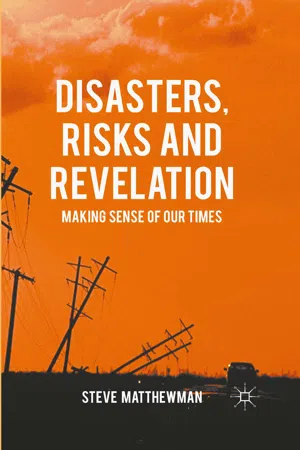
Disasters are part of the modern condition, a source of physical anxiety and existential angst, and they are increasing in frequency, cost and severity. Drawing on both disaster research and social theory, this book offers a critical examination of their causes, consequences and future avoidance.
Information
1
Introduction
Bad times on happy island: a not-so-fortunate place
Low-frequency acoustic waves generated by the major quake were picked up by the European Space Agency’s satellite Goce. Dynamic stress transfer caused mini quakes around the globe. Tsunami waves prised icebergs loose from Antarctica’s Sulzberger Shelf. Two-metre waves crashed into the Chilean coast. Shoreline houses were destroyed in Indonesia. Russia evacuated 10,000-plus people from low-lying areas of the Kuril Islands. In Papua New Guinea, Boram Hospital reported $4,000,000 of damage. Radioactive isotopes circled the planet. A 3,000 kilometre-plus stretch of debris began to move across the North Pacific. On the internet, calls for calm and official denials were met with conspiracy theories and accusations of a cover-up. Beijing supermarkets witnessed panic buying of salt, spurred by the mistaken belief that it would guard against radioactive contamination. Similar patterns were observed to the east in Zhejiang, to the south in Guangdong and to the west in Sichuan. A run on potassium iodide tablets was reported in British Columbia. South of the border sales of gas masks, Geiger counters and survival kits spiked. A truck plant closed down in Louisiana. Cattle futures hit record prices in Chicago. The share prices of Swiss reinsurers and Taiwanese producers of semiconductor packaging materials plummeted. Global supplies of the specialist paint pigment Xillaric dried up, and those of aluminium capacitors, bismaleimide-triazine (BT) resin, silicon wafers and critical automobile components became increasingly difficult to source. A host of European countries announced radical changes to their national energy policies. The price of uranium dropped precipitously on world markets, while that of liquefied natural gas (LNG) soared. Uranium mines in South Australia were mothballed. In sub-Saharan Africa a number of uranium mines deferred their opening, while mergers and proposed purchases were cancelled. Gas-fired power generation in Britain went into the red. A shipping container en route to Guyana from Japan was turned back by Jamaican customs authorities who claimed its contents were radioactive. The United Kingdom’s first commercial kelp farm opened for business.
All of the above are media-reported consequences of, and responses to, a disaster far, far away whose effects were nevertheless felt on all continents and to the very edges of space. On 11 March 2011 a 9.0 magnitude megathrust earthquake occurred off the coast of Tōhuku, Japan – the largest the country had experienced since modern scientific instrumentation began measuring them – it would subsequently become known as the Great East Japan Earthquake. It moved the Japanese island of Honshu 2.4 metres eastward. The Earth’s axis shifted. The earthquake created massive tsunami waves up to 40 metres high at some points. Such was the power of this wall of water that it completely overran one of the world’s most tsunami-protected coastlines. In the Sendai region, the waves penetrated 10 kilometres inland. At the Fukushima Daiichi nuclear power plant, they breached the sea walls leading to explosions. The plant’s cooling system failed. Three reactor units had meltdowns. There followed the largest ever radioactive discharge into the ocean. The International Atomic Energy Agency declared it a level 7 event – the most serious possible – on its International Nuclear and Radiological Event Scale, a logarithmic measure similar to the moment magnitude scale used by seismologists.
Sometimes ‘Fukushima’ serves as a shorthand way of referring to all of these events; other times it is called ‘3/11’ to resonate with the defining moment of the twenty-first century thus far – 9/11. In Fukushima (which translates as happy island, fortunate place) we have something unique. The World Bank (2012, p. 2) identified it as the planet’s first ‘quadruple’ disaster, combining an earthquake, tsunami and nuclear reactor accident with world-wide supply chain disruption. In Fukushima, we also have something prophetic, a harbinger of the twenty-first century’s risks and hazards. Today’s risks are marked by their complexity and exacerbated by our interconnectivity. The techniques of modern industrial production (including nuclear power) magnify their ambiguity and potency. ‘Radiation is for ever and I think, as a species, we’re barely into our dialogue with it’, wrote the novelist Douglas Coupland (2014, p. 19). Moreover, ‘the uncertainties associated with our best estimates of the health effects of low-doses of radiation are large. And not knowing the risks means that we really don’t know what is a reasonable evacuation zone, whom to evacuate, when to evacuate or when to allow people back’, wrote David J. Brenner (2011), a radiological scientist.
Disasters of the twenty-first century have a number of novel features. First, there is the scale of devastation. They damage more infrastructure and affect more people. The greatest impacts were felt in the Miyagi, Iwate and Fukushima prefectures of Japan, where 20,000 were killed, up to a thousand times that number displaced, and a million buildings destroyed. The cost of the clean-up alone – and it is a matter of heated debate whether radioactive contamination is ever ‘cleaned up’ – has ballooned to over a billion dollars. It is widely regarded as the most complex nuclear accident to date. Moreover, ‘indirect losses from supply chain interruptions can be as severe if not worse than direct losses’ (UNISDR, 2013c, p. 185). Fukushima also led to widespread power outages and loss of water supply for millions (which is but one reason why reference to only a ‘quadruple’ disaster may well be to sell it short). Second, these new disasters are much more complex in terms of their distribution. Their reach is such that their ability to be managed is made difficult in the extreme. What happened on happy island did not stay on happy island. Fukushima’s impacts are truly diffuse. Neither the radioactive waste nor the tsunami debris can be contained within Japan’s sovereign territory, and supply chain impacts span the globe. Third, these new disasters are ‘inconceivable’ prior to the event (Smet, Lagadec and Leysen, 2012, pp. 140–1). As one of the Fukushima investigations revealed, those running the plant were ‘caught up in a safety myth that deemed a severe accident such as a core meltdown to be impossible, and were not prepared for the reality that a crisis could occur right in front of them’ (Soble, 2014, p. 2).
Just as Fukushima worked its way through various earth systems (atmospheric, land-based and oceanic) it also worked its way through numerous human systems (communication, economic, energy, health, technical and political). The two systems are, of course, very much entangled. Tectonic forces, waves, currents and winds mix with settlement patterns, share prices and business practices. These processes display multiple spatialities: ground zero, 250 kilometres away (at the edge of space), 13,000 kilometres away (in Antarctica). They involve different materialities commingling the natural, the human and the sociotechnical. And they display different temporalities. A disaster is many things at the same time and many different things at different times. Tourists have returned to Japan in pre-disaster numbers, but Fukushima is still depopulated. The Japanese automobile industry is now operating normally, but the reactor clean-up (assuming that such a thing is possible) will go on for a generation or more, while the evacuation zone will stay off-limits for decades. Some things will never return to the status quo ante. Instead adjustments will have to be made to the new normal. Human outcomes and fortunes also vary according to location and occupation. Fukushima was terrible for those in the prefectures directly affected. It gave Japan its severest post-war crisis, and it was bad news for those associated with the nuclear industry. But it was rather better for those in the business of selling anti-cancer pharmaceuticals, shale gasfields and LNG, and in Britain it gave birth to an entirely new commercial enterprise, a kelp farm.
This leads us to a consideration of Fukushima’s aftershocks. Amongst the fallout we must list casualties in the realms of energy, politics and economics. Fukushima has undermined the Japanese public’s trust in authority. Globally, pressure has mounted to expunge the nuclear option from the portfolio of national energy policy, and it has shaken the business world’s faith in ‘just-in-time’ production systems. Questions of sustainability have been brought into sharp relief, focusing on such issues as the requirement for greater levels of corporate and political transparency, the need for clean renewable energy, and supply chain security.
More, bigger, dearer, worse: disasters define the times
Disasters are very much part of the modern condition, a source of physical insecurity and of existential angst. They are syndromes of our times. The justification for this book can be simply stated: all available evidence suggests that disasters are increasing in frequency, scale, cost and severity. These are points that aid agencies (Hillier and Castillo, 2013), charitable organizations (Hillier and Castillo, 2013), disaster scholars (Perrow, 2007, p. 1), the reinsurance industry (Bevere, Rogers and Grollimund, 2011; Rauch, 2012, p. 31), risk governance professionals (Kröger, 2005), social activists (Klein, 2007b, p. 415; Solnit, 2009, p. 6) and United Nations Secretariats (World Bank, 2003; UNGAR, 2013) can all agree upon.
This work is positioned at the intersection of disaster studies and social theory. It is motivated by three concerns: that disaster studies currently lacks theoretical sophistication, that they are marginal to mainstream sociology and that this marginality has been to the detriment of both. The argument will be made that general sociology has as much to gain from fruitful dialogue with this speciality, and that this dialogue is needed now more than ever.
Important work is done in disaster studies, and insofar as these labours seek to uncover the causes of (avoidable) disasters and to protect, advance or recover collective human well-being whenever they occur, they are to be supported. On occasion, others have confessed to ‘discipline envy’ due to the manifold case studies of thick description and persuasive argumentation disaster scholars have produced and for the practical value they have yielded, both in terms of emergency management procedures and public policy applications (Valelly, 2004). Yet, in his Presidential Address to the International Research Committee on Disasters, Robert A. Stallings (2006) expressed fears that disaster researchers were fringe-dwellers doomed to ‘institutionalized marginality’, despite all that they have to offer. Leading figures within the field have criticized disaster studies for being silent on issues of political power, for being piecemeal, isolationist and theoretically stagnant (Vaughan, 1999; Tierney, 2007 and 2010, p. 661).
For Kathleen Tierney (2010, p. 660), it is in the theoretical realm where the most work is needed, the only ‘progress’ of note being a move from functionalism to mid-range theory. This poverty of theory is a frequently stated problem for disaster scholars (see Watts, 1983; Dombrowsky, 1995, p. 242; Kreps and Drabek, 1996, p. 136; Stallings, 2002, p. 282, and 2006; Alexander, 2013; Vollmer, 2013, pp. 3 and 7). This book brings the theoretical world to bear on disaster. It is to be read as a meditation on the theory and practice of disasters: their causes, consequences and future circumvention. The intention is to integrate disaster studies with scholarship beyond its traditional domain in the hope of advancing our knowledge of catastrophes.
For the purposes of this work the focus will be on large-scale accidents and disasters. Following Charles Perrow (1984, p. 64) accidents are here defined as unintended events that damage people, materials and systems. We will begin by defining disasters as major accidents, human and ‘natural’, that are large-scale, expensive, public, unexpected and traumatic (Turner and Pidgeon, 1997, p. 19). Tierney’s (2014, pp. 11–12) usage of risk, hazard and vulnerability is utilized here. Risk refers to settings and events where humans or the things they value are threatened and the consequences of these threats are unclear. Hazards refer to the causes of harm and damage. Vulnerability refers to what is placed at risk, in other words what is valued and what is exposed to hazard.
While disasters are defining elements of contemporary life, working definitions of them, and much of the theory that informs disaster research, have remained relatively static for more than half a century (Fritz, 1961; UNISDR, 2009). Simply put, disaster research has not kept pace with social reality (Alexander, 2013). This is understandable. Will Steffen and colleagues (2011) call this period of change the most ‘dramatic and unprecedented … in human history’. So, while theories and conceptions of disaster have been slow to change, the world they attempt to make sense of has transformed enormously. Taken together, these trends massively increase vulnerability. Some of the most obvious elements of this include: unparalleled wealth disparities, huge human population increases, a shift to predominantly urbanized living, peak oil and other resource depletion and anthropogenic climate change. Richard Heede’s (2014) study of anthropogenic carbon dioxide and methane emissions from fossil fuels and cement production between 1854 and 2010 shows that half of all emissions have been since 1986. The combined new levels of planetary environmental devastation have been dubbed the Anthropocene (Crutzen and Stoermer, 2000). Such is our impact that humans have been positioned as geological agents. Reputable scientists are now asking the question: ‘Has the Earth’s Sixth Mass Extinction Already Arrived?’ (Barnosky et al., 2011). We consider risks and hazards specific to our times in Chapter 5.
Disasters, intensive and extensive
Disaster research must change with the times. In sticking to a definition of disaster that stresses the immediate, the visible and the spectacular, the focus of research has fixed on quick onset ‘intensive’ disasters as opposed to slower ‘extensive’ disasters like famines and epidemics (Kreps and Drabek, 1996, pp. 131–2). Yet Humberto Jaime (2013) notes that it is the unreported, ‘silent disasters’ that have taken the greatest economic and human toll in the Americas across the last two decades. Drawing data from 16 Caribbean and Latin American countries over 22 years, analysing 83,000 historical records extracted from 10,000 municipalities, a UN Office for Disaster Risk Reduction (UNISDR) study found that it is localized and recurring events which evade the ‘emergency imaginary’ of news media (Calhoun, 2008) that ultimately do the most damage. Being routine and socially embedded they hardly ‘count’ as disasters in mainstream research, but their effects are certainly disastrous: 90 per cent of damage to human life, persons affected, homes lost or badly affected can be attributed to these extensive disasters. In tabling data from the Centre for Research on the Epidemiology of Disasters’ (CRED) Emergency Management Database (EM-DAT), Ben Wisner and colleagues (2003, p. 3) demonstrate that the UNISDR’s findings adhere to a longstanding global pattern. The EM-DAT data show that the vast majority of fatalities (86.9 per cent) are from the slow onset disasters of famines and droughts, rather than rapid onset events like floods and wildfires. We will have the opportunity to amend the usual view of disasters as spectacular disruptive events concentrated in time and space in Chapter 8, when we consider alternative intensities and temporalities in our discussion of ‘everyday disasters’.
In all likelihood, disasters are even more devastating than official tolls acknowledge. The sta...
Table of contents
- Cover
- Title
- Copyright
- Contents
- List of Tables
- Acknowledgements
- Chapter: 1 Introduction
- Chapter: 2 Sociology and Disasters
- Chapter: 3 Accidents, Disasters and Revelation
- Chapter: 4 The New Normal
- Chapter: 5 Riskworld? New Species of Trouble
- Chapter: 6 Political Economy, I: Capitalism and Disaster
- Chapter: 7 Political Economy, II: Capitalism as Disaster
- Chapter: 8 Everyday Disaster: Notes on Low Visibility Catastrophe
- Chapter: 9 Conclusions
- References
- Index
Trusted by 375,005 students
Access to over 1.5 million titles for a fair monthly price.
Study more efficiently using our study tools.
Frequently asked questions
Yes, you can cancel anytime from the Subscription tab in your account settings on the Perlego website. Your subscription will stay active until the end of your current billing period. Learn how to cancel your subscription
No, books cannot be downloaded as external files, such as PDFs, for use outside of Perlego. However, you can download books within the Perlego app for offline reading on mobile or tablet. Learn how to download books offline
Perlego offers two plans: Essential and Complete
- Essential is ideal for learners and professionals who enjoy exploring a wide range of subjects. Access the Essential Library with 800,000+ trusted titles and best-sellers across business, personal growth, and the humanities. Includes unlimited reading time and Standard Read Aloud voice.
- Complete: Perfect for advanced learners and researchers needing full, unrestricted access. Unlock 1.5M+ books across hundreds of subjects, including academic and specialized titles. The Complete Plan also includes advanced features like Premium Read Aloud and Research Assistant.
We are an online textbook subscription service, where you can get access to an entire online library for less than the price of a single book per month. With over 1.5 million books across 990+ topics, we’ve got you covered! Learn about our mission
Look out for the read-aloud symbol on your next book to see if you can listen to it. The read-aloud tool reads text aloud for you, highlighting the text as it is being read. You can pause it, speed it up and slow it down. Learn more about Read Aloud
Yes! You can use the Perlego app on both iOS and Android devices to read anytime, anywhere — even offline. Perfect for commutes or when you’re on the go.
Please note we cannot support devices running on iOS 13 and Android 7 or earlier. Learn more about using the app
Please note we cannot support devices running on iOS 13 and Android 7 or earlier. Learn more about using the app
Yes, you can access Disasters, Risks and Revelation by Steve Matthewman in PDF and/or ePUB format, as well as other popular books in Social Sciences & Environment & Energy Policy. We have over 1.5 million books available in our catalogue for you to explore.