- English
- ePUB (mobile friendly)
- Available on iOS & Android
eBook - ePub
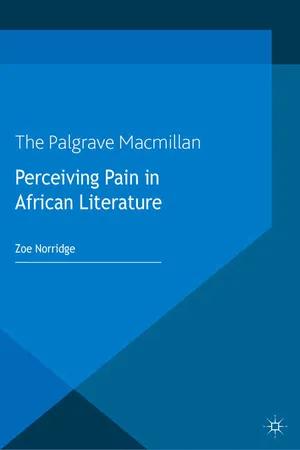
Perceiving Pain in African Literature
About this book
An analysis of literary accounts of suffering from sub-Saharan Africa, this book examines fiction and life-writing in English and French over the last forty years. Drawing on writers from the canonical to the less well-known, it uses close readings to examine the personal, social and political consequences of representing pain in literature.
Information
1
Painful Encounters in Yvonne Vera’s The Stone Virgins
Grandmother says that a woman cannot point to the source of her pain, saying, it is here and there. A woman finds her sorrow in her dream and everywhere.
Yvonne Vera (Under 162)
Yvonne Vera’s novels carry within them an insidious sense of sadness, a feeling for the tragedy of people frustrated by surroundings and circumstance. As the quotation above suggests, in Vera’s writing pain pervades women’s daily existence. It extends from the workings of the imagination to the daily process of living. Here, as elsewhere, Vera examines how individual and collective suffering is experienced as a result of curtailed dreams, social inequalities and violent conflict. Known for her linguistic brilliance and poetic complexity, Vera nonetheless uses the term ‘pain’ repeatedly, in many different contexts. Why does she return to this word? And how does she embed it conceptually and aesthetically within her texts to produce such a myriad of different meanings? Such questions tie into key themes that will run throughout this book: the role of literature in representing aversive emotions and sensations; the use of language in probing experiences of suffering; and the search for appropriate critical approaches that attempt to capture the nuances of pain descriptions so aptly personalised through fiction.
The Stone Virgins is the last text Vera published during her lifetime. News of her death, aged forty, in April 2005, shocked many who mourned the loss of one of Zimbabwe’s most emotive and eloquent writers. Her work is located in the Zimbabwean past, treating taboo subjects such as incest and abortion through descriptions of the personal lives of women. Born to an influential family in Bulawayo, Vera met her Canadian husband whilst teaching English literature. She travelled with him to Toronto, where she completed degrees leading to a PhD in African prison writing at York University in 1995. Vera began composing fiction whilst working on her master’s thesis and published a collection of short stories and two novels whilst studying for her doctorate. On completion, she returned home to Zimbabwe to concentrate on her writing, publishing three further novels and serving as the Director of the National Gallery in Bulawayo. During this time, her work was increasingly critically acclaimed and she received, amongst other awards, the 1997 Commonwealth Writer’s Prize (Africa Region) and the 2004 Tucholsky Award (Swedish PEN). However, whilst her literary career was taking flight, Vera’s health was deteriorating. She had been diagnosed with HIV in 1989 and by the end of 2002, the year in which The Stone Virgins was published, realised she was struggling with terminal illness. Eventually returning to spend the last year of her life with her husband in Canada, she died from AIDS-related meningitis in Toronto.1
Vera’s work echoes enduring themes of Zimbabwean literature: the literary depiction of the liberation struggle, emerging nationalism and the representation of women.2 She shares a highly poetic writing style with fellow Zimbabwean writers such as Chenjerai Hove, who also examines collective and personal pain in his novels Shadows and Bones. However, to a greater extent than Hove, Vera is interested in detailed psychological explorations of her characters’ experiences, thoughts and bodies. In this her writing perhaps bears some resemblances to Tsitsi Dangarembga’s Nervous Conditions, which also describes the complex character of an educated girl from a rural background. But in contrast to this earlier canonical work, Vera’s novels are specifically focussed on violent testimonial narratives and physical as well as mental suffering. Of all her texts describing the personal lives of women, her last novel provides the most extensive insights into pain infliction and its aftermath.
The Stone Virgins tracks the story of two sisters living in Rhodesia as it becomes Zimbabwe. The first part of the novel, ‘1950–81’, is set in Bulawayo and Kezi, a nearby town. During these years, Robert Mugabe’s ZANU and Joshua Nkomo’s ZAPU were both fighting a guerrilla war calling for majority rule.3 Vera’s primary focus is on personal encounters between men and women played out against this background tension. The first two chapters take the reader from the Jacaranda-lined streets of Bulawayo through the Matopo Hills to Kezi. In Kezi, we see the beginning of a love story between a local woman, Thenjiwe, and Cephas, a man she meets just off the bus at the Thandabantu store. After this chance encounter, the couple embark on a physically-consuming love affair. But with time, Thenjiwe becomes increasingly emotionally distant, an absenting explored through her fascination with a Mazhanje seed Cephas brought with him from Chimanimani – a sign of fertility, of lives going on elsewhere. Although the young woman hopes her lover will stay to meet her sister Nonceba when she returns from boarding school, he leaves. Cephas’ departure is followed by descriptions of liberation. Local women celebrate in the streets as male guerrillas return home and female fighters adopt the space outside the store.
The second part of the novel, ‘1981–6’, describes the aftermath of liberation, which in Matabeleland (where Kezi is located) was marked by mounting violence as government forces allegedly attempted to control remaining ZIPRA dissident soldiers with heavy-handed repressions that affected former fighters and civilians alike.4 As Ian Phimister observes, this dissident threat was greatly exaggerated and many ordinary people bore the brunt of the violence. Between 1983 and late 1986, the North Korean trained Fifth Brigade of the Zimbabwe National Army was responsible for around 20,000 brutal killings of civilians in the area (Phimister 197–8). Vera chooses to describe both a dissident attack and government aggression. She opens her portrayal of this violence in Kezi with the depiction of Nonceba being raped and hurt by a dissident solider later named as Sibaso. He cuts off Thenjiwe’s head and slices away Nonceba’s lips. These violent acts form the central pain narrative of the novel and are returned to repeatedly as Nonceba recovers in hospital. This second section is characterised by temporal complexities and fractured stories that grow and change. Vera interweaves descriptions of Sibaso’s past struggles with Nonceba’s patient journey from oblivion to something resembling clarity. All this within a context of ongoing violence. The Thandabantu store and the social gathering point it represented are destroyed by what appears to be Mugabe’s Fifth Brigade, the owner Mahlathini tortured and burnt alive with his own produce.
Finally, the novel offers what could be construed as hope in the form of Cephas Dube, Thenjiwe’s former lover, who after reading about her death in the newspaper, travels to Kezi, despite the roadblocks, to visit Nonceba. He persuades her to leave the ‘open cemetery’ that Kezi has become and to return with him to the city. Once there, the younger sister undergoes further reconstructive surgery and eventually finds herself a job. The final chapter is filled with the same vibrant social detail that characterised the opening of the novel. But Nonceba’s relationships with Cephas and the town remain ambiguous. It is uncertain whether this remaining ambiguity is synonymous with, or defiant of, the surrounding optimism. Both live with scars, haunted by the past and a longing for Thenjiwe, a time before pain. In the present, they seek solace in a quiet, kind friendship, Cephas’ growing love for Nonceba a hanging question that he guards suspended, as he retreats into his work as an archivist at the National Museums and Monuments of Zimbabwe.
Responses to The Stone Virgins have tended to focus on its historical and gendered aspects. Ranka Primorac points out that this is ‘the first work of fiction that openly exposes and condemns the government-sponsored violence against civilians in independent Zimbabwe’ (“Obituary” 150) and Terrence Ranger has also discussed the work’s historical genesis (“History”). Annie Gagiano and Sofia Kostelac have both published articles about masculinity and sexual violence in the text. The novel also plays a key role in Caroline Rooney’s chapter about Zimbabwean women in her critical work Decolonising Gender, where she comments upon the role of the literary in (re)writing history and tensions between fixed and more fluid approaches to the past. My discussion contributes to this conversation but with a particular emphasis on the experiences of individuals in pain. Aiming to explore the literary complexities involved in representing highly personalised hurt, I examine how the narrative engages with the infliction of extreme suffering and the long recovery process through memory.
Perceptions of pain: the role of fiction
The Stone Virgins explores a contested period of Zimbabwe’s history, contributing an intimate and poetic narrative to the existing historical and literary canon. By fictionalising murder and mutilation that historians have argued did take place, the novel explores a realm of past possibilities and uncertainties for their aesthetic and ethical ambiguities. Vera does not claim to offer access to a so-far undiscovered truth or metastory but instead asks us to imagine what historical events might have meant for individuals who lived through them. Contrasting with the quest of many of the social sciences to establish evidence to further our knowledge of population trends, The Stone Virgins extends our conception of this period through an imaginative probing of the perceptions of individual people in pain. Vera’s novel has much to add to existing pain narratives concerned with the Matabeleland Crisis, the richness of the fictional text diverging in intriguing ways from both historical and testimonial approaches.
The timeframe for the second half of The Stone Virgins (1981–6) begins with Zimbabwean Independence and ends with the resolution of the worst of the brutalities in Matabeleland. Although the international community chose not to intervene, much was written about the violence as it unfolded, in both the local and international media (Phimister, Stiff). This has formed the starting point for humanities scholars and human rights activists researching the period, alongside extensive interviews with civilians. Despite the personal and anecdotal nature of many of their sources, academic texts and policy reports have tended to focus not on individual narratives but on the collecting evidence to inform understandings of events in the public sphere. For example, the Catholic Commission for Justice and Peace report Breaking the Silence, Building True Peace: A Report on the Disturbances in Matabeleland and the Midlands 1980–1988 concentrates on practical considerations and case studies without in-depth analysis of the psychological impact of events on perpetrators and the local population. Whilst the authors assert that ‘there is still much pain in the communities as a result of what happened [affecting] not only the bodies, but the hearts and minds of those who suffered’,5 the majority of the report focuses on acts of violence, with pain constantly implied but rarely directly described. The section of the report which does deal with the implications of organised brutality indicates generalised outcomes for social groups with the purpose of garnering support for both acknowledgement of past atrocities and reparation. This much-needed emphasis on ‘fact’, action and responsibility potentially obscures the subjectivity of the witness, the complexity of the informant’s emotional landscape.
Vera herself has explained that her text was born out of a dialogue with history (Vera in Bryce 225). She remembers how initially she was reluctant to write about this difficult period, but agreed to the project following conversations with Terrance Ranger, whose historical work on Matabeleland, Violence and Memory, was published whilst she was writing The Stone Virgins. Ranger has contrasted this novel with her previous work, saying:
It is not a book about pauses and expectations, about waiting for something to happen. It is a book about what – unfortunately – happens. It is not a book in which narratives are compressed into a private tragedy. It is a book about people caught up in and destroyed by a public disaster. (“History” 206)
This comment’s focus on the public events of The Stone Virgins is indicative of Ranger’s perspective as an academic historian. What Ranger claims the text does not do is almost as revealing as what he argues it does. For me, this tension between what is acknowledged and what is denied demonstrates how fiction engages with stories of the past in a very different manner to other academic disciplines. Where Ranger suggests this is a book about ‘what happens’, I would argue that this is a novel about remembering and living with what has happened. Where Ranger states that the narrative is concerned with people destroyed by public disaster as opposed to private narratives, I would argue that Vera’s text displays intensely private and personal explorations of the meanings of historically inflicted pain for individuals.
The ways in which historians and writers of fiction may emphasise different aspects of the past can be illustrated by briefly comparing the different approaches adopted by Ranger and Vera to similar incidents. Ranger writes of the troubles in Matabeleland:
Some dissident murders introduced a new level of sadistic cruelty. In an infamous Lupane case, a headmaster’s wife was forced to cut off her husband’s head. In another instance, a son was forced to kill his father after the latter was accused of informing on a dissident. In a widely cited Nkayi case, a second wife was forced to cut off the hands of her husband. Civilians also testified to two cases of mutilation by cutting off lips or ears. (Violence 213)
This account is accompanied by various footnotes detailing the location and date of interviews in which these events were mentioned – the emphasis is on providing evidence. Vera, on the other hand, takes the incident of the lip mutilation and turns the event into a novel.6 She uses her fictional writing to explore what such emotive facial mutilation means for a multifaceted human being embedded in a social context. Vera’s text also mentions a woman who was forced to cut off her husband’s head with an axe (88). Yet, in contrast to Ranger’s empirical reporting, this incident is introduced by the hospitalised woman’s traumatised and uncertain screams and develops into a meditation from Nonceba’s perspective as another wounded woman.
We might expect to find inspiration for Vera’s explicitly personal and openly emotional style of narration in first-person testimonial accounts of this period. However, in practice this is not the case. Most of the published testimonial accounts of these years of violence in Southern Zimbabwe are interpreted by a third party. Quotations and case studies in historical analyses such as Ranger’s, or evidence reports such as Breaking the Silence, are selected and edited by academics. Even collections focussing exclusively on testimonial narratives, such as Irene Staunton’s Mothers of the Revolution (which deals with the liberation struggle in general) are shaped by interviewers, translated and edited.
In addition to this sense of mediation, testimonial narratives in Matabeleland are still affected by a climate of fear. The Breaking the Silence report remarks that many of the civilians the researchers attempted to interview in Matobo (Kezi) were too afraid to talk (117). This is perhaps also the case with the testimonial collection Mothers of the Revolution. Although the women Staunton and her fellow editors interviewed voluntarily participated in this project, it seems unlikely that many would offer detailed accounts of violence which implicitly criticised the current government, particularly if they knew that the accounts would be published with their photographs, real names and locations. For example, Thema Khumalo from Esigodini mentions dissidents and government suppressions only in the vaguest of terms:
Some people, in some areas, say that they [former ZIPRA soldiers] became dissidents. They say that they were very frightening. Civilians were afraid of them and they wondered why they had gone back to fighting. So, although they did not want to give them food or water to drink, they ended up doing so, after asking themselves: why did he go back to fight: and what is his aim in doing so? There must have been a reason. Of course, they were also afraid for their lives. But some, a lot, of homes were burnt down. I cannot say how many and I also cannot give names because I am still frightened. There were also men who were killed for nothing, nothing. (Staunton 82)
There is no exploration of what these events meant for Thema personally. The focus here, much like more historical accounts, is on what happened rather than on what events meant emotionally for those who witnessed or were caught up in them. Save for the brief articulations of enduring fear, the overwhelmingly optimistic nature of Mothers of the Revolution avoids any detailed discussion of complex feelings roused by violence both during the war and afterwards, perhaps for fear that such explorations might be deemed unpatriotic.
Oral testimonies are also particularly problematic for exploring deeply personal issues. As Vera herself comments in the Preface to Opening Spaces, an edited collection of African Women’s Writing:
If speaking is still difficult to negotiate, then writing has created a free space for most women – much freer than speech. There is less interruption, less immediate and shocked reaction. The written text is granted its intimacy, its privacy, its creation of a world, its proposals, its individual characters, its suspension of disbelief. (3)
The topics Vera broaches, such as the intimacy of rape, the disturbing imaginings of the recovering patient and the person in pain’s desperate isolation from the world, are indeed shocking and not easily described in speech. Even when the person a researcher may be interviewing has the linguistic skill to express difficult emotions, recalling the past out loud could be too painful, embarrassing, or appear socially unacceptable. Still today, despite the work of post independence women’s groups to push such issues into the public field, many women find it hard to talk about their experiences of violence and sexual assault (A. Armstrong 1). Vera, on the other hand, con...
Table of contents
- Cover
- Title page
- Copyright
- Contents
- Acknowledgements
- Introduction – Pain, Literature and the Personal
- 1 Painful Encounters in Yvonne Vera’s The Stone Virgins
- 2 Between Minds and Bodies – the Location of Pain and Racial Trauma in Works by Bessie Head and J.M. Coetzee
- 3 Women’s Pains and the Creation of Meaning in Francophone Narratives from West Africa
- 4 Writing around Pain – Personal Testimonies from Rwanda by African Writers
- 5 Responding to Pain, from Healing to Human Rights – Aminatta Forna, Antjie Krog and James Orbinski
- Epilogue – Literature and the Place of Pain
- Notes
- Works Cited
- Index
Trusted by 375,005 students
Access to over 1.5 million titles for a fair monthly price.
Study more efficiently using our study tools.
Frequently asked questions
Yes, you can cancel anytime from the Subscription tab in your account settings on the Perlego website. Your subscription will stay active until the end of your current billing period. Learn how to cancel your subscription
No, books cannot be downloaded as external files, such as PDFs, for use outside of Perlego. However, you can download books within the Perlego app for offline reading on mobile or tablet. Learn how to download books offline
Perlego offers two plans: Essential and Complete
- Essential is ideal for learners and professionals who enjoy exploring a wide range of subjects. Access the Essential Library with 800,000+ trusted titles and best-sellers across business, personal growth, and the humanities. Includes unlimited reading time and Standard Read Aloud voice.
- Complete: Perfect for advanced learners and researchers needing full, unrestricted access. Unlock 1.5M+ books across hundreds of subjects, including academic and specialized titles. The Complete Plan also includes advanced features like Premium Read Aloud and Research Assistant.
We are an online textbook subscription service, where you can get access to an entire online library for less than the price of a single book per month. With over 1.5 million books across 990+ topics, we’ve got you covered! Learn about our mission
Look out for the read-aloud symbol on your next book to see if you can listen to it. The read-aloud tool reads text aloud for you, highlighting the text as it is being read. You can pause it, speed it up and slow it down. Learn more about Read Aloud
Yes! You can use the Perlego app on both iOS and Android devices to read anytime, anywhere — even offline. Perfect for commutes or when you’re on the go.
Please note we cannot support devices running on iOS 13 and Android 7 or earlier. Learn more about using the app
Please note we cannot support devices running on iOS 13 and Android 7 or earlier. Learn more about using the app
Yes, you can access Perceiving Pain in African Literature by Z. Norridge in PDF and/or ePUB format, as well as other popular books in Literature & African Literary Criticism. We have over 1.5 million books available in our catalogue for you to explore.