eBook - ePub
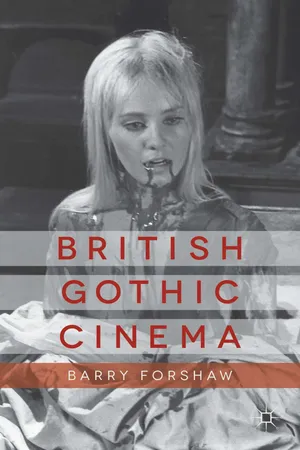
British Gothic Cinema
About this book
Barry Forshaw celebrates with enthusiasm the British horror film and its fascination for macabre cinema. A definitive study of the genre, British Gothic Cinema discusses the flowering of the field, with every key film discussed from its beginnings in the 1940s through to the 21st century.
Information
Subtopic
Film & Video1
Gothic Fiction: English Terror and Carnality
The origins of the Gothic genre in English literature demonstrates, even in its nascent form, a delirious mix of eroticism and horror, as found in such works as Keats’ ‘La Belle Dame sans Merci’ and Coleridge’s ‘Christabel’. The poet Percy Bysshe Shelley nurtured a fascination with horror and cruelty which was to prove (as we shall see) highly influential, while the haunted novels of Ann Radcliffe provided several key elements. Similarly (in other fields), the German romantic painters left their mark on the visual character of British horror. But, above all, it’s essential to note the crucial importance of two key works of English literature: Mary Shelley’s Frankenstein and Bram Stoker’s Dracula; their continual re-invention and rejuvenations, as noted earlier, have continued into the twenty-first century.
An influential literary offspring came not from the poet Shelley but from his 19-year-old inamorata Mary. The latter, with Frankenstein, created the most enduring Gothic myth alongside that of the vampire, utilising ideas of the God-usurping creation of life (adumbrated in such works as E.T.A. Hoffmann’s ‘The Sandman’ in 1812, in which the dancing doll Olympia is granted a grotesque half-life), as well as the myth of the monstrous, stalking Golem, which the young Mary Shelley had found grimly fascinating. The notion of audacious scientific experimentation was also familiar to her from the experiments of Erasmus Darwin, grandfather of the author of Origin of Species.
Mary Shelley’s original notion for Frankenstein was that of a short story, but the canny Lord Byron, recognising that something much more ambitious might be created from the young woman’s tentative idea, encouraged her to expand it to novel length.
The narrative of Victor Frankenstein’s creation of life has (in the twenty-first century) lost its shocking power in a secular age, despite the growing influence of fundamentalist Middle Eastern theocracies and the unstoppable rise of the Religious Right in the USA, so the notion of a man playing God and creating life no longer has the blasphemous charge that it would have had for Mary Shelley’s original readers (and the suggestion by Charles Darwin that life on Earth might be the product of natural selection and evolution rather than the seven-day creation of a deity was to cause even more seismic upsets, even among scientists such as Philip Henry Gosse). What made the story that Shelley created particularly disturbing was not just the usurpation of the creator’s role by a man, but the basic materials utilised by Frankenstein, the gruesome stitched-together remnants of mortuaries, and the book’s first appearance in three volumes in 1818 was not at all well received. Early reviewers included Sir Walter Scott, who (while acknowledging the commendably flesh-creeping qualities of the narrative) expressed a slightly school-marmish revulsion towards the whole enterprise via a curious backhanded compliment, suggesting that the author’s undoubted skill made her macabre narrative more disturbing than a poorly written tale might have been – and thus, for him, more deserving of condemnation.
But tut-tutting moral condemnations of works of art often have a corollary (something that is as true today as it was in the nineteenth century): they inspire a keen interest in their target audience, hungry for the transgressive and the forbidden. A dramatisation of the novel some three years later was (unsurprisingly) highly successful, making a considerable mark first at the new Covent Garden Theatre in London with a subsequent transfer to the highly appropriate setting of the Grand Guignol theatre in Paris. The creature was played by the actor T.P. Cooke, a sort of Boris Karloff avant la lettre, whose Grand Guignol repertoire included vampires, murderous wizards and assorted monstrous types. His performance is inevitably lost to history, although we do have a fragmentary record of the very first filmic Frankenstein monster (played by Charles Ogle in J. Searle Dawley’s 1910 silent film). Theatrical productions continue to hold the stage to this day, with a recent London production in which the actors Benedict Cumberbatch and Jonny Lee Miller alternated as the (sometimes naked) creature and his creator, drawing large audiences.
While Shelley’s novel has inspired a host of literary imitators (among them the British writer Brian Aldiss’ Frankenstein Unbound, its title a play on the original novel’s subtitle The Modern Prometheus), it is of course the cinematic legacy which has proved the most enduring – far more people have seen actors from Boris Karloff to Christopher Lee and beyond incarnating the creature than have ever read the novel. In fact, an acquaintance with the grim finale of Shelley’s book (set in frigid Arctic wastes) is often surprising to viewers of the many films, given that so few have chosen to represent Shelley’s concluding selection, either for budgetary or artistic reasons. The choice of the name of Prometheus as a subtitle for Shelley’s novel referred to the Greek myth of the God who presented mankind with the gift of fire, only to pay a heavy price at the hands of his fellow gods; punishment, Shelley was suggesting, for responses to destabilising advances in scientific knowledge which stretch from Galileo being shown the instruments of torture by the Inquisition (for suggesting that the Earth was not the centre of the universe) to the modern day, when science is once again under siege from newly confident religious movements of various kinds. Mary Shelley herself was punished to some degree and was not pleased by the suggestion that she had been inspired to write Frankenstein because of the popular perception of her father William Godwin as a dangerous outsider. But her success (now that the dust of history has settled) extends across many areas, not least her status as a feminist heroine. It’s interesting that her first cinematic representation was via a sympathetic portrayal by the English actress Elsa Lanchester in a film directed by another English artist, the highly unorthodox James Whale, in the Hollywood film The Bride of Frankenstein (1935). This film is considered later in this study, but by the time of Hammer’s groundbreaking late 1950s spin on the characters, Mary Shelley had become to some extent just a name in the credits.
Initially, several Gothic novels were infused with a certain Anglican perspective that (among other things) aligned the sinister influence of the Church of Rome with the locations where Catholicism reigned (notably France, Spain and Italy), concomitantly identified as a fertile breeding ground for eldritch evil. A corollary of this was a certain fascination with the French Revolution (among such writers as Mary Wollstonecraft, who was to give birth to the creator of Frankenstein, Mary Shelley), which also provided much of the gruesome imagery, including the copious shedding of blood and severed heads. The ‘threat from abroad’ scenario was an infinitely serviceable plot engine, using strategies similar to those that were to be used later on in the golden age of crime fiction in England. A settled status quo is presented in order to be disrupted by a malign presence before order is wrested from chaos (the locus classicus here is Bram Stoker’s Dracula). Italy was often located as a source of potential corruption and decay; the notion of Il Bel Paese as a place in which the destruction of hapless Englishmen was wrought was still finding expression in the writings of Daphne du Maurier a century and a half later in such books as My Cousin Rachel (1951), with its dark, corrupting Italian influences. The latter even sports the metaphor of a ‘vampiric’ woman whose sexual involvement with an Englishman in Florence brings about his weakening and subsequent death.
Sexuality as a harbinger of destruction is very much the central notion of British vampire films, where the undead monster is often presented as a charismatic, sexually attractive figure, is also to be found in Coleridge’s ‘Christabel’, notably in the beautiful and seductive figure of Geraldine – who also, of course, embodies the lesbian sexuality to be found in Sheridan Le Fanu’s ‘Carmilla’ (1872). The latter has proved to be an almost boundless source of inspiration for many lesbian-themed horror films, both foreign (Harry Kümel’s Daughters of Darkness (1971)) and British (the ‘Carmilla’ cycle that begins with The Vampire Lovers (1970)).
But as well as producing the negative, destructive aspects that would be so serviceable and re-usable for Gothic cinema, the age of romanticism (concurrent with the Gothic impulse), as well as drawing on the eldritch, might also be said to reflect the rational figure to be set against unspeakable evil – the avatar here would be Stoker’s Van Helsing, who would appear in a variety of guises and names throughout (for instance) the Hammer horror cycle.
Coleridge’s moody ‘Christabel’, however, with its encounter between the virginal innocent maiden of the title and the dark destructive succubus Geraldine, is actually something of a cornucopia of Gothic themes (not least the reference to ‘heaving breasts’). We are given the classic Gothic setting (in which darkness cloaks the evil impulses of the non-human characters, with an obbligato of animal noises, similar to those that will accompany Dracula and his ilk); there is also the channelling of unconscious impulses which was to prove so suggestive, particularly in the 1950s innovations of the Hammer company, which allowed the studio’s writers and directors to deal with themes that would otherwise have been verboten, but which slipped by the censor as the settings and locales drew attention away from the often barely disguised libidinous impulses that powered the characters.
Geraldine in Coleridge’s poem is initially presented as a figure of light and is contrasted with the dark woods in which she is discovered, apparently in distress after a brutal kidnapping. And as in so many subsequent British Gothic films, a naïve protagonist is drawn into a monstrous web against which their lack of worldliness is no protection; a parallel here might be with Henry James’ innocent Americans abroad, unable to cope with the machinations of older – and possibly malign – Europeans (one might think here of the figure of Dracula, against whom his English victims are quite unable to cope without the aid of another older, sager European figure).
However, the vampirism of the poem remains nebulous, particularly when compared with Bram Stoker’s influential Dracula, in which the dead Prince of Darkness becomes a far more interesting figure than his historical antecedent Vlad the Impaler; the latter’s sadistic pleasures (notably dining surrounded by the tortured, stake-impaled bodies of his victims) is less interesting than Stoker’s character’s immortality and ability to transmogrify into a variety of animal forms. The sexual impulse of the novel is incarnated in the Count’s diaphanously clad, ravenous brides who are denied their blood feast, and this can truly be seen as a sexual consummation. Such themes were later to be confronted head-on, notably in the films starring Christopher Lee. Whether or not Stoker was working out feelings about his browbeating employer, the celebrated actor Henry Irving (who is now seen as vampirising his much-abused employee and who was cruelly dismissive of the latter’s attempts at writing) is beside the point – the impulses that gave birth to Dracula are perhaps less interesting than the myriad possibilities the character opened up for Gothic cinema, both in the United States and Great Britain. And Dracula’s progeny flourish to this day, although the first cinematic incarnations of the vampire count did not involve British talent – it was to be Mary Shelley’s Frankenstein creature which would be brought to murderous life by some eccentric and unorthodox British talents working in a foreign country.
2
Through American Eyes: Stoker and Shelley in US Cinema
‘It’s alive! It’s alive!’ gasps the English actor Colin Clive, working himself into a paroxysm over the twitching, scarred body of the patchwork corpse he has reanimated in Frankenstein (1931). It’s a seismic moment in several senses, freezing the derisory laugher it might prompt in an age of more subtle performances. An analysis of the English influence on the first important wave of adaptations of Gothic literature in Hollywood in the 1930s is obliged to concentrate on the achievements of the massively influential James Whale, director of Frankenstein and several key movies of the genre (sometimes informed by his irreverent gay sensibility). Later British-made adaptations (e.g. from the Hammer studios) were both reactions to and departures from the earlier films, with certain elements (including copious bloodletting) moved from the periphery to centre stage, but Whale (and his cadre of the British talent) set the gold standard for other treatments of English Gothic in US and world cinema in general, establishing templates for the form which have remained influential to this day. The exodus of British writing, directing and acting talent to the USA created a specifically English vision in American cinema, along with the foregrounding of the literary aspects in these adaptations (e.g. English actress Elsa Lanchester playing Mary Shelley).
For the purposes of this study (which, after all, is called British Gothic Cinema), we must note – relatively briefly – the 1931 Hollywood film version of Dracula (directed by Tod Browning and starring, of course, the larger-than-life Bela Lugosi), as the British element of the film lies merely in the residue of what is left of the original novel. It is the superior UK-made version produced several decades later (with Christopher Lee as a notably more sophisticated – and sexually attractive – Dracula) that will demand attention. As an aside, it should be noted that a few bars of Tchaikovsky’s Swan Lake under the title (as inappropriately utilised by Universal in its inaugural version) must have seemed a curious choice, even before the grinding dissonances of James Bernard’s brass-based score heralded the appearance of Lee’s vampire count, but that is not the only element which requires a certain tolerance in modern audiences. The Gothic elements of the opening scenes set in the Carpathian Mountains suggest that some justice might be done to Stoker’s original, not to mention the production design of Dracula’s splendidly dilapidated castle (with its wandering armadillos), but the more prosaic orientation of the London scenes deadeningly suggests the proscenium arch of the play from which the film is adapted; ironically, the constraints of the Bray Studios locales for the later Dracula are used far more creatively, even though budgetary restrictions meant that Lee’s Count never reaches London.
The key problem for modern audiences, inevitably, is Bela Lugosi’s eye-rolling, outrageously camp Dracula. The actor, while undoubtedly charismatic, betrays his phonetic learning of the lines (the Hungarian Lugosi’s English was never secure, even at the end of his career) by some truly bizarre emphases and articulations which are more likely to prompt mirth today than shudders of dread. What’s more, the latent eroticism of the count’s nocturnal activities is left largely inert and may really only be read in the interstices of how the count is presented. This first film Dracula (leaving aside the unauthorised version Nosferatu) is, these days, more of a fascinating curio than a fully realised piece of Gothic cinema – that phenomenon was to arrive with a far superior film, directed by an expatriate Englishman and starring two fellow Brits as a scientist and the gruesome, barely human result of his experiment.
Even before the completion of Dracula, Universal Studios had considered filming Mary Shelley’s Frankenstein, and the talented director Robert Florey (later to make the deliriously inventive The Beast with Five Fingers) was in the frame – long-lost screen tests had even been made with Lugosi as the monster in make-up which apparently owed something to the Paul Wegener version of The Golem). But the Florey/Lugosi Frankenstein was not to be – an impeccable Englishman of iconoclastic manner named James Whale stepped into the frame and created (pace Browning’s Dracula) the first great universal Gothic film with this extremely free adaptation of Mary Shelley’s novel. Whale had made his mark with two much-acclaimed films, a 1930 adaptation of R.C. Sherriff’s anti-war play Journey’s End (which he had directed in 1929 both in London’s West End and New York) and the more workaday Waterloo Bridge (1931, which, significantly, starred Mae Clarke as a prostitute – the director was subsequently to cast her as Frankenstein’s endangered fiancée in his Shelley adaptation).
Whale came to America as one of the many European talents that early US cinema was beginning to assiduously collect (and domesticate); his sophisticated manner and homosexuality were regarded as aspects of the ‘otherness’ which distinguished these ‘exotic’ foreign talents from US directors. What was not immediately apparent was his pitch-black sense of comedy. To modern audiences, the opening scenes of Frankenstein (with its outré components: grave-robbing, a grotesquely scarred hunchback, the driven, shibboleth-defying Frankenstein hiding behind headstones) are now clearly infused with a delicious gallows humour (literally so, when the hunchbacked assistant Fritz, played by Dwight Frye, cuts down a body from a gibbet – and there is the lovely moment when the dishevelled Fritz carefully adjusts his sock before scuttling up a staircase). None of this wry underlay provided by Whale would have been immediately apparent to the film’s original audiences, who would have focused on the macabre atmosphere and who would never have seen scenes so redolent with horror before. This judicious balance of irony and dread was new in this nascent genre, demonstrating how Whale was ahead of his time.
The British expats in Hollywood often favoured each other’s company, so it was hardly surprising that Whale employed the actor Colin Clive (with whom he had made Journey’s End) for his Frankenstein (now renamed ‘Henry’; Shelley’s ‘Victor’ is assigned to another character). Clive’s performance, viewed today, has a curious duality, with some re markably contemporary underplaying alternating with scenery-chewing excess. But as an organic part of Whale’s idiosyncratic conception, Clive cannot be faulted. The film’s definitive coup, however, was Whale’s hiring of an English actor (of Anglo-Indian antecedents), the prosaically named William Henry Pratt, who was to be granted the memorable stage name Boris Karloff. As with Christopher Lee’s later assumption of the role for the Hammer studios, this judicious piece of casting is one of the film’s several master strokes, furnishing a mimed, virtually silent performance which is one of the cinema’s great assumptions of a monstrous outsider (finessed, of course, by Jack Pierce’s brilliantly utilitarian make-up which allowed the actor to retain and use much of his own facial expressivity).
Those looking for a faithful channelling of Mary Shelley’s literary original would be disappointed; once again (as with Browning’s Dracula), a variety of stage adaptations as much as the original novel had been utilised for the film version, jettisoning Shelley’s Arctic finale. The device of the theft of a supposedly ‘abnormal’ criminal brain (clearly – and rather ludicrously – labelled to that effect), as opposed to the carelessly dropped ‘normal’ brain which was to be placed in the monster’s cranium, suggests that a more quotidian rather than a poetic approach was taken in adapting Shelley’s narrative.
One might read another significant change from the novel as e...
Table of contents
- Cover
- Title Page
- Copyright
- Contents
- Introduction
- 1 Gothic Fiction: English Terror and Carnality
- 2 Through American Eyes: Stoker and Shelley in US Cinema
- 3 Undermining British Cinema: Gothic Horror in the 1930s and 1940s and Censorship
- 4 Bloody Revolution: The Worldwide Impact of Hammer’s Cottage Industry
- 5 Beyond the Aristocracy
- 6 The Sexual Impulse
- 7 The Rivals: On Hammer’s Coat-Tails
- 8 Nights of the Demon: The English Supernatural Story and Film
- 9 One-Shots and Short Runs: The Black Sheep of Gothic Cinema
- 10 Fresh Blood or Exhaustion?: The 1970s to the Turn of the Century
- 11 The Legacy: Gothic Influence on Television
- 12 The Modern Age: Horror Redux
- Appendix: Interviews
- Selected Filmography
- Index
Trusted by 375,005 students
Access to over 1.5 million titles for a fair monthly price.
Study more efficiently using our study tools.
Frequently asked questions
Yes, you can cancel anytime from the Subscription tab in your account settings on the Perlego website. Your subscription will stay active until the end of your current billing period. Learn how to cancel your subscription
No, books cannot be downloaded as external files, such as PDFs, for use outside of Perlego. However, you can download books within the Perlego app for offline reading on mobile or tablet. Learn how to download books offline
Perlego offers two plans: Essential and Complete
- Essential is ideal for learners and professionals who enjoy exploring a wide range of subjects. Access the Essential Library with 800,000+ trusted titles and best-sellers across business, personal growth, and the humanities. Includes unlimited reading time and Standard Read Aloud voice.
- Complete: Perfect for advanced learners and researchers needing full, unrestricted access. Unlock 1.5M+ books across hundreds of subjects, including academic and specialized titles. The Complete Plan also includes advanced features like Premium Read Aloud and Research Assistant.
We are an online textbook subscription service, where you can get access to an entire online library for less than the price of a single book per month. With over 1.5 million books across 990+ topics, we’ve got you covered! Learn about our mission
Look out for the read-aloud symbol on your next book to see if you can listen to it. The read-aloud tool reads text aloud for you, highlighting the text as it is being read. You can pause it, speed it up and slow it down. Learn more about Read Aloud
Yes! You can use the Perlego app on both iOS and Android devices to read anytime, anywhere — even offline. Perfect for commutes or when you’re on the go.
Please note we cannot support devices running on iOS 13 and Android 7 or earlier. Learn more about using the app
Please note we cannot support devices running on iOS 13 and Android 7 or earlier. Learn more about using the app
Yes, you can access British Gothic Cinema by B. Forshaw in PDF and/or ePUB format, as well as other popular books in Media & Performing Arts & Film & Video. We have over 1.5 million books available in our catalogue for you to explore.