eBook - ePub
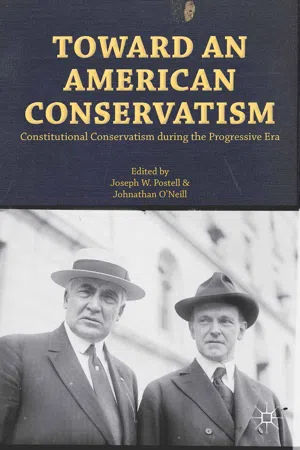
Toward an American Conservatism
Constitutional Conservatism during the Progressive Era
- English
- ePUB (mobile friendly)
- Available on iOS & Android
eBook - ePub
Toward an American Conservatism
Constitutional Conservatism during the Progressive Era
About this book
During the Progressive Era (1880-1920), leading thinkers and politicians transformed American politics. Historians and political scientists have given a great deal of attention to the progressives who effected this transformation. Yet relatively little is known about the conservatives who opposed these progressive innovations, despite the fact that they played a major role in the debates and outcomes of this period of American history. These early conservatives represent a now-forgotten source of inspiration for modern American conservatism. This volume gives these constitutional conservatives their first full explanation and demonstrates their ongoing relevance to contemporary American conservatism.
Information
1
Constitutional Conservatism during Progressive Era
The National Association for Constitutional Government and The Constitutional Review
Johnathan O’Neill
Electoral defeats and long-standing differences of principle have separated the strands of conservatism held together for so long by the leadership of William F. Buckley and Ronald Reagan. Libertarians, who place their conception of liberty and individual choice above all else, have gained adherents due to dissatisfaction with the steadily increasing power of modern government. Traditionalist conservatism’s emphasis on virtue and moral restraint, sometimes rooted in religion, distances it from the moral relativist orientation typical of libertarianism. The neoconservative understanding of human nature and dedication to an activist foreign policy, both built on a version of American exceptionalism, are often rejected by both libertarians and traditionalists.
Today these schools of contemporary conservatism usually think that there is more to be gained by supporting the Constitution than by attacking it, although they were more critical of it in earlier times. Consequently, another era of practical accord might be encouraged by a politics of constitutional preservation and defense.1 Regardless of the ultimate principles and immediate aims of the various strands of conservatism, defense of the Constitution benefits all conservatives more than contemporary liberals or progressives, who would more likely prefer to abandon it.
How might politics look if conservatism oriented itself around preservation of the Constitution? We can gain historical perspective on this question by considering how various kinds of conservatives responded when Progressivism challenged the established constitutional order in the early twentieth century.
Progressivism was an intellectual and political reform movement that aimed to alter the American constitutional system.2 At the deepest level, as expressed especially in the thought of Woodrow Wilson and Herbert Croly, Progressives aimed to refound America based on the managerial–administrative political philosophy of the European state. Consequently, Progressives typically rejected the foundational American principles of natural rights and limited government for their own understanding of “progress,” defined as governmental experts’ management of social and economic change toward an evermore just and statist future.3
Progressives called for more activist regulatory power in the federal government via administrative bureaucracies and more direct democratic control of political decision making to wrest it from the supposedly corrupt hands of big business and the party system. They were confident that they knew the direction of history and could tutor and direct Americans in what was required to be in harmony with it, so they zealously attacked or redefined aspects of constitutionalism that they regarded as outmoded or simply false. Accordingly, local self-government, protected by federalism, was an obstacle to be overcome, as was the Supreme Court’s resistance to many of Progressives’ desired regulations. The president would become the representative of a properly instructed public opinion and then would oversee the bureaucracy that would affect the will of the masses.
As this description suggests, in many respects, Progressives created the world we now inhabit, and the modern liberal incarnation of Progressivism remains very much with us. Those who would resist the further implementation of the Progressive vision would do well to study the arguments and limitations of those who first opposed it. It is in this spirit that we will examine the critical responses to Progressivism by three prominent kinds of conservatism, including Burkean traditionalism, Southern Agrarianism, and libertarianism. In the early twentieth century, these types of conservatism had more of a strained, ambiguous, or hostile relationship to the American constitutional order than do some of their current exponents. Their principles, though considered and sometimes profound, limited their commitment to American constitutionalism, thereby preventing a stronger and more coherent conservative response to Progressivism. These conservatives’ insufficient attachment to the Constitution, at the time when it most needed thoughtful defenders, should serve as a warning to today’s conservatives.
After considering these three types of responses, we will examine a now-neglected group of conservatives who also rejected Progressivism but did so precisely by rededicating themselves to American constitutionalism. Many people in this group were loosely affiliated with a now nearly forgotten organization called the National Association for Constitutional Government, as well as its journal, The Constitutional Review, which was published from 1917 to 1929. As I have described elsewhere, they understood Progressivism’s challenge to the constitutional order and met it with arguments derived from the principles of the American regime. They defended individual liberty based on natural rights, federalism as the division of authority and responsibility between levels of government, an independent judiciary dedicated to the rule of law but not somehow above the Constitution, and a presidency constrained by other governmental institutions rather than by mere public opinion.4 In this chapter I will emphasize something at once more cultural and philosophical, though less precise—constitutional conservatives met Progressivism with precisely the respectful attachment to the Constitution that was lacking in the other types of conservatism. They saw Progressivism as a dangerously shortsighted falling away from the tried and true, and they thought that renewed education in America’s first principles was essential to combat it.
Conservatives Alienated from American Constitutionalism
Humanism and the Limits of Burkean Conservatism
In the 1920s, Irving Babbitt (1865–1933), a professor at Harvard University, led a movement of conservative cultural criticism known as humanism. Sustained by Babbitt’s influential writing and his popularity as a university instructor, humanism rejected the wooly headed utopianism and crude self-indulgence that it saw as degrading modern culture, especially literature.
Humanism steadily gained adherents among conservatives, and Babbitt remains an abiding referent for traditionalists who cast a wary eye on American culture. His deepest intellectual loyalty was to Edmund Burke, whose thought informed Babbitt’s brief but pointed attack on Progressivism. Though Babbitt was not primarily a political thinker, his Democracy and Leadership (1924) is a fine example of a Burkean approach to the political and constitutional questions of the day.
In this book, Babbitt condemned Progressives’ confiscatory reform schemes and defended the absolute necessity of property rights for any decent society (though always remaining critical of crude materialism). He praised the Supreme Court as the institutional embodiment of the principled restraint central to his thought. He also cautioned against increased presidential power, ridiculed Prohibition as a characteristic modern intrusion on liberty, and warned that the Progressives’ zeal for direct democracy was profoundly dangerous to republican government. Moreover, Babbitt valorized Washington and Lincoln as paragons of principled leadership who knew that ethical restraint was needed if democracy was to endure.
In the teeth of Progressivism, then, Babbitt’s deep learning generated a kind of constitutional conservatism, yet his Burkean orientation ultimately distanced him from America’s foundational principles. Babbitt held that on one side of man’s dual nature stood insatiable appetite and passion, and on the other side stood moral self-restraint and willed moderation that constituted the “inner check” or “veto power” on the former.5 He deployed this dualism, which he knew had a long history in Western thought, as a powerful critique of democratic culture, materialism, and politics. Drawing somewhat on Aristotle and more on Burke, Babbitt argued that only an aristocracy could orient society toward ethical standards and self-restraint, thereby moderating the selfishness, vulgarity, and redistributionist meddling loosed by modern mass democracy.
But his Burkean distaste for democracy distanced him from the natural rights and popular sovereignty principles announced in the Declaration of Independence and sustained by the constitutional order. Focused on ethical standards and self-restraint, Babbitt saw in Locke and in Jefferson’s Declaration only the assertion of “abstract rights” shorn of duties and thus the inevitable modern slide into vulgarity and petty self-interest. “The liberty of the Jeffersonian,” he wrote, “makes against ethical union like every liberty that rests on the assertion of abstract rights.” With more than an echo of Burke, Babbitt too quickly conflated the French and American Revolutions, dismissing the “supposed rights of man” as serving only the destructive leveling of democracy.6
Babbitt hoped that aristocratic leadership and ethical standards could be revived, but this was a hope against what he viewed as the low and irredeemably appetitive character of American principles. Consequently, his conservatism backed into a defense of important aspects of the constitutional order yet rejected its foundation in the early modern liberal theory of natural rights, popular sovereignty, and social contract.
Babbitt denied himself recourse to America’s foundational ideas just at the time the Progressives were severely undermining them. This limitation was encapsulated in his juxtaposition of antebellum abolitionists’ appeal to natural rights (and that of Lincoln, one might add) with the states’ rights claims of Calhounite fire-eaters. He said both sides took equally “extremist” positions. So “the whole question of union, instead of being settled on ethical lines, had to be submitted to the arbitrament of force.”7 But Babbitt’s form of conservatism, as has been noted, “could not determine whether some rights supercede some duties; his argument gives the impression that a stable social order is all-important, even though it mean some men and women live enslaved.”8
After the New Deal victory, some Burkean traditionalists reconsidered whether their position might form a closer attachment to the American founding than Babbitt had managed in the Progressive era. Russell Kirk, the Burkean giant of post–New Deal conservatism so influenced by Babbitt, initiated this shift by lauding the Constitution as a conservative bulwark for the American Revolution’s vindication of traditional English liberties—but not of natural rights.9
Kirk keenly appreciated that American conservatism depended on the achievements of Western civilization, and that the Americans would be aided and sustained by recovering this broader historical context. Yet Kirk and Burkean conservatism more generally were never fully reconciled to the idea of natural rights and persisted in viewing America as a somewhat disappointing offshoot of English civilization. Engagement with this set of problems, inherited from Babbitt, gradually helped form major fault lines among traditionalism and other strands of post–New Deal conservatism as they related themselves to America’s principles and Constitution.
The Limits of Southern Agrarian Conservatism
Another significant strand of conservatism in the early twentieth century was Southern Agrarianism, whose founding manifesto was an essay collection published in 1930 entitled I’ll Take My Stand. Southern Agrarians’ basic claim was that the South was a culturally distinct section, based on agriculture, which must be liberated from the alleged domination of the mercantile, industrial, and crudely materi...
Table of contents
- Title Page
- Copyright Page
- Contents
- Introduction
- 1. Constitutional Conservatism during the Progressive Era: The National Association for Constitutional Government and The Constitutional Review
- 2. The Progressive Origins of Conservative Hostility to Lochner v. New York
- 3. William Howard Taft and the Struggle for the Soul of the Constitution
- 4. The Election of 1912 and the Origins of Constitutional Conservatism
- 5. William Howard Taft on America and the Philippines: Equality, Natural Rights, and Imperialism
- 6. Civilization versus Modernity: The League of Nations in the Crisis of World Civilization
- 7. “Roaring” against Progressivism: Calvin Coolidge’s Principled Conservatism
- 8. Rational Compromise: Charles Evans Hughes as a Progressive Originalist
- 9. The Two Phases of Herbert Hoover’s Constitutional Conservatism
- Epilogue
- About the Contributors
Trusted by 375,005 students
Access to over 1.5 million titles for a fair monthly price.
Study more efficiently using our study tools.
Frequently asked questions
Yes, you can cancel anytime from the Subscription tab in your account settings on the Perlego website. Your subscription will stay active until the end of your current billing period. Learn how to cancel your subscription
No, books cannot be downloaded as external files, such as PDFs, for use outside of Perlego. However, you can download books within the Perlego app for offline reading on mobile or tablet. Learn how to download books offline
Perlego offers two plans: Essential and Complete
- Essential is ideal for learners and professionals who enjoy exploring a wide range of subjects. Access the Essential Library with 800,000+ trusted titles and best-sellers across business, personal growth, and the humanities. Includes unlimited reading time and Standard Read Aloud voice.
- Complete: Perfect for advanced learners and researchers needing full, unrestricted access. Unlock 1.5M+ books across hundreds of subjects, including academic and specialized titles. The Complete Plan also includes advanced features like Premium Read Aloud and Research Assistant.
We are an online textbook subscription service, where you can get access to an entire online library for less than the price of a single book per month. With over 1.5 million books across 990+ topics, we’ve got you covered! Learn about our mission
Look out for the read-aloud symbol on your next book to see if you can listen to it. The read-aloud tool reads text aloud for you, highlighting the text as it is being read. You can pause it, speed it up and slow it down. Learn more about Read Aloud
Yes! You can use the Perlego app on both iOS and Android devices to read anytime, anywhere — even offline. Perfect for commutes or when you’re on the go.
Please note we cannot support devices running on iOS 13 and Android 7 or earlier. Learn more about using the app
Please note we cannot support devices running on iOS 13 and Android 7 or earlier. Learn more about using the app
Yes, you can access Toward an American Conservatism by Joseph W. Postell,Johnathan O'Neill in PDF and/or ePUB format, as well as other popular books in Politics & International Relations & North American History. We have over 1.5 million books available in our catalogue for you to explore.