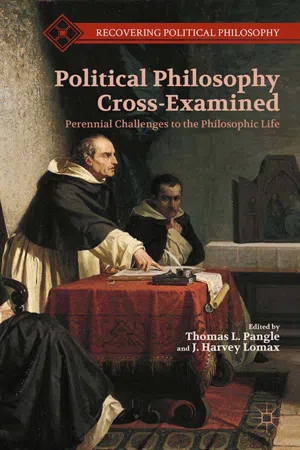
Political societies frequently regard philosophers as potential threats to morality and religion, and those who speak for politics often demand a defense of philosophy. This book will address philosophy as a mode of existence put into question.
- English
- ePUB (mobile friendly)
- Available on iOS & Android
eBook - ePub
About this book
Information
CHAPTER 1
SOPHISTRY AS A WAY OF LIFE
Robert C. Bartlett
Socrates’s life is noteworthy not least for its unnatural end: Socrates was executed by democratic Athens on a twofold charge of not believing in the city’s gods and of corrupting the young. Inasmuch as Socrates’s way of life and the death to which it led are intended by Plato to be instructive and even exemplary, he seems intent on indicating a fundamental tension between the philosophic life as Socrates lived it and political life, even when, as in the case of Athens, it is characterized by considerable freedom and enlightenment. This tension is treated most directly in the four dialogues that depict the trial and execution of Socrates (Euthyphro, Apology of Socrates, Crito, and Phaedo). Yet interwoven with these most political works are three dialogues that record conversations originally occurring immediately before (Theaetetus) and immediately after (Sophist, Statesman) the initiation of court proceedings against Socrates (Theaetetus 210d1–4). And this trilogy of dialogues presents Socrates in his relation to the two great camps of philosophy prior to him, that represented by (among others) Heraclitus, who stressed the fundamental importance of motion or a certain kind of “relativism,” and that of Parmenides, who evidently denied motion altogether (consider Theaetetus 152e2–5). Moreover, this trilogy has a special status in the Platonic corpus. It alone is presented as consisting of conversations transcribed by a companion of Socrates, Euclides by name, who repeatedly verified his written account with Socrates himself, as he waited in jail, and who corrected it accordingly; these dialogues were “pretty much” written up by Euclides, which is to say that they are the closest thing we have to books written by Socrates himself (Theaetetus 143a1–5). At the end of his life, Socrates cooperated with an effort to leave behind a record, shaped by him, of these very theoretical conversations that not only allow no doubt as to his status as a philosopher, a truly theoretical man, but also distinguish him from other philosophers or schools of thought. They therefore also serve to highlight his peculiar achievement as a thinker.
In the seven dialogues that together treat Socrates at the end of his life, then, Plato compares Socrates both to his fellow citizens, on the one hand, and to his fellow theoreticians, on the other. To accomplish the latter task, Plato shines a light on the sophists especially: the central dialogue of the trilogy is entitled precisely Sophist; and the bulk of the Theaetetus treats the answer to the question “what is knowledge?” given by Protagoras, the most famous sophist of antiquity. The Theaetetus is therefore a kind of sequel to the dramatically earlier Protagoras, and together they constitute our most important source of knowledge about the man. Plato evidently thought it helpful, in understanding Socrates’s way of life, to contrast this with the sophists in general and Protagoras in particular. The following remarks are intended to be an introduction to Plato’s two-part presentation of Protagoras in the hope that they may be useful in coming eventually to understand the achievement of Socrates.
The Moral-Political Teaching
The task of recovering Protagoras’s understanding of himself and the world is complicated by the fact that he rarely speaks his mind or that he is an immensely “wise” speaker (Protagoras 310d6, e5–7). Protagoras does present himself to the world as a sophist, it is true, the first to do so according to his own account. He is therefore marked by a certain outspokenness or frankness, he whose name happens to mean “first to speak out.” This outspokenness is remarkable in that those known or suspected to be sophists were deeply mistrusted by many respectable people, by the Athenian democrat Anytus, for example, whose hostility to sophists was equaled or exceeded only by his eventual hostility to Socrates (Meno 91c1–5; Apology of Socrates 18b3). Even young Hippocrates of the Protagoras, whose eagerness to study with the visiting sophist affords the occasion for the whole dialogue, blushes at the mere thought of becoming a sophist himself (Protagoras 312a1–7). And yet, Protagoras admits that such frankness is itself a mark of his prudence or the product of calculation: the poor job of concealment effected by the crypto-sophists before him served only to exacerbate the problem. And, besides, Protagoras has devised certain other, unspecified means of concealment that have permitted him to practice sophistry for decades, so far unscathed, dangerous though that practice remains. Protagoras therefore trumpets a frankness that is in fact far from complete and that is guided not by respect for honesty, for example, but by the demands of self-protection. As will be confirmed in the Theaetetus, where we learn that the now-deceased Protagoras used to teach one thing to the “unwashed many” while reserving his “secret” teaching for his students (Theaetetus 152c8–10), Protagoras is a consummate liar. He avails himself of myths and other such means of indirection that, “to speak with god,” have kept him safe all these years.
Why then does Protagoras need to proceed as indirectly as he does? Once we strip away the dazzling rhetoric, and follow up on his hints and indications, we arrive at this understanding of the man: Protagoras contends that the so-called virtues of moderation, piety, and justice are in fact tools that every community relies on to transform naturally isolated and selfish human beings into unnatural citizens, or sheep, who obey the law more or less willingly. In doing so, they serve mostly the good of others while sacrificing their own—virtuously, as they think, but stupidly in fact. According to Protagoras, then, human beings are not by nature political animals except in the attenuated sense that they attempt to form societies in order to flee the harshness of our truly natural condition, one of wretched misery stemming from the original scarcity and of heart-pounding terror at the hands of predatory animals, other human beings not least.
It hardly needs to be said that Protagoras is an atheist, a fact he cleverly conveys even as he speaks with apparent respect of Zeus and Hermes and the rest: anyone who is actually unjust would be crazy to admit to that injustice, Protagoras notes (323a5–c2), and his deed here, in the form of his long speech, suggests that it is a good idea too to promote in others the idea of a lawgiving god in heaven who unfailingly punishes the unjust. And once we are rid of the good that justice and piety are supposed to be in themselves or for their own sakes, it is a short step to identifying pleasure as the good that remains, one’s own pleasure. Pleasure is a good whose immediacy and certainty bespeak the natural in a way that the demands of justice or piety or moderation cannot match. Protagoras is a hedonist. But by the time this question of hedonism is broached in the Protagoras, he has been having a hard time of it, thanks to Socrates’s insistent and indelicate queries, and he has been rendered too cautious to cop to hedonism. He will say only that considerations of “safety,” with a view to his life as a whole, lead him to say that he pursues only “noble” or respectable pleasures (351c1–d7). As punishment for this caution, Socrates proceeds to give, on the basis of an avowed hedonism that has baffled many commentators, a much better advertisement for sophistry than any Protagoras had managed to that point.
If we put all of this together, we see that Protagoras is an atheistic, amoral hedonist. He conceives of a world that is beyond good and evil—though evidently not beyond good and bad, because we can be guided in it by the pursuit of pleasure and the avoidance of pain. If there are delights to be had in figuring important things out for ourselves, then surely Protagoras takes no small pleasure in lifting the curtain that conceals the true character of polite society, in seeing, with godlike strength or courage, the utter falsity of the deepest opinions that guide most people most of the time.
What does all this mean for the life Protagoras leads? He is in the first place a very famous and wealthy teacher; his arrival in Athens, recorded in the dialogue that bears his name, causes a stir even beyond the likely circles. The case for pursuing fame and wealth is easier to make on the basis of hedonism, of course, fame and wealth being in themselves trifles, perhaps, but leading to pleasures nonetheless. As for Protagoras’s activity as a teacher, it must be complex. When we first see Protagoras, he is walking about in a private home, surrounded by students, some of them local Athenians, others whom he has collected as he passes from town to town, entranced as they are by his Orpheus-like voice. Closer inspection suggests that in fact there is an inner circle of students who are surrounded by others at a certain remove; and that inner circle includes one Antimoerus, a foreigner, who is Protagoras’s best student and is himself training to become a sophist. In contrast to him, the vast majority of Protagoras’s paying pupils are, like Hippocrates, attracted by the promise of realizing their political ambitions; to these students he presumably conveys the principles of effective rhetoric, so that they may become “most powerful” in their respective cities when speaking about the city’s affairs (consider 318e5–319a2). Whatever else Protagoras teaches them, about the so-called virtues and the gods, for example, it must be compatible with the persistence of political ambition or act as no corrosive on that ambition: all but one of those in his train do not seek to become sophists themselves, although it is true that those who leave their hometowns to follow Protagoras must cease to be the citizens they once were. If we judge by the life he himself leads, as an itinerant teacher and hence perpetual foreigner, Protagoras is without political ambitions in any ordinary sense. His concern with politics—the realm of the merely conventional—seems limited to avoiding the ire of the few powerful in every city, as distinguished from the majority, mere fools, according to him, who “perceive as it were nothing.” Protagoras must have a largely political teaching, then, that appeals to and to some extent aids the political ambitions of the young; and some versions of this political teaching keep intact the student’s basic moral opinions: at one point Protagoras boasts that he allows students to pay him as much as they think the instruction is worth, with the proviso that the student must go to a temple and swear to a god that the amount he will pay—when it is less than the advertised price—is his sincere opinion of the instruction’s worth. Hence, Protagoras too relies on, or exploits, the piety of at least some of his students. But as for his theoretical teaching, to the likes of Antimoerus, the core of it is contained not in the Protagoras but in the first two-thirds or so of the Theaetetus.
The Theoretical Doctrine
Early on in his conversation with the gifted young mathematician Theaetetus, Socrates resurrects the dead Protagoras and has him both explain and defend himself. Socrates does so because the young fellow’s second attempt at a definition of knowledge—“knowledge is nothing other than perception”—amounts to the same thing as Protagoras’s famous dictum that “human being is the measure, of the things that are, that they are and of the things that are not, that they are not.” Socrates gradually transforms Theaetetus’s perhaps commonsensical suggestion of the crucial importance of sense perception to knowledge into Protagoras’s momentous contention that each of us can know only the world constituted by our necessarily private or individual perceptions of things. We can know only the content or character of our perceptions and not the things in themselves that “give” us or somehow cause those perceptions; still less can we know the fundamental cause or causes of the coming-into-being, persistence, and perishing of the things as what they are or of the world that would seem to be constituted by the sum of such things.
Socrates sets forth this doctrine in stages, each one appearing to be more radical or far-reaching than the preceding. And so—to look ahead a bit—attempting to track down Protagoras’s final view of things is a tall order: Protagoras’s doctrine of “human being as measure” is sometimes linked with the thought that all things are constantly in motion or changing—both perceiver and perceived, actions active as well as passive—and it includes the assertion that no forms or fixed classes (eidē) can be known to exist but are instead constructions in human speech traceable to communal habit and a lack of precisely knowledge (157a7–c2). According to what may well be the final stage of the exposition of Protagoras’s doctrine, not only can one not speak intelligibly of beings any longer, but even “becoming” should be banished from one’s thought, if not also from one’s necessarily imprecise speech. For if there are no intelligible classes or kinds, then there can be nothing fixed that persists through the process of coming-into-being or becoming. And so Socrates’s very attempt to capture Protagoras’s doctrine in speech amounts to assigning, in violation of the doctrine, a fixed characteristic (e.g., constant motion) to “things” that cannot be known to be such; in violation of the doctrine, Socrates attempts to bring the world to a halt by describing in speech its finally ineffable motion. Partly as a result of this difficulty, Socrates’s account of Protagoras’s doctrine, especially inasmuch as it is linked with the motion doctrine, is itself constantly in motion. It thus presents in deed or before our eyes the central contention of the argument—an explanation by way of imitation.
Protagoras seems to have begun from reflection on the readily available experience of sense perception: one of us may be chilled by a wind that another does not experience as cold at all. Of the wind “itself by itself” we cannot say anything; the qualities of the wind depend for their existence entirely on their being perceived and hence on the perceiver. But this proves to be only a preliminary stage of the argument. More serious is Protagoras’s “secret” teaching, intended for students only, of the fundamentally relational character of our experience of the world—all the qualities we assign to things as we experience them depend on the act of contrasting and comparing: “If you address something as big, it will appear also small, and if heavy, light, and in fact all things together [sumpanta] are this way, on the grounds that there is no one thing that either is something or is of any sort whatever” (152d2–6). In addition, all the things that we assert “are” and wrongly address as such, in fact come into being through varieties of motion: locomotion and motion and mixing with one another. For nothing ever “is” but is always in the process of coming-into-being, of changing.
After stating and evidently abandoning an argument according to which all such ceaseless motion is for the sake of and to that extent guided by the good (153a1–d7)—an argument that depends entirely on a very free interpretation of two lines of a tragic poet—Socrates returns to following out Protagoras’s argument (153e4; cf. 152b1). He does so by explaining how we perceive color. This explanation stresses the centrality of the isolated experience of the perceiver (154a3–8) and the impossibility of supposing that a given color (or other quality: size or temperature) is “in” the thing perceived. More important still is the example Socrates gives next of three sets of dice: 4 dice set next to 6 will prompt us to say that the 6 are more than the 4 (and by half as much as the 4); but when 12 dice are set next to the 6, we will say that the 6 are fewer than the 12 (and by half as much as the 12). There is here both a striking fixity—the 6 dice remain throughout what they are, a collection of 6 like things that we group together as a unit called “six” (dice)—and a disorienting motion—the six are both more and less, greater and fewer, simultaneously. From this example, Socrates indicates that we have to abandon the following, otherwise very powerful thoughts: that nothing could ever become greater or lesser in bulk or number while remaining equal to itself; and that whatever something was not previously it could not subsequently be without becoming and have come to be. In other words, the six dice do become lesser while remaining equal to themselves, and they do subsequently become what they were not previously while undergoing no change in themselves. These examples are meant to bring home to us how much the qualities we assign to things as though they were inherent in them depend somehow on the active presence of the classifying mind. And with what confidence can we speak of “the things” themselves, those that bear these unstable qualities?
It is nonetheless possible to give, on this basis, an explanation of what is happening “behind” the world of our perceptions—Socrates offers here a second account of the perception of color—an explanation that classifies kinds of motion according to their active and passive qualities as well as their relative speed. Yet, Socrates also dubs this a “myth”: it is at most a plausible hypothesis, since it turns out, according to the comprehensive conclusion Socrates here draws (157a7–c3), that we really cannot speak of any form, any eidos, whether of a stone (cf. 156e6 with 157c1) or even of a human being. All such terms are devices to bring to a halt in speech what is ceaselessly in motion and hence changing. And when, at the end of Protagoras’s vigorous rebuttal of the charge that everyone reasonably distinguishes between true and false perceptions—and hence that perception as such cannot be knowledge—we are evidently left with his contention that there is no ground on which to deny to anyone the truth for him of his perceptions, he who as perceiver is constantly changing in the midst of a world that is also constantly in motion, as Protagoras perceives it.
Protagoras’s position seems to deny the possibility of knowledge and even of saying very much about the world at all, as distinguished from our individual perceptions; his stance divides “the world” into greater awareness of individual perception on which each of us is wholly and necessarily dependent, on the one hand, and the utter mysteriousness of all that may lie behind or cause that perception, on the other.
Theory and Practice
The closest points of contact between Protagoras’s view of political virtue and his theoretical doctrine are found, first, in the atheism on display in the Protagoras: according to the details of his famous myth, the world is fundamentally “Epimethean” as distinguished from “Promethean”—that is, thought or mind is subsequent to, it is the product of, dumb matter in motion; there is no divine mind prior to the world that brought the world into being and governs it, as is confirmed by the misery of our existence, absent human art and invention. Or, to speak in the language of the myth, the basic stuff out of which we came to be was itself formed by unnamed subterranean gods who worked without light and hence blindly. The second point of contact between the two dialogues consists in the application of Protagoras’s thoroughgoing relativism to things “just and noble,” or to morality. This latter first occurs as if in passing in the Theaetetus: without being quite aware of what he is doing, Theaetetus easily agrees to include morality (“good and noble”) in the flux (consider 157d7–11).
Helpful in seeing the implications of Protagoras’s theoretical doctrine is Socrates’s first important criticism of him: he wonders why Protagoras didn’t begin his book called Truth by stating that a pig or baboon—or some other, still s...
Table of contents
- Cover
- Title Page
- Introduction: The Philosophic Life in Question
- 1. Sophistry as a Way of Life
- 2. Aristotle on Theory and Practice
- 3. Aristotle’s Politics Book VII on the Best Way of Life
- 4. Inexhaustible Riches: Mining the Bible
- 5. On the Philosophic Character of Tacitus’s Imperial Political History
- 6. Maimonides on Knowledge of Good and Evil: The Guide of the Perplexed I 2
- 7. Machiavelli in The Prince: His Way of Life in Question
- 8. Of Human Ends in Bacon’s Essayes
- 9. Hobbes’s Natural Theology
- 10. Rousseau’s Happiness of Freedom
- 11. Heidegger on Nietzsche on Nihilism
- 12. How Benardete Read the Last Stage of Socrates’s Philosophic Education
- Appendix: Bibliography of Heinrich Meier
- Notes on Contributors
Trusted by 375,005 students
Access to over 1.5 million titles for a fair monthly price.
Study more efficiently using our study tools.
Frequently asked questions
Yes, you can cancel anytime from the Subscription tab in your account settings on the Perlego website. Your subscription will stay active until the end of your current billing period. Learn how to cancel your subscription
No, books cannot be downloaded as external files, such as PDFs, for use outside of Perlego. However, you can download books within the Perlego app for offline reading on mobile or tablet. Learn how to download books offline
Perlego offers two plans: Essential and Complete
- Essential is ideal for learners and professionals who enjoy exploring a wide range of subjects. Access the Essential Library with 800,000+ trusted titles and best-sellers across business, personal growth, and the humanities. Includes unlimited reading time and Standard Read Aloud voice.
- Complete: Perfect for advanced learners and researchers needing full, unrestricted access. Unlock 1.5M+ books across hundreds of subjects, including academic and specialized titles. The Complete Plan also includes advanced features like Premium Read Aloud and Research Assistant.
We are an online textbook subscription service, where you can get access to an entire online library for less than the price of a single book per month. With over 1.5 million books across 990+ topics, we’ve got you covered! Learn about our mission
Look out for the read-aloud symbol on your next book to see if you can listen to it. The read-aloud tool reads text aloud for you, highlighting the text as it is being read. You can pause it, speed it up and slow it down. Learn more about Read Aloud
Yes! You can use the Perlego app on both iOS and Android devices to read anytime, anywhere — even offline. Perfect for commutes or when you’re on the go.
Please note we cannot support devices running on iOS 13 and Android 7 or earlier. Learn more about using the app
Please note we cannot support devices running on iOS 13 and Android 7 or earlier. Learn more about using the app
Yes, you can access Political Philosophy Cross-Examined by T. Pangle, J. Lomax, T. Pangle,J. Lomax in PDF and/or ePUB format, as well as other popular books in Politics & International Relations & Political Philosophy. We have over 1.5 million books available in our catalogue for you to explore.