- English
- ePUB (mobile friendly)
- Available on iOS & Android
eBook - ePub
About this book
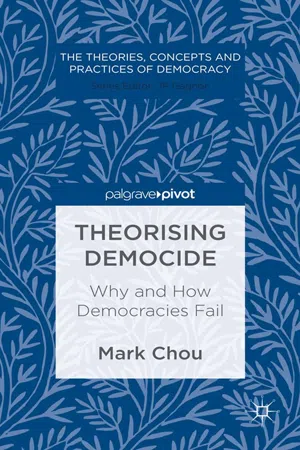
Beginning with the premise that democracies are often deeply implicated in their own downfall, The Theory of Democide challenges the conventional view of how and why democracies collapse by demonstrating that democratic collapse is often a direct result of the inherent logic of democracy itself.
Information
1
Constituted to Fail: Democracy and Its Self-Negation
Abstract: Despite experiencing what for many commentators constitutes nothing short of a ‘world-historical peak’, democracy also finds itself enervated by a number of interminable ailments. Widespread governmental torpor, strongarm executives, declining levels of political bipartisanship and an apathetic political culture are just some of the factors said to be responsible for the democratic disillusionment and authoritarian nostalgia felt in certain parts of the world today. In response to these claims, the conventional position put forward by democratic advocates has been to view such democratic setbacks as an anomaly; at odds with the ‘proper’ workings of democracy. This chapter challenges the prevailing wisdom and offers an alternative take on democracy’s failings. To do so, it critically reviews the recent works of a small minority of otherwise democratically committed scholars, before making the somewhat controversial claim that the fallibility of democracy is not now nor has it ever been an anomaly as much as a constitutive feature of democracy.
Chou, Mark. Theorising Democide: Why and How Democracies Fail. Basingstoke: Palgrave Macmillan, 2013.
DOI: 10.1057/9781137298690.
DOI: 10.1057/9781137298690.
For something that began life largely as an ad hoc political experiment, an ancient project said to have been hastily cobbled together by a group of revolutionary Athenians, democracy has certainly come a long way.1 Considered by many as a pejorative and potentially dangerous idea for much of its blotted history, democracy has defied the odds and in our own uncertain age become ‘enshrined across the globe as the only legitimate, even imaginable, form of political society’.2 Today, it is no exaggeration to suggest that few systems of political governance are as commonplace as that which seeks to hand power to the people. With more than 120 different episodes of democratisation having swept through some 90 countries in the brief period since the 1960s alone, the natural conclusion to draw is that the golden age of democracy is now.3 Particularly notable have been the recent transitions to democracy – now known collectively as the Third Wave – that began in the early 1970s after prolonged periods of dictatorships in places like Portugal, Greece, Spain and then later in Ecuador, Peru, Brazil, Chile, the Philippines, South Korea, and Bangladesh.4 Together, these and other democracies slowly established the type of competitive multiparty electoral systems that had become mainstays in long since matured democracies. Nearly 40 years on, and with what appears to be the beginnings of a Fourth Wave of democratisation now taking place, the global standing of democracy remains strong. From the far reaches of the former Soviet Union, where democracies replaced the old communist regime decades ago, to the nascent democratic configurations that have taken root as a result of the Arab Spring, there is no denying that democracy is enjoying something of a ‘world-historical peak’.5
Of course, this was precisely the prediction made by those who first associated democracy with the so-called end of history thesis. Beginning with Bruce Russett, one of the intellectual forefathers of the now infamous democratic peace theory, we read that ‘if history is imagined to be the history of wars and conquest, then a democratic world might in that sense represent “the end of history”.’6 Crucially, what we can take away from Russett’s thesis is the entrenched assumption that there is something implicitly progressive if not teleological about democracy, which is coincidental with the end of wars, the end of conquest and with the end of history as such. For his part, Francis Fukuyama concurs. His argument begins with the claim that at the end of the Cold War, a resounding global consensus appeared to have emerged regarding both the prevalence and legitimacy of liberal democracy as the best system of governance.7 This was a statement which has been backed both empirically and normatively by a range of political scientists and international relations scholars in the post–Cold War era.8 But Fukuyama takes it a step further by choosing to equate liberal democracy with the ‘end point of mankind’s ideological evolution and the final form of human government’.9 Unlike previous ideologies and systems of governance whose intrinsic ‘defects and irrationalities’ eventually corrupted themselves, liberal democracy represents the pinnacle of an ‘evolutionary process [that] was neither random nor unintelligible’ but ‘would end when mankind had achieved a form of society that satisfied its deepest and most fundamental longings’.10 This, according to Fukuyama’s prescriptions, is what has begun to happen with democracy’s rise to global prominence.
And although even Fukuyama would not dispute the claim that democracy is still a work in progress, a point which became especially pertinent as the post–Cold War optimism gave way to the post-9/11 pessimism, these projections do seem buoyed by the fact that there are now political reforms moving in a distinctly democratic direction in contexts where democratisation would have been impossible only a decade earlier. No single case is a better example of this trend than the democratic developments taking place within China, the world’s largest nation to have resisted democracy’s global spread thus far. Though it continues to be perceived by many Western powers as an ‘outlaw regime’ potentially at odds with liberal democratic values and US hegemony, China has made significant strides when it comes to democracy in recent years.11 As Peter Foster, the Telegraph’s Beijing correspondent, recently made clear, China may still be ‘far from free, but three decades after 150 years of invasions, civil wars and political upheaval finally came to a close, it is a long way from the totalitarian state it has at times appeared to be’.12 Likewise, China scholars like Baogang He have emphasised from as early as the mid-1990s that the ‘totalitarian paradigm is no longer appropriate’ when it comes to understanding contemporary China.13 It may not yet be a democracy in the Western sense, and it may still have a questionable reputation when it comes to the issue of human rights, but there are recent advances which suggest that neither is it any longer a traditional totalitarian state.
Now, as the longer term observer might be aware, the idea of democracy is actually not new in China. Numerous waves of democratisation, along with various types of democracy, have swept through China during the past century.14 But particularly in recent years, with Communism having ‘lost its capacity to inspire the Chinese’, as Beijing-based political philosopher Daniel Bell claims it has, it is oddly democracy that has taken yet another foothold in its wake.15 This is certainly the case if we take the official pronouncements of the Chinese Communist Party seriously. As early as 2007, during the 17th National Party Congress, for example, Party leaders began sending out the clear message ‘to expand people’s democracy’.16 This would, they assured, entail a renewed vision for Chinese citizenship that would enable the people, among other things, to ‘enjoy democratic rights in a more extensive way’ and ‘to participate, to express their views and to supervise the administration’. President Hu Jintao affirmed this by stating that in China the people are to become ‘masters of the country’.17 It is the people’s right, he declared, ‘to be informed, to participate, to be heard, and to oversee’. The Party, as such, would be subjected to a greater level of scrutiny in its exercise of power and in its decision-making capacity. Similarly, the outgoing Premier Wen Jiabao has commented that democracy is a universal value, one that includes ‘the three important components: elections, judicial independence, and supervision based on checks and balances’.18 And while he believes that what is best for China is a form of democracy that best reflects its unique history and needs, Wen openly associates democracy promotion with the type of market liberalism thriving in China, and elsewhere, today.19 And so, even in a place like China it seems, where one party rule has dominated the political landscape for more than half a century, the democratic impetus has begun to usher in the type of political reforms that one more commonly associates with democracies in the West.
However, despite this rosy outlook, democracy’s global ascendency, especially during the latter part of the twentieth century, has not been without its problems. It has not been without a counter-story, a darker underbelly that is less deserving of the optimism usually associated with democracy. It may be true to say that democracy’s appeal is now almost universal. Yet it is also true that nearly everywhere we look there are visible signs suggesting that democracy is under threat. The French sociologist Alain Touraine said it best when he conceded that, though ‘one can find the democratic spirit at work’ in almost all corners of the world today, ‘the risk [democracy runs] of becoming degraded or disappearing’ looms ever large.20
What is more, the ailments which democracies are now being enervated by, when one manages to catch sight of them, are actually quite interminable and in some cases symptomatic of democratic politics at large. Being too numerous and varied, the full list of these ailments cannot be catalogued here in any practical way. But it only takes a skim off the top of this pile to get a sense of the full scale of what is going wrong. Indeed, in almost all democracies now, the declining levels of civic participation, which incorporates such factors as the dwindling voter turnout during elections; the increased levels of political repression, even in strong liberal democracies; the absence of grassroots political campaigns for all but the most prominent issues; and the falling numbers of those who actively participate in town hall meetings, civic group events and political parties are becoming more symptomatic of democratic politics as such. All of this, according to International Crisis Group analyst Alan Keenan, is clear evidence of ‘democracy’s discontent’; a term that both encapsulates democrats fed up with how debased democracy has become as well as the ambit of problems that democracy faces today.21 Similarly, Wendy Brown, well known for her critical assessments of contemporary US politics, particularly the constellation of neoliberal forces that has worked to eviscerate democracy into a form of corporatism, laments just how far elections – the supposed beacon of all democratic politics – have fallen.22 Less of a frank exchange of ideas between competing parties and representatives with unique political visions for the future than a circus, democratic elections have descended into marketing exercises televised only for their entertainment value. For Brown then, the claim that ‘we are all democrats now’ has become hard to deny, something which is more a cause for concern than for celebration.
More insidiously, against the backdrop of perhaps the greatest period of democratisation that the world has ever known, Alfred Stepan begins Democracies in Danger, his recent book on the state of contemporary democracy, with a sobering reminder: ‘Thirty-five years after the Third Wave of democratization began and twenty years after the Berlin Wall came down, many of the new ...
Table of contents
- Cover
- Title
- 1 Constituted to Fail: Democracy and Its Self-Negation
- 2 Exogenous Breakdown: The Institutional, Socioeconomic and Political Causes of Democratic Termination
- 3 Endogenous Breakdown: The Conditions and Characteristics of Democracies Which Self-Destruct
- 4 Towards a Theory of Democide
- Bibliography
- Index
Trusted by 375,005 students
Access to over 1.5 million titles for a fair monthly price.
Study more efficiently using our study tools.
Frequently asked questions
Yes, you can cancel anytime from the Subscription tab in your account settings on the Perlego website. Your subscription will stay active until the end of your current billing period. Learn how to cancel your subscription
No, books cannot be downloaded as external files, such as PDFs, for use outside of Perlego. However, you can download books within the Perlego app for offline reading on mobile or tablet. Learn how to download books offline
Perlego offers two plans: Essential and Complete
- Essential is ideal for learners and professionals who enjoy exploring a wide range of subjects. Access the Essential Library with 800,000+ trusted titles and best-sellers across business, personal growth, and the humanities. Includes unlimited reading time and Standard Read Aloud voice.
- Complete: Perfect for advanced learners and researchers needing full, unrestricted access. Unlock 1.5M+ books across hundreds of subjects, including academic and specialized titles. The Complete Plan also includes advanced features like Premium Read Aloud and Research Assistant.
We are an online textbook subscription service, where you can get access to an entire online library for less than the price of a single book per month. With over 1.5 million books across 990+ topics, we’ve got you covered! Learn about our mission
Look out for the read-aloud symbol on your next book to see if you can listen to it. The read-aloud tool reads text aloud for you, highlighting the text as it is being read. You can pause it, speed it up and slow it down. Learn more about Read Aloud
Yes! You can use the Perlego app on both iOS and Android devices to read anytime, anywhere — even offline. Perfect for commutes or when you’re on the go.
Please note we cannot support devices running on iOS 13 and Android 7 or earlier. Learn more about using the app
Please note we cannot support devices running on iOS 13 and Android 7 or earlier. Learn more about using the app
Yes, you can access Theorising Democide by M. Chou in PDF and/or ePUB format, as well as other popular books in Politics & International Relations & Political Philosophy. We have over 1.5 million books available in our catalogue for you to explore.