eBook - ePub
Traditional Chinese Thinking on HRM Practices
Heritage and Transformation in China
- English
- ePUB (mobile friendly)
- Available on iOS & Android
eBook - ePub
About this book
Suggests important ramifications for both Western and Eastern Human Resources Practices and is the first research of its kind to empirically investigate the effect of Chinese core values, which originated from Chinese traditional thinking, on HRM practices in China.
Information
Topic
CommerceSubtopic
Gestion des ressources humaines1
Introduction
China’s economic competitiveness
With a population of over 1.3 billion inhabitants, the People’s Republic of China (PRC) is the most populous country in the world. It was once insignificant in the global economic arena, despite its large population. The Third Plenary of the Eleventh Central Chinese Communist Party Congress (中国十一届三中全会), held in December 1978, is regarded as the turning point in the history of the People’s Republic of China, as it witnessed the inauguration of China’s economic reform. A series of economic reforms since then have led to a ‘socialist market economy with Chinese characteristics’ (有中国特色的社会主义市场经济).
Since then, China’s economy has undergone unprecedented rapid growth, and the role of China in global, economic and political affairs has increasingly moved towards centre stage. The average gross domestic product (GDP) of China increased more than tenfold from the late 1970s (when China opened its doors) to 2006, making the Chinese economy the fourth largest in the world after the United States, Japan and Germany (China Daily, 2007). According to the list of countries ranked by GDP in 2009 – based on estimates from the World Bank, the International Monetary Fund and the CIA World Factbook – China became the third-largest economy in the world after the United States and Japan. Then, in mid-2010, China became the world’s second-largest economy, surpassing Japan and second only to the United States (China Daily, 2010). In 2012, while the world economy was experiencing deep recession in this difficult year, China’s economic growth reached 7.7 per cent, above the government’s 7.5 per cent full-year target (China Daily, 2013). It is estimated that in 2013 China’s economy will grow much more rapidly than other major economies because of its structural strength and its superior mechanisms for dealing with economic downturn, which 2012 again demonstrated (China.org.cn, 2013). Among all developing countries, China has been the recipient of the largest foreign direct investment (FDI) because of its current and expected future strong economic growth, great potential business opportunities and cheap labour (Xinhua News, 2007); and its accession to the World Trade Organization (WTO) in late 2001 has further accelerated China’s market-oriented economic reforms.
From the ‘world factory’ to ‘world market’, from ‘made in China’ to ‘created in China’, China has contributed, and will continue to contribute, to the world economy. There is no previous burst of economic activity that has been so dramatic anywhere in the world, recently or historically, as China has maintained annual growth at figures between 7 and 11 per cent for three decades. These significant economic developments have, in turn, resulted in major changes in the management of Chinese enterprises and ‘hold considerable implication for human resource (HR) practices in the nation with the largest workforce in the world’ (Zhu, 2005: xvi).
Particularity of Chinese HRM
The impressive economic growth and commercial importance as well as its intrinsic particularity (cultural, political and economic) make China’s business and management a focus of interest for an increasing number of domestic and foreign researchers and managers who try to discover how Chinese organizations manage to generate such apparent efficiency and effectiveness. Zheng and Lamond (2009) state that if China’s rapid rise is a miracle, it did not happen overnight, and the underlying traditional wisdom passed on through generations over the millennia of Chinese history may have contributed to developing distinctive ways of managing people inside China.
HRM is seen as an essentially American concept, finding its fullest exemplification in non-unionized multinational firms (Guest, 1992: 12), and overlapping with practices found elsewhere in enterprises in many capitalist economies. Most HRM theories derive from a non-universal tradition of scientific rationality, meritocracy, individualism and short-termism (see Chapter 4). For much of the literature on HRM, an ‘ideal’ HRM model appears to contain elements that are drawn from practices in a number of Western countries, especially the United States. These elements generally include: an integration of HRM with business strategy; the close involvement of line managers; high levels of mutual commitment between employer and employee; performance-related payment systems; agreements on flexible working arrangements; and a diminishing significance of the role of trade unions (Storey, 1992; Guest, 1992). This ‘ideal’ model is often used with presupposed national and cultural characteristics (Easterby-Smith, 1995: 35), as Warner argues that theories and models of HRM may not be comprehensively applied, let alone fully understood, outside the cultural context in which they developed (that is, in the United States), and ‘if [they] diffused outside this [context], [they] may not be analysed without conceding limited knowledge/managerial/software transfer’ (Warner, 1993: 46). So, merely applying Western concepts to analyse what has been going on in Chinese HRM, ranging from management strategies and policies to work attitudes and behaviour patterns, presents a number of difficulties.
It is a controversial issue as to whether standardization of production technology is causing worldwide homogenizing of organizational processes, managerial practices and behaviour in organizations, and some researchers observe that the apparent global assimilation is superficial (Kerr, 1983; Redding, 1990). Beneath the homogenization,
the cross-national variety in the world of the mind remains as undisturbed as ever. Economic progress does not appear to radically alter the original values which shape the rules whereby a person cooperates with others. Organisations which may look the same are not the same when you get very close. (Redding, 1990: 239)
The HRM system in China has some distinctive or even unique characteristics. The process of its formation and transformation has been marked by some ingrained factors related to the deep-rooted traditional culture and value systems as well as historical evolution. Undoubtedly, with increasing global competition and the influence of multinational companies’ management practices, the Chinese economy has been gradually affected by Western HRM dimensions – ‘key aspects such as individual fixed-term contracts, individual performance evaluation, individual career development, downsizing and retrenchment, freedom to hire and fire, strategic role of HRM and so on’ (Zhu et al., 2007: 763) have been increasingly adopted by Chinese people-management systems.
However, according to Warner (2008: 771), China’s reformers did not uncritically adopt foreign models; ‘they have implanted overseas economic management practices since the late 1970s [, ... but] they did so by incorporating them into the Chinese “way of doing things”’. Redding (1990: 116) states that although for over a hundred years Chinese business has been influenced by Western technologies and theories and practised with a vast amount of international cooperation, its typical organizational system has retained its basic character. Therefore the growing role of China in the world economy arouses more and more researchers’ interest to uncover what exactly is the ‘Chinese way of doing things’, especially as it is known to be very different from that of the West (Warner, 2008: 788). Nonetheless, most research on Chinese management tend to start from a Western perspective, directly addressing what and how issues, with less concern about why (Liu, 2009: xiv). There are some questions that need further thought: Why do the Chinese have a different way of doing things compared to the West? What is the fundamental explanation of this?
From its geographic size, its population and its long history, to its levels of social complexity and the emerging-market nature of its socialist economy, China is enormous on all counts, and all of these paint a confusing picture for foreigners (Wright et al., 2008: 800). Jacques (2009) states that the Western media has mistakenly paid too much attention to the Chinese communist government and China’s alleged economic and military threat to the Western world, while in fact the real challenge is the rise of Chinese culture. Although often regarded as extremely difficult to comprehend, Chinese cultural characteristics appear as constants against this multifaceted setting. Even if the characteristics of political or economic systems provide plausible explanations for the cross-national differences in terms of management issues, Osigweh and Huo (1993: 106, 107) believe such an explanation seems ‘anecdotal’ and ‘hard to generalize’, because ‘political or economic systems may change quickly and dramatically’ while ‘culture tends to change at a slower pace than political/economic structures’. Zhu et al. (2007: 764) also point out that the state policies on industrial relations and labour market regulations which are strongly associated with the people-management systems shift from time to time, but the cultural value of a state is relatively constant. To a large extent, individual experience is predicted by national origin and the common values of a given society; ‘the self – what people think and feel, what holds their attention, how they know and understand, and what counts as knowledge – is culturally conditioned’ (Bailey et al., 1997: 606). Thus, cultural characteristics can be seen as more stable, reliable and inclusive explanatory factors for the ‘Chinese way of doing things’ than political/economic structures. Redding (1990: 42) explains it more clearly: ‘[B]efore we understand, however, the nature of organizing in Chinese society, we must first understand the basic unit of organisation – the Chinese person. Such an understanding can only come from seeing the culture matrix in which he/she is embedded’.
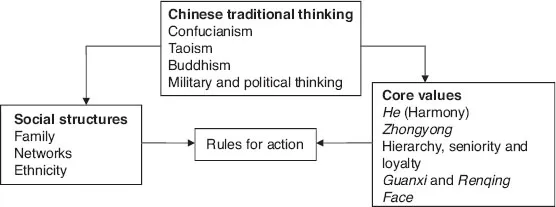
Figure 1.1 Cultural determinants of individual Chinese values (adapted from Redding’s model, 1990)
The reason why the Chinese organizational system has retained its basic character for so long despite significant economic and political reforms in past decades, according to Redding (1990: 116–117), lies in three main forces, all of which derive from Chinese culture and history. These three forces are: the sense of insecurity, which derives from a historical combination of the insecurity of wealth in a society lacking a fully reliable system based on equal rights, and the exclusive trust based on in-group membership; hierarchy, which rests on a long Confucian tradition sponsoring familism and authoritarianism; and personalism, which denies the emergence of a rational, objective and neutral bureaucracy. It is undeniable that the forces of modernization have inevitably seeped into the old traditions, but ‘modernization has not yet radically affected the most fundamental aspects of organizing’ (Redding, 1990: 117). Redding’s three original forces could find their origins in the Chinese traditional approach that is characterized by holistic/naïve, fuzzy/processual and indirect/long-term thinking. Beneath the sense of insecurity there are Chinese processual thinking and long-term orientation – everything is unfixed and in ceaseless change, and, therefore, any good fortune cannot be guaranteed to last. Acceptance of hierarchy derives from the Chinese holistic view, as it emphasizes the holistic harmony: the social hierarchy is an extension of the natural order, and the entire social harmony could be maintained by obeying the social hierarchy. Personalism originates from fuzzy thinking, which involves a multivalent, multi-valued and nonlinear worldview that is not so keen on something ‘logically correct’ but prefers something more in accord with human nature. In order to research Chinese organizations, we must begin with Chinese traditional thinking, which underpins Chinese culture. Also, it is necessary to point out that undoubtedly the culture itself is not the sole contributor to the total explanation of management with Chinese characteristics, but it is a significant one.
Chinese traditional thinking and its derived core values
As one of the oldest civilizations, China has a recorded history spanning 4,000 years that has outlived the other great empires in Eurasia – including the Egyptian, Roman, Byzantine, Arabian, Ottoman and Tsarist–Soviet (Deng, 2000: 1). Joseph Needham (1956), a renowned sinologist, started his research and writing on the history of Chinese science and technology by explaining Chinese history, geography and culture in depth, as knowledge of these fields is considered to be the fundamental basis of science and technology. Without knowing Chinese history, traditional thinking and its derived core values, trying to understand Chinese HRM practices would be like studying the human body by merely examining the skin rather than the heart or brain (Liu, 2009: xiv).
It is an over-simplification to characterize Chinese traditional culture as being merely based on Confucianism, and it shows a lack of understanding of the Chinese cultural system, which is constituted by various philosophical and historical threads (Paton and Henry, 2009). ‘Chinese traditional thinking’ refers, in general, to the thinking that prevailed in China from the Pre-Qin period until the mid-nineteenth century Opium War, a way of thinking with Confucianism at its core, mixed first with Taoism and later with Buddhism, and also combined with ancient military and political strategic thinking (Zi, 1987: 443; Liu, 2009; Louie, 1986; Tang and Li, 2008), which had its roots in a social system that stemmed from primitive clan society and went right up through the slave and feudal societies in China. Any new interpretation of Chinese culture owes its inspiration to a return to this original pure wellspring (de Bary, 1959: 47). There are three features of ancient Chinese thinking: holistic and naїve thinking; fuzzy and processual thinking; and indirect and long-term thinking, which respectively correspond to the West’s abstract and scientific thinking; binary and static thinking; and direct and short-term thinking. Chinese traditional thinking continually provides a moral, intellectual and social nexus for the Chinese psyche, which even the ten-year-long Cultural Revolution was unable to exorcise (Cheng, 1986). In what follows, I will briefly describe each of these three attributes.
The first feature of Chinese traditional thinking is holistic and naïve. ‘Naïve thinking’ here refers to a way of thinking which is not detached, atomistic and abstract. It is rather subjective, relational and concrete. Most of the Western philosophers, from Plato and Aristotle to the twentieth-century philosophers, endeavoured to pursue the universal law of the world and wanted to find the truth and ideals to explain the world. As the result of chasing the ‘Truth’, Western thinking is characterized by Aristotelian binary logic, foundationalist and black-and-white symbolic logic that applies its bivalent ideology universally and without reflection (Alon, 2003: 3). Western thinking has a strong tendency to focus on the measurable, bivalent terms of foundational ‘Truth’ and is less concerned with the holistic and plurivalent phenomena. By contrast, the Chinese have no concept of ‘Truth’ (Munro, 1969; Graham, 1970; Hansen, 1985). Chinese thinking emphasizes holistic harmony, simplicity and dialectic change.
The second feature is fuzzy and processual thinking. Unlike Western logical, binary and static thinking, the Chinese use fuzzy and changing thinking to understand the nature of the human being and the world. Chinese traditional thinking, especially Taoism (for example, the concept of yin and yang), involves a multivalent, multi-valued, nonlinear worldview and fuzzy shade of gray between black and white that sees paradox and contradiction as normal, valuable, experiential, coherent common sense (Lowe, 2003: 7). Due to the Western desire for fixity, universality and certainty, the eternal and the unchanging are viewed as the essential features of ultimate reality. By contrast, Chinese fuzzy thinking stresses not only that everything is unfixed, temporary and there are always manifold possibilities, but also that the process of change is immanent and everything is in the process of changing (Chia, 2003). What is more, unlike the Western philosophical tradition, which seeks fixed p...
Table of contents
- Cover
- Title
- 1 Introduction
- 2 Western HRM and HRM in China
- 3 Philosophical Underpinnings of HRM Theory
- 4 Re-examining Traditional Chinese Thinking
- 5 Chinese Traditional Values – Implication for HRM in China
- 6 Research Findings and Analyses
- 7 Conclusion
- Appendices
- Notes
- References
- Index
Trusted by 375,005 students
Access to over 1.5 million titles for a fair monthly price.
Study more efficiently using our study tools.
Frequently asked questions
Yes, you can cancel anytime from the Subscription tab in your account settings on the Perlego website. Your subscription will stay active until the end of your current billing period. Learn how to cancel your subscription
No, books cannot be downloaded as external files, such as PDFs, for use outside of Perlego. However, you can download books within the Perlego app for offline reading on mobile or tablet. Learn how to download books offline
Perlego offers two plans: Essential and Complete
- Essential is ideal for learners and professionals who enjoy exploring a wide range of subjects. Access the Essential Library with 800,000+ trusted titles and best-sellers across business, personal growth, and the humanities. Includes unlimited reading time and Standard Read Aloud voice.
- Complete: Perfect for advanced learners and researchers needing full, unrestricted access. Unlock 1.5M+ books across hundreds of subjects, including academic and specialized titles. The Complete Plan also includes advanced features like Premium Read Aloud and Research Assistant.
We are an online textbook subscription service, where you can get access to an entire online library for less than the price of a single book per month. With over 1.5 million books across 990+ topics, we’ve got you covered! Learn about our mission
Look out for the read-aloud symbol on your next book to see if you can listen to it. The read-aloud tool reads text aloud for you, highlighting the text as it is being read. You can pause it, speed it up and slow it down. Learn more about Read Aloud
Yes! You can use the Perlego app on both iOS and Android devices to read anytime, anywhere — even offline. Perfect for commutes or when you’re on the go.
Please note we cannot support devices running on iOS 13 and Android 7 or earlier. Learn more about using the app
Please note we cannot support devices running on iOS 13 and Android 7 or earlier. Learn more about using the app
Yes, you can access Traditional Chinese Thinking on HRM Practices by L. Yuan in PDF and/or ePUB format, as well as other popular books in Commerce & Gestion des ressources humaines. We have over 1.5 million books available in our catalogue for you to explore.