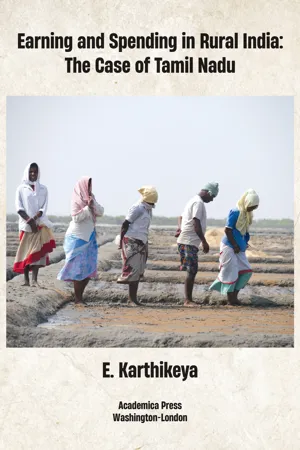
India has one of the world’s largest tribal populations. According to the 2011 census, the total tribal population was estimated at 8.6 percent in India. In Tamil Nadu, the tribal population is about 1.1 percent spread among six major primitive tribal communities. Consumption expenditure is one of the indicators of wellbeing and standard of living in households. This book focuses on the Malaiyali Tribe, which inhabits the Jawadhu hills. This tribal group lives below the poverty line, deriving main sources of income from seasonal agricultural and agricultural labor work. It also depends on secondary sources of income from gathering and selling forest-based products. The major objectives of the study are i) to identify factors influencing household income and expenditure patterns, and ii) to analyze income and expenditure patterns of scheduled tribe households. An appropriate study area will be chosen in the State of Tamil Nadu. The book aims to help understand tribal income and expenditure patterns, and it would be useful for designing further tribal livelihood programs in India and elsewhere.
- English
- ePUB (mobile friendly)
- Available on iOS & Android
eBook - ePub
About this book
Information
Table of contents
- Cover
- Title Page
- Copyright
- Contents
- Chapter I
- Chapter II: Review of Literature
- Chapter III: Tribal Development
- Chapter IV: Profile of The Study Area
- Chapter V: Differences Between the Households Living BPL and APL
- Chapter VI: Conclusion
- Bibliography
- Maps
- Study Area Photographs
- Charts
Trusted by 375,005 students
Access to over 1.5 million titles for a fair monthly price.
Study more efficiently using our study tools.
Frequently asked questions
Yes, you can cancel anytime from the Subscription tab in your account settings on the Perlego website. Your subscription will stay active until the end of your current billing period. Learn how to cancel your subscription
No, books cannot be downloaded as external files, such as PDFs, for use outside of Perlego. However, you can download books within the Perlego app for offline reading on mobile or tablet. Learn how to download books offline
Perlego offers two plans: Essential and Complete
- Essential is ideal for learners and professionals who enjoy exploring a wide range of subjects. Access the Essential Library with 800,000+ trusted titles and best-sellers across business, personal growth, and the humanities. Includes unlimited reading time and Standard Read Aloud voice.
- Complete: Perfect for advanced learners and researchers needing full, unrestricted access. Unlock 1.5M+ books across hundreds of subjects, including academic and specialized titles. The Complete Plan also includes advanced features like Premium Read Aloud and Research Assistant.
We are an online textbook subscription service, where you can get access to an entire online library for less than the price of a single book per month. With over 1.5 million books across 990+ topics, we’ve got you covered! Learn about our mission
Look out for the read-aloud symbol on your next book to see if you can listen to it. The read-aloud tool reads text aloud for you, highlighting the text as it is being read. You can pause it, speed it up and slow it down. Learn more about Read Aloud
Yes! You can use the Perlego app on both iOS and Android devices to read anytime, anywhere — even offline. Perfect for commutes or when you’re on the go.
Please note we cannot support devices running on iOS 13 and Android 7 or earlier. Learn more about using the app
Please note we cannot support devices running on iOS 13 and Android 7 or earlier. Learn more about using the app
Yes, you can access Earning and Spending in Rural India by E. Karthikeya,E. Karthikeyan in PDF and/or ePUB format, as well as other popular books in Business & Business General. We have over 1.5 million books available in our catalogue for you to explore.