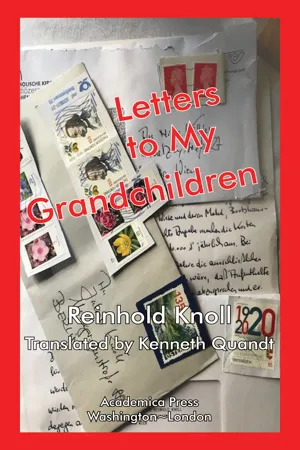
Distinguished Austrian sociologist Reinhold Knoll’s letters to his grandchildren, written daily during the Covid-19 pandemic, evolved into an obituary of European culture, politics, and society. They also embody a gesture of thanks to the United States, which took a different path from Europe and then saved it in World War I and World War II. Like Beethoven’s piano sonatas, some of Professor Knoll’s letters are light and humorous while others plumb the depths of the human psyche. But each brings the past into the present, often enhanced by Viennese ironic wit, with recondite and penetrating observations on enlightenment and revolution, art and music, social thought, the devolution of the museum, the status of the church, migration, fashions in pedagogy, and the role of technology in society. This is the remarkable work of a balanced conscience in troubled times. America owes most of its cultural and spiritual traditions to the erstwhile European stewardship of a legacy that goes back to Athens, Jerusalem, and Rome – the subject, verb, and predicate of our human story, – though Europe now finds itself in a crisis of confidence with profound warnings for the American reader.
- English
- ePUB (mobile friendly)
- Available on iOS & Android
eBook - ePub
Letters To My Grandchildren
About this book
Information
Table of contents
- Cover
- Title Page
- Copyright
- Table of Contents
- Foreword
- Apology of the Translator
- 1. The First Step in Science
- 2. How Knowledge Builds
- 3. The Reality of Nature and the Reality of Society
- 4. Fruitful Doubt
- 5. Politics and Philosophy
- 6. Between Marxism and Phenomenology
- 7. Consciousness a Creature of Technology
- 8. What is an Hypothesis?
- 9. What is a Theory?
- 10. A Plea for Humor
- 11. Politics and Philosophy Again
- 12. What is Luck?
- 13. Are We Still of Any Use?
- 14. Non schola sed vita discimus…
- 15. Who Teaches Us Human Rights?
- 16. A Sketch of Industrial Culture
- 17. Enlightenment in a Good Sense
- 18. Remembrance and Memory
- 19. Does a Theory of History Exist?
- 20. On Responsibility
- 21. Conceptions of Humanity
- 22. History as a Fantasy
- 23. What Can Empiricism Resolve?
- 24. Were the “Good Old Days” Good?
- 25. Signs of an End Time?
- 26. Shadows of Modernity
- 27. A Crisis of Credibility
- 28. On Language and Speaking
- 29. De amicitia
- 30. The Encounter with Painting
- 31. Who Determines our Social Abilities?
- 32. The Problem of Comprehensibility
- 33. Understanding History through Music
- 34. Portrait of an Aunt
- 35. Stories about Little Rascals
- 36. How History Influences Political Philosophy
- 37. What Does Architecture Tell Us?
- 38. The Old Relation between Art and Politics
- 39. State of Mind as a Virtue
- 40. Pedagogy Offsides
- 41. “Culture” as a Political Instrument
- 42. A Refusal to Look?
- 43. A View on the Sociology of Religion
- 44. Bruno Kreisky – Politics and Emotion
- 45. A Glimpse into My Life-World
- 46. Reconstruction of a Family
- 47. Cold Feet
- 48. Schools and Education Policy
- 49. Thoughts on Music
- 50. Is Social Integration Failing?
- 51. Sociology as a Department
- 52. The Fate of Language
- 53. Theater and Politics
- 54. From Cultural Competence to Knowledge
- 55. An Excursion through European History
- 56. You Can Always Resist!
- 57. Can a University be Reformed?
- 58. Science – the “Second Nature”
- 59. A Second Gift: Life
- 60. A Grotesque
- 61. Is Art Prophetic?
- 62. What is Consciousness?
- 63. … if I may start from myself …
- 64. Remarks on Beethoven
- 65. On Pitch, Sound, and Silence
- 66. What is To Be Painted?
- 67. Language between the Dyslexic and the Infantile
- 68. Christmas as Rebirth
- 69. Troubles with Technology
- 70. An Etymology of Peace
- 71. The Lodge: a Mysterious Organization
- 72. Does Information Change Anything?
- 73. Is It All Meaningless?
- 74. A Political Miscellany
- 75. What Can Be Known?
- 76. A Shock in Washington
- 77. On the End of Emperors and the Sultan
- 78. How Rare is Political Virtue?
- 79. Is There Social Politics After All?
- 80. Looking Back on a Lecture
- 81. Does our Present Have Historical Substance?
- 82. What Kind of a Present Do We Have?
- 83. Another Look at Vienna
- 84. How Prussia Became “Germany”
- 85. Social Reality in a Crime Novel
- 86. Are Crime Novels Frivolous?
- 87. Natura naturans, natura naturata
- 88. Why Property Cannot be Theft
- 89. The Political Message of Music
- 90. A Monument for Johann Strauss
- 91. Sociology as a Department in Decline
- 92. May One Be a Model Student?
- 93. Florence
- 94. The Return of Antiquity and the Gods
- 95. What Disappears with the Word “modern?”
- 96. What Does a “Fail” at School Mean?
- 97. The Messages of Music
- 98. Thoughts on the Biosphere
- 99. The Holy Landscapes: Jerusalem, Athens, and Rome
- 100. On Astonishment
- 101. “How happy it is still to be a child” – Albert Lortzing
- 102. What is Politics? Again
- 103. The Church’s Crisis is Also Our Crisis
- 104. On the University
- 105. On Reading
- 106. Hope Against Hopelessness
- 107. From Painting to Poetry
- 108. What is the Significance of Beauty?
- 109. The Calamity of Aesthetics
- 110. On the Question of Power
- 111. A Closing Cadence
- Afterword
- Index of Names and Family Tree
Trusted by 375,005 students
Access to over 1.5 million titles for a fair monthly price.
Study more efficiently using our study tools.
Frequently asked questions
Yes, you can cancel anytime from the Subscription tab in your account settings on the Perlego website. Your subscription will stay active until the end of your current billing period. Learn how to cancel your subscription
No, books cannot be downloaded as external files, such as PDFs, for use outside of Perlego. However, you can download books within the Perlego app for offline reading on mobile or tablet. Learn how to download books offline
Perlego offers two plans: Essential and Complete
- Essential is ideal for learners and professionals who enjoy exploring a wide range of subjects. Access the Essential Library with 800,000+ trusted titles and best-sellers across business, personal growth, and the humanities. Includes unlimited reading time and Standard Read Aloud voice.
- Complete: Perfect for advanced learners and researchers needing full, unrestricted access. Unlock 1.5M+ books across hundreds of subjects, including academic and specialized titles. The Complete Plan also includes advanced features like Premium Read Aloud and Research Assistant.
We are an online textbook subscription service, where you can get access to an entire online library for less than the price of a single book per month. With over 1.5 million books across 990+ topics, we’ve got you covered! Learn about our mission
Look out for the read-aloud symbol on your next book to see if you can listen to it. The read-aloud tool reads text aloud for you, highlighting the text as it is being read. You can pause it, speed it up and slow it down. Learn more about Read Aloud
Yes! You can use the Perlego app on both iOS and Android devices to read anytime, anywhere — even offline. Perfect for commutes or when you’re on the go.
Please note we cannot support devices running on iOS 13 and Android 7 or earlier. Learn more about using the app
Please note we cannot support devices running on iOS 13 and Android 7 or earlier. Learn more about using the app
Yes, you can access Letters To My Grandchildren by Reinhold Knoll, Kenneth Quandt in PDF and/or ePUB format, as well as other popular books in Politics & International Relations & Philosophy History & Theory. We have over 1.5 million books available in our catalogue for you to explore.