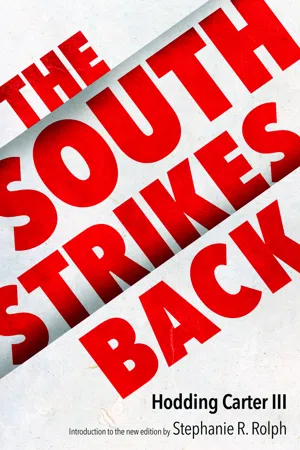
In The South Strikes Back, Hodding Carter III describes the birth of the white Citizens' Council in the Mississippi Delta and its spread throughout the South. Originally published in 1959, this book begins with a brief historical overview and traces the formation of the Council, its treatment of African Americans, and its impact on white communities, concluding with an analysis of the Council's future in Mississippi.
Through economic boycott, social pressure, and political influence, the Citizens' Council was able to subdue its opponents and dominate the communities in which it operated. Carter considers trends working against the Council—the federal government's efforts to improve voting rights for African Americans, economic growth within African American communities, and especially the fact that the Citizens' Council was founded on the defense of segregation's status quo and dedicated to its preservation. As Carter writes in the final chapter, "Defense of the status quo, as history has shown often enough, is an arduous task at best. When, in a democracy such as ours, it involves the repression of a minority, it becomes an impossibility."
- 194 pages
- English
- ePUB (mobile friendly)
- Available on iOS & Android
eBook - ePub
The South Strikes Back
About this book
Information
CHAPTER I
Background for Resistance
I think that since the Supreme Court decision segregation has become inevitable. The integrationists have aroused folks as they might never have been aroused otherwise. Through the 40s and early 50s most Southerners were apathetic, resigned to what they felt was inevitable. By raising an immediate target, the integrationists hurt themselves. In fact, I think the stupidest thing that was done was the wholesale onslaught by the integrationists on the whole area at one time…. By insisting on immediate integration everywhere, they sent a whole region up in arms. They should have nibbled slowly at the edges.—William Simmons, Editor, The Citizens Council
The decade from the conclusion of World War II to the Supreme Court desegregation decision of 1954 was in many ways a halcyon period for the exponents of gradualism in the handling of the South’s racial problems. The mass of white Southerners were opposed to any major, drastic change in the status of the Negro, as historically they had ever been; but there was nevertheless a growing measure of tolerance of those who sought to eliminate the more blatant forms of discrimination. This toleration existed only so long as the goals remained within the framework of segregation, but it was tolerance nonetheless. Perceptible throughout the South was a widening acceptance, in theory at least, of the concept that the “separate but equal” doctrine which had long been the region’s racial byword should be applied as strenuously toward providing equal facilities and opportunities as toward insuring that those facilities and opportunities should be separate.
This decade witnessed the eclipse, through death or retirement or defeat, of such notorious demagogues as Senator Theodore G. Bilbo and Congressman John Rankin, both of Mississippi, and Gene Talmadge of Georgia. While their political places were often taken by equally ardent defenders of segregation, the nation’s attention began shifting more and more to the men who fell under the loose classification of “Southern liberal,” a term which, while it took in many who were far more Southern than liberal, did include some whose starting point on all racial matters was 180 degrees to the left of the South’s gaudier former champions. Most, if not all, of these men were not politicians, but many of them reached further with their pens than the politicians had with their words.
It was during this decade also that the federal courts began the slow but thorough cutting away of many of the South’s and the nation’s Jim Crow laws governing in interstate travel, public housing, public transportation, and higher education. Each new ruling received the usual denunciation reserved for such “outside interference”; but with no effective organized opposition each was grudgingly accepted. It was an increasingly common event for the white Southerner to discover that a Negro was attending his state university’s graduate school or that Negroes were ordering meals in the white sections of railroad dining cars even south of Atlanta. Overt violence in such cases was exceedingly rare.
Increasingly also, the casual visitor to the South would hear from his hosts such pronouncements as, “Segregation will never end in my lifetime, of course, but my children will see its end”; or “I know that segregation is morally wrong, but I was brought up believing in it. Maybe my kids won’t be as prejudiced.” This was a new climate for the South, a mixture of passivity and troubled conscience, of acceptance of some changes and resignation to others, but it was one that many believed was growing stronger with each year.
More indications of this appeared than mere generalized expressions by isolated individuals. Tentative biracial groups were putting out more and more exploratory feelers each year, groping toward increased communication and understanding between the hitherto isolated islands of the white and colored community. State after Southern state outlawed the masked activities of the Ku Klux Klan as a seemingly final result of regional disenchantment with an organization which in the South of Reconstruction had been the symbol of its finest ideals. When other, often more vicious, hate organizations such as the Columbians multiplied immediately after the war, they were summarily broken by the massed opposition of Southern whites and their state governments. The “New South” was becoming something more than had been envisioned in the shadow of the post-Reconstruction period when Georgia’s eloquent Henry W. Grady had implanted the hopeful phrase in the minds of Yankee and onetime Rebel alike.
This was hardly the entire picture, however, nor was it the only one. The mores of an area do not die so suddenly as to be placed in any such rigid category or perspective by a contemporary chronicler. Enough resentment existed over the changes that were taking place or being attempted, no matter how gradually or minutely, to create a receptive climate for the abortive third-party movement of 1948. Four Southern states backed the presidential ticket of the States’ Rights party, the “Dixiecrats,” four states which left the confines of a party allegiance older than segregation itself. Defeat, foreordained or not, did not diminish either that resentment nor the collective wish for a suitable outlet for it.
Equalization of facilities, particularly in the public schools, was in most areas more a matter of intent than reality. It was with great reluctance that a Southern state legislature would allocate funds on anywhere near a 50–50 basis to white and Negro schools, the proportion more commonly being two or four to one in favor of the white schools. The four years prior to the Supreme Court’s desegregation decision saw a trend toward equality in allocations; but it was a trend prodded by the threat of just such a court action.
Rarely in the Deep South, as always, was a Negro’s murderer, if he was white, found guilty by his peers; and if he was convicted, the death penalty was even more rarely pronounced, no matter what the circumstances. On the other hand, crimes of black against white still met a swift and sure retribution. Lynch law, once a common phenomenon, was no longer practiced or condoned by the mass of Southern whites as it had once been, but there were still Negroes who found that the doors of their jails were conveniently open when the mob came.
Activist Negro groups, and especially the National Association for the Advancement of Colored People—the Negro organization most hated and feared by the Southern white—were certainly not willing to concede that much had been granted the Southern Negro. Progress within the confines of segregation was, by and large, no progress as far as they were concerned. In fact, the targets for the publicists and the orators of the NAACP were increasingly the “Southern liberals,” since, rightly or wrongly, that organization felt that these more sophisticated proponents of change within the pattern of segregation were the biggest obstacles to its eventual destruction. To those who wanted an immediate end to segregation, the Southern liberals were, as Lillian Smith named them, the “killers of the dream” of equality.
Such, then, was the South upon which the Supreme Court decision of May 1954 exploded, a region slowly groping its way out of the racial pattern of centuries, not fast enough for some, too fast for others. There was no immediate Southern public reaction to the decision save that of dazed stillness, no uniformity of comment from the politicians or the newspapers of the South. Some indulged in angry protests, others in calls for “study,” others took refuge in “no comment.” As in the aftermath of a war’s first engagement, there followed a period of hurried regrouping and hesitant probing of the enemy’s intentions.
Strangely enough, the one group which might best have used this temporary lull was the most inactive, the most silent body of all. The minority of the South’s population which had anticipated the Court’s decision included few of the leading Southern liberals. This was apparently true despite the fact that many of these same men and women had for years attacked the immorality of the South’s position and its untenability in the face of a democratic society’s demands. Suddenly, when a need arose for some kind of middle-ground action, there was none. “Acceptance” and “calm”; these were the two words heard most often from this group, but action was rapidly becoming the order of the day. For some reason there had been no planning by the middle of the roaders, but the activists on both right and left either already had, or soon did have, their plan of action.
Certainly calm was the one element least likely to prevail after the initial shock. The potential end of segregation in the schools meant to most white Southerners the beginning of integration in every aspect of life, social as well as academic. To argue otherwise was to argue alone. On this subject there was general agreement. This feeling was not made any less intense when the NAACP’s spokesmen announced that it proposed to press for the immediate implementation of the Court’s decision throughout the entire South. This announcement, coupled with the NAACP’s subsequent court actions and public pronouncements, united the entire white South as it had not been united since the Civil War.
This coming together was and is as real as it is unrealistic, combining as it does such diverse states as Virginia and Mississippi, as Texas and South Carolina, Alabama and Florida. But under the stress of a similar emotion such a unity had been established once before. As far as many white Southerners were concerned, the war had begun again, and the blanket salvos of the “outsiders” were reason enough for togetherness.
The pressure for unity came from outside the South. The precedent for it came from history. But the cement to hold it together once the first flaring of passion had subsided came from within. Lacking this cement, the Southern states might have gone their separate ways, each accommodating itself to the Court’s demands as best its citizens and leadership would allow. With this hardening element, however, almost the entire region was joined within the space of little more than a year in “massive resistance” to any integration whatsoever. The catalyst was supplied by a grassroots organization of Southern whites which named itself the Citizens’ Council.
From a tiny nucleus of men in the Yazoo-Mississippi Delta in the summer of 1954, the Citizens’ Council expanded into an areawide apparatus claiming some three hundred thousand members. From the single sheet throwaways of a duplicating machine, its propaganda effort expanded to include a newspaper, a regional television and radio show, and an army of speakers for any occasion from a school assembly to a Rotarians’ luncheon. Belying its “nonpolitical” beginning, its membership spread to include the legislative leaders and the legislative followers, the gubernatorial hopefuls and the governors, the senators and the mayors, of countless Southern states and towns. The strength of each state’s organization varied from Florida’s eight-thousand-member Council to Mississippi and Alabama’s eighty thousand plus, but in every state it made itself known.
With the rise of the Citizens’ Councils came the decline of the Southern liberal (or moderate, as the term evolved). The tenderly nurtured biracial commissions dried up in the heat of local hatred or suspicion. The moderate became first an isolated figure, then more and more the subject of comprehensive efforts to silence him. Just as in any area at war, the white South’s majority had no need or respect or tolerance for neighbors who did not believe wholeheartedly in its efforts. Those who spoke out in opposition were pasted with the labels of “traitor” and “nest-fouler,” “Red” and “n----r lover” and coveter of “Yankee dollars.” The device was greatly effective.
Throughout the South, state legislatures erected a hodgepodge of stopgap legal barriers to integration. Throughout the South the NAACP found itself under steadily increasing pressures, its membership declining or going underground, its name becoming a synonym for the enemy. Throughout the South the Supreme Court, scarcely less than the NAACP, was attacked as “Communist infiltrated,” criminal, or insane, its rulings labeled “unenforceable” or “laughable.” The century’s great crusade became in much of the white South the crusade for segregation and states’ rights, and at its head or nearby moved in nearly every state the Citizens’ Councils.
Too much credit or blame should not be given to any organization, especially a loosely knit one, for the mobilization of a region for concerted action. And the analysis by a native of his region’s actions may be suspect, perspective being often dimmed by too close proximity. Nevertheless, the fact remains that in the South the Citizens’ Council takes and merits most of the credit for whatever success massive resistance, with all its implications, has had; and there is little or no disposition by anyone, politician or not, to argue the point. Certainly this assumption of responsibility is valid in Mississippi; and it is with Mississippi’s progenitive Citizens’ Councils that the remainder of this study is concerned.
Such a drastic narrowing of the subject matter may be objected to on a number of grounds. But there are other factors which favor an especial examination of Mississippi’s Councils. The first, which contains something of a contradiction, is that the story of the Mississippi phenomenon contains elements of an examination of the entire region. This is true because the movement was begun in Mississippi, was spread from Mississippi by Mississippians, and is still controlled to significant extent from Mississippi.
The second factor is that Mississippi’s Citizens’ Council presents the important features of the Councils of each of the other Southern states, but in far stronger form than any other state organization can boast. It is at once the biggest, the most tightly organized, and the most powerful Citizens’ Council of them all.
The third and last factor favoring such a localized study is that Mississippi itself, as a state, is a classic representative of the Deep South. In tradition, in tribulation, in present activity, in ambition, and in future possibilities, Mississippi is the Deep South, and the presence and activity of the Citizens’ Councils within such an environment can be interpreted in more general terms than those simply of Mississippi.
CHAPTER II
The Councils Form
This is no time to be calm. We have been as docile as the Asinus while our head is being thrust into the yoke. If in one mighty voice we do not protest this travesty on justice, we might as well surrender. The Supreme Court awaits our reaction. Be deliberate, yes, but not calm. Be determined, yes, but not impulsive. Be resolute, yes, but not violent.—Judge Tom P. Brady, Black Monday
The school decision of May 17, 1954, declaring racial segregation unconstitutional in public schools, did not come as a surprise to the political leaders of Mississippi, no matter how it may have affected the mass of the state’s citizens. In the year prior to the decision the state legislature had taken several definite steps either to influence the Court’s decision or to circumvent any ruling unfavorable to the continuation of racial segregation in the public school system. The first such action had come in a special session of the legislature in November–December 1953, when an “equalization” program for the public schools was enacted calling for equal salaries for white and Negro teachers, and equal transportation, equal buildings, and equal school opportunities for all the state’s children, white or black. The program was not to go in effect, however, until after the anticipated Supreme Court decision was handed down and unless it was favorable to the state’s position on continued separation of the races. There were neither to be funds allotted nor bonds issued for the program unless such a “favorable” decision was given.
Later, in the legislature’s regular session in early 1954, the lawmakers came up with additional safeguards against what was anticipated by many to be an inevitably unfavorable decision by the Court. First, rather than provide enough funds for the public schools to operate for a full two years, the legislature appropriated only enough money for the 1954–55 school session. The representatives reasoned that they would have to be called into session again after the decision to provide the estimated $18 million which would be needed for the schools’ operations in 1955–56, and that at such a time a program could be worked out to meet any problems created by the Supreme Court decision. They apparently decided that this was the only sure way to insure their being reconvened before the next regular session in 1956.
As a second and equally important step during the 1954 regular session, the legislature established the Legal Education Advisory Committee. This committee would, the bill said, “formulate a plan or plans of legislation, prepare drafts of suggested laws, and recommend course of action for consideration whereby the states may, by taxation or otherwise, provide education and/or assistance for all its citizens consistent with the provisions of the constitution of the United States and constitution of the state of Mississippi.”
This bill was offered to the legislature by Speaker of the House Walter Sillers, one of the most powerful politicians of the state and later, whether or not a member, a chief spokesman for the Citizen’s Councils in the House. The LEAC was established, the bill continued, since “in order to preserve and promote the best interest of both races and the public welfare, it is necessary to maintain separate education and separate schools for the white and colored races.”
Before the legislature adjourned, it passed one other important bill, this one placing a constitutional amendment before the people in November 1954. The amendment was designed to tighten voting qualifications, and it passed without much opposition. The legislature then adjourned, and Mississippi awaited the Court’s ruling.
Mississippi was a state which had traditionally held strongly to both the theory and practice of segregation, and in which ramifications of that practice had reached into almost every aspect of life. With the highest proportion of Negroes to white of any state—some 45.4 in the 1950 census—and the lowest number of Negro voters in any Southern state—twenty-two thousand in the 1952 presidential election—the patterns of racial segregation seemed as secure in 1954 as they had in 1900. Only a year or so before 1954 had the “separate but equal” clause in the state constitution even begun t...
Table of contents
- Cover Page
- Title Page
- Copyright
- Dedication
- Contents
- Introduction to the New Edition
- Chapter I: Background for Resistance
- Chapter II: The Councils Form
- Chapter III: The Citizens’ Councils and Mississippi Politics (1955–58)
- Chapter IV: The Citizens’ Councils and the Negro
- Chapter V: The Citizens’ Councils and Conformity in the White Community
- Chapter VI: The Future of the Citizens’ Councils in Mississippi
- About the Author
- About the Contributor
Trusted by 375,005 students
Access to over 1.5 million titles for a fair monthly price.
Study more efficiently using our study tools.
Frequently asked questions
Yes, you can cancel anytime from the Subscription tab in your account settings on the Perlego website. Your subscription will stay active until the end of your current billing period. Learn how to cancel your subscription
No, books cannot be downloaded as external files, such as PDFs, for use outside of Perlego. However, you can download books within the Perlego app for offline reading on mobile or tablet. Learn how to download books offline
We are an online textbook subscription service, where you can get access to an entire online library for less than the price of a single book per month. With over 1.5 million books across 990+ topics, we’ve got you covered! Learn about our mission
Look out for the read-aloud symbol on your next book to see if you can listen to it. The read-aloud tool reads text aloud for you, highlighting the text as it is being read. You can pause it, speed it up and slow it down. Learn more about Read Aloud
Yes! You can use the Perlego app on both iOS and Android devices to read anytime, anywhere — even offline. Perfect for commutes or when you’re on the go.
Please note we cannot support devices running on iOS 13 and Android 7 or earlier. Learn more about using the app
Please note we cannot support devices running on iOS 13 and Android 7 or earlier. Learn more about using the app
Yes, you can access The South Strikes Back by Hodding Carter III in PDF and/or ePUB format, as well as other popular books in History & North American History. We have over 1.5 million books available in our catalogue for you to explore.