eBook - ePub
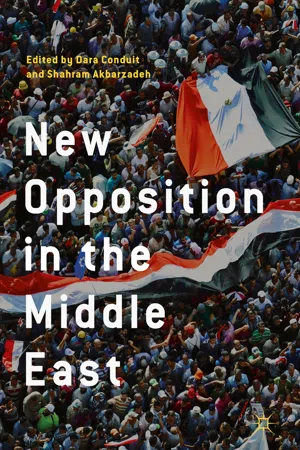
New Opposition in the Middle East
- English
- ePUB (mobile friendly)
- Available on iOS & Android
eBook - ePub
New Opposition in the Middle East
About this book
This book uses a Contentious Politics lens to examine patterns of contestation since 2009 and 2011 among the Middle East's most important opposition actors. The volume is comprised of seven chapters that ask questions in relation to the responsiveness of opposition groups to their political environments, the long-term legacies of authoritarianism, and whether the post-2009/2011 political environment is better or worse for Middle Eastern oppositions. It interrogates the ways in which oppositions have morphed in relation to this changed operating environment, subjectively interpreting the costs and benefits of contestation in order to maximise political opportunities. To some oppositions, changes in the power balance between regime structures and opposition agents led to unprecedented opportunity for political action, while for others, structures were galvanised to restrict opposition activities. In total, the volume shows that even though the Arab Uprisings and Green Movement achieved few of their overt goals, the events unleashed smaller shifts across the region that have led to a fundamental change in the politics of contestation amongst the region's oppositions. These patterns echo experiences in other parts of the world, including the coloured revolutions in post-Soviet states, and the political environment in Chile after Pinochet.
Information
© The Author(s) 2018
Dara Conduit and Shahram Akbarzadeh (eds.)New Opposition in the Middle Easthttps://doi.org/10.1007/978-981-10-8821-6_11. Contentious Politics and Middle Eastern Oppositions After the Uprisings
Dara Conduit1 and Shahram Akbarzadeh1
(1)
Middle East Studies Forum, Alfred Deakin Institute for Citizenship and Globalisation, Deakin University, Burwood, VIC, Australia
Keywords
Arab SpringArab UprisingsGreen MovementReform movementAuthoritarianismThe Middle East is no stranger to political contestation. Although an outpost of authoritarianism throughout the twentieth century, oppositions in the Middle East existed as tolerated ‘regime-loyal’ coalitions such as the National Progressive Front in Syria, through popular ‘anti-system’ movements seen in those who overthrew the Shah’s regime in Iran in 1979, and in the form of the ‘semi-tolerated’ opposition groups that contested elections despite no chance of winning power such as the Muslim Brotherhood in Egypt.1 These patterns provided a rich set of case studies for scholars of Contentious Politics, who noted structures and repertoires of contestation unique to illiberal political environments around the world.2 However, the Middle East underwent a seismic shift following the outbreak of the 2009 Iranian Green Movement protests and the 2011 Arab Uprisings, which recast the boundaries of the relationships between rulers and the ruled across the region.
The June 2009 Iranian presidential election represented a seminal moment in Iran’s post-revolution history. Following a closely contested campaign between the hard-line incumbent Mahmoud Ahmadinejad and the reformist Mir Hossein Mousavi, Iran’s state news agency announced that Ahmadinejad had won in a landslide result. The following day, hundreds of thousands of protesters took to the street in support of Mousavi with the simple but powerful slogan, ‘Where is my vote?,’ marking the formation of the Green Movement.3 The protests continued at key junctures over the following six months, at their peak drawing more than three million people onto the streets. The movement did not succeed, with the Iranian regime brutally cracking down on peaceful protesters and arresting the movement’s leaders. Nonetheless, the events had a significant impact on the politics of contention in Iran, redrawing the lines of political activity in the Republic. The regime’s renewed authoritarianism, and particularly its crackdown on Internet activity in Iran, led to a shrinking of the Iranian opposition’s political space.4 Simultaneously, the regime’s new sensitivity to public opinion—particularly around the question of elections—provided limited new political openings for opposition members.
The following year, broad-based protests broke out across the Arab Middle East. In December 2010, the Tunisian fruit seller Mohamed Bouazizi self-immolated in protest to local government corruption and shrinking economic opportunities. This single act prompted large-scale protests across Tunisia which eventually felled the country’s long-reigning leader Zine el-Abidine Ben Ali. Bouazizi’s grievances and the messages of the Tunisian uprising resonated deeply across the region. Within weeks, Egypt’s long-term President Mohamed Mubarak was overthrown, and protests spread to Yemen, Bahrain, Libya and Syria. This provided a once-in-a-lifetime political opening across many Middle Eastern states. Although few of the Arab Spring’s overt goals were achieved, the sudden shift in political opportunity structures has seen the emergence of new patterns of opposition across the Arab world.
In many ways, therefore, the Iranian Green Movement and the Arab Uprisings changed the nature of opposition in the Middle East. Providing a once-in-a-lifetime opportunity for political change, the events created new openings and barriers to opposition. This volume examines the nature of this shift over seven case studies from a Contentious Politics perspective, interrogating the ways in which oppositions have morphed in relation to their changed operating environments. Contentious Politics offers an important framework for understanding these shifts because it views regimes and opposition movements under the one conceptual umbrella, highlighting the symbiotic relationship between the two ostensibly separate forces. Although it does not view all regime or opposition behaviour as the product of structure or agency, it highlights the important ways in which the two sets of actors co-exist, survive and push boundaries.
This edited volume therefore asks questions such as: To what extent is opposition behaviour in the Middle East a product of its political environment? What sort of limitations have environments imposed on movements? How have groups used the political opportunities that emerged after 2009/2011? Did international actors shape the dynamics of contestation? And is the post-2009/2011 environment better or worse for Middle Eastern oppositions? In answering these questions, the chapters show that the Arab Spring and the Green Movement unleashed small shifts across the region that have led to a fundamental change in the politics of contestation. As Dabashi observed of Iran, ‘No country can “go back to business as usual.” The climate has changed—for good.’5
Contesting Authoritarianism Before the Green Movement and the Arab Spring
Scholars of Contentious Politics have made a significant contribution to understanding the Middle East through their extensive work on the existence and nature of political contestation under authoritarianism. To McAdam, Tilly and Tarrow, Contentious Politics involved:
Episodic, public, collective interaction among makers of claims and their objects when (a) at least one government is a claimant, an object of claims, or a party to the claims and (b) the claims would, if realized, affect the interest of at least one of the claimants.6
The process of collective political contestation can be undertaken by non-violent groups, networks or social movements and can span violent or non-violent opposition under authoritarianism, democratic or community politics. Tarrow goes so far as to argue that even civil wars should be considered as part of the ‘larger episodes of contention from which they emerge and to which they may eventually give way.’7 The study of Contentious Politics therefore observes the way contestation occurs, including the repertoires of contestation that actors use, the regimes in which they exist and the political opportunity structures that shape operating environments in and beyond the Middle East.8 The model has also enjoyed considerable application outside authoritarian climates, through scholars examining right-wing global politics, indigenous rights movements in Mexico, political contestation in rural China and social movements during periods of crisis.9
Most opposition movements in the Middle East prior to 2009–2011 fell into the category of opposition groups under authoritarian regimes. Although significant political differences exist between the states, most countries in the Middle East exhibited some authoritarian characteristics. According to Linz:
Authoritarian regimes are political systems with limited, not responsible, political pluralism … without intensive nor extensive political mobilization … and in which a leader (or occasionally a small group) exercises power within formally ill-defined limits but actually quite predictable ones.10
Albrecht suggested that oppositions under authoritarianism fit into three distinct categories : ‘regime-loyal opposition,’ ‘tolerated opposition’ and ‘anti-system opposition,’ although at times the distinction between the three is not clear-cut.11 Oppositions can also occupy different spaces at different times. A group may be non-violent in one period and violent in another, while other groups in the Middle East such as Hezbollah simultaneously possess both violent and non-violent wings. Although this may be a survival tactic, it often leaves groups vulnerable to state repression because of the perceived duplicity.
Not all opposition types exist in every state, but the presence of regime-loyal and tolerated oppositions in otherwise authoritarian states such as Egypt, Jordan and Morocco prompted authors to consider whether opposition groups h...
Table of contents
- Cover
- Front Matter
- 1. Contentious Politics and Middle Eastern Oppositions After the Uprisings
- 2. The Women’s Movement and State Responses to Contentious Campaigns in Iran
- 3. Pulling and Gouging: The Sadrist Line’s Adaptable and Evolving Repertoire of Contention
- 4. Opposition Party Political Dynamics in Egypt from the 2011 Revolution to Sisi
- 5. The Rise and Fall of Bahrain’s Al-Wefaq Society: De-democratisation and Crackdown in a Troubled Gulf State
- 6. The Iranian Reform Movement Since 2009
- 7. Surviving the Syrian Uprising: The Syrian Muslim Brotherhood
- 8. Nahda and Tunisian Islamic Activism
- 9. Conclusion
- Back Matter
Trusted by 375,005 students
Access to over 1.5 million titles for a fair monthly price.
Study more efficiently using our study tools.
Frequently asked questions
Yes, you can cancel anytime from the Subscription tab in your account settings on the Perlego website. Your subscription will stay active until the end of your current billing period. Learn how to cancel your subscription
No, books cannot be downloaded as external files, such as PDFs, for use outside of Perlego. However, you can download books within the Perlego app for offline reading on mobile or tablet. Learn how to download books offline
Perlego offers two plans: Essential and Complete
- Essential is ideal for learners and professionals who enjoy exploring a wide range of subjects. Access the Essential Library with 800,000+ trusted titles and best-sellers across business, personal growth, and the humanities. Includes unlimited reading time and Standard Read Aloud voice.
- Complete: Perfect for advanced learners and researchers needing full, unrestricted access. Unlock 1.5M+ books across hundreds of subjects, including academic and specialized titles. The Complete Plan also includes advanced features like Premium Read Aloud and Research Assistant.
We are an online textbook subscription service, where you can get access to an entire online library for less than the price of a single book per month. With over 1.5 million books across 990+ topics, we’ve got you covered! Learn about our mission
Look out for the read-aloud symbol on your next book to see if you can listen to it. The read-aloud tool reads text aloud for you, highlighting the text as it is being read. You can pause it, speed it up and slow it down. Learn more about Read Aloud
Yes! You can use the Perlego app on both iOS and Android devices to read anytime, anywhere — even offline. Perfect for commutes or when you’re on the go.
Please note we cannot support devices running on iOS 13 and Android 7 or earlier. Learn more about using the app
Please note we cannot support devices running on iOS 13 and Android 7 or earlier. Learn more about using the app
Yes, you can access New Opposition in the Middle East by Dara Conduit, Shahram Akbarzadeh, Dara Conduit,Shahram Akbarzadeh in PDF and/or ePUB format, as well as other popular books in Politics & International Relations & Middle Eastern Politics. We have over 1.5 million books available in our catalogue for you to explore.