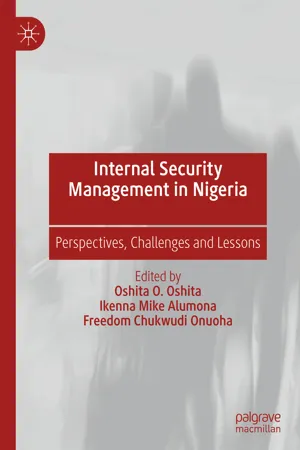
This book explores the disturbing dimensions of the problem of insecurity in Nigeria, such as herdsmen violence, the Boko Haram insurgency, cybercrime, militancy in the Niger Delta, communal conflict and violence, as well as police corruption. It offers a comprehensive discussion of the theoretical foundations of internal security, the threats to internal security, the role of formal and informal agencies in internal security management and the challenges of internal security management.
eBook - ePub
Internal Security Management in Nigeria
Perspectives, Challenges and Lessons
- English
- ePUB (mobile friendly)
- Available on iOS & Android
eBook - ePub
Internal Security Management in Nigeria
Perspectives, Challenges and Lessons
About this book
Information
© The Author(s) 2019
Oshita O. Oshita, Ikenna Mike Alumona and Freedom Chukwudi Onuoha (eds.)Internal Security Management in Nigeriahttps://doi.org/10.1007/978-981-13-8215-4_11. Introduction: Understanding the Crisis of Internal Security Management in Nigeria
Ikenna Mike Alumona1 , Oshita O. Oshita2 and Freedom Chukwudi Onuoha3
(1)
Department of Political Science, Chukwuemeka Odumegwu Ojukwu University, Igbariam, Nigeria
(2)
Institute for Peace and Conflict Resolution, Abuja, Nigeria
(3)
Department of Political Science, University of Nigeria, Nsukka, Nsukka, Nigeria
Ikenna Mike Alumona (Corresponding author)
Oshita O. Oshita
Freedom Chukwudi Onuoha
Rationale for the Study
Internal security management has taken a centre stage in political and academic discourses, particularly after the September 11, 2001 attacks on the World Trade Center and the Pentagon in the United States. It was the 9/11 attacks in the United States, together with similar attacks such as the one in Istanbul on November 15, 2001 and the Madrid train bombing in Spain on March 11, 2004 that brought to fore the need for states to reinforce their internal security mechanisms to meet up with the challenge of protecting citizens and other nationals living within their territorial boundaries. The resultant effect of these global indices of insecurity is that in contemporary international politics, the ability of a state to ensure adequate security has become a principal variable in measuring the success or failure of the state. Thus, state failure is associated with countries that have lost control over the instruments of security maintenance.
On the other hand, states have begun to redesign the architecture of their internal security network in order to forestall occurrence of threats of global dimensions. For example, the United States passed into law the Homeland Security Act on November 25, 2002. The act which now combined the efforts, authorities and powers of 22 different federal departments and agencies into a single and unified entity called the US Department of Homeland Security, also created the position of the Secretary of Homeland Security (U.S Department of State Archive 2002).
In the African context, the nature of insecurity has been worrisome. According to the 2017 report of the State of Peace and Security in Africa, in 2016, a total of 17,539 violent events took place in the continent. A total of 8050 conflict-related fatalities and 5098 migrant deaths were also recorded. The continent has also recorded progress in the use of African-centred solutions in managing armed conflict and insecurity (Institute for Peace and Security Studies 2017). The insecurity situation in Africa as argued by Nnoli (2006) points to the collapsed character of the state which is caused by the factors of political exclusion, economic marginalisation and social discrimination as the most serious impediment to security. As a result of this, much has not been achieved in terms of redesigning the security architecture of most African states because most of them are engrossed in the struggle for survival.
Nigeria exemplifies the insecurity situation in the African continent. Admittedly, the rising concern about insecurity cannot be explained outside the numerous terrorist attacks by the Boko Haram and other similar sects, the litany of kidnappings, increasing crime rate, the emerging culture of violence perpetuated by legal and illegal revenue collectors, youth militancy and cultism, the herdsmen-farmers conflict and other factors of insecurity that have been a regular feature of life in the country. Against the reoccurring incidents of these factors of insecurity and the continued reassurance of the Nigerian government to control the situation, there is widespread doubt about the capability of the Nigerian government to provide adequate security for her citizens and others living within its territorial boundaries. The implications of this include loss of confidence in the state, decline in foreign direct investment and the “privatisation” of security as increasing number of people and corporate organisations are now relying more on nongovernmental security operatives for their safety (Abrahamsen and Williams 2006; Adesegun and Olumide 2015).
At the heart of the internal insecurity crisis in Nigeria are two critical issues. First, is the seeming inability of the state to meet up with the challenges of internal security management. Since the return of democracy in 1999, Nigerians have witnessed, on a daily basis, an upsurge of factors of insecurity that threaten their peaceful coexistence despite the assurances of the government to ensure their safety and bring to justice the perpetrators of various heinous crimes. Equally linked to this problem is that while there appears to be enough agencies that are meant to take care of the country’s security, there is still clamour for the creation of new ones such as the Nigerian Peace Corps whose enabling law the President has refused to assent to.
Secondly and as a corollary of the above, is the increasing participation of armed non-state actors such as vigilante groups, hunters, private security companies and ethnic militias in the provision of security. This has become so pervasive and is gradually eroding the monopoly of the coercive powers of the state. Fraught with its own challenges, the involvement of armed non-state actors has itself been identified as a trigger of insecurity. Evidences abound of situations where these non-state actors have used their arms against ordinary citizens. The seeming inability of the state to provide adequate regulation and supervision of the activities of these armed non-state actors is equally disturbing. These developments have cast some doubts on the veracity of the long-held view that the state is the sole guarantor of peace and security. In fact, to the discerning mind, the architecture of internal security and its management in Nigeria is bedevilled with a lot of disturbing questions that are in need of urgent answers.
It is against this background that this book focuses on a critical examination of the issues, perspectives and challenges in the management of Nigeria’s internal security architecture. The book basically seeks to examine the causes, nature and dynamics of insecurity in a fledging democratic environment. This has become necessary because across various epochs, the continued existence of the Nigerian state has been more threatened by internal security challenges than external ones. More importantly, the hope that attended the restoration of democratic governance in May 1999 after 26 years of military rule appears to have placed the burden of solving Nigeria’s internal security crisis on the dynamics of democratic governance and practice. Unfortunately, the expectations have been dashed as the increasing nature of insecurity of lives and property has remained the greatest threat to democracy in Nigeria. Okoye and Alumona (2014) have tried to underscore the nexus between the practice of democracy and the challenges of internal security in Nigeria. They rightly assert that “despite the restoration of civil rule in Nigeria more than a decade ago, the Nigerian people have not been provided security of life and property as part of the dividends of democracy that the leaders often flaunt” (Okoye and Alumona 2014, p. 195). In many ways, the character and dynamics of democratic politics appear to be fuelling the insecurity problem. The level of violence that has manifested in the interplay of power and forces since 1999 leaves much to be desired. The struggle for power among the political elites has remained a “do or die” affair as a good number of the elites have lost their lives in the struggle for power and control. The conduct of the political parties and the key political actors involved in the political process has not contributed to the process of democratic consolidation (Adejumobi and Kehinde 2007).
The worrisome character of internal insecurity and the dynamics of its management have for some time commanded the attention and tasked the energies of various scholars. The research efforts of these scholars have been exposed in the different publications that seek to examine the nature, character and dynamics of internal security management in Nigeria. Among such scholarly works are Dapo Adelugba and Phillip Ogo Ujomu, Rethinking Security in Nigeria: Conceptual issues in the quest for social order and national integration, 2008; Ozoemenam Mbachu and Umar M. Bature, Internal security management in Nigeria: A study in terrorism and counter terrorism, 2013; Ozoemenam Mbachu and Chukwudi Mayor Eze, Democracy and National security in Nigeria: Issues, challenges and prospects, 2009; John Adewale Abolurin, Nigeria’s National Security: Issues and Challenges, 2011; Isaac Olawale Albert, Willie Aziegbe Eselebor and Nathaniel Danjibo, Peace, Security and Development in Nigeria, 2012; Okwudiba Nnoli, Democracy and National security in Nigeria, 2013; and Nwolise, O.B.C., Is physical security alone enough for the survival, progress and happiness of man, 2013.
This present volume complements the existing scholarly works on the subject matter. However, it moves beyond them to offer a comprehensive discussion of the theoretical foundations of internal security, the threats to internal security, the role of formal and informal agencies in internal security management and the challenges of internal security management in Nigeria.
Structure of the Book and Overview of Chapters
This book, Internal Security Management in Nigeria: Perspectives, challenges and lessons, was initiated as a modest contribution of the editors and contributors towards solving the crisis of internal security in Nigeria. Specifically, the book critically explores some salient issues, perspectives and challenges that have tended to challenge the foundations of the internal security management paradigm in Nigeria. In addressing these concerns, the book has 30 chapters spread across four parts. In the introduction, the editors, Oshita O. Oshita, Ikenna Alumona and Freedom Onuoha basically set the tone of the analyses, justified the focus of the study and briefly highlighted the discourses about the internal security management in Nigeria.
The first part of the book sets out to examine the theoretical and practical nexus between the state and security management. The part contains three chapters. The first, by Oshita O. Oshita and Augustine Ikelegbe, interrogates internal security management as a legitimate human interest and an aspect of the broad concept of security governance. Drawing from the theoretical framing of issues in internal security management in Nigeria, the authors basically explore how the mix of historical and structural factors, together with governance, legislation, actors, drivers, dynamics and capabilities of stakeholders, has impacted on the efficacy or otherwise of the internal security sub-sector. The chapter provides a historical insight into the many challenges of internal security management and argues that outside the nature of management of internal security by the security agencies and the conduct of security personnel, which have alienated them from the ordinary citizens, interference by the political class in the management processes in the security sector has remained the greatest challenge to ensuring adequate security provisioning.
In the second chapter of the part, Ikenna Mike Alumona reflects on the theoretical nexus between the state and security management. He begins by contextualising the essence of the state which many authorities have acknowledged to be the provision of security and welfare for the citizens. He makes the point that since the state is an abstract entity that cannot be seen nor touched, the responsibilities of the state are exercised by the government. Thus, the government in the final analysis through the processes of governance takes responsibility of providing security and welfare. As he argued, “since it is in the processes of governance that state structures or institutions do perform the essential function of security maintenance, the relationship between governance and security cannot be ignored”. In the final substantive part of the chapter, Alumona critically engages with the debate about the state of internal security and offers explanations for understanding the crisis of internal security in Nigeria. The chapter is premised on the thesis that the dysfunctionality of Nigeria’s federal system, which is a product of the post-colonial character of the Nigerian state, has resulted in the politicisation of security structures and governance processes involved in security management. This in turn has negatively aggravated and sustained insecurity in the country. In the last chapter of Part 1, Rosemary Okolie-Osemene provides a historical discourse of internal security challenges in Nigeria since 1999 when the country returned to democratic governance. The author outlines the various factors of internal insecurity since 1999 and argues that the democratic dispensation has not abated internal security threats because most security agencies have either become victims of insecurity or faced criticism from the masses because of the capacity of non-state actors to overrun some communities and towns.
The second part of the book, which features 13 chapters, outlines and critically discusses the many dimensions of internal security threats in Nigeria. There is no doubt that Nigeria is in the throes of a major internal security crisis. On a daily basis, the national dailies are awash with reports of the horrifying incidents of internal threats to lives and property. The internal insecurity crisis is denoted by two major features, namely the increasing frequency of factors of insecurity and the changing character and dynamics of their manifestations. While some of the manifestations of the insecurity have a national character, different geopolitical zones have been plagued by a specific form of insecurity or another. On the whole, the rising level of insecurity has much left to be desired. Nigerians have lost count of the number of attacks by the dreaded Boko Haram and other similar sects and the value of life and property involved. On the other hand, the havoc caused by the Fulani herdsmen in many cases appears to have outweighed the impact of the Boko Haram menace. In another dimension, while the phenomenon of the kidnapping appears to be going down, the emerging culture of violence perpetuated by legal and illegal revenue collectors in many urban cities is becoming a serious matter of concern.
Francis Chigozie Chilaka and Ikechukwu Idika open the part with an examination of the menace of Boko Haram in Northern Nigeria. They trace the origin of the formation of the Boko Haram sect and argue that in order to downgrade the sect considerably and recapture outstanding territories from the group, efforts should be made to deepen intelligence sharing with other regional military forces because evidence abound that Boko Haram operate more effectively along borders in Northern Nigeria. This is followed by Jude Odigbo, who looks at the security implications of the conflict between the Fulani herdsmen and rural farmers in the different parts of the country. From another dimension, Al Chukwuma Okoli and Onyekachi Ernest Nnabuihe, using the central region as a focal point of analysis, re-examine the phenomenon of communal conflicts in Nigeria. They contend that the existing knowledge about communal conflicts which generally attributes its cause to the dialectics of identity politics and ethno-religious convolutions is not completely correct. Within the context of the political ecology perspective, the authors basically try to explain how in reality primordial social and cultural factors serve as veritable fault lines for harbouring communal conflicts. This is particularly true when these communal conflicts are accorded strategic partisan attention through the political manipulation of the elites who are basically after their own interest.
The Niger Delta region is another hotspot in the crisis of insecurity in Nigeria. The nature and character of oil politics in the region has resulted in a legion of problems such as environmental degradation, kidnapping, destruction of oil facilities, oil theft, youth militancy and so on. Of all the problems created by the politics of oil exploitation and the distribution of oil wealth, none has threatened the stability of Nigerian economy as the phenomenon of youth militancy in the Niger Delta. In this regard, Ernest Tooch Aniche examines the phenomenon of youth militancy in Niger Delta. He provides a historical sketch of youth militancy in the region and also looks at the nature, methods and drivers of youth militancy. He argues that years of environmental degradation and total neglect in the Niger Delta region led to the emergence of many youth organisations that subsequently took to militancy as a bargaining tool to get a fair share in the distribution of oil revenue. He concludes that unless attention is paid to constitutional reforms that will ensure adequate distribution of oil revenue, the problem of youth militancy will continue to be a feature of politics in the region.
In a related vein, Cornelius Ozeh and Chukwuemeka Ohajionu explore the link between unemployment, migration and cyber criminality. They argue that the alarming rate of unemployment and underemployment has significantly contributed to cyber-criminality in Nigeria despite the existence of extant laws to address cybercrimes in the country. Relying on the analytical framework of McClelland’s Needs theory, they further reveal that the motivation to satisfy needs for achievement, affiliation and power, which could not be satisfied due to unemployment or underemployment, remains the propelling force for the intimidating level of cyber-criminality in Nigeria. Thus, they recommend value reorientation, job creation and the implementation of the letters and spirits of the laws against cyber-criminality as the solutions to the problem which already has battered the image of Nigeria in the international scene. Ikenna Mike Alumona and Kingsley Onwuanabile shift attention to the close and complex connection between the environment and human security. They explore the nature and character of environmental insecurity in Nigeria. They further highlight the efforts of government towards ensuring a safe and clean environment starting with the promulgation of the Federal Environmental Protecti...
Table of contents
- Cover
- Front Matter
- 1. Introduction: Understanding the Crisis of Internal Security Management in Nigeria
- Part I. Theoretical Perspectives
- Part II. Threats to Internal Security in Nigeria
- Part III. Formal and Informal Agencies and the Management of Internal Security in Nigeria
- Part IV. Challenges of Internal Security Management in Nigeria
Trusted by 375,005 students
Access to over 1.5 million titles for a fair monthly price.
Study more efficiently using our study tools.
Frequently asked questions
Yes, you can cancel anytime from the Subscription tab in your account settings on the Perlego website. Your subscription will stay active until the end of your current billing period. Learn how to cancel your subscription
No, books cannot be downloaded as external files, such as PDFs, for use outside of Perlego. However, you can download books within the Perlego app for offline reading on mobile or tablet. Learn how to download books offline
Perlego offers two plans: Essential and Complete
- Essential is ideal for learners and professionals who enjoy exploring a wide range of subjects. Access the Essential Library with 800,000+ trusted titles and best-sellers across business, personal growth, and the humanities. Includes unlimited reading time and Standard Read Aloud voice.
- Complete: Perfect for advanced learners and researchers needing full, unrestricted access. Unlock 1.5M+ books across hundreds of subjects, including academic and specialized titles. The Complete Plan also includes advanced features like Premium Read Aloud and Research Assistant.
We are an online textbook subscription service, where you can get access to an entire online library for less than the price of a single book per month. With over 1.5 million books across 990+ topics, we’ve got you covered! Learn about our mission
Look out for the read-aloud symbol on your next book to see if you can listen to it. The read-aloud tool reads text aloud for you, highlighting the text as it is being read. You can pause it, speed it up and slow it down. Learn more about Read Aloud
Yes! You can use the Perlego app on both iOS and Android devices to read anytime, anywhere — even offline. Perfect for commutes or when you’re on the go.
Please note we cannot support devices running on iOS 13 and Android 7 or earlier. Learn more about using the app
Please note we cannot support devices running on iOS 13 and Android 7 or earlier. Learn more about using the app
Yes, you can access Internal Security Management in Nigeria by Oshita O. Oshita, Ikenna Mike Alumona, Freedom Chukwudi Onuoha, Oshita O. Oshita,Ikenna Mike Alumona,Freedom Chukwudi Onuoha in PDF and/or ePUB format, as well as other popular books in Business & International Business. We have over 1.5 million books available in our catalogue for you to explore.