This volume explores how Catholicism began and continues to open its doors to the wider world and to other confessions in embracing ecumenism, thanks to the vision and legacy of the Second Vatican Council. It explores such themes as the twentieth century context preceding the council; parallels between Vatican II and previous councils; its distinctively pastoral character; the legacy of the council in relation to issues such as church-world dynamics, as well as to ethics, social justice, economic activity. Several chapters discuss the role of women in the church before, during, and since the council. Others discern inculturation in relation to Vatican II. The book also contains a wide and original range of ecumenical considerations of the council, including by and in relation to Free Church, Reformed, Orthodox, and Anglican perspectives. Finally, it considers the Council's ongoing promise and remaining challenges with regard to ecumenical issues, including a groundbreaking essay on the future of ecumenical dialogue by Cardinal Walter Kasper.
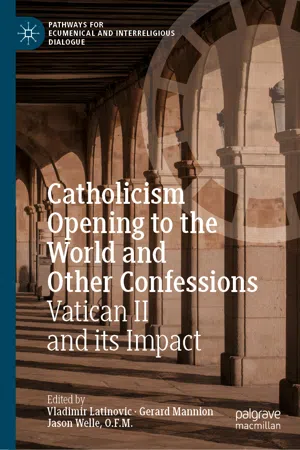
eBook - ePub
Catholicism Opening to the World and Other Confessions
Vatican II and its Impact
- English
- ePUB (mobile friendly)
- Available on iOS & Android
eBook - ePub
Catholicism Opening to the World and Other Confessions
Vatican II and its Impact
About this book
Information
Topic
Theology & ReligionSubtopic
European History© The Author(s) 2018
Vladimir Latinovic, Gerard Mannion and Jason Welle, O.F.M. (eds.)Catholicism Opening to the World and Other ConfessionsPathways for Ecumenical and Interreligious Dialoguehttps://doi.org/10.1007/978-3-319-98581-7_11. How a Church Opened Its Doors
Gerard Mannion1
(1)
Department of Theology, Georgetown University, Washington, DC, USA
2015 marked the 50th anniversary of the close of one of the most important events in the history of the Roman Catholic Church: The Second Vatican Council, which took place between 1962 and 1965. This is the first of three volumes that originated from a major international conference to commemorate that milestone.1 These events were staged at Georgetown University as well as at the National Cathedral, Washington, DC, and Marymount University in Virginia. It took as its theme Vatican II: Remembering the Future—Ecumenical, Interreligious and Secular Perspectives on the Council’s Impact and Promise.
Staged across several days, this constituted the 9th international gathering of the Ecclesiological Investigations International Research Network (EI).2 The Network was founded in 2005—its raison d’être arising out of the realization that many different churches and religious communities from other traditions share common concerns and challenges, as well as hopes and aspirations. The network came into being to help facilitate the dialogue necessary to help diverse church and faith communities come to understand one another better, to understand themselves better, to engage and interact with the wider society in which people live out their faiths better and to help work toward common constructive ends.
EI, then, is an ecumenical venture established to promote dialogue, scholarship and collaboration in an open, pluralistic and inclusive spirit throughout the different churches, between Christianity and other faith communities, and between the church and secular societies. In particular, EI promotes collaborative ecclesiology in national, international, intra-ecclesial and ecumenical contexts. In addition to ecumenical and interreligious encounter and understanding, EI’s work has an equally central and ongoing commitment to promoting dialogue toward the ends of enhancing social justice. The Network initiates research ventures and tries to help break new ground through making conversations, scholarship and education in these fields happen.
The commemorative Vatican II event received worldwide media attention, with highlights including keynote addresses from the late Cardinal Jean-Louis Tauran (President of the Vatican’s Pontifical Council for Interreligious Dialogue and who announced to the world the election of Pope Francis back in March 2013), who opened the event, from Cardinal Luis Antonio Tagle , Archbishop of Manila and a leading voice on many key committees in Rome, and a hugely significant address on the future of ecumenical dialogue, delivered during a moving ecumenical prayer service at Washington National Cathedral, by Cardinal Walter Kasper , President Emeritus of the Vatican’s Pontifical Council for Christian Unity and a key adviser to Pope Francis, particularly on ecumenism.
The aim of this gathering was not merely to have academic reflections on dialogue but for participants to engage one another in dialogue during and beyond the gathering itself.
It was a gathering of people from all around the world, featuring well over 300 regular participants from different continents, churches, religions and multiple different academic disciplinary perspectives. Those speaking alone numbered around 133 different perspectives. For the organizers, at times along the way, it felt as if we were not so much commemorating Vatican II as reconvening it!
Why This Council?
For readers perhaps less familiar with the story of the council, the name—Vatican II—points to the fact that it was assembled at the Vatican, itself, as well as that it was only the second such council to be held there (after the first in 1869–1870). The main council sessions were held in St. Peter’s Basilica itself. The council was a gathering of bishops, heads of religious orders, accompanied by an army of theologians and related specialists, along with many there to ‘observe’ proceedings from within and without the church. At the close of the council, the most substantive outcomes were the sixteen final documents agreed upon by varying majority votes among those assembled, the end result of painstaking preparations, discussions, arguments, revisions and finally promulgations over the course of its four sessions. Of varying degrees of importance, significance and length, these included four constitutions, three declarations and nine decrees. The council’s true and lasting significance, however, would be with regard to the implementation of the ecclesial vision and reforms outlined in those documents and the resultant impact upon the church, its subsequent teaching and the life of Catholics worldwide.
Thanks to this council, day-to-day life for Catholics would be transformed in many ways. The church’s organization, liturgy, outlook, teaching and self-understanding were all left transformed in deeply significant ways. The church became a more open church in many respects and it embraced the modern world, at last, vowing to learn from the ‘signs of the times’. And the lives and ministry of priests, religious and bishops would equally be transformed. The Catholic Church’s understanding of relations with other Christians, other religious traditions, as well as communities and people of no faith were likewise radically changed for the better.
But the story is neither as exclusively positive nor radically revolutionary as some accounts suggest. The conciliar documents contain much compromise, ambivalence and ambiguity on vital issues at multiple junctures. And, as with earlier councils in the church’s history, many opposed the changes which Vatican II brought in and have continued to challenge aspects of its legacy down to this day.
Having allowed time for the dust of the cycle of fiftieth anniversaries to settle (and it was also judged prudent to wait some time to allow ‘Vatican II anniversary fatigue’ to subside), we believe it is a good moment to publish these volumes. This is particularly so because further time has now also passed to allow Pope Francis’s agenda to further implement the spirit and intentions of Vatican II with regard to contemporary church-world, ecumenical and interfaith relations to become further consolidated and so better understood. As with the EI event out of which they arose, these volumes bring together an internationally renowned and diverse group of scholars and church leaders, alongside many exciting emerging voices to explore the Second Vatican Council, just as the cycle of sixtieth anniversary commemorations of the council dawns.
Remembering the Future of Vatican II
Why this theme, why these areas of focus, why the people involved who were there? The EI Network chose this theme to further expand and deepen the dialogue engaged in throughout its work since 2005, particularly through its previous eight international conferences. Following the original 2007 gathering at St. Deiniol’s in Hawarden, Wales, invitations to which were sent out to a carefully selected global group of leading figures in ecclesiology and ecumenical dialogue and research, further past themes have included Religious Pluralism, held in Kottayam, India (2008); The Household of God and Local Households in Leuven, Belgium (2010); Ecclesiology and Exclusion in Dayton, Ohio (2011); Religion Authority and the State in Belgrade, Serbia (2013); Hope in the Ecumenical Future in Oxford, England (2014); Christianity and Religions in China in Hong Kong (2016); The Reformation and Global Reconciliation in Jena, Germany (2017); and The Church and Migration: Global In-difference? in Toronto, Canada (2018). In 2012, we broached a broader and more ambitious program in Assisi , Italy: Pathways for Dialogue in the Twenty-First Century, where we encouraged ‘thinking outside the ecumenical box’ in developing new methods and practices for ecumenical, interreligious and church-world dialogue. Since 2005, Ecclesiological Investigations has also organized multiple sessions each year as part of the American Academy of Religion’s Annual Meeting which have proved further venues for groundbreaking dialogue, encounter and research. More recently, the Network has also been a regular part of the annual program for the European Academy of Religion which, to date, has met each year in Bologna, Italy.
The primary genesis for the precise theme of these volumes, and the event of which they reflect many of the fruits, was obviously the fiftieth anniversary of the conclusion of the Second Vatican Council. But its genesis was more than that. At times it seemed as if every institution and organization were marking Vatican II—our intention was to do something distinctive, something truly different. The core flash of inspiration that made this gathering something different came from Professor Brian Flanagan of Marymount University who conceived of the great idea of exploring what people from other churches, other religions and secular standpoints made of Vatican II. Thus EIDC 2015 was born. And there was also a feeling that it would enhance the quality of the conversations we hoped to encourage all the more if a still further distinctive dimension was added to the theme in order to channel the focus of this event, given the plethora of conferences marking Vatican II in recent times. The solution was to place the emphasis upon the future, rather than simply the past or indeed the present—this proved the final piece in the jigsaw. And so we embarked upon the road to Vatican II, Remembering the Future: Ecumenical, Interfaith and Secular Perspectives on the Council’s Impact and Promise. It was not the most succinct and catchy of titles, but it was evocative of what we wanted to achieve across four days of what would become a packed and, we hoped, inspirational program.
Most distinctively, then, as with the original EI event, these volumes assess the council, its legacy and promise through the eyes of scholars and practitioners from beyond the Roman Catholic world, alongside perspectives from a wide variety of Catholic scholars, practitioners and church leaders within the Catholic tradition. So multiple Catholic assessments are brought into dialogue with contributions on the council and its key documents from Christians belonging to other churches, figures from other faith traditions and wider perspectives informed by secular-oriented research. The contributors come from a wide range of different disciplinary backgrounds and different contexts. The volumes include contributions from most continents and feature many contributions from pioneering and leading figures in their respective fields. They feature the voices of those who were around during the council itself as well as voices from scholars not yet born when the council closed. These volumes are dialogue in action. Each contribution has been substantially revised and expanded in the light of the gathering itself. All in all, each volume draws together a range of perspectives with international, disciplinary and experiential breadth and depth.
The pioneering film director, Christopher Nolan, has spoken of the score to the 1981 multiple Academy Award winning film, Chariots of Fire, as among his all-time favorites. Nolan described the electronica genre music by Vangelis—for a film set in the 1920s—as ‘nostalgia for the future’. We hereby declare our unapologetic nostalgia for the future of Vatican II in these volumes.3 So how and even why should we continue to go on remembering Vatican II in these volumes and into the future? The simple answer is because no matter what historical or rhetorical perspectives that have been put to the contrary—it was a monumental event of significance that changed the Roman Catholic Church and indeed helped change the world—in a positive sense—forever. This despite the opinion of the Archbishop of Dublin, John Charles McQuaid , who, returning from Vatican II in December 1965 famously told the people of Ireland that nothing had happened at the council and reassured his flock that ‘You may have been worried by talk of changes to come. Allow me to reassure you: no change will worry the tranquility of your Christian lives’.4 How wrong he would be proved to have been! On the contrary, Vatican II, was a monumental event in history, period, and arguably the most significant council ever in terms of its global impact upon Catholicism. These volumes bear testimony to the fact that the council continues to be an event of transformative power and influence throughout today’s church and the world alike.
In the period of anniversaries relating to the council—especially the fortieth then fiftieth anniversary periods, there were many debates about whether the council’s teachings and reforms primarily constituted continuity or discontinuity with earlier, particularly more recent periods of the church’s history. This led to an especially rather pointed debate in recent years about whether anything really did happen at the council or not. A clear answer was given by the eminent church historian and Jesuit, John O’Malley, S.J.,
the questions recur: Is there a “before” and an “after” Vatican II? Is there any noteworthy discontinuity between the council and what preceded it? Did anything happen? When the council ended in 1965 …, practically everybody would have answered those questions with a resounding affirmative, to the point that … Archbishop Lefebvre condemned the council as heretical and led a group into schism. Today, however, there are learned, thoughtful, and well-informed people who are responding in the negative. … As a historian … I believe we must balance the picture by paying due attention to the discontinuities. When we do so, one thing at least becomes clear: the council wanted something to happen.5
History will judge the council as a decisive era when the church sought to turn away (i.e., to embrace metanoia) fro...
Table of contents
- Cover
- Front Matter
- Part I. Introduction
- Part II. Opening to the World—The Turn to Moral Mission and Social Justice
- Part III. Women and Vatican II
- Part IV. Inculturation: The Contextual Reception of the Council
- Part V. Ecumenical Readings of Vatican II
- Part VI. The Fruits and Future of Vatican II’s Ecumenical Opening
- Part VII. Conclusion
- Back Matter
Trusted by 375,005 students
Access to over 1.5 million titles for a fair monthly price.
Study more efficiently using our study tools.
Frequently asked questions
Yes, you can cancel anytime from the Subscription tab in your account settings on the Perlego website. Your subscription will stay active until the end of your current billing period. Learn how to cancel your subscription
No, books cannot be downloaded as external files, such as PDFs, for use outside of Perlego. However, you can download books within the Perlego app for offline reading on mobile or tablet. Learn how to download books offline
Perlego offers two plans: Essential and Complete
- Essential is ideal for learners and professionals who enjoy exploring a wide range of subjects. Access the Essential Library with 800,000+ trusted titles and best-sellers across business, personal growth, and the humanities. Includes unlimited reading time and Standard Read Aloud voice.
- Complete: Perfect for advanced learners and researchers needing full, unrestricted access. Unlock 1.5M+ books across hundreds of subjects, including academic and specialized titles. The Complete Plan also includes advanced features like Premium Read Aloud and Research Assistant.
We are an online textbook subscription service, where you can get access to an entire online library for less than the price of a single book per month. With over 1.5 million books across 990+ topics, we’ve got you covered! Learn about our mission
Look out for the read-aloud symbol on your next book to see if you can listen to it. The read-aloud tool reads text aloud for you, highlighting the text as it is being read. You can pause it, speed it up and slow it down. Learn more about Read Aloud
Yes! You can use the Perlego app on both iOS and Android devices to read anytime, anywhere — even offline. Perfect for commutes or when you’re on the go.
Please note we cannot support devices running on iOS 13 and Android 7 or earlier. Learn more about using the app
Please note we cannot support devices running on iOS 13 and Android 7 or earlier. Learn more about using the app
Yes, you can access Catholicism Opening to the World and Other Confessions by Vladimir Latinovic, Gerard Mannion, Jason Welle, O.F.M., Vladimir Latinovic,Gerard Mannion,Jason Welle, O.F.M. in PDF and/or ePUB format, as well as other popular books in Theology & Religion & European History. We have over 1.5 million books available in our catalogue for you to explore.