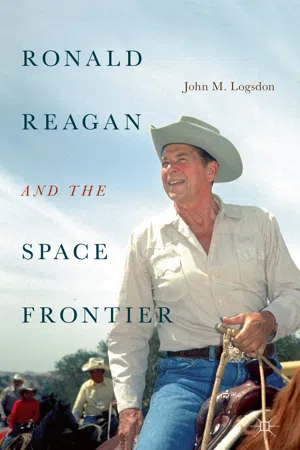
When Ronald Reagan was elected in 1980, limits on NASA funding and the lack of direction under the Nixon and Carter administrations had left the U.S. space program at a crossroads. In contrast to his predecessors, Reagan saw outer space as humanity's final frontier and as an opportunity for global leadership. His optimism and belief in American exceptionalism guided a decade of U.S. activities in space, including bringing the space shuttle into operation, dealing with the 1986 Challenger accident and its aftermath, committing to a permanently crewed space station, encouraging private sector space efforts, and fostering international space partnerships with both U.S. allies and with the Soviet Union. Drawing from a trove of declassified primary source materials and oral history interviews, John M. Logsdon provides the first comprehensive account of Reagan's civilian and commercial space policies during his eight years in the White House. Even as a fiscal conservative who was hesitant to increase NASA's budget, Reagan's enthusiasm for the space program made him perhaps the most pro-space president in American history.
- English
- ePUB (mobile friendly)
- Available on iOS & Android
eBook - ePub
Ronald Reagan and the Space Frontier
About this book
Information
© The Author(s) 2019
John M. LogsdonRonald Reagan and the Space FrontierPalgrave Studies in the History of Science and Technologyhttps://doi.org/10.1007/978-3-319-98962-4_11. A Cowboy Comes to Washington
John M. Logsdon1
(1)
Space Policy Institute, The George Washington University, Washington, DC, USA
John M. Logsdon
“Space truly is the last frontier.”
Ronald Reagan, handwritten diary entry, June 11, 1985
End AbstractOn November 4, 1980, Ronald W. Reagan was elected to be the 40th president of the United States. Reagan won the presidency by only a slim majority of the popular vote, 50.7 percent, compared to President Jimmy Carter’s 41 percent and third-party candidate John Anderson’s 6.6 percent. But Reagan was the winner in 44 states, capturing a landslide total of 489 electoral votes compared to Carter’s meager 49. Reacting to Jimmy Carter’s dour four years in the White House, and before that Richard Nixon’s failed presidency, voters “sought relief in the … mythic imagery of America’s limitless potential and special mission. They summoned a cowboy hero out of the West, a nostalgic flashback out of the heart of America.”1
As president , Ronald Reagan would face a challenging array of issues, among them double-digit inflation, a burgeoning government deficit, declining military power, and geopolitical and ideological challenges from the communist-led Soviet Union. But perhaps more significant, he would face what President Jimmy Carter in July 1979 had labeled a “crisis of confidence” among the American people. Addressing the nation, Carter had said: “It is a crisis that strikes at the very heart and soul and spirit of our national will. We can see this crisis in the growing doubt about the meaning of our own lives and in the loss of a unity of purpose for our Nation. The erosion of our confidence in the future is threatening to destroy the social and the political fabric of America.” It would be up to Reagan, whose “idiosyncratic conservatism, which combined forward-looking optimism with his deep regard for America’s heritage and the idea of American exceptionalism,” to counter Carter’s assessment of national “malaise.”2
One facet of that perceived lack of a positive national spirit was the depressed status of the U.S. space program. A decade after the triumphant first human footsteps on the surface of the Moon, president-elect Reagan was told that “the U.S. civil space program stands at a crossroads … NASA [National Aeronautics and Space Administration] and the space program are without clear purpose or direction … The year 1980 finds NASA in an untenable position.”3
This study chronicles how President Ronald Reagan and his administration over their eight years in the White House reacted to this assessment. Aerospace historian Andrew Butrica has suggested that “Ronald Reagan’s two terms as president saw the United States undertake more new and more large space initiatives than any previous administration since that of John Kennedy,” and that the programs and policies initiated during the Reagan administration would “cause the 1980s to be remembered as a major turning point in space history.” He concluded that “Reagan would pass on a lasting legacy to the nation’s space program.”
The following pages provide the basis for evaluating this judgment. It contains a detailed account of the Reagan administration’s engagement with the U.S. civilian space program. The word civilian is important here. Probably the first space-related Reagan initiative that comes to many people’s mind is his March 1983 proposal to create a defense against ballistic missile attack, the Strategic Defense Initiative (SDI). This initiative quickly became known as “Star Wars” after the 1977 movie with that title. While the SDI is an important part of Reagan’s heritage, this study will not discuss it or, for that matter, other national security space efforts during the Reagan presidency, many of which remain classified. For one thing, SDI was not a space program per se; it was a national security initiative that incidentally involved stationing defensive systems in orbit. There are already a number of excellent accounts of the decision process that led to Reagan’s defense against ballistic missiles initiative and his unwillingness to compromise it in order to achieve other agreements with the Soviet Union.4 In contrast, there is no comprehensive account of the decisions made by President Reagan and his associates with respect to U.S. civilian and commercial space activities.
The Reagan administration made a number of decisions intended to reinvigorate the U.S. civilian space effort, and Ronald Reagan personally would turn out to be the most pro-space U.S. president, before or since. He valued almost everything associated with the space program, from its many accomplishments to the astronauts and others responsible for achieving them. While John F. Kennedy had sent Americans to the Moon in the 1960s, he pursued that path, not because of his own vision of an expansive future in space, but as a battleground in the Cold War competition with the Soviet Union. Reagan did have a space vision, one that saw space as the final frontier for American leadership. In one of his last space speeches, Reagan in September 1988 would say: “It is mankind’s manifest destiny to bring our humanity into space; to colonize this galaxy; and as a nation, we have the power to determine whether America will lead or will follow. I say that America must lead.”5
An Actor-Turned Politician
Ronald Reagan was 69 years old when elected, until then the oldest person ever chosen to occupy the White House. He was most widely perceived as an actor in Western and other low-prestige movies, although he had also starred in several well-regarded films. Reagan appeared in 52 Hollywood features between 1937 and 1964, and was a performer or narrator in the long-running television series General Electric Theater and for one year on Death Valley Days.
Reagan had several other identities; he had been a labor leader, serving eight years as president of the Screen Actors Guild. As a spokesman for General Electric (GE) between 1954 and 1962 he had traveled the country meeting employees in GE plants and giving as many as 14 speeches in a day’s time. Once a liberal Democrat, he became increasingly conservative in his political views and switched his voting registration to the Republican Party in 1962. Reagan’s October 1964 eloquent “A Time for Choosing” speech in support of presidential contender Barry Goldwater made him a leading spokesperson of the conservative wing of the Republican Party and led him to an increasingly active role in electoral politics. In 1966, Reagan was elected governor of California, the nation’s most populous state, and served two four-year terms in that position. After leaving the governorship, he made an unsuccessful 1976 attempt at challenging incumbent President Gerald Ford for the Republican presidential nomination; in 1980, he battled with George H.W. Bush, Senators Howard Baker and Robert Dole, and several others before securing that nomination.6
Still, even after his many years as an active politician, Reagan’s identity as an actor was what many thought of as they elected him to perform “the role of a lifetime.” To one observer, “Reagan’s career in Hollywood was almost as important in preparing him for Washington as his eight years in Sacramento” as California governor; “both made him more effective as a leader.” Another biographer suggests with admiration that Reagan “made politics, and governing, too, into a branch of his old business, entertainment” and that “he knew how to be President.”7
There are multiple portrayals of Ronald Reagan during his White House years. One of the most insightful of them comes from an oral history interview of Howard Baker conducted in 2004. Baker during the first Reagan term was a senator from Tennessee who as majority leader of the Senate dealt with the president on a frequent basis. Baker retired from the Senate in 1985, and in February 1987 was asked by Reagan to become his White House chief of staff, a position he held until July 1988. Baker described Reagan as a “unique” and “multidimensional” personality. He added that Reagan’s personality “may be the most unappreciated part of the Reagan legacy, not just his achievements, which were extraordinary, or his political successes, which were obvious, or his foreign policy endeavors, which are historic.” Baker continued
He’s quick and insightful. He was a quick study … The least deserved thing about the Reagan legacy is that he wasn’t very bright. He was very bright, very quick. The idea that he forgot stuff is sort of true, but is more in the nature of a delete key than it was actual forgetting. When things were done he just deleted them from his mind and went on to other things.He was the most unpassive person I ever saw in the Oval Office. He was quiet and well modulated … He had strong views … He coupled that with a willingness to … have strong people around him and listen to them.He was also not afraid to delegate. As long as that delegation stayed within the parameters of his fundamental conviction on whatever the issue was, he gave people extraordinary latitude … Only when you seemed to veer over the line of what he really wanted to do or really thought, did he pull you back.He knew who he was. He was comfortable in his own skin. He understood that people thought he wasn’t intellectually agile and that he wasn’t very smart, but he knew better.8
“A Man of Ideas”
That Ronald Reagan was a person of basic intelligence and a lively imagination is confirmed by many of those who have studied his life. Richard Reeves in his book President Reagan, subtitled The Triumph of Imagination, suggests that while “no one ever called Reagan an intellectual … he did see the world in terms of ideas.” Hugh Heclo adds “Reagan was a man of ideas born out of life experiences, even though he was not a thinker’s idea of a thinker.” Rather, he was “a public man seeking political power in the name of certain ideas.” By the time he was elected president, Reagan had developed “a particular philosophy of history.” At the center of that philosophy was a vision of the United States as the God-chosen nation which was “the last best hope of man on Earth” and “a shining city on a hill.” Reagan’s belief in divinely guided American exceptionalism was the fundamental conviction that propelled his quest for the political power needed to translate that belief into action. It also shaped his views on the U.S. space program.
In addition to his belief in the superiority of the American way of life, which set him far apart from Jimmy Carter’s “crisis of confidence,” Ronald Reagan came to the White House knowing, according to his wife Nancy, “exactly what he wanted to achieve … His goals had been honed over a twenty-year period … Economic recovery. Greater economic freedom. A stronger defense. Less government.” Added to this agenda was a strong anti-communism. Reagan saw “communist states as simply the latest enemy on the offensive against the American idea of freedom, an enemy that needed to be defeated rather than accommodated.”
Reagan was a conservative, but one with a strong interest in the future. Even though he had little feeling for or understanding of the underlying technology, he “shared an American enthusiasm for technological gadgets … and an American proclivity for endorsing progress in the same breath in which he celebrated memories of things past. He was at once old-fashioned and forward-looking, and frequently sounded as if he wanted to go back to the future.”9
In his eight years as...
Table of contents
- Cover
- Front Matter
- 1. A Cowboy Comes to Washington
- 2. Getting Started
- 3. First Decisions
- 4. An Initial Reagan Space Policy
- 5. SIG (Space) Gets Started
- 6. Space Shuttle Issues: Round One
- 7. The Next Logical Step
- 8. Debates and Disagreement
- 9. The Space Station Decision
- 10. “Follow Our Dreams to Distant Stars”
- 11. Together in Orbit: Round One
- 12. Space Commercialization
- 13. Commercializing Earth Orbit
- 14. Space Shuttle Issues: Round Two
- 15. Finishing the First Term
- 16. Changing of the Guard
- 17. Shuttle Wars
- 18. Challenger
- 19. Recovering from the Accident
- 20. Correcting a Policy Mistake
- 21. The Home Stretch
- 22. Together in Orbit: Round Two
- 23. The Quest for Leadership
- 24. The Reagan Space Legacy
- Back Matter
Trusted by 375,005 students
Access to over 1.5 million titles for a fair monthly price.
Study more efficiently using our study tools.
Frequently asked questions
Yes, you can cancel anytime from the Subscription tab in your account settings on the Perlego website. Your subscription will stay active until the end of your current billing period. Learn how to cancel your subscription
No, books cannot be downloaded as external files, such as PDFs, for use outside of Perlego. However, you can download books within the Perlego app for offline reading on mobile or tablet. Learn how to download books offline
Perlego offers two plans: Essential and Complete
- Essential is ideal for learners and professionals who enjoy exploring a wide range of subjects. Access the Essential Library with 800,000+ trusted titles and best-sellers across business, personal growth, and the humanities. Includes unlimited reading time and Standard Read Aloud voice.
- Complete: Perfect for advanced learners and researchers needing full, unrestricted access. Unlock 1.5M+ books across hundreds of subjects, including academic and specialized titles. The Complete Plan also includes advanced features like Premium Read Aloud and Research Assistant.
We are an online textbook subscription service, where you can get access to an entire online library for less than the price of a single book per month. With over 1.5 million books across 990+ topics, we’ve got you covered! Learn about our mission
Look out for the read-aloud symbol on your next book to see if you can listen to it. The read-aloud tool reads text aloud for you, highlighting the text as it is being read. You can pause it, speed it up and slow it down. Learn more about Read Aloud
Yes! You can use the Perlego app on both iOS and Android devices to read anytime, anywhere — even offline. Perfect for commutes or when you’re on the go.
Please note we cannot support devices running on iOS 13 and Android 7 or earlier. Learn more about using the app
Please note we cannot support devices running on iOS 13 and Android 7 or earlier. Learn more about using the app
Yes, you can access Ronald Reagan and the Space Frontier by John M. Logsdon in PDF and/or ePUB format, as well as other popular books in History & North American History. We have over 1.5 million books available in our catalogue for you to explore.