eBook - ePub
Beyond Official Development Assistance
Chinese Development Cooperation and African Agriculture
- English
- ePUB (mobile friendly)
- Available on iOS & Android
eBook - ePub
Beyond Official Development Assistance
Chinese Development Cooperation and African Agriculture
About this book
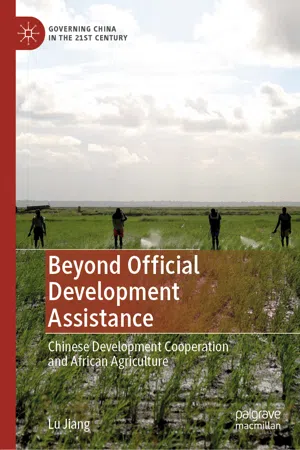
This book investigates China's contemporary development cooperation mentality and modality through the case of its agricultural engagement with Africa. It identifies three models, namely traditional agro-aid, innovative agro-aid and agribusiness models, of Chinese current agro-development cooperation with Africa, and unpacks the different models by tracing their historical origins and examining the actual practice based on project-level fieldwork conducted in Mozambique and South Africa. The book provides a preliminary and qualitative evaluation of China's current agro-development cooperation with Africa, and explains the 'implementation gaps' as observed on the ground adopting a public policy approach. It also compares the Chinese way of development cooperation with that of the traditional donors (particularly the OECD-DAC members), and calls for a broadening understanding for international development cooperation that can allow win-win ideology and embrace diversified cooperation forms beyond the official development assistance (ODA).
Information
© The Author(s) 2020
L. JiangBeyond Official Development AssistanceGoverning China in the 21st Centuryhttps://doi.org/10.1007/978-981-32-9507-0_11. Introduction
Lu Jiang1, 2
(1)
Shanghai University of International Business and Economics, Shanghai, China
(2)
Fudan Development Institute, Shanghai, China
Keywords
International development cooperation (IDC)Northern/traditional donorsSouthern development partners/emerging donorsChinaAfricaAgricultural development cooperationResearch concernsResearch methodsAs a student of international relations and development, the sixty years of Chinese engagement in African agriculture since the 1960s has been such an interesting story and wonderful case for me to investigate. It stems from a period when the People’s Republic of China (PRC) itself was still a weak and vulnerable new-born regime and has since witnessed the ups and downs of China’s development and reforms both at home and in its external relations. As of the turn of the 2020s, when China has now stood as the second largest economy and one of the major powers in the world, agricultural cooperation remains an integral part in China’s relations with the African continent—though tremendous changes have taken place in terms of the motivations, priorities, actors and modalities involved in it.
Particularly, from the perspective of international development cooperation (IDC) that the book primarily adopts, the agro-cooperation of China with Africa not only serves as a perfect example of the evolution of Chinese external development cooperation in the past decades, but more importantly, the contemporary forms of it may indicate, or at least experiment with, a fresh model against the context of a transitioning IDC landscape globally. In a time when China, among other ‘emerging’ Southern development partners, has gained increasing significance and caught the eyes of the world, this book aims to explore the dynamics and modalities, among other key issues, as regards its contemporary development cooperation behaviours through examining the typical case of China’s agro-cooperation with Africa. But to start with, I will firstly set the stage for the story of ‘China-Africa agriculture’ by outlining the development and current status of the IDC.
International development cooperation—as broadly understood as a form of collaborative activity among international community1 that is aimed at assisting the achievement of commonly accepted development objectives 2 in the developing world—is largely a contemporary idea that emerged after the Second World War (WWII). Although the practice of IDC, since the very beginning in the 1940s, developed along two lines—that is IDC from the developed countries (‘the North’) to the so-called underdeveloped areas3 (‘the South’) and IDC within the developing world (South-South cooperation)—the former had long possessed a dominant position on the global IDC landscape while the latter being largely sidelined in the twentieth century. Another common practice in IDC during the twentieth century was the overwhelming application of official aid, which is the case for both the Northern donors in the form of official development assistance (ODA) and the Southern actors through their external aid and technical assistance.
Changes, however, started to take place quietly towards the end of the last century. While the Northern ODA received widespread criticisms since the late 1990s (see, e.g., Hansen and Tarp 2000; Easterly 2003; Sachs 2005; Moyo 2010) and went through continual self-reflection and reforms,4 the once low-profile Southern development partners—particularly China but also India, Brazil, and Turkey, just to mention a few—have rapidly developed into a non-negligible new polar in the world IDC arena. What further compound the situation are the divergent development cooperation models of the Southern actors from the North. While opening new opportunities for the cooperation recipient countries, some of the Southern actors’ distinctiveness has seemed to get on the nerves of the traditional donors and impose a potential threat to the latter’s long-held dominant status. The North–South divide within the development cooperation providers has hence become more visible in the current times.
More recently, another notable trend also started to emerge, that is the growing participation of global private sector actors in the IDC. Though still in its infancy, this new trend bears the potential not only to massively increase the development finances that can be mobilized, but also significantly change the ODA-dominating situation in IDC by incorporating more and diversified cooperation forms. The Public–Private Partnership (PPP) initiative that has been increasingly adopted in the Northern development cooperation circle is surely one embodiment of the trend. But perhaps a more forceful echo comes from some of the Southern development partners like China who have taken more open attitudes towards cooperation beyond mere official aid, and more essentially, cooperation that entails a ‘mutual-development’ mentality. ‘Development package’, as referred to in the book, is precisely such an experiment.
In a nutshell, it is fair to say that the global IDC is currently facing a turning point. And it may concern far beyond just a proliferation of actors, combination of modalities, or diversification of financial sources; but equally (if not more) important, a change of mind-set in terms of what on earth ‘development cooperation’ is, how we should treat it, and how much we can possibly expect from it.
1.1 International Development Cooperation in the Transition
Growing North–South Divide
In 1947, the Secretary of State of the United States George C. Marshall launched the famous European Recovery Programme (1948–1952) through which more than $12 billion were funded by the US government to help with the reconstruction of the Western Europe (Department of State of the US). Many of the recipient countries, partly due to this external assistance, managed to recover from the ravages of war within a relatively short period of time. The great success of the ‘Marshall Plan’ thus ignited considerable enthusiasm and expectation for the prospects of helping other poorer countries in the world by means of external assistance (Führer 1996, 4; Hjertholm and White 2000, 61). The US, again, took a lead in this process through President Truman’s ‘Point Four Programme’ proposed in 1949 (Truman 1949), and a number of newly recovered European countries soon joined the undertaking in the 1950s.5
Meanwhile, a series of development initiatives, funds and agencies were launched by multilateral international organizations such as the United Nations, World Bank and European Economic Co...
Table of contents
- Cover
- Front Matter
- 1. Introduction
- 2. Tracing the Root of China’s Contemporary Agro-Development Cooperation with Africa: A Historical Review
- 3. China’s Agro-Development Cooperation with Africa: The Innovative Agro-Aid Model
- 4. China’s Agro-Development Cooperation with Africa: The Agribusiness Model
- 5. Practical Challenges of Chinese ‘Package’ Model of Development Cooperation: A Public Policy Implementation Approach
- 6. Conclusion
- Correction to: Beyond Official Development Assistance
- Back Matter
Trusted by 375,005 students
Access to over 1.5 million titles for a fair monthly price.
Study more efficiently using our study tools.
Frequently asked questions
Yes, you can cancel anytime from the Subscription tab in your account settings on the Perlego website. Your subscription will stay active until the end of your current billing period. Learn how to cancel your subscription
No, books cannot be downloaded as external files, such as PDFs, for use outside of Perlego. However, you can download books within the Perlego app for offline reading on mobile or tablet. Learn how to download books offline
Perlego offers two plans: Essential and Complete
- Essential is ideal for learners and professionals who enjoy exploring a wide range of subjects. Access the Essential Library with 800,000+ trusted titles and best-sellers across business, personal growth, and the humanities. Includes unlimited reading time and Standard Read Aloud voice.
- Complete: Perfect for advanced learners and researchers needing full, unrestricted access. Unlock 1.5M+ books across hundreds of subjects, including academic and specialized titles. The Complete Plan also includes advanced features like Premium Read Aloud and Research Assistant.
We are an online textbook subscription service, where you can get access to an entire online library for less than the price of a single book per month. With over 1.5 million books across 990+ topics, we’ve got you covered! Learn about our mission
Look out for the read-aloud symbol on your next book to see if you can listen to it. The read-aloud tool reads text aloud for you, highlighting the text as it is being read. You can pause it, speed it up and slow it down. Learn more about Read Aloud
Yes! You can use the Perlego app on both iOS and Android devices to read anytime, anywhere — even offline. Perfect for commutes or when you’re on the go.
Please note we cannot support devices running on iOS 13 and Android 7 or earlier. Learn more about using the app
Please note we cannot support devices running on iOS 13 and Android 7 or earlier. Learn more about using the app
Yes, you can access Beyond Official Development Assistance by Lu Jiang in PDF and/or ePUB format, as well as other popular books in Politics & International Relations & African Politics. We have over 1.5 million books available in our catalogue for you to explore.