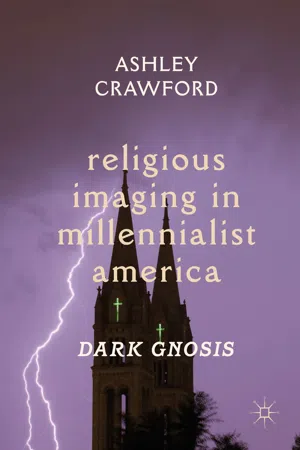
Ashley Crawford investigates how such figures as Ben Marcus, Matthew Barney, and David Lynch—among other artists, novelists, and film directors—utilize religious themes and images via Christianity, Judaism, and Mormonism to form essentially mutated variations of mainstream belief systems. He seeks to determine what drives contemporary artists to deliver implicitly religious imagery within a 'secular' context. Particularly, how religious heritage and language, and the mutations within those, have impacted American culture to partake in an aesthetic of apocalyptism that underwrites it.
- English
- ePUB (mobile friendly)
- Available on iOS & Android
eBook - ePub
About this book
Information
© The Author(s) 2018
Ashley CrawfordReligious Imaging in Millennialist Americahttps://doi.org/10.1007/978-3-319-99172-6_11. Introduction: American Gnosis
Ashley Crawford1
(1)
University of Melbourne, Melbourne, VIC, Australia
Ashley Crawford
With their carcinomatous prosthetics, their leering, hungry demeanor, their gaping, rotting mouths and their apocalyptic, murderous words they haunt the dark edges of the American psyche. They’ve crept into the literature, the films, the art, the comics, even at times the opera halls and musicals of contemporary culture, these denizens of a dark carnivalesque, hideous figures triggered from reading the Book of Revelations on bad, bad lysergic acid.
In some ways, they resemble creatures of the Middle Ages when plague and pestilence ruled the lands. These are the contemporary progeny of Bosch and Breughel. They are the spawn of such contemporary American artists as David Lynch, Matthew Barney and Ben Marcus. Why are they appearing now? And in what ways do they reflect contemporary readings of Judaism , Christianity and Mormonism in the current age?
The French philosopher Michel Foucault (1926–1984) pointed out that: “Religious beliefs prepare a kind of landscape of images, an illusory milieu favorable to every hallucination and every delirium.” 1 And, it can be argued, it is America where we see such hallucinations and deliriums made manifest via its creative expressions.
Fredric Jameson, in his groundbreaking treatise Postmodernism, Or the Cultural Logic of Late Capitalism , notes that postmodernism is what we attain when modernization is complete and “nature is gone for good.” 2 I would similarly argue that secularization is what we get if and when ‘religion is gone for good.’ America, it is often stated, is a secular state. Indeed, the essence of this notion is in the First Amendment to the United States Constitution: “no religious Test shall ever be required as a Qualification to any Office or public Trust under the United States.” However, it transpires that religion, like nature, is remarkably resilient. And, like nature, it can mutate into radically new forms in order to survive. America, more than any other nation, suffers symptoms of a distinctive form of ‘cultural schizophrenia’ between its gnostic desires and secular status that are expressed through its cultural output. The term cultural schizophrenia is used here to evoke the schisms that are created by the Church/State divide and how they are illustrated in specific cultural artifacts. Indeed, this is perhaps similar to the way William S. Burroughs described the use of such terminology to describe the 1975 Schizo-Culture conference in New York City in the 2014 MIT book on the event: “I think ‘schizo-culture’ here is being used rather in a special sense. Not referring to clinical schizophrenia , but to the fact that the culture is divided up into all sorts of classes and groups, etc., and that some of the old lines are breaking down.”
As a youth during the 1960s and ’70s, it was nigh impossible to avoid what self-styled religious critic Harold Bloom dubs The American Religion . 3 With its attendant pseudo-mysticism, strange references to religion appeared in the American comic books of my youth: Ghost Rider , Dr. Strange , Thor , The New Gods . It was on the television : The Night Stalker and reminders of religious systems throughout Star Trek . It was the life-blood of the science fiction of Philip K. Dick and the horror of H. P. Lovecraft . And, of course, what would The American Religion be without the American Apocalypse: THX 138 , Silent Running , Soylent Green , The Omega Man , The Planet of the Apes , and the spiritual horrors of The Exorcist and The Shining or the neon-napalm Armageddon of Apocalypse Now ? 4 Matthew Avery Sutton, in his book American Apocalypse: A History of Modern Evangelicalism , cites other examples: “As evangelical apocalypticism penetrated the White House, it also became ubiquitous in American culture. Films like The Omen , Rosemary’s Baby and hundreds more depicted a cataclysmic end to the world, while the music of popular groups like Megadeth, Iron Maiden, KISS, and many others used evangelical motifs to entertain millions of Americans.” He also cites the success of the ‘Left Behind’ series of books by apocalyptic evangelist Tim LaHaye in the mid-’90s. Anthropologists Kathleen Stewart and Susan Harding reference what political scientist Michael Barkun describes as “the improvisational apocalypticism of the 1990s—a bricolage of disparate elements from religion, ideology, the occult, and bits and pieces of esoteric knowledge covering a vast area including lost continents, astrology, alchemy, unconventional medicine, UFOs, and conspiracy theories—previously marginalized and stigmatized forms of knowledge are mainstreamed and politicized as suppressed truths.” 5
Ben Marcus’ novel The Flame Alphabet (2012) and Matthew Barney’s film and exhibition River of Fundament (2014), David Lynch’s Eraserhead (1977) and Blue Velvet (1986), all of these works can be read as expressions of a form of eschatological crisis, or what may be described as an eschatological aesthetic, 6 or form of ‘epidermal Apokálypsis’—the cultural flesh as an expression of decay.
Reference to religious ‘mutants,’ of course, suggests there is a true, real, natural or base form of Christianity. Christianity’s history, however, is one of unorthodoxy—it has always been contingent on culture, politics and economics.
A ‘masculine’ emphasis herein, I believe, reflects the Abrahamic religions chosen for discussion, reflecting their potent cultural presence in contemporary America and, in turn, the male hierarchy of their institutional frameworks. While there is a powerful history of female deities throughout ancient history, as seen in pagan and Hindu belief systems, Christianity, Judaism and Mormonism are clearly androcentric. The ordination of women as Rabbis and Priests is a comparatively recent phenomenon in historical terms in Judaic and Christian churches and remains a contentious source of debate in some Mormon circles. It is abundantly clear that in Abrahamic systems it is men who hold the reigns of structured power. 7
The regular referencing to both teeth and the mouth throughout was inspired by a comment made by the French theorists Giles Deleuze and Felix Guattari in reference to American musician and poet Patti Smith : “Don’t go for the root, follow the canal …” 8 One thing that the charismatic Televangelists—Jimmy Swaggart , Jerry Falwell , Pat Robertson et al.—have in common is inhumanely perfect teeth which, alongside booming voices and the occasional tear, they utilize to hammer home their sermons. As history has proven, these perfect teeth conceal a cornucopia of mistruths and out-right lies. Televangelism (a term coined by Time magazine in March 1998) remains a distinctly American phenomenon and teeth are among its motifs.
That said, I shall embrace Bloom’s term, ‘The American Religion ,’ for there is none more apt. He summarizes the assumption taken here, that all Americans carry a streak of the Gnostic in their cultural formation, that notions of religiosity in America are “pervasive and overwhelming, however it is masked, and even our secularists, indeed even our professed atheists, are more Gnostic than humanist in their ultimate presuppositions.” 9 Bloom claims, correctly I believe, that America is “a religiously mad culture …” 10
Where my own discussion differs from these writers is by contextualizing the works of the artists discussed within the framework of an inherently American sense of religiosity and the direct (and sometimes indirect) referencing and mutating of Abrahamic structures and a pervading sense of the apocalyptic.
I am also not the first to have juxtaposed the works of Matthew Barney and Ben Marcus. In 2004, Duncan White presented a paper at the Manchester Metropolitan University in which he asked whether Marcus and Barney: “offer a robust and divisive critical alternative to America as place or system?” 11 The answer to this is in the affirmative, but to which I would add America as belief. Where my work differs is in the stark fact that Dr. White considers Barney and Marcus in terms of spatiality, while I explore their work through a lens of religiosity, the apocalyptic and a sense of eschatological crisis.
To illustrate this, I have selected key works by Barney: CREMASTER 2 , CREMASTER 3 and River of Fundament, Marcus: The Age of Wire and String (1995), Notable American Women (2002) and The Flame Alpha...
Table of contents
- Cover
- Front Matter
- 1. Introduction: American Gnosis
- 2. Delirium: A Brief History of America’s Religious Founding(s)
- 3. Dualism: An Exploration of Good and Evil via David Lynch’s Films
- 4. Delusion: On Mormon and Masonic Symbolism in Matthew Barney’s CREMASTER Films
- 5. Deconstruction: On Judaic Law and the Apocalypse of Language in Ben Marcus’ The Flame Alphabet
- 6. Dereliction and Defecation: On the Religious Underpinnings in Matthew Barney’s Subliming Vessel and Ben Marcus’ Leaving the Sea and the Apocalyptic Imaging of Matthew Barney’s River of Fundament
- 7. Dark Gnosis
- Back Matter
Trusted by 375,005 students
Access to over 1.5 million titles for a fair monthly price.
Study more efficiently using our study tools.
Frequently asked questions
Yes, you can cancel anytime from the Subscription tab in your account settings on the Perlego website. Your subscription will stay active until the end of your current billing period. Learn how to cancel your subscription
No, books cannot be downloaded as external files, such as PDFs, for use outside of Perlego. However, you can download books within the Perlego app for offline reading on mobile or tablet. Learn how to download books offline
Perlego offers two plans: Essential and Complete
- Essential is ideal for learners and professionals who enjoy exploring a wide range of subjects. Access the Essential Library with 800,000+ trusted titles and best-sellers across business, personal growth, and the humanities. Includes unlimited reading time and Standard Read Aloud voice.
- Complete: Perfect for advanced learners and researchers needing full, unrestricted access. Unlock 1.5M+ books across hundreds of subjects, including academic and specialized titles. The Complete Plan also includes advanced features like Premium Read Aloud and Research Assistant.
We are an online textbook subscription service, where you can get access to an entire online library for less than the price of a single book per month. With over 1.5 million books across 990+ topics, we’ve got you covered! Learn about our mission
Look out for the read-aloud symbol on your next book to see if you can listen to it. The read-aloud tool reads text aloud for you, highlighting the text as it is being read. You can pause it, speed it up and slow it down. Learn more about Read Aloud
Yes! You can use the Perlego app on both iOS and Android devices to read anytime, anywhere — even offline. Perfect for commutes or when you’re on the go.
Please note we cannot support devices running on iOS 13 and Android 7 or earlier. Learn more about using the app
Please note we cannot support devices running on iOS 13 and Android 7 or earlier. Learn more about using the app
Yes, you can access Religious Imaging in Millennialist America by Ashley Crawford in PDF and/or ePUB format, as well as other popular books in Social Sciences & Film & Video. We have over 1.5 million books available in our catalogue for you to explore.