- English
- ePUB (mobile friendly)
- Available on iOS & Android
eBook - ePub
About this book
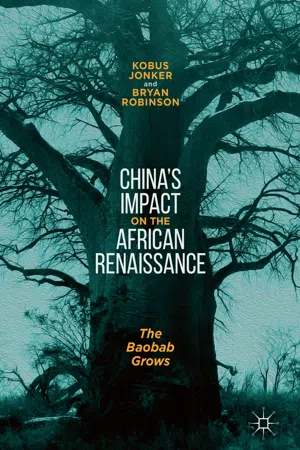
This book provides the first comprehensive academic study of what China's trade with, and investment in, African countries mean for the socio-economic well-being of the continent. Based on the African Tree of Organic Growth Framework developed in the book, Jonker and Robinson outline the factors necessary in realizing Africa's Renaissance vision and the impact that the Chinese might have on this process. Using the metaphor of the Baobab tree, the authors analyze the historical, cultural and economic contexts within African countries, the channels available to produce development and growth, and the fruits or social and economic well-being created by this integrated process. The book takes readers on a journey of numerous African examples and case studies, describing and analyzing the challenges and complexities of countries in their desire to achieve organic, cultural, scientific and economic renewal, and the improvement of the well-being of their citizens. This book will be of great value to economists, people who wish to do business in Africa, China-watchers, those who are following the development and growth of Africa, and more.
Information
© The Author(s) 2018
Kobus Jonker and Bryan RobinsonChina’s Impact on the African Renaissancehttps://doi.org/10.1007/978-981-13-0179-7_11. China in Africa: New Colonists or Facilitators of Development and Growth
Kobus Jonker1 and Bryan Robinson1
(1)
Nelson Mandela University, Port Elizabeth, Eastern Cape, South Africa
Kobus Jonker (Corresponding author)
Bryan Robinson
China’s presence in Africa has led to a heated debate by various authors over the last decade or two. The debate centred on the reason for the involvement of China and the implications of this involvement for the development and growth on the African continent. Chinese investment in Africa has skyrocketed in the last couple of years, outpacing every other nation. China finances more infrastructure projects in Africa than the World Bank and has become a key provider of aid. The Chinese model, with no colonial past in Africa, is considered a legitimate challenger to the Western aid status quo. Most of the research and analysis on China in Africa tends to focus on generalisations about Africa, without necessarily considering the unique growth trajectories of each country. The main purpose of this book is to evaluate the impact of China on Africa by evaluating case studies in African countries in terms of the influence on their specific growth and development phases and in terms of ‘The African Tree of Organic Growth’ presented in Chap. 2.
The success of China’s own ‘renaissance’ has proved that a transformational agenda directed at the conditions of a specific country can succeed and abet a large segment of the population out of poverty. While China’s poverty reduction is often associated with economic growth and diversification, much of it actually occurred in the early phase of China’s reform. In 1978, China embarked on a national restructuring process that facilitated more than 30 years of rapid economic growth and social development starting with agricultural reforms to jumpstart poverty reduction. China also has an impressive organic development history, where the rents on resources were used to fuel economic and infrastructure development, while industry partnerships with developed countries secured the technology transfer for important new industries. China can therefore serve in more than one way as a benchmark for Africa. A number of countries, such as Ethiopia and Senegal, confirm that they have a lot to learn from China’s successes. Others are not so pleased with China’s increasing presence. The recently successful election of the new president of Zambia, Michael Sata, who threatened to throw all Chinese investors out of Zambia, is a good example of this reaction.
The involvement of China in Africa offers some clear advantages for the growth and development of African counties. One of the key advantages is speed. Chinese firms are able to deliver quickly and provide a package of financial and implementation partners and support, which makes execution of projects fast and effective. Timing and speed are a big comparative advantage of the Chinese in Africa, especially because of existing bottlenecks in Africa, especially in infrastructure development and energy provision. Chinese construction companies are globally very competitive and are able to effectively deliver on big projects at an affordable cost. Africa’s information and communications technology (ICT) needs remain high, and telecommunications infrastructure has become very reliant on Chinese technology, which tends to be competitively priced, durable and enjoys strong back-up service. The rising African middle class is also providing opportunities for affordable consumer goods to be exported from China to Africa, facilitated by the World Trade Organization (WTO) having decreased tariffs and opened up the African marketplace—an attractive opportunity for China.
As a growing economy, China needs Africa’s energy, resources and access to African markets. As a rising power, China needs the political support of African leaders as a bulwark against the West. During his visit to the African Union in 2014, Chinese Premier Li Keqiang announced that China expects to achieve US$400 billion in trade volumes with Africa in 2020 and raise its direct investment in the continent to US$100 billion. Most African countries are in a transformative developmental state and therefore need the investment and support of world powers like China.
Africans do have reciprocal power in their relationship with China, and should therefore make sure that these investments and support contribute to their own internal renewal and growth process. African governments are learning that China’s growing needs and aspirations mean that they need Africa as much as Africa needs them. A good example is that of Angola, who in 2011 walked away from an oil deal after having struck many similar deals before; months later the Chinese came back with a better offer. Similarly, local protests in Mozambique forced China to rethink land settlement plans.
It is clear that the response to potential Chinese exploitation has been growing and that Africa will continue to play a more prominent role in setting the rules of engagement to ensure that its citizens directly benefit from these interventions and investments.
1.1 Perceptions in the African Media
Before detailing China’s historical and current engagement in Africa, it is worthwhile evaluating what the perceptions are towards the Chinese in Africa. One way of doing this is to investigate media reporting on the matter.
A ‘snapshot’ was taken of 155 media articles for the period 1 January 2016 to 31 December 2016 in two North African nations, two West African nations, two South African Nations and two East African nations. The results are reflected in Table 1.1.
Table 1.1
Media perceptions towards China’s engagement in Africa
Country of publication | Total | Positive | Neutral | Negative | |
|---|---|---|---|---|---|
1 | Alge ria | 34 | 32 (94%) | 2 (6%) | 0 |
2 | E gypt | 10 | 10 (100%) | 0 | 0 |
3 | Egypt | 7 | 6 (86%) | 1 (14%) | 0 |
4 | Camer oon | 3 | 0 | 1 (33%) | 2 (66%) |
5 | Ca meroon | 2 | 2 (100%) | 0 | 0 |
6 | Nige ria | 11 | 7 (64%) | 3 (27%) | 1 (9%) |
7 | Nig eria | 19 | 14 (74%) | 2 (10%) | 3 (16%) |
8 | South Africa | 12 | 11 (92%) | 0 | 1 (8%) |
9 | Zam bia | 18 | 17 (94%) | 1 (6%) | 0 |
10 | Mala wi | 17 | 14 (82%) | 1 (6%) | 2 (12%) |
11 | Keny a | 18 | 7 (39%) | 7 (39%) | 4 (22%) |
It is immediately clear that there is an overwhelmingly positive regard by the press for China in Africa: 94% of press releases of Algerian publications, 100% of Egyptian, 64% and 74% of Nigerian, 92% of South African, 94% of Zambian and 82% of Malawian publications were positive news reports. Some exceptions include the Kenyan newspaper, where only 39% were positive, but then a further 39% were neutral, with only 22% being negative; and in Cameroon, one publication was mostly negative in reporting while the other was positive.
A survey in 2013 by the Pew Global...
Table of contents
- Cover
- Front Matter
- 1. China in Africa: New Colonists or Facilitators of Development and Growth
- 2. Renewal of Africa: The African Tree of Organic Growth Paradigm
- 3. Economic Growth and Diversification Fuelling Development in Africa
- 4. Infrastructure: The Most Important Enabler of Organic Growth in Africa
- 5. The Role of Effective Governments and Institutions
- 6. A Skilled and Educated Workforce for Africa
- 7. Developing a Sustainable Africa through Green Growth
- 8. Improving the Human Well-Being of All Africans
- 9. Integrated Organic Growth: The Cases of Cameroon and Mauritius
- 10. The Impact of China on the African Renaissance: Let the Baobab Grow…
- Back Matter
Trusted by 375,005 students
Access to over 1.5 million titles for a fair monthly price.
Study more efficiently using our study tools.
Frequently asked questions
Yes, you can cancel anytime from the Subscription tab in your account settings on the Perlego website. Your subscription will stay active until the end of your current billing period. Learn how to cancel your subscription
No, books cannot be downloaded as external files, such as PDFs, for use outside of Perlego. However, you can download books within the Perlego app for offline reading on mobile or tablet. Learn how to download books offline
Perlego offers two plans: Essential and Complete
- Essential is ideal for learners and professionals who enjoy exploring a wide range of subjects. Access the Essential Library with 800,000+ trusted titles and best-sellers across business, personal growth, and the humanities. Includes unlimited reading time and Standard Read Aloud voice.
- Complete: Perfect for advanced learners and researchers needing full, unrestricted access. Unlock 1.5M+ books across hundreds of subjects, including academic and specialized titles. The Complete Plan also includes advanced features like Premium Read Aloud and Research Assistant.
We are an online textbook subscription service, where you can get access to an entire online library for less than the price of a single book per month. With over 1.5 million books across 990+ topics, we’ve got you covered! Learn about our mission
Look out for the read-aloud symbol on your next book to see if you can listen to it. The read-aloud tool reads text aloud for you, highlighting the text as it is being read. You can pause it, speed it up and slow it down. Learn more about Read Aloud
Yes! You can use the Perlego app on both iOS and Android devices to read anytime, anywhere — even offline. Perfect for commutes or when you’re on the go.
Please note we cannot support devices running on iOS 13 and Android 7 or earlier. Learn more about using the app
Please note we cannot support devices running on iOS 13 and Android 7 or earlier. Learn more about using the app
Yes, you can access China’s Impact on the African Renaissance by Kobus Jonker,Bryan Robinson in PDF and/or ePUB format, as well as other popular books in Business & Business General. We have over 1.5 million books available in our catalogue for you to explore.