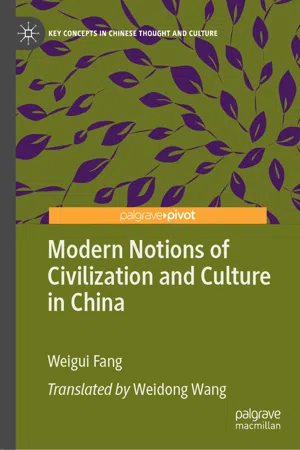
This Key Concepts pivot examines the fundamental Chinese ideas of 'Civilization' and 'culture', considering their extensive influence both over Chinese society and East Asian societies. The pivot analyses the traditional connotations of those two concepts and their evolution in the Sino-Western exchanges as well as their renewed interpretation and application by contemporary Chinese scholars. It analyses how the years 1840-1900 which mark a period of major transition in China challenged these concepts, and highlights how the pursuit of innovation and international perspective gave birth to new values ??and paradigm shifts, and culminated in the May Fourth New Culture Movement. Considering the underlying humanistic ideas in the key concepts of traditional Chinese civilisation and culture, this pivot contributes to this series of Chinese Key Concept by offering a unique analysis of the conceptual evolutions brought about by the change of values in 21st century China.
- English
- ePUB (mobile friendly)
- Available on iOS & Android
eBook - ePub
Modern Notions of Civilization and Culture in China
About this book
Information
Print ISBN
9789811335570
Subtopic
Chinese History© Foreign Language Teaching and Research Publishing Co., Ltd. 2019
Weigui FangModern Notions of Civilization and Culture in ChinaKey Concepts in Chinese Thought and Culturehttps://doi.org/10.1007/978-981-13-3558-7_11. The Chinese People’s “Great Geographical Discovery”
Abstract
The modern Chinese language uses 文化 (wenhua) as a term that corresponds to the Western notion of “culture,” and 文明 (wenming) as the term that corresponds to “civilization.” Despite their foreign origins, both 文化 (wenhua) and 文明 (wenming) are terms that convey notions of profound significance. The notions inscribed in wenhua and wenming—terms that have been widely adopted by today’s Chinese—are very different from notions expressed by terms relating to “culture” in ancient China. This fact points to semantic change that took place in the second half of the nineteenth century when Chinese writers of that time translated these two important, modern Western concepts, “civilization” and “culture”. To say so amounts to saying a few introductory words about the “great geographical discovery” of the nineteenth century Chinese. Doing this will help readers to understand the changes that occurred with respect to these two concepts and to trace their origins.
Keywords
Wenhua Wenming Great geographical discoveryChinese mindsetModern Chinese uses 文化 ( wenhua ) as a term that corresponds to the Western notion of “culture,” and 文明 ( wenming ) as a term that corresponds to “civilization .” In the Chinese language, the first expression began to exist a long time ago; it is thus traceable far back to pre-Qin Confucian classics . The same is true of the second expression, except that it first appeared in Chinese classics even earlier, thus six times in the Book of Changes alone. In view of such remote origins, these two terms are of profound significance. Besides, they are closely interrelated and resemble each other in meaning. As it were, wenming means in those days “thriving development of culture and education,” whereas wenhua refers to cultural enhancement as opposed to military fortification. We can say that these two expressions conceptually do not exactly mean “civilization ” or “culture” in their modern sense, despite the fact that they have much in common with the latter. Initial Chinese translations of the Western notions of “civilization” and “culture” that reflect their modern sense did not distinguish them clearly from one another conceptually. In fact, wenhua and wenming remained interchangeable even as late as the 1920s. So, wenhua as referred to in this book can mean the same as wenming . Likewise, wenming does not exclude wenhua, either.
The concepts of wenhua and wenming widely adopted by today’s Chinese are very different from those used in ancient China. The change took place in the second half of the nineteenth century, with the result that modern-day Chinese use these two concepts in a vastly different way from their ancestors in terms of implicit meaning, despite a certain degree of interrelatedness. In view of this, before discussing these two old concepts, I wish to put forward one question: Why and how did the Chinese of that time translate the two important, modern Western concepts of “civilization ” and “culture?” To pose the question is equivalent to saying a few introductory words about the “great geographical discovery ” of the nineteenth-century Chinese. Looking into this matter will help readers to understand the changes the two concepts underwent and to trace their origins.
The world map seen by Matteo Ricci (1552–1610), in late-Ming China, had all the fifteen provinces of the Great Ming placed at its center and a number of islets scattered around its periphery. If those islets are put together, the total area would be smaller even than the smallest province of the country. This vividly shows the pre-modern Chinese perception of “all quarters of the world.” Thus, the Complete Terrestrial Map (1584) and the Great Universal Geographic Map (1602), brought in by the Italian Catholic missionary, offered Chinese people a spherical-earth perspective unknown to them before, as well as the theory that the world consists of a myriad countries, forcing traditional Chinese scholars and literati to rethink their stubborn old belief that China was naturally at the center of the world and to accept Catholic missionaries’ worldview. The long-held doctrine whereby heaven was spherical and earth was square started to lose ground. However, after the Kangxi Emperor (1654–1722) banned the spread of Catholicism, the Chinese people suffered a major setback in their geographic knowledge. Worse still, the erroneous view that China was at the center of the world, surrounded by some insignificant barbarian countries, again became a platitude commonly heard in Chinese society. The Yongzheng Emperor and his son, the Qianlong Emperor, declared even stricter bans on Catholicism, thus severing all ties with Western civilization, which was making tremendous progress at the time. China, by contrast, became increasingly ill-informed and backward.
In 1832, the ship Lord Amherst of the British East India Company carried out a survey and spying activities along the coastal areas of Xiamen, Fuzhou, Ningbo and Shanghai. Hugh Hamilton Lindsay, who oversaw these activities as a senior employee of the company’s Guangdong chamber, wrote in his voyage report: “In most places we visited we found the Chinese, even of the higher classes, ignorant to an extreme degree of everything connected with foreigners, so much so, for instance, that I rarely met any who knew the English under any designation than Hung-maou, ‘Red Bristled Nation.’” That was basically true. Chinese people had for a long time thought that, beyond the Chinese territory, there were only brutes and barbarians incapable of speaking a human language; what they could do was to howl like oxen or wobble like birds. After the eruption of the First Opium War in 1839, a Chinese scholar named Wang Zhongyang described the British soldiers he saw in this way: “They have aquiline noses, catlike eyes and red beards. They cannot bend their knees, so they do not run swiftly. With eyes fearful of light, they cannot open them at noon.” Wang was not the only person to think so. Yu Qian, the Governor of the then Jiangnan and Jiangxi provinces, voiced a similar conviction in his memorial to the imperial throne: “If they get hit in the knees, they will immediately flop to the ground without fail.” Facts show, however, that far more Chinese people than Britons died during the opium war.
China has had no lack of historical annals, but there are few records about European culture and customs, especially with regard to modern European powers. The Chinese people’s earliest knowledge of world geography has arisen mainly from the Jesuit missionaries of the late Ming and early Qing period. Even this was limited to the compilation and publishing of atlases. Prior to 1840, the few relevant reference books in this respect that were produced by Chinese authors included A Glimpse of Overseas Countries (1730) by Chen Lunjiong, An Anecdotal Account of Islands (1806) by Wang Dahai and Maritime Records (1820) by Xie Qinggao. After the opium war, there appeared famous works such as Wei Yuan’s Illustrated Records of Overseas Countries (1843, 1848, 1852), Liang Tingnan’s An Account of Maritime Countries in Four Sections (1846), Yao Ying’s Notes from My Travels in Western Sichuan and Eastern Tibet (1846) and Xu Jishe’s Records about Major Maritime Countries of the World (1848). These mid-nineteenth-century works shed much light on world geography and on the histories and politics of foreign countries, though more or less in introductory form, and they became prized even by young Japanese scholars of the time as great, eye-opening works. However, the great geographic discovery somehow remained unconvincing for a long time, especially to the general Chinese populace. Otherwise, Li Gui, who attended the world expo held in celebration of the U.S.A.’s centennial anniversary in 1876, would not have written the following in his New Records about My Travels around the Globe:
The earth is shaped like a ball and spins around the sun. The sun never moves whereas the earth does. Although there are quite a few Chinese who understand this quite well, most of my fellow countrymen refuse to believe it. I, too, used to be skeptical about this. But now that I am out here traveling around the globe on a task-related trip, I have become convinced.
Before Li Gui, Zhi Gang in his Our Corps’ First Inspection Tour around Europe and America related what the three Chinese diplomats had seen when visiting Western countries from 1868 to 1870. Below are a few lines, both easily intelligible and extraordinary, taken from that book:
We departed from Shanghai and headed east for Japan. After stopping there for some time, our ship finally arrived at the west coast of America, namely the east coast of the Great Eastern Ocean [the Pacific Ocean]. Neither the Chinese nor the Japanese had known that the Great Eastern Ocean, too, has an eastern edge. Only after we learned from the Westerners of the last dynasty and made a voyage around the world ourselves, did we see that this was so. Having crossed the whole of America, we reached its east coast, namely the western coast of the Atlantic Ocean. We had not known, either, that the Atlantic Ocean has a western edge until the Westerners of the last dynasty had informed us so. Now that we had got to the east coast of America, we traveled further east across the Atlantic Ocean. However, the eastern edge of the Great Eastern Ocean is in fact the western edge of the Great Western Ocean [the Atlantic Ocean]. This resembles a situation wherein a man on the east side of a wall would point to it as a western wall but, once he has moved over to the opposite side, he would call it an eastern wall instead. The ship thus carried us to the eastern coast of the Atlantic Ocean. We visited all major European countries. Saying that European countries lie east of the Atlantic Ocean is like saying that the coastal provinces of China lie west of the Great Eastern Ocean [the Pacific Ocean].
Well into the second half of the nineteenth century, such naive statements as to whether the earth is spherical or square were still quite frequent. The first official delegation sent to Europe by the Qing government in 1866 to learn about Western culture, consisted of three students of the School of Combined Learning led by Bin Chun and his son. The organizer of the trip was Robert Hart, the British inspector-general of the Chinese maritime customs service. Bin Chun, otherwise known as the “First Person from the Middle Kingdom to set foot on European soil and America,” thus wrote with wonderment about their ship’s passage through the Baltic Sea: “To the north are hills and islands. Looking toward the southeast, we saw sky and waters merging together. There were a few vessels and sails faintly visible in the far distance. Then, only mast tips remained in sight, showing that those ships were already a hundred li away. This suffices to prove that the spherical-earth theory was correct.” (Bin Chun: Notes on a Voyage to Western Countries). Even by the 1890s, Xue Fucheng, the Chinese ambassador to four European countries, was still saying: “When I was young, I used to doubt the boundlessness of the universe. Vast as it was, the universe could not be truly boundless. When Zou Zi, a ying-yang theoretician of the Warring States period, said that the universe is limitless, he was perhaps only trying to create a stir. Many of today’s people who have traveled around the globe know that all geographical formations and distances can well be calculated or measured. This makes me see that Zou Zi’s theory was not entirely wrong; […]” (Xue Fucheng: The Diary of an Ambassador to Britain, France, Italy and Belgium).
In that era of Chinese geographical discovery, at least such sensible Chinese intellectuals realized that beyond the Jiuzhou Island there were many other islands. Or as Guo Songtao, the first Chinese ambassador to a foreign country, said: “Isn’t it true that wise people think much the same, all willing to comply with heaven’s will? If a mean person says: ‘China occupies a prominent place in the east of the world, whereas other countries are all inhabited by barbarians,’ I will hardly agree with him.” (Guo Songtao: A Diary of What I Experienced in London and Paris). However, “China” was after all a high-sounding name; a traditional Chinese person would not willingly give up the central status associated with that name. In his book Our Corps’ First Inspection Tour around Europe and America, Zhi Gang expressed a virtually “nonsensical” view on China:
When in Spain, the host asked us, “In this world, a country is just a country. Why is it that you Chinese people call yours a ‘middle kingdom’?”, we answered: “If you say that ‘middle’ here suggests a center in its physical sense, then since the earth hangs high in the firmament, which part of it isn’t at the center? If you say that it refers to a space between two countries, then whereas all countries are linked together, they each have a space in between. If you insist that ‘middle’ can here be associated with the heart of the earth, then a country actually lies on the earth’s surface, not anywhere deep below. So by ‘middle kingdom,’ we do not mean the kingdom as a physical formation or presence. After Fu Xi drew the eight diagrams, China’s sage kings of Yao, Shun, Yu, Tang, Wen, Wu, the Duke of Zhou, Confucius and Mencius all continued to pursue the Middle Way, namely the Fair Way. This has been going on for all 4000 years. It is not serene emptiness as valued by Indian Buddhism. It is not universal love as prized by Jesus Christ in Judaism. Not Persia’s mazdaism, nor Mohammed’s mosques, nor Japan’s Shinto. These are the world’s prominent religious faiths. As for grotesque oddities found in remote areas, they are even more numerous. At any rate, the ‘middle kingdom’ highlights the idea of pursuing the middle, therefore correct, way. It is a heritage passed down from generation to generation of Chinese sages. No other country should ever attempt to usurp this name.”
Zhi Gang’s statement well reflected what Song Yuren pointed out in his book Things I Witnessed in European Countries (1895): “If I prize kindness, who else doesn’t? If I strive for fame, who else will not?” To distinguish their merits and accomplishments from a natural state of being, humans always tend to regard their own nation’s development and transformation as being unique. Broadly speaking, this is exactly what culture is conceptually about. From the perspective of the history of the development of concepts, the Chinese dichotomy of civilized Chinese versus barbarian non-Chinese closely resembles the development of similar concepts in the West. According to Westerners of that time, all non-Greek people were barbarians; Persians and Egyptians, for example, were barbarians. In the work The Persians by the ancient Greek tragedy writer Aeschylus (525 BC–456 BC), the word “Asia” was synonymous with the Persian Empire. The subject of the renowned work The History by the ancient Greek historian Herodotus (480–425 BC) was also the strife between ancient Greece and Persia, namely between Europe and Asia. Thus, it can be seen that as early as in the fifth century, “Asia” was already a largely derogatory word, hinting at autocracy and barbarism. Cultural notions are laden with values. With the passage of time, the value orientation of such a dichotomy as that between civilized Chinese and barbarian non-Chinese became even more obvious, thus creating a model of cultural identification. The notion of Europe as opposed to Asia, in particular, represents a fixed way of thinking long embedded in human history. After European history entered into the early modern phase, the ancient Greek word “βάρβαροζ,” meaning “brutish creatures,” became adopted for use as a contrast to the idea of “civilized humans.”
“People think alike because they exert the power of reason in much the same way.” The Chinese dichotomy of genteel Chinese versus uncultured non-Chine...
Table of contents
- Cover
- Front Matter
- 1. The Chinese People’s “Great Geographical Discovery”
- 2. Wen Is the Manifestation of the Great Way
- 3. The Bankruptcy of Chinese Order in East Asia
- 4. After Japan’s Departure from Asia, Where Did the Once Prosperous China Go?
- 5. The Paradigm Shift of “Civilization” in the Age of Transformation
- 6. The Early Spread of “Civilization” as a Modern Notion in China
- 7. “Civilization” and “Culture” in Bilingual Dictionaries
- 8. Getting Prepared for a Meeting with Western Civilization
- 9. Distinguishing Between “Civilization” and “Culture” in the New Culture Movement
- Back Matter
Trusted by 375,005 students
Access to over 1.5 million titles for a fair monthly price.
Study more efficiently using our study tools.
Frequently asked questions
Yes, you can cancel anytime from the Subscription tab in your account settings on the Perlego website. Your subscription will stay active until the end of your current billing period. Learn how to cancel your subscription
No, books cannot be downloaded as external files, such as PDFs, for use outside of Perlego. However, you can download books within the Perlego app for offline reading on mobile or tablet. Learn how to download books offline
We are an online textbook subscription service, where you can get access to an entire online library for less than the price of a single book per month. With over 1.5 million books across 990+ topics, we’ve got you covered! Learn about our mission
Look out for the read-aloud symbol on your next book to see if you can listen to it. The read-aloud tool reads text aloud for you, highlighting the text as it is being read. You can pause it, speed it up and slow it down. Learn more about Read Aloud
Yes! You can use the Perlego app on both iOS and Android devices to read anytime, anywhere — even offline. Perfect for commutes or when you’re on the go.
Please note we cannot support devices running on iOS 13 and Android 7 or earlier. Learn more about using the app
Please note we cannot support devices running on iOS 13 and Android 7 or earlier. Learn more about using the app
Yes, you can access Modern Notions of Civilization and Culture in China by Weigui Fang, Weidong Wang in PDF and/or ePUB format. We have over 1.5 million books available in our catalogue for you to explore.