- English
- ePUB (mobile friendly)
- Available on iOS & Android
eBook - ePub
About this book
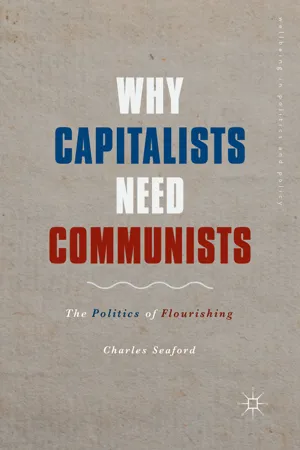
Britain faces huge challenges: inequality, public services under constant pressure, climate change - and in the long term, the impacts of automation and artificial intelligence. At the same time, the political and economic elite seem to have reached an impasse: there is a sense that things can only get worse. In Why Capitalists Need Communists, Charles Seaford demonstrates that this need not be, that radical, progressive change is perfectly possible and that the polarisation and nostalgia afflicting us is not inevitable. History shows that it is precisely when the ruling elite loses confidence – which it has – that significant change happens and that new alliances are formed to take over. Tackling the challenges will take planning, redistribution, re-fashioned business and finance, and a new ideology – one which confirms that we really can create the conditions for more people to flourish. But this is not a pipe-dream. This book sets out just how this can come about, based on interviews with over 50 business people, politicians, analysts and activists. Everyone with an interest in the future should read it.
Information
© The Author(s) 2019
Charles SeafordWhy Capitalists Need CommunistsWellbeing in Politics and Policyhttps://doi.org/10.1007/978-3-319-98755-2_11. Introduction
Charles Seaford1
(1)
London, UK
Charles Seaford
We are at a turning point: the orthodoxies that have dominated political and economic thinking since the 1980s are crumbling, and it is widely recognised that those orthodoxies won’t help us solve the big problems we face. I will argue in this book that there is an emerging and coherent alternative, what I have called the ‘politics of flourishing ’, and that members of an emerging counter-elite,1 upon whom major change normally depends, may be ready to adopt this alternative. It is based on a new set of ideas and ideals that between them can provide the cohesion needed for action and change the terms of political debate.
The biggest of our big problems are climate change and inequality , both of which may worsen as the developing world becomes more prosperous. These and three other related problems—automation , the housing shortage and the rising cost of public services —are the starting point for this book. They are not our only big problems, and inequality in particular is a shorthand for a whole complex of social and economic issues. However, the test of any alternative to the current orthodoxy will be whether it can help solve these problems, and other pressing issues which cluster round them, such as threats to biodiversity, obesity , family breakdown and immigration . i
Market Liberalism and Its Breakdown
Inequality in particular has led to turbulent politics. The world is getting richer but the lives of many in Europe and the US have been getting worse—and even when they haven’t been, people fear that they will. That is one of the reasons UK citizens voted for Brexit in 2016, one of the reasons they gave Labour its biggest vote share increase since 1945 in 2017, and one of the reasons they have become increasingly divided on immigration . ii In November 2016, the Americans elected Donald Trump . In France, radicals of the right and left, Marine Le Pen and Jean-Luc Mélenchon , attracted 41% of the vote between them in the first round of the 2017 presidential election. The winner, Emmanuel Macron , was successful because he presented himself as something new, and his party was indeed a new creation. In Germany, the far right AfD (Alternative für Deutschland) became the third largest party in the 2017 elections and entered the Bundestag for the first time with 90 seats. In Italy, the anti-establishment Cinque Stelle became the party with the largest number of votes (32%) in the 2018 elections and has formed a government with the right wing Lega .
Turbulence of this kind signals a breakdown, at least a temporary breakdown, of the deal between the elite — those with the most power—and the masses, the deal that is common to most democracies. ‘Vote for us’ say the politicians, ‘accept our wealth’ say the business leaders—‘and we will deliver steadily improving lives for you and your children.’ When the elite does not deliver on its part of the deal, it is hardly surprising that the masses decide the deal is off. As Financial Times correspondent Martin Wolf has put it, the “elites have failed” and “the durability of contemporary globalized capitalism cannot be taken for granted.” iii The root of this failure is in the relationship between the state and capital, or more concretely in the relationships between members of the elite representing the state and members representing capital. It is this failure that leads to blocks of flats burning down, inequality and climate change . Much of this book is about what it will take to reform these relationships .
The orthodoxy that has dominated since the 1980s is not ‘neoliberalism ’, the rabid adulation of markets that some extremists adopted and that became fashionable when Thatcher and Reagan were in power: a refusal to recognise market failure and injustice, a rejection of regulation and an insistence on business freedom. Rather it is a much more measured, rational and therefore beguiling system of thought shaped by neoclassical economics , that is the mainstream economic theory taught in universities . It is so much the orthodoxy that it doesn’t have a universally agreed name, but I shall call it ‘market liberalism .’ In this view of the world, markets produce the best possible outcomes but only if their well-understood failures, including environmental externalities and various social injustices, are addressed; crucially, proponents of this view believe that these failures can be addressed through a combination of market regulation , tax and subsidy. Economists can advise politicians on the technical failures, and voters can send signals about unacceptable levels of injustice or poor public service. Provided politicians respond with appropriate policies, a virtuous circle should follow: markets will produce economic growth , while political action will ensure its proceeds are fairly shared, softening those social tensions which, for example in the 1970s, have held back growth in the past.
This approach has been shared by all governing parties, with minor modifications, and underpins the Treasury’s formal guide to economic policy appraisal and evaluation, the Green Book .2, iv When Tony Blair and Gordon Brown came to power in 1997, it felt for many like a fresh breath of air after the slow decline of John Major’s government, and radical new policies were introduced on the constitution and public services . However, there was no significant change from the Major government’s economic policy or from its fundamental stance on markets and the working of the economy. The Labour leadership felt that to depart from this was to invite certain political defeat—although the orthodoxy was so strong that they would not have known how to depart from it even had they wanted to.
But, to be fair, there was no reason why they should have wanted to. The traditional market liberal economic programme which they inherited was supremely optimistic and at least partly successful: the combination of free markets , clever economists and wise politicians had produced good outcomes and could be expected to continue to do so. The result was a particular style of politics, what I shall call the ‘politics of consumption’, with politicians’ primary role being to raise living standards . For a Labour government this included raising the quality of public services . There were no enemies to threaten these standards, and so, according to the liberal prospectus, the process would ultimately lead to universal liberal democracy and a world where borders were irrelevant: the ‘end of history’ and a ‘flat world’, to paraphrase the titles of two books published in 1992 and 2005. v
We now know, of course, that this didn’t happen. The consensus is that things are more complicated than was previously thought and that the approach to the economy must change. Nonetheless market liberalism remains the orthodoxy, and even its extreme variant, neoliberalism , is alive and well. The European Commission ’s main economic department, DG ECFIN, for example, continues to argue for less product and labour market regulation in the interests of higher business investment; these arguments depend on entirely tendentious assumptions. In a recent paper presenting the evidence for its recommendation, it did not consider whether there were any trade-offs, whether the costs to workers and consumers that might result from reduced regulation would be justified by the increased investment that would result. It just assumed that they would be. Nor did it assess whether the damaging effect on investment in some countries that it identified would have been less severe had all countries adopted similar tough regulatory standards. Again, it just assumed it would not have been. vi
Similarly, in France, Macron won the 2017 general election with a partly neoliberal programme and in September of that year he signed five decrees weakening employee protection under the Code du Travail. He has also promised significant budget and tax cuts, mainly benefiting the richest 10%. Meanwhile, as a Washington Post headline put it, “Don’t let his trade policy fool you: Trump is a neoliberal.” vii As the article goes on to explain, he is offering a “messy mix of free market fundamentalism and hyper-nationalistic populism,” the latter mainly evident in increased spending on the military and border controls and some “mostly symbolic moves on trade.” This similarity between the two men’s economic policies (Macron also has his nationalist gestures, such as resisting foreign ...
Table of contents
- Cover
- Front Matter
- Part I. Why We Should Change
- Part II. Why We Can Change
- Part III. How We Can Change
- Back Matter
Trusted by 375,005 students
Access to over 1.5 million titles for a fair monthly price.
Study more efficiently using our study tools.
Frequently asked questions
Yes, you can cancel anytime from the Subscription tab in your account settings on the Perlego website. Your subscription will stay active until the end of your current billing period. Learn how to cancel your subscription
No, books cannot be downloaded as external files, such as PDFs, for use outside of Perlego. However, you can download books within the Perlego app for offline reading on mobile or tablet. Learn how to download books offline
Perlego offers two plans: Essential and Complete
- Essential is ideal for learners and professionals who enjoy exploring a wide range of subjects. Access the Essential Library with 800,000+ trusted titles and best-sellers across business, personal growth, and the humanities. Includes unlimited reading time and Standard Read Aloud voice.
- Complete: Perfect for advanced learners and researchers needing full, unrestricted access. Unlock 1.5M+ books across hundreds of subjects, including academic and specialized titles. The Complete Plan also includes advanced features like Premium Read Aloud and Research Assistant.
We are an online textbook subscription service, where you can get access to an entire online library for less than the price of a single book per month. With over 1.5 million books across 990+ topics, we’ve got you covered! Learn about our mission
Look out for the read-aloud symbol on your next book to see if you can listen to it. The read-aloud tool reads text aloud for you, highlighting the text as it is being read. You can pause it, speed it up and slow it down. Learn more about Read Aloud
Yes! You can use the Perlego app on both iOS and Android devices to read anytime, anywhere — even offline. Perfect for commutes or when you’re on the go.
Please note we cannot support devices running on iOS 13 and Android 7 or earlier. Learn more about using the app
Please note we cannot support devices running on iOS 13 and Android 7 or earlier. Learn more about using the app
Yes, you can access Why Capitalists Need Communists by Charles Seaford in PDF and/or ePUB format, as well as other popular books in Politics & International Relations & Comparative Politics. We have over 1.5 million books available in our catalogue for you to explore.