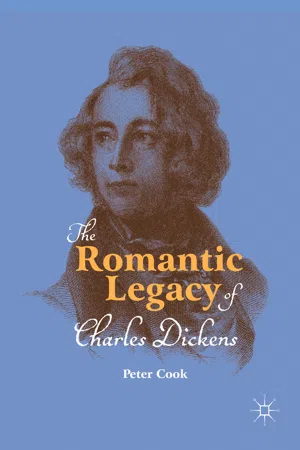
This book explores the relationship between Dickens and canonical Romantic authors: Blake, Wordsworth, Coleridge, Byron, Percy and Mary Shelley, and Keats. Addressing a significant gap in Dickens studies, four topics are identified: Childhood, Time, Progress, and Outsiders, which together constitute the main aspects of Dickens's debt to the Romantics. Through close readings of key Romantic texts, and eight of Dickens's novels, Peter Cook investigates how Dickens utilizes Romantic tropes to express his responses to the exponential growth of post-revolutionary industrial, technological culture and its effects on personal life and relationships. In this close study of Dickensian Romanticism, Cook demonstrates the enduring relevance of Dickens and the Romantics to contemporary culture.
- English
- ePUB (mobile friendly)
- Available on iOS & Android
eBook - ePub
The Romantic Legacy of Charles Dickens
About this book
Information
© The Author(s) 2018
Peter CookThe Romantic Legacy of Charles Dickenshttps://doi.org/10.1007/978-3-319-96791-2_11. Introduction
You are not so tolerant as perhaps you might be of the wayward and unsettled feeling which is part (I suppose) of the tenure on which one holds an imaginative life, and which I have, as you ought to know well, often only kept down by riding over it like a dragoon. 1
This frequently quoted complaint to John Forster is significant not only in intimating the conflicts that Charles Dickens experienced between his creative inner life and his external everyday life, but also in terms of the lack of understanding of these conflicts even among his closest literary friends, let alone his wider readership. A close reading of Dickens’s fictions reveals that he was only partially successful in keeping down these conflicts—like Silas Tomkyn Comberbache before him, he was ‘an indifferent dragoon’. 2 This study explores how Dickens found ways to stop riding roughshod over his deepest imaginative perceptions, and express in his fiction values and ways of thinking which were profoundly at odds with his time and place, but which because of his work came eventually to represent that time and place. Donald Stone’s observation that Dickens’s ‘Romantic sympathies are frequently at odds with his anti-Romantic views’ 3 is acute, but Stone follows Philip Collins in asserting that Dickens ‘probably owed much more to the Romantic middlemen—essayists such as Lamb , de Quincey and Leigh Hunt’ , than to ‘the poets’. 4 In this book, I will argue that it is through Dickens’s relationship with the work of ‘the poets’: Wordsworth , Blake, Coleridge , Percy Shelley, Keats and Byron, and with Mary Shelley , rather than Stone’s ‘middlemen’, that he was able to come to terms with and express much of his ‘wayward and unsettled [ … ] imaginative life’.
In his biography of Dickens, Peter Ackroyd makes a casual reference to Dickens and ‘the Romantic movement (of which he himself was the most important legatee)’. 5 There is no development of this huge, unqualified, tantalising parenthesis in Ackroyd’s book, and very little attention to its implications elsewhere. The most recent edition of the Oxford Companion to Charles Dickens (2011) reflects the situation precisely: there is no entry on ‘Romanticism’, although ‘Roman Catholic Church’ and ‘Royal General Theatrical Fund’, either side of where ‘Romanticism’ would have stood in the alphabetical sequence, are deemed important enough to merit inclusion. 6 Byron receives a substantial entry, Wordsworth and Coleridge briefer ones, while Blake, Keats, Mary Shelley and Percy Shelley do not receive entries. It is the aim of this study to fill this gap: to substantiate the assertion that Dickens was indeed an important legatee of the Romantic movement by offering a close reading of eight of his novels, exploring the extent to which their power and meaning are linked to Dickens’s struggles to overcome the anxiety of Romantic influence , to ‘unname the precursor while earning one’s own name’, 7 as Harold Bloom argues all great writers must. To trace this influence throws entirely new lights on Dickens’s achievement. It is my aim in this study to demonstrate precisely how and why.
Literary Context
Romanticism was a broad cultural movement; its protagonists linked to the social, technological and political upheavals of the time, and to each other, in often complex ways. Seamus Perry has traced the evolution of the word and noted that the writers themselves would not have described themselves or their work as ‘Romantic’ or ‘romantic ’, 8 with the fascinating exception of Coleridge . As Raymond Williams points out, 9 it was Coleridge who established the terms for future thought and debate. In Chapter 14 of Biographia Literaria , he distinguishes between Wordsworth’s poems for Lyrical Ballads, devoted to the ‘things of every day’, and his own, ‘directed to persons and characters supernatural, or at least romantic’. 10 In ‘Kubla Khan’ , he evokes ‘that deep romantic chasm which slanted/Down the green hill athwart a cedarn cover!’ 11 The word also carried less positive connotations for Coleridge. In a letter to a friend in 1796, he bemoans the Pantisocracy venture as ‘a scheme of virtue impracticable and romantic’. 12 Dickens too was to use the word tellingly, and with a parallel range of meaning, in his fictions. In the ‘Preface’ to the first edition of Bleak House , he echoes Coleridge’s Lyrical Ballads distinction between the ‘every day’ and the ‘romantic’ and hints at their union in his fiction: ‘I have purposely dwelt upon the romantic side of familiar things’. 13 Out of such uses of ‘romantic ’, of course, came ‘Romantic’. 14
Jeffrey Robinson argues against what he calls the ‘institutional Romanticism’ of critics who characterise the movement as brief, escapist, and inward-looking. 15 Robinson argues convincingly for ‘the recovery of the radical dynamic of Romantic poets’, and sees a ‘vital continuity between a radical Romanticism and modern […] innovative poetry and politics’. 16 Andrew Radford and Mark Sandy also stress its abiding relevance, writing of ‘the ambiguous yet sustained fascination that Romanticism held for many subsequent nineteenth-century intellectuals. Its allure is a heady mixture of aspiration and transgression, the ennobling and the subversive, which continues its appeal to the present day’. 17
Marilyn Butler is right to warn against oversimplified notions of Romanticism as exclusively ‘revolutionary’. 18 But there seems little doubt that this ‘heady mixture’ had its origins in writers’ reactions to the changes effected by the American and French Revolutions and the Industrial Revolution . Blake, Wordsworth and Coleridge immersed themselves in the atmosphere of the 1790s, openly declaring their support for radical change and the spirit of the French Revolution , and their fears for the effects of industrialisation, in poems, dramas, lectures and journalism. Shelley called the French Revolution ‘the master plot of the epoch in which we live’ 19 and proclaimed the central role of writers in the process: ‘The great writers of our own age are […] the companions and forerunners of some unimagined change in our social condition or the opinions which cement it. The cloud of mind is discharging its collected lightning’. 20 William Blake wrote The French Revolution (1791) and America, a Prophecy (1793), 21 and proclaimed in ‘Now Art has lost its mental Charms’ :
France shall the arts of Peace restore,
. . . . .
Spirit, who lov’st Brittania’s Isle
Round which the Fiends of Commerce smile
Lyrical Ballads famously announced the most radical literary shift of all, the desire ‘to ascertain how far the language and conversation in the middle and lower classes of society is adapted to the purposes of poetic pleasure’, and write poetry with ‘a natural delineation of human passions, human characters, and human incidents’. 23 These aspirations required radical new techniques and forms, new approaches to diction and imagery. And these evolved rapidly, as Richard Cronin notes: ‘the careers of the Romantic poets [who] completed, in a decade, five years, or less, a process of poetic...
Table of contents
- Cover
- Front Matter
- 1. Introduction
- 2. Childhood
- 3. Time
- 4. Progress
- 5. Outsiders
- 6. Conclusion
- Back Matter
Trusted by 375,005 students
Access to over 1.5 million titles for a fair monthly price.
Study more efficiently using our study tools.
Frequently asked questions
Yes, you can cancel anytime from the Subscription tab in your account settings on the Perlego website. Your subscription will stay active until the end of your current billing period. Learn how to cancel your subscription
No, books cannot be downloaded as external files, such as PDFs, for use outside of Perlego. However, you can download books within the Perlego app for offline reading on mobile or tablet. Learn how to download books offline
Perlego offers two plans: Essential and Complete
- Essential is ideal for learners and professionals who enjoy exploring a wide range of subjects. Access the Essential Library with 800,000+ trusted titles and best-sellers across business, personal growth, and the humanities. Includes unlimited reading time and Standard Read Aloud voice.
- Complete: Perfect for advanced learners and researchers needing full, unrestricted access. Unlock 1.5M+ books across hundreds of subjects, including academic and specialized titles. The Complete Plan also includes advanced features like Premium Read Aloud and Research Assistant.
We are an online textbook subscription service, where you can get access to an entire online library for less than the price of a single book per month. With over 1.5 million books across 990+ topics, we’ve got you covered! Learn about our mission
Look out for the read-aloud symbol on your next book to see if you can listen to it. The read-aloud tool reads text aloud for you, highlighting the text as it is being read. You can pause it, speed it up and slow it down. Learn more about Read Aloud
Yes! You can use the Perlego app on both iOS and Android devices to read anytime, anywhere — even offline. Perfect for commutes or when you’re on the go.
Please note we cannot support devices running on iOS 13 and Android 7 or earlier. Learn more about using the app
Please note we cannot support devices running on iOS 13 and Android 7 or earlier. Learn more about using the app
Yes, you can access The Romantic Legacy of Charles Dickens by Peter Cook in PDF and/or ePUB format, as well as other popular books in Literature & European Literary Criticism. We have over 1.5 million books available in our catalogue for you to explore.