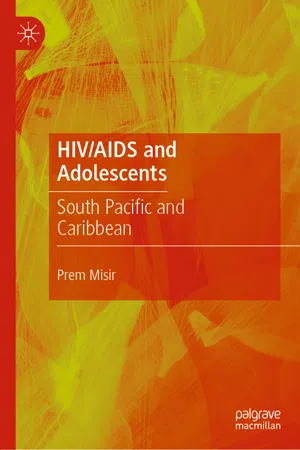
This book addresses the relationship between high school students' HIV and AIDS knowledge and their stigma-related attitudes/perceptions of people living with HIV (PLHIV) in the Caribbean and South Pacific, with a view to designing effective stigma-reduction combined intervention programs.
Presenting an international cross-sectional study using a purposive sample of high school students from Fiji (South Pacific), Vanuatu (South Pacific), Guyana, and Antigua & Barbuda (Caribbean) to assess HIV and AIDS knowledge and stigma-related attitudes by gender, age, religion, race/ethnicity, and socioeconomic status, the book shows how stigmatizing attitudes and beliefs negatively impact interventions to prevent and treat HIV and AIDS.
Prem MisirHIV/AIDS and Adolescentshttps://doi.org/10.1007/978-981-13-5989-7_1
Begin Abstract
1. Introduction
Prem Misir1
(1)
The University of the South Pacific (USP), Solomon Islands Campus, Honiara, Solomon Islands
Prem Misir
End Abstract
Three and half decades ago, a major public health phenomenon, more dreadful than the Black Death, descended upon humankind. This phenomenon which continues to plague the global population is Acquired Immunodeficiency Syndrome (AIDS), the end-stage of the Human Immunodeficiency Virus (HIV). HIV is the virus that produces AIDS, and AIDS emerges at the later stages of the HIV infection. Even though there are precautionary measures that people can take to avoid or limit their chances of contracting this fatal virus, HIV/AIDS remains a serious threat to human existence because at this time, the virus is transmittable as well as incurable. In the search for a cure, technical clinical skills remain a potent necessity. At the same time, in the absence of a cure, behavioral skills and knowledge, possible preconditions for behavioral changes, persist as an absolute necessity to stem the flow of HIV transmission.
There is a view out there that presents AIDS not as an epidemic, but a plague (Roell 2018). This view suggested that the term ‘epidemic’ does not depict the full gamut of human suffering. This interpretation probably implies that this is the first disease that impacts each person in a family, and the communities where they live and work, and, indeed, the disease is global. Undeniably, many developing countries are at the mercy of this epidemic. These factors place developing countries at high risk for transmitting HIV: illiteracy, low per capita income, genderdiscrimination, inadequate HIV transmission knowledge, and social stigma (Othman 2014). Population growth, urban migration, sociocultural barriers, and deficient prevention activities also could contribute to HIV/AIDS transmission (UNAIDS2012).
UNAIDS (2018) presented the following global statistics:
36.9 million PLHIV in 2017.
21.7 million people had access to antiretroviral therapy in 2017.
1.8 million people were newly infected with HIV in 2017.
940,000 people succumbed to AIDS-related illnesses in 2017.
77.3 million people were HIV-infected since the commencement of the epidemic in 1981.
35.4 million people died from AIDS-related illnesses since the commencement of the epidemic in 1981.
PLHIV
In 2017, PLHIV numbered 36.9 million, of which 35.1 million were adults and 1.8 million were children < 15 years.
75% of PLHIV were aware of their HIV status in 2017, but circa 9.4 million people were unaware that they contracted HIV.
PLHIV with Access toAntiretroviralTreatment
In 2017, 21.7 million PLHIV had access to antiretroviral therapy, a rise of 2.3 million since 2016 and an increase from 8 million in 2010.
In 2017, 59% of all PLHIV had access to antiretroviral treatment.
In 2017, 80% of HIV-infected pregnant women had access to antiretroviral treatment.
New Infections
In 2017, new HIV infections showed a 47% reduction, since its highest number in 1996.
90–90–90
In 2017, 3 out of 4 PLHIV (75%) were aware of their HIV status.
Among PLHIV who were aware of their status, 4 out of 5 of them (79%) had access to antiretroviral treatment.
Of those accessing treatment, 4 out of 5 (81%) experienced viral suppression.
47% of all PLHIV were virally suppressed.
Women
Each week, some 7000 young women aged 15–24 contract HIV.
In excess of one-third (35%) of women globally experience physical and/or sexual violence; in some regions, women who are victims of violence are one and a half times more probable to contract HIV.
HIV/Tuberculosis (TB)
TB is the leading cause of death among PLHIV, generating 1 in 3 AIDS-related deaths.
In 2016, 10.4 million people contracted TB, of which 1.2 million were PLHIV. PLHIV with no TB symptoms should have TB preventative therapy, which may reduce the risk of contracting TB and could cut TB/HIV death rates by about 40%.
Unquestionably, there have been considerable gains in the fight against HIVand AIDS. UNAIDS (2018) provided some regional statistics for 2017, thus:
Eastern and Southern Africa which is the world’s most HIVand AIDS-ravaged region had about 12.9 million people with access to treatment; there were 19.6 million PLHIV; in addition, there were 380,000 AIDS-related deaths.
In the Asia and Pacific region, there were 5.2 million PLHIV; 2.7 million persons with access to treatment; 280,000 new infections; and 170,000 AIDS-related deaths.
In Latin America, there were 1.8 million PLHIV; 100,000 new infections; 37,000 AIDS-related deaths; and 1.1 million people with access to treatment.
In the Caribbean, there were 310,000 PLHIV; 15,000 new infections; 10,000 AIDS-related deaths; and 181,000 persons with access to treatment.
Figure 1.1 provides a sense of the current HIV/AIDS scenario: there were 36.7 million PLHIV in 2016 (36.9 million PLHIV in 2017); only 70% knew that they were HIV positive; about 50% of PLHIV had access to treatment; and about 44% had untraceable levels of HIV. And so, there was the need for a new strategy to combat HIVand AIDS, thus, the current pursuit of the 90–90–90 treatment target: by 2020, 90% of PLHIV will know their HIV status; by 2020, 90% who will know their HIV status will receive treatment; and by 2020, 90% receiving treatment will have a repressed viral load (UNAIDS2016). UNAIDS favors this strategy because it is not possible to end the AIDS epidemic without antiretroviral treatment.
Fig. 1.1
90–90–90 treatment for all (
Source [UNAIDS2016])
Significance of Study
The evidence is clear that significant advances continue to penetrate almost every dimension of the fight against HIVand AIDS. But advancements for adolescents are still way behind. The WHO defines adolescents as persons within the 10–19 age group (WHO 2018). In this multi-country study, the high school students were adolescents, who constituted on average about 20% or one-fifth of the total population in each of the four countries (Fiji, Vanuatu, Antigua and Barbuda, and Guyana).
The United Nations Children’s Fund (UNICEF) (2018) n...
Table of contents
Cover
Front Matter
1. Introduction
2. A Systematic Review of the Literature
3. Methodology
4. HIV/AIDS Knowledge
5. HIV/AIDS Stigma
6. Predictors of HIV/AIDS Knowledge and HIV-Related Stigma
7. Discussion and Implications
Back Matter
Trusted by 375,005 students
Access to over 1.5 million titles for a fair monthly price.
Study more efficiently using our study tools.
Frequently asked questions
Yes, you can cancel anytime from the Subscription tab in your account settings on the Perlego website. Your subscription will stay active until the end of your current billing period. Learn how to cancel your subscription
No, books cannot be downloaded as external files, such as PDFs, for use outside of Perlego. However, you can download books within the Perlego app for offline reading on mobile or tablet. Learn how to download books offline
Perlego offers two plans: Essential and Complete
Essential is ideal for learners and professionals who enjoy exploring a wide range of subjects. Access the Essential Library with 800,000+ trusted titles and best-sellers across business, personal growth, and the humanities. Includes unlimited reading time and Standard Read Aloud voice.
Complete: Perfect for advanced learners and researchers needing full, unrestricted access. Unlock 1.5M+ books across hundreds of subjects, including academic and specialized titles. The Complete Plan also includes advanced features like Premium Read Aloud and Research Assistant.
Both plans are available with monthly, semester, or annual billing cycles.
We are an online textbook subscription service, where you can get access to an entire online library for less than the price of a single book per month. With over 1.5 million books across 990+ topics, we’ve got you covered! Learn about our mission
Look out for the read-aloud symbol on your next book to see if you can listen to it. The read-aloud tool reads text aloud for you, highlighting the text as it is being read. You can pause it, speed it up and slow it down. Learn more about Read Aloud
Yes! You can use the Perlego app on both iOS and Android devices to read anytime, anywhere — even offline. Perfect for commutes or when you’re on the go. Please note we cannot support devices running on iOS 13 and Android 7 or earlier. Learn more about using the app
Yes, you can access HIV/AIDS and Adolescents by Prem Misir in PDF and/or ePUB format, as well as other popular books in Business & Management. We have over 1.5 million books available in our catalogue for you to explore.