The book examines the international treaty regimes and the Indian laws in depth. It also looks into the landmark cases, decided by both, the domestic courts in India and the international tribunals. The book would give an understanding between the concepts of extradition in relation to terrorism-related cases. It would provide an in-depth understanding of the inter-relatedness of the various branches of International law and the municipal laws as well.
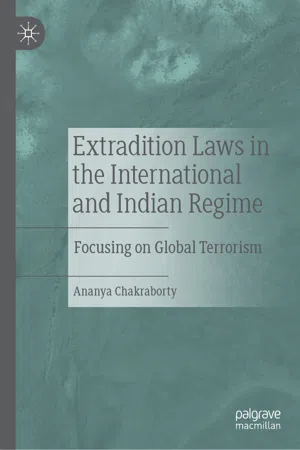
eBook - ePub
Extradition Laws in the International and Indian Regime
Focusing on Global Terrorism
- English
- ePUB (mobile friendly)
- Available on iOS & Android
eBook - ePub
Extradition Laws in the International and Indian Regime
Focusing on Global Terrorism
About this book
Information
© The Author(s) 2019
Ananya ChakrabortyExtradition Laws in the International and Indian Regimehttps://doi.org/10.1007/978-981-13-6397-9_11. Introduction
Ananya Chakraborty1
(1)
National Law University Odisha, Cuttack, India
Ananya Chakraborty
Keywords
ExtraditionTerrorismAut dedere aut judicareSAARC1.1 Conceptualizing the Problem
The term “Extradition ” means a procedure followed between nations where it enables one state to hand over to another state suspected or convicted criminals who have fled to the territory of the former. It implies the legal duty to either prosecute or extradite which is contained within several multilateral instruments aimed at securing international cooperation in the suppression of certain kinds of criminal conduct.1 The laws of extradition have been derived wholly from treaty sources which have resulted in considerable uniformity in respect of certain important matters within the bilateral treaties and municipal extradition statutes.2 International law allows states substantial flexibility to set up their municipal legal structure for extradition, because of diverse customs and approaches followed by both civil and common law systems. In spite of these different approaches, the laws of extradition have still been able to develop a body of common principles, as follows:
- The requesting state is required to present an official extradition demand;
- Extradition being made subject to fulfilling the requirement of being an “extraditable offence ”;
- The principle of double criminality [PODC];
- Evidence of guilt;
- The rule of speciality [RoS].3
Basic principles of laws of extradition have gone through further changes by regional developments. One of such watershed development has been the (FDEAW),4 which has precluded the application of PODC under certain kinds of offences.5
The laws of extradition in spite of the developments have not failed to safeguard the individuals’ interests. A number of exceptions to the obligation to extradite primarily related to the personal circumstances of the alleged offender, existing peculiarities with regard to criminal proceedings in the requesting nation and to certain categories of offences, are to be found in most extradition treaties and are reflected in national extradition acts. The situations where an individual can be exempted from being extradited are as follows:
- Principle of non-extradition of nationals;
- Principles of fundamental justice and fairness;
- Possibility of being subjected to death penalty ;
- Humanitarian exceptions ;
- Military offences ;
- Political offences .
In the light of the aforesaid information, the author looks into the very fundamental question, as to, if states are under any duty to extradite or not, before discussing the challenges to be overcome by the laws of extradition . “Aut dedere aut judicare (ADAJ) ” is considered as one of the important philosophy behind the concept of extradition, which is considered to be the contemporary version of the phrase “Aut Dedere Aut Punire (ADAP)” as originally proposed by Grotius. The modern discourse is more focused on the kind of obligation, treaty based or customary, that states have under international law, in relation to international crimes, like War Crime (WCs); Crimes against humanity (CAH); actions which may fall within the contours of terrorism ; and transnational offences. Applying principles of erga omnes and jus cogens , the nations under obligation to prohibit CAH and such international concurrence among nations to assist commission of such offences would be void. The concept of universal jurisdiction under International Criminal Law (ICL) has led many to believe that every nation is possessing right to take legal action or engage in civil suits against the person responsible for committing jus cogens crimes, who are later found on their territory, which would also consequently lead to a duty to extradite or prosecute those who have committed such crimes. However, the state practice 6 of giving way to amnesty agreements or asylum to individuals indicted for committing CAH, have made it more difficult to say conclusively that nations have an obligation to extradite, for the commission of international offences.
Over centuries, extradition has become one of the key factors to deliver justice to the victims of international crimes. The scope of international crimes has also been expanding over centuries with more focus on seeing that no individual can get away with impunity . To that extent we have even witnessed significant developments made in the branch of ICL , with active support from the office of the Security Council and the comity of nations on a whole. All the international or semi-international forums that have been created post-UN for addressing punishment of individuals have primarily focused on the breaches of International humanitarian law (IHL) . IHL also has kept up with the challenges that are faced in the modern conflicts, which are again mostly Non-International Armed Conflict (NIAC) in nature. It is in this respect, the author must delve into the changing methods of fighting in NIACs , which over the last few decades have mostly comprised acts, which are popularly called “acts of terrorism ”. Terrorism comprises offences which are defined both in international conventions and in municipal legislations. When an offence has been committed which can be categorized as a terrorist act, it becomes important to the get the accused to face prosecution in the domestic courts, incorporating at times both international law and municipal laws, making extradition a very important aspect.
It is in this light, the author studies the extradition laws in the light of international treaties under the UN as well as Regional Arrangements.
The author would now shift focus on the member nations of the “South Asian Association for Regional Cooperation (SAARC) ”, specially on India and its relation with the SAARC members,7 focusing more on the ways they cooperate to meet the challenges of the modern nature of crimes and if extradition as a tool has emerged as effective or not. One of the key objectives8 behind establishing SAARC was to improve the quality of life for people in South Asia; to work towards mutual trust and understanding of one another’s problems. In the light of such objectives, SAARC as an organization has taken up quite a few initiatives to fulfil them, especially in building mutual trust, for example, by establishing SAARC Terrorist Offences Monitoring Desk (STOMD),9 SAARC Drug Offences Monitoring Desk (SDOMD),10 and discussions are on establishing SAARC Police (SAARCPOL).11 In addition to the said efforts, some of the SAARC nations have also committed themselves to conventions on terrorism .12 For the past many decades, South Asia has been witnessing internal unrests and upheavals arising from a range of destabilizing factors like religious fundamentalism, ethnic conflicts and intense political polarization and the most disturbing fact remains that many states continue to provide direct or indirect support to terrorist organizations.13 Despite these initiatives, regional efforts to counter-terrorism continue to face significant challenges.14 As early as 1987, the region’s political leaders agreed on the SAARC Regional Convention on Suppression of Terrorism (SAARCRCST), which obliged parties to criminalize the acts under the convention as terrorist acts, and for this purpose called for cooperation among its member states on extradition , evidence sharing and other forms of information exchange and cooperation to prosecute individuals who have allegedly committed such grave crimes.15
In the light of the above-mentioned circumstances, it becomes for all the SAARC members to work in cooperation and adopt measures, like frequent intelligence sharing; having extradition treaties among themselves; and also ratifying the said regional terrorism conventions16 by all the members. The researcher would after doing a comprehensive study of the situation prevailing in the SAARC countries solely focus on India with respect to its security concerns; its relation with the SAARC members with respect to mutual legal assistance .17
1.2 The Issues and Challenges of Extradition
The issues and challenges related to extradition practices are multi-fold. These challenges exist primarily because of lack of political will on...
Table of contents
- Cover
- Front Matter
- 1. Introduction
- 2. Growth of Extradition Under International Legal Regime
- 3. International Legal Regime: Analysis of Cases Relating to Global Terrorism
- 4. Extradition: Analysis of National Legal Regime and Cases
- 5. Extradition: Emerging Issues, Challenges and Cases
- 6. Conclusion and Suggestions
- Back Matter
Trusted by 375,005 students
Access to over 1.5 million titles for a fair monthly price.
Study more efficiently using our study tools.
Frequently asked questions
Yes, you can cancel anytime from the Subscription tab in your account settings on the Perlego website. Your subscription will stay active until the end of your current billing period. Learn how to cancel your subscription
No, books cannot be downloaded as external files, such as PDFs, for use outside of Perlego. However, you can download books within the Perlego app for offline reading on mobile or tablet. Learn how to download books offline
Perlego offers two plans: Essential and Complete
- Essential is ideal for learners and professionals who enjoy exploring a wide range of subjects. Access the Essential Library with 800,000+ trusted titles and best-sellers across business, personal growth, and the humanities. Includes unlimited reading time and Standard Read Aloud voice.
- Complete: Perfect for advanced learners and researchers needing full, unrestricted access. Unlock 1.5M+ books across hundreds of subjects, including academic and specialized titles. The Complete Plan also includes advanced features like Premium Read Aloud and Research Assistant.
We are an online textbook subscription service, where you can get access to an entire online library for less than the price of a single book per month. With over 1.5 million books across 990+ topics, we’ve got you covered! Learn about our mission
Look out for the read-aloud symbol on your next book to see if you can listen to it. The read-aloud tool reads text aloud for you, highlighting the text as it is being read. You can pause it, speed it up and slow it down. Learn more about Read Aloud
Yes! You can use the Perlego app on both iOS and Android devices to read anytime, anywhere — even offline. Perfect for commutes or when you’re on the go.
Please note we cannot support devices running on iOS 13 and Android 7 or earlier. Learn more about using the app
Please note we cannot support devices running on iOS 13 and Android 7 or earlier. Learn more about using the app
Yes, you can access Extradition Laws in the International and Indian Regime by Ananya Chakraborty in PDF and/or ePUB format, as well as other popular books in Law & Civil Rights in Law. We have over 1.5 million books available in our catalogue for you to explore.