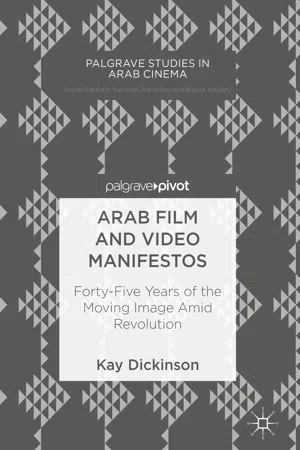
Arab Film and Video Manifestos presents, in their entirety, five key documents that have fundamentally shaken up and helped change the face of image culture in the Middle East and beyond. The book collects together, for the first time, these influential, collectively written calls and directives that span a fifty-year period and hail from a range of different countries. Each urges a radical rethinking of film and video's role in culture, its relation to politics, and its potential to instigate profound change. Kay Dickinson carefully positions the manifestos within their broader socio-historical contexts and provides supplementary reading and viewing suggestions for readers who cannot access Arabic-language sources.
eBook - ePub
Arab Film and Video Manifestos
Forty-Five Years of the Moving Image Amid Revolution
- English
- ePUB (mobile friendly)
- Available on iOS & Android
eBook - ePub
About this book
Information
Subtopic
Film & Video© The Author(s) 2018
Kay DickinsonArab Film and Video ManifestosPalgrave Studies in Arab Cinemahttps://doi.org/10.1007/978-3-319-99801-5_11. Why the Manifesto?
Kay Dickinson1
(1)
Mel Hoppenheim School of Cinema, Concordia University, Montreal, QC, Canada
Kay Dickinson
Abstract
This chapter explores how the manifesto form aims not to interpret the world, but to change it. It investigates how the manifesto became a popular format in the Arab world, one with particular commitment to anti-colonial liberation. The rousing stylistic potential of the manifesto genre receives attention, as does the group authorship of the five documents collected within the subsequent chapters. These manifestos interweave different temporal registers in order to challenge a debilitating conceptualization of history. They also invoke a sense of “the people” so vital for collective struggle. By presenting highly practical suggestions, these manifestos suggest how that struggle might be enacted and what sorts of brighter futures they can bring into being.
Keywords
ManifestoRevolutionArab historiography“The people”Communal writingWhat can writing about the moving image accomplish? The five film and video manifestos compiled in this volume hold high hopes for the answer to that question, as well as for the moving image’s own capacity to foment profound change. Not for the manifesto the small-scale modesty or narrowly evaluative focus familiar from academic or critical expression. These documents ask: what can film do for society? And vice versa? Although they span a forty-five-year period (1968–2013) and hail from a range of different places (Egypt , international gatherings in Algeria , Palestine in exile), each urges, and puts faith in, a radical role for film or video’s role in culture and politics. Their authors hitch their ambitions to a particular genre of writing that they deem laden with possibility. To fully grasp the promise they find in it, this introductory chapter examines the capacities of the manifesto form itself, its ways and means, as well as its particular status in the Arab world.
First and foremost, a manifesto is a public declaration of intentions. The five upcoming documents decline to cower in reticently analytical registers because they have serious political work to accomplish. They compel us to see things as they are and as they should be, to convert, to act and, in the particular examples selected for this anthology, to join the revolution, through cinema and all other ways. They are nourished by a deep rooting in the political openings of their times and in their discernment of the transformative facilities of mass culture. Their writers stand up as committed militants in the wars against colonization, trade inequality and social injustice. They challenge the unjust means by which moving images circulate as commodities, and the confining pronouncements and misrepresentations in which they transact. They pull us straight to the heart of how film workers themselves understand the medium; its traditions, processes, practices and industries; its methods of communication and dissemination.
In reaching further than most writing about cinema, they surpass criticality for revolutionary intention. They do not stop short at emphatically pronouncing what is wrong. In almost the same breath, they compel practical means for change and concrete plans for acting otherwise. Their avowed participation in broader politics stimulates their concoction of correctives and solutions, dreams and perfect scenarios, simultaneous to their onslaught against oppression. As a genre, the manifesto denounces past mistakes and tragedies, fidgets uneasily and impatiently in an inadequate present and dares to project an unambiguous, tangible, preferable future. These five manifestos help formulate alternative social imaginaries of which a new horizon for cinema is merely one feature. Film workers here decisively articulate what they want from and for their medium; its capacity as a weapon in the struggle for freedom; how, in the immediate, it can function otherwise; and its place when that freedom is attained. Rarely is writing about cinema so dedicated to reform. Rarely does it call on us so unequivocally to join collective forces to demand what is due us all.
Doing justice to the manifesto’s reach into the future, this book advocates for something more than appreciating writings from the past as a window into bygone days. For certain, these five manifestos unlock, through their direct participation, valuable insights into broader liberation movements, from pan-Arabism and Third Worldism to the Palestinian struggle and the so-called Arab Spring. Yet the very circumstances prompting these mobilizations, the injustices they remonstrate, largely persist. This being the case, these manifestos remain vibrantly pertinent in their proposals about everything from decolonization and governmental oppression to the nuts and bolts of financing, distribution, audience activation, intellectual property and the social purpose of the filmmaker. The futures they model still have much to offer and hence the drive to bring them new readers.
Their infectious fighting spirit rouses us to explore the potential writing itself can activate. If manifestos contribute to more ambitious political mobilization, can historical analysis (of them) too? From within the discourses of revolutionary Arab historiography, the response to this question would be a resounding “yes.” As just one proponent of such activity, the Moroccan intellectual Abdallah Laroui, coming to the fore as part of the national liberation efforts of the 1960s, latches onto the past’s “instability, that constant changing of historical perspective,” the same restlessness familiar from the manifesto (Laroui 1970: 66). Laroui refuses to conceive of history as finished or as a static picture. For him, this interpretation colludes with the pinioning objectives of imperialism, its ambition to detain the Arab world in a stagnancy that is altogether easier to dismiss and control (see, for instance, Laroui 1970: 131, 136, 166–168). Instead, historiographers of his ilk throw themselves into history’s dynamism, particularly the forces that pit themselves against foreign domination (also a primary aggressor for our five manifestos). Another scholar, Youssef M. Choueiri, summarizes Laroui’s approach as one that “unleashes [history] into the turbulent passage of becoming. Its qualities are constantly changing in the whirlwind of conquests, invasions, and uprisings” (Choueiri 2003: 193). History simultaneously reveals, informs, reinforces and enacts struggle as it takes shape and transmogrifies. Through history, through its manifestos and fuelled by their vitality, entreaties from the past can open us to liberation as active participants within that history and what lies ahead of it.
Accordingly, this introduction first gauges how the manifesto became a popular format in the Arab world and assesses how these specificities of regional history might energize the present and future. The chapter then spends time within what the manifesto’s style of writing can induce, the potential surging-out of the form itself. Further in, the temporalities that the manifesto draws together are assessed: its interrelationship of past, present and future. Amidst all this, how does the manifesto fashion an “us” so vital for collective struggle? How does it speak out to but also create publics against and through which to achieve its objectives? All five manifestos compiled here were written communally. They thus fundamentally challenge individualistic expression in favour of speaking collectively about how an expansive implied “we” should act. Lastly, the closing section involves itself in how manifestos present their objectives as achievable through highly practical suggestions. They do so by encouraging at the same time as embodying filmmaking and writing praxis (the integration of theory and practice). In so doing, they fold their own activities into their desired templates for social, cultural, political and economic life. This introduction suspends the urge to discuss the role particular movies have played in these activities in order to dedicate its energies to the much less studied capabilities of the manifesto itself. As each primary document is introduced in the subsequent chapters, case study films will be drawn in so that cinematic output can be recognized as, of course, a central contributor to these manifestos’ revolutionary milieux.
Manifest History, Manifesto History
The Arab world is a place where manifestos have gained strong purchase historically. Indeed, a number of popular accounts of the ancestry of the manifesto cite the Baghdad Manifesto of 1011 as the genre’s genesis point. In reality, this text is more of an edict: the Abbasid caliphate declaiming the divine ascendancy of the Fatimid dynasty. All the same, tracing the manifesto’s lineage from this point encourages an acknowledgement of the genre’s sustained and efficacious presence across this part of the world. Manifestos, as will become apparent, have proven themselves a central component of political operations in the region.
From the outset, we have to concede that “manifesto” is not an Arabic word. We find an opening here, rather than a closure. What, in English (and other languages), we would ascribe to the manifesto is work typically done in the region by the term bayan , whose semantics are more capacious and enabling. Bayan means not just manifesto but also declaration, statement, communiqué and even inventory. This constellation insinuates and formally encourages the listing of objectives that these types of documents embrace. Like so many Arabic words, bayan derives from a three-letter verbal root that proliferates an array of associated connotations. In this case, the root is b-y-n, a designation from whose kernel spring a number of other related connotations: to be evident, totally separate, make clear (form 2 of the verb, for Arabic speakers), to set forth, and discriminate (form 3), as well as further nouns implying rhetoric and eloquence. All these sibling meanings stoke manifestos’ clarity, flourish and demarcation of severance as they spiral outwards from its Arabic iterations. They offer expanded possibilities for the genre as a tool of revolution, cinematic and beyond. Etymology here cultivates various qualities that become exceedingly advantageous to the formulation of political gesture. Pronouncement binds with itemized stipulation and ideals with concrete backing.
It is no wonder, then, that recent Arab history is awash with manifestos, from Muammar Gaddafi’s Green Book of 1975—part political agenda, part jumble of aphorisms, an everyday presence in media and education during its author’s dictatorship—to Hezbollah’s of 2009. Practically every political presence in the region has entered public discourse via this format and a not infrequent number mention the media. The Constitution of the Ba‘ath Party of 1947, at that point a manifesto, but latterly a founding discourse of governance, even explicitly petitions for media usage “which will be nationalist, Arab, free, progressive, comprehensive, profound, and humane in its goals” and thereby “improve the lot of the people” (“The Constitution of the Arab Resurrection. (Ba‘ath) Socialist Party of Syria,” 1959: 199, 200). Hasan al-Banna, founder of the Muslim Brotherhood in 1928, also drew film into his public declarations. His 1947 open letter statement, “Toward the Light,” for instance, encompasses a call for “The surveillance of theatres and cinemas, and a rigorous selection of plays and films” into a thirty-point list of what needs to be done regarding “the social and educational” (Al-Banna 1978: 127). Here we stray far from the beliefs of the five manifestos compiled in this volume, their writers often in direct confrontation with these parties and figures. The aim of citing them is to underscore the concentration and diversity of manifestos, not their similarities.
Yet, all these declarations, and many more, stem from the particular shape of modern Arab history, one that confirms Laroui’s insistence on immanence and struggle. This is not a region marked by slow, plodding democratic evolution. Instead, it has been wrought by imperialism and other despotisms, where revolutions are conjured in the mind, on paper, then enacted. Sometimes the manifesto even converts to doctrine via successful ascendance to power, as has been the case in Syria. However precarious or risky, these situations-in-waiting propagate a common people and a common ground into and for which rebellious proclamations can be dispatched. The planning of revolutionary action is well rehearsed in the Arab world and finds its iterations in the realms of filmmaking too, as well as the arts more generally (for a fuller account of the Arab literary manifestos, see Halim 1991; for the arts movements of the mid-twentieth century, LaCoss 2009–2010 and 2010; and for primary visual arts documents, including manifestos, Lenssen et al. 2018).
Once in power, many of the region’s regimes have then followed programmatic, statist inscriptions for the future: the sort of long-term projections that a stable government (often through refusal of meaningful elections) can envision without more democratic negotiations, blockages and compromises. These plans are regularly delivered in manifesto-like forms that reiterate incipient declarations. An example here would be President Gamal Abdel Nasser of Egypt’s National Charter, which proposed constitutional, political, social and economic reforms that soon followed on from its publication in 1964. Throughout the mid-twentieth century, centralized planning reigned with the governments of Egypt (under Nasser ), Algeria and Syria , redistributing agricultural land and reforming education, healthcare and labour according to scientific socialist principles. Even regimes much further to the right, such as those in the Gulf, have coordinated life from the top down (although certainly not through manifestos), with the state insisting itself as the primary organizer of public life. From all corners, the development, progress and good of the citizen have thereby been sculpted according to a staged rolling-out of...
Table of contents
- Cover
- Front Matter
- 1. Why the Manifesto?
- 2. The Naksa’s New Cinema: New Cinema Group, “Manifesto of New Cinema in Egypt” (1968)
- 3. Cinematic Third Worldism: “Resolutions of the Third World Filmmakers Meeting” (Algeria 1973)
- 4. Cinema Within Armed Struggle: “Manifesto of the Palestinian Cinema Group” (1972) and Popular Front for the Liberation of Palestine, “The Cinema and the Revolution”
- 5. “The Images are the Revolution’s”: Mosireen, “Revolution Triptych” (2013)
- Back Matter
Trusted by 375,005 students
Access to over 1.5 million titles for a fair monthly price.
Study more efficiently using our study tools.
Frequently asked questions
Yes, you can cancel anytime from the Subscription tab in your account settings on the Perlego website. Your subscription will stay active until the end of your current billing period. Learn how to cancel your subscription
No, books cannot be downloaded as external files, such as PDFs, for use outside of Perlego. However, you can download books within the Perlego app for offline reading on mobile or tablet. Learn how to download books offline
Perlego offers two plans: Essential and Complete
- Essential is ideal for learners and professionals who enjoy exploring a wide range of subjects. Access the Essential Library with 800,000+ trusted titles and best-sellers across business, personal growth, and the humanities. Includes unlimited reading time and Standard Read Aloud voice.
- Complete: Perfect for advanced learners and researchers needing full, unrestricted access. Unlock 1.5M+ books across hundreds of subjects, including academic and specialized titles. The Complete Plan also includes advanced features like Premium Read Aloud and Research Assistant.
We are an online textbook subscription service, where you can get access to an entire online library for less than the price of a single book per month. With over 1.5 million books across 990+ topics, we’ve got you covered! Learn about our mission
Look out for the read-aloud symbol on your next book to see if you can listen to it. The read-aloud tool reads text aloud for you, highlighting the text as it is being read. You can pause it, speed it up and slow it down. Learn more about Read Aloud
Yes! You can use the Perlego app on both iOS and Android devices to read anytime, anywhere — even offline. Perfect for commutes or when you’re on the go.
Please note we cannot support devices running on iOS 13 and Android 7 or earlier. Learn more about using the app
Please note we cannot support devices running on iOS 13 and Android 7 or earlier. Learn more about using the app
Yes, you can access Arab Film and Video Manifestos by Kay Dickinson in PDF and/or ePUB format, as well as other popular books in Media & Performing Arts & Film & Video. We have over 1.5 million books available in our catalogue for you to explore.