- English
- ePUB (mobile friendly)
- Available on iOS & Android
eBook - ePub
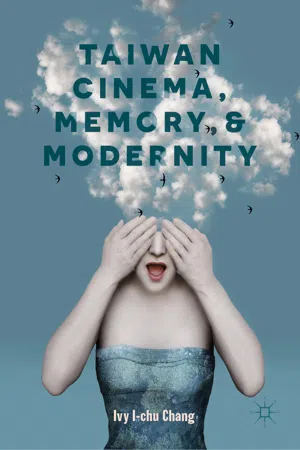
Taiwan Cinema, Memory, and Modernity
About this book
This book investigates the aesthetics and politics of Post/Taiwan-New-Cinema by examining fifteen movies by six directors and frequent award winners in international film festivals. The book considers the works of such prominent directors as Edward Yang, Tsai Ming-liang and Chang Tsuo-chi and their influence on Asian films, as well as emergent phenomenal directors such as Wei Te-sheng, Zero Chou, and Chung Mong-hong. It also explores the possibility of transnational and trans-local social sphere in the interstices of layered colonial legacies, nation-state domination, and global capitalism. Considering Taiwan cinema in the wake of globalization, it analyses how these films represent the socio-political transition among multiple colonial legacies, global capitalism, and the changing cross-strait relation between Taiwan and the Mainland China. The book discusses how these films represent nomadic urban middle class, displaced transnational migrant workers, roaming children and younggangsters, and explores how the continuity/disjuncture of globalization has not only carved into historical and personal memories and individual bodies, but also influenced the transnational production modes and marketing strategies of cinema.
Information
Subtopic
Film & Video© The Author(s) 2019
Ivy I-chu ChangTaiwan Cinema, Memory, and Modernityhttps://doi.org/10.1007/978-981-13-3567-9_11. Introduction
Ivy I-chu Chang1
(1)
National Chiao Tung University, Hsinchu, Taiwan
Ivy I-chu Chang
Keywords
ModernityTaiwan cinemaGlobalizationMemoryTransnationalFocusing on sixteen films by six prominent Taiwanese directors and frequent award winners at international film festivals, this book investigates the aesthetics and politics of Post/Taiwan New Cinema (or Post/Taiwan New Wave Cinema), its ramification of French New Wave or Hollywood films, and its outlook at the turn of the century. It investigates the recent works of such prominent directors as Edward Yang , Tsai Ming-liang and Chang Tsuo-chi and their influence; it also covers the emergent phenomenal directors such as Wei Te-sheng , Zero Chou , and Chung Mong-hong with the sociocultural phenomena arising from their films. The research on their films has been conducted in global scope through the lens of global time-space compression associated with alternative modernity or secular modernity . Moreover, it explores the possibility of transnational and trans-local social sphere in the interstices of layered colonial legacies, nation-state domination, global capitalism , emergent ethnicities, and cross-strait relations between Taiwan and the mainland China.
Through the dialogue between Western critical theories and Taiwan cinema , this book is engaged with nuanced thinking of the location of Taiwan cinema in global landscape. It analyzes how these films represent the sociopolitical transition and quotidian lives in the wake of “glocalization ,” which comes as a consequence of modernity , when the boundaries of “nation,” “city,” and “home” have been redefined. Furthermore, it discusses how these films represent nomadic unban middle class, displaced transnational migrant workers, unhomely and roaming children and young gangsters , and perplexed sexual dissidents in anticipating a transnational social sphere connecting Taiwan , Asia, and global Chinese communities. With analyses on the cinematic time-image and body-image in the global time-space compression , this book explores how the continuity/disjuncture of modernity and globalization have not only carved into historical and personal memories and individual bodies, but also influenced the transnational production modes and marketing strategies of Taiwan cinema .
Taiwan New Cinema (also called Taiwan New Wave Cinema) emerged in the early 1980s as resistance to the accelerated invasion of Hollywood cinema and Hong Kong commercial films into Taiwan’s market as a group of young Taiwanese directors from within the nation and abroad sponsored by the Central Pictures Corporation to make films. According to Chen Robert Ru-shou , the movement of Taiwan New Cinema began in 1982 with Edward Yang’s (楊德昌) In Our Times (光陰的故事; 1992). Directors of Taiwan New Cinema like Hou Hsiao-hsien (侯孝賢) and Edward Yang contributed to Taiwan’s cinema with French-influenced auteur films , which had been permeated with the directors’ personal taste and unique styles with an emphasis on the concepts of “caméra-stylo (camera-pen)” and “director-as-author”. To get closer to ordinary people’s everyday lives, their films made use of natural light and a limited camera movement (e.g., Hou prefers to use a long take and a deep focus and Yang strongly resisted the use of zoom ); sometimes they emphasized the dialectical or incongruous relationship between images and sounds in order to present multiple viewpoints; the cinematic diegesis was developed in an ambiguous, non-linear way—either via putting together the fragmented episodes of everyday banalities or via multiple storylines blurring the line between the real and the fictional. In fact, the audience of the Taiwan New Cinema is often required to be actively involved in putting the pieces of the puzzle together. In those films of Taiwan New Cinema, the directors developed their unique personal style to trace the historical past through personal memoirs (Hou Hsiao-hsien’s (侯孝賢) A Summer at Grandpa’s (冬冬的假期; 1984), A Time to Live and a Time to Die (童年往事; 1985), Dust in the Wind (戀戀風塵; 1986)); to excavate collective traumas to interrogate Taiwanese identities (Hou Hsiao-hsien’s A City of Sadness (悲情城市; 1989), Wang Tung’s (王童) Banana Paradise (香蕉天堂; 1989), Edward Yang’s (楊德昌) A Brighter Summer Day (牯嶺街少年殺人事件; 1991), Wu Nien-chen’s (吳念真) A Borrowed Life (多桑; 1994)); to make a parody of the urban lives in the wake of Taiwan’s modernization (Edward Yang’s (楊德昌) In Our Times (光陰的故事; 1982)), and The Terrorizers (恐怖份子; 1986)) (Robert Ru-Shou Chen 1993: 47–49).
The films of Taiwan New Cinema landmarked the unprecedented internationalization of Taiwan’s films in terms of cinematic aesthetics and production modes. Many film directors admitted the influence of French New Wave: Hou Hsiao-hsien was influenced by Jean-luc Godard (Olivier Assayas 1984: 62), Robert Bresson, Pier Paolo Pasolini, and Rainer Werner Fassbinder (Emmanuel Burdeau 2005 [1999]: 74); Tsai Ming-liang payed tribute to François Truffaut in his films. In particular, after Hou Hsiao-hsien had drawn international attention with 113 shows of his eight films at various international film festivals during 1983–1988, his stylistic signature of fixed camera, long take , and deep focus influenced Taiwanese directors such as Edward Yang , Tsai Ming-liang (James Udden 2007: 194), Chang Tsuo-chi, Lin Cheng-sheng (Ti Wei 2008: 277) and Chung Mong-hong , and also Asian directors like Hong Sang-soo, Lee Kwang-mo, and Hirokazu Kore-eda (Udden 194).
Taiwan New Cinema reached its pinnacle when Hou Hsiao-hsien’s A City of Sadness won the Golden Lion award in the 1989 Venice Film Festival. It was the first time that Taiwan’s film won a very important award in a prominent international film festival, which was reported by Taiwan’s mass media as a national pride. In addition to Hou’s artistic flair and virtuosity, the film’s theme of Taiwan’s February 28 political incident was articulated with the Tiananmen Square incident taking place in 1989 in the film’s campaign and promotion, which helped boosting the judges’ and critics’ support for the film in the festival. The phenomena aroused by A City of Sadness within the nation and abroad suggest the paradoxical relationship between European film festival and the national cinema in the non-Western world. Dai Jinhua points out, during the post-Cold War era, the organizers of European film festivals try to revive the festivals by inviting the third-world (including China and Taiwan ) cinema directors to be the participants. In addition to their inheritance of the spirits of humanism and anti-Hollywoodism of the European auteur films of the 1960s, the film organizers and critics regard themselves as the lead of modernization and enlightenment for the third-world cinema directors while at once requiring their innovative techniques, experimental styles, and dissident’s stand against their own government (Jin-hua Dai 2008: 241–42). Valentina Vitali indicates, most European film critics emphasize how Taiwanese directors like Hou Hsiao-hsien , Edward Yang , and Tsai Ming-liang repr...
Table of contents
- Cover
- Front Matter
- 1. Introduction
- 2. The Visible and the Invisible: Edward Yang’s Taipei Trilogy
- 3. The Ruin, Body, and Time-Image in Tsai Ming-liang’s Films: The Wayward Cloud, What Time Is It There, and I Don’t Want to Sleep Alone
- 4. Colonial Reminiscence, Japanophilia Trend, and Taiwanese Grassroots Imagination in Cape No. 7
- 5. Mourning Love: Queer Performativity and Transformation in Zero Chou’s Spider Lilies and Splendid Float
- 6. Aesthetics of Violence and Elegy for the Young: Chang Tso-chi’s Gang Trilogy
- 7. Repressed Memories and the Unhomely in Chung Mong-hong’s Children Trilogy
- Back Matter
Trusted by 375,005 students
Access to over 1.5 million titles for a fair monthly price.
Study more efficiently using our study tools.
Frequently asked questions
Yes, you can cancel anytime from the Subscription tab in your account settings on the Perlego website. Your subscription will stay active until the end of your current billing period. Learn how to cancel your subscription
No, books cannot be downloaded as external files, such as PDFs, for use outside of Perlego. However, you can download books within the Perlego app for offline reading on mobile or tablet. Learn how to download books offline
Perlego offers two plans: Essential and Complete
- Essential is ideal for learners and professionals who enjoy exploring a wide range of subjects. Access the Essential Library with 800,000+ trusted titles and best-sellers across business, personal growth, and the humanities. Includes unlimited reading time and Standard Read Aloud voice.
- Complete: Perfect for advanced learners and researchers needing full, unrestricted access. Unlock 1.5M+ books across hundreds of subjects, including academic and specialized titles. The Complete Plan also includes advanced features like Premium Read Aloud and Research Assistant.
We are an online textbook subscription service, where you can get access to an entire online library for less than the price of a single book per month. With over 1.5 million books across 990+ topics, we’ve got you covered! Learn about our mission
Look out for the read-aloud symbol on your next book to see if you can listen to it. The read-aloud tool reads text aloud for you, highlighting the text as it is being read. You can pause it, speed it up and slow it down. Learn more about Read Aloud
Yes! You can use the Perlego app on both iOS and Android devices to read anytime, anywhere — even offline. Perfect for commutes or when you’re on the go.
Please note we cannot support devices running on iOS 13 and Android 7 or earlier. Learn more about using the app
Please note we cannot support devices running on iOS 13 and Android 7 or earlier. Learn more about using the app
Yes, you can access Taiwan Cinema, Memory, and Modernity by Ivy I-chu Chang in PDF and/or ePUB format, as well as other popular books in Media & Performing Arts & Film & Video. We have over 1.5 million books available in our catalogue for you to explore.