- English
- ePUB (mobile friendly)
- Available on iOS & Android
eBook - ePub
About this book
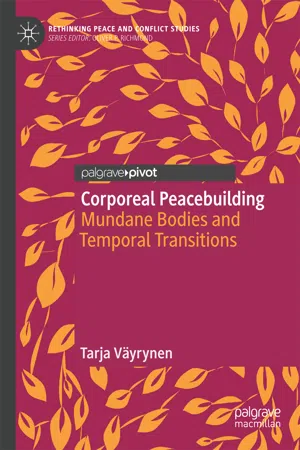
This book demonstrates how peace is an event that comes into being in mundane and corporeal encounters. The book brings living and experiencing, sentient body to Peace and Conflict Studies and examines war and peace as socio-political institutions that begin and end with bodies. It therefore differs from the wider field of Peace and Conflict Studies where the human body is treated as an abstract and non-living entity. The book demonstrates that conflict and violence as well as peace touch our bodies in multiple ways. Through attending to witnessing, wounded, remembering, silenced and resistant bodies, the empirical cases of the book attest to the scope and diversity of war, peace and the political of post-conflict peacebuilding. The book offers a sustained engagement with feminist social and political theory and will be of interest to academics and practitioners alike.
Information
© The Author(s) 2019
Tarja VäyrynenCorporeal PeacebuildingRethinking Peace and Conflict Studieshttps://doi.org/10.1007/978-3-319-97259-6_11. Introduction: Corporeal Peacebuilding
Tarja Väyrynen1
(1)
Tampere Peace Research Institute (TAPRI), University of Tampere, Tampere, Finland
Abstract
The introductory chapter offers an elaboration of peacebuilding as corporeal event that becomes into being in mundane encounters. The objective is to argue that Peace and Conflict Studies can be revitalized by employing feminist theorizing, non-representational ethnography, post-colonial thinking and critical theorizing of everyday life. The chapter shows how taking the body seriously introduces phenomenological registers that prioritize the relational and vulnerable elements of human being and, thereby, mundane practices of peacebuilding and peace. In addition to that, the chapter urges a novel ethical stance to peacebuilding that is based on the Scandinavian research tradition where one of the initial goals was to study the ordinary mechanisms of conflict resolution and peace maintenance, not just violence and its management.
Keywords
BodyFeminist theoryEveryday lifeI seek to demonstrate in this book that peacebuilding, and consequently peace, is an event that becomes into being in mundane and corporeal encounters. In the process of developing my argument, I draw from several theoretical sources that include feminist Peace and Conflict Studies, non-representational ethnography, post-colonial thinking, critical theorizing of everyday life and feminist theorizing on the body and vulnerability . The book seeks also to establish a novel ethico-political stance to peace , and in this sense return back to the early Scandinavian research tradition where one of the initial goals was to study the ordinary mechanisms of conflict resolution and peace maintenance, not just violence and its management (Jutila et al. 2008).
Furthermore, I seek to bring living and experiencing, sentient, body to the study of peacebuilding and peace . The book examines war and peace as socio-political institutions that begin and end with bodies. It, therefore, differs from the part of Peace and Conflict Studies where the human body is treated as an abstract and non-living entity. I demonstrate in the empirical chapters that war and peace touch our bodies in multiple ways and, as noted, the body is constitutive of war and peace . I illustrate through my empirical case studies also that different forms of violence render bodies vulnerable in different ways. I outline how bodies can resist violence, and argue that resistance is a precondition for peace. In other words, I show that vulnerable bodies that are not assumed to have agency indeed carry historical and political content as well disturbing and resistant qualities that are vital for the politics of peacebuilding, and ultimately for sustainable peace .
Through attending to witnessing, wounded, remembering , silenced and resistant bodies , the empirical cases of the book attest to the scope and diversity of conflict, peace and the political of post-conflict peacebuilding. My case study examples deal with home front , distant warfare , post-conflict affective landscapes and colonial violence. I employ material from Finland , but by discussing it from the perspective of political theory I seek to problematize peacebuilding in more general. The criteria for the selection of the cases in the book are their “closeness” as the book also wants to demonstrate that post-conflict is not “there and then”, but also “here and now”. The case study examples discuss “close” and mundane and invite Peace and Conflict Studies to focus on the everyday interactions through which peacebuilding takes place. The empirical material employed in the book is embodied data in the sense that it bears witness the affective and corporeal elements of the cases and events examined (cf. Walkerdine 2010). My primary material is audiovisual (e.g. documentaries, images), textual (e.g. narratives in media, interviews) and “artistic” (e.g. art work, performances) and it is collected from a variety of sources. It is hence mainly mediated material, i.e. I did not myself engage in its face-to-face/direct collection, but I show how this type of mediated material can bring valuable insights to Peace and Conflict Studies.
Peacebuilding refers in this book to John Paul Lederach’s (1997, 20) broad definition where peacebuilding is understood to be:
[…] a comprehensive concept that encompasses, generates, and sustains the full array of processes , approaches, and stages needed to transform conflict toward more sustainable, peaceful relationships. The term thus involves a wide range of activities that both precede and follow formal peace accords. Metaphorically, peace is seen not merely as a stage in time or a condition. It is a dynamic social construct.
My take on peacebuilding holds similarities with Lederach’s definition as it emphasizes the relational and the political nature of peacebuilding. As Lederach points out, peacebuilding and peace are dynamic socio-political constructs. However, in this book my aim is to go beyond his definition and demonstrate that they are more: peacebuilding and peace are dynamic corporeal events and, thereby, they should be approached from multiple ontological positions.
Multiple Ontologies and the Political of Peacebuilding
As indicated, the aim of the book is to bring human body to Peace and Conflict Studies, and through this inclusion discuss the problematique of peacebuilding. The book attempts to shed light on the issues that are seldom examined in the field—e.g. trans-generational memory, resistance , silence , post-conflict governance of subaltern bodies, agency, the affective dimensions of war and conflict —from corporeal angles. When discussing the body, I argue that there is no singular body. Rather, body is always already multiple. This view derives from the above-mentioned conviction that there is no singular ontology; there are rather ontologies. The multiple ontologies of the body and, consequently, multiple bodies derive from the variety of forces that make bodies known to us. As Karen Barad (2003, 822) argues, there is a large number of material-discursive forces , including ones that get labeled “social”, “cultural”, “psychic”, “economic”, “natural”, “physical”, “biological”, “geopolitical”, and “geological”, that are important to the processes through which we come to know the body. Barad’s idea of forces enables me to see the “body multiple” (Mol 2002) through different ontologies and boundary -making practices that are formative of matter and meaning, productive of, and part of, the bodies that come into being. The book thereby attests to the variety of ontologies and forces and each chapter presents an unique perspective to the forces through which the human body becomes to be known. Ultimately, the aim to explore the implications these multiple ontologies have for peacebuilding and peace .
Since ontology is not singular and given, the question arises about which reality to “do” as there are always specific relevant interventions to be made. In this view, ontologies do not precede or escape politics, but have politics of their own. The question is about a politics of what is the reality that takes shape and that various people come to live with. This approach offers a novel perspective to peacebuilding as it deals with the corporeal reality of peacebuilding. Rather than asking whether or not some ontologies know the body correctly, the book shifts to the question what are the topics, the concerns and the questions that these ontologies bring forth in relation to the body, conflict resolution and peace , i.e. corporeal peacebuilding . Furthermore, I seek to show that different ontologies are related: since there is more reality than one, its different versions are variously entangled with one another. It is in this sense the book forms a collage (Sylvester 2009) that allows me to look a phenomenon from multiple angles, each of which offer a slightly different, yet complementary, understanding of peacebuilding.
This book is also about peacebuilding agency. It demonstrates that agency is about the abilities and the potential of the material, relational and vulnerable body to enact the “political” anew, not so much about certain subject positions. Agency is, in this vein of thought, about visibility and “response-ability” (Barad 2012, 206–207), about the p...
Table of contents
- Cover
- Front Matter
- 1. Introduction: Corporeal Peacebuilding
- 2. Thinking and Theorizing Peace: Corporeal and Mundane Dimensions
- 3. Relational and Connecting Body on the Home Front
- 4. Returning Body: Transferring Violence Across Time and Space
- 5. Abjected and Silenced Bodies
- 6. Peacebuilding as a Corporeal, Temporal and Mneumonic Site
- 7. Peacebuilding in Colonial Relations
- 8. Conclusions: Corporeal and Response-able Peacebuilding
- Back Matter
Trusted by 375,005 students
Access to over 1.5 million titles for a fair monthly price.
Study more efficiently using our study tools.
Frequently asked questions
Yes, you can cancel anytime from the Subscription tab in your account settings on the Perlego website. Your subscription will stay active until the end of your current billing period. Learn how to cancel your subscription
No, books cannot be downloaded as external files, such as PDFs, for use outside of Perlego. However, you can download books within the Perlego app for offline reading on mobile or tablet. Learn how to download books offline
Perlego offers two plans: Essential and Complete
- Essential is ideal for learners and professionals who enjoy exploring a wide range of subjects. Access the Essential Library with 800,000+ trusted titles and best-sellers across business, personal growth, and the humanities. Includes unlimited reading time and Standard Read Aloud voice.
- Complete: Perfect for advanced learners and researchers needing full, unrestricted access. Unlock 1.5M+ books across hundreds of subjects, including academic and specialized titles. The Complete Plan also includes advanced features like Premium Read Aloud and Research Assistant.
We are an online textbook subscription service, where you can get access to an entire online library for less than the price of a single book per month. With over 1.5 million books across 990+ topics, we’ve got you covered! Learn about our mission
Look out for the read-aloud symbol on your next book to see if you can listen to it. The read-aloud tool reads text aloud for you, highlighting the text as it is being read. You can pause it, speed it up and slow it down. Learn more about Read Aloud
Yes! You can use the Perlego app on both iOS and Android devices to read anytime, anywhere — even offline. Perfect for commutes or when you’re on the go.
Please note we cannot support devices running on iOS 13 and Android 7 or earlier. Learn more about using the app
Please note we cannot support devices running on iOS 13 and Android 7 or earlier. Learn more about using the app
Yes, you can access Corporeal Peacebuilding by Tarja Väyrynen in PDF and/or ePUB format, as well as other popular books in Politics & International Relations & Sustainable Development. We have over 1.5 million books available in our catalogue for you to explore.