eBook - ePub
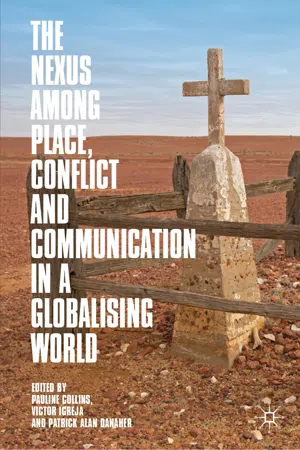
The Nexus among Place, Conflict and Communication in a Globalising World
- English
- ePUB (mobile friendly)
- Available on iOS & Android
eBook - ePub
The Nexus among Place, Conflict and Communication in a Globalising World
About this book
The world abounds with conflicts and the associated communication practices and technologies that perpetuate and contest conflict as it occurs in place. All conflicts are crucially connected with place, and all conflicts are communicated in multiple ways. This book explores the complex nexus among place, conflict and communication and brings together 11 investigations around the interplay of place, conflict and communication. The interdisciplinary focus includes education, history, international relations, law and sociology. The chapters are geographically diverse, traversing Aceh in Indonesia, Australia, England, Finland, Ireland, Singapore, South Africa and Zimbabwe. The book highlights the possibilities for reimagining the future so that more democratic and peaceful understandings of place can lead to fewer conflicts and less conflict-based communication. Better futures are possible only if place is replotted, conflict is reconceptualised and communication is recontextualised from new, varied and more inclusive perspectives with a vision to creating a more harmonious world.
Information
© The Author(s) 2019
Pauline Collins, Victor Igreja and Patrick Alan Danaher (eds.)The Nexus among Place, Conflict and Communication in a Globalising Worldhttps://doi.org/10.1007/978-981-13-5925-5_11. Frames and Intersections of Studies of Place, Conflict and Communication
Victor Igreja1
(1)
School of Humanities and Communication, University of Southern Queensland, Toowoomba, QLD, Australia
Keywords
AlternativesCommunicationConflictPlaceResearchVictor Igreja—Research fellow at the Center for Interdisciplinary Research (ZiF, Bielefeld), Fritz Thyssen Foundation (Köln), and School of Social Science (University of Queensland).
End AbstractIntroduction
The emerging intersection of place , conflict and communication is the focus of this work. While attention has been given separately to the analysis of place , conflict and communication in diverse studies of interpersonal relations and conflict resolution, the increasing importance of analysing projects directed at mediating and reducing conflicts has demonstrated the need to refocus attention on the interplay of these domains and modes of social action. We pursue this goal by reiterating that human beings are both makers and products of places, conflicts and forms of communication , which nevertheless are subjected to constant negotiations , adaptations and reformulations. This is not intended to be interpreted as a denial of deterritorialisation (Appadurai, 1996), which is one of the hallmarks of globalisation , and a reflection of how ‘the capitalist modernization is very much about speed-up and acceleration in the pace of economic processes and, hence, in social life’ (Harvey, 1989, p. 230). Instead, it is suggested that all conflicts arise in a place , and in a context of social relations and practices, even if over time some conflicts become deterritorialised and manifested in a myriad of ways in new places and times. Even the increasing recognition of global warming and its global impacts cannot be properly grasped without considering the conditions in which people live in specific places.
In this work, we embrace the idea that places are physical , psychical, cultural, historical and social (Casey, 1996, p. 31). We engage with diverse places, conflicts and versatile forms of communication : from provincial and district levels of political action in contemporary Africa; from urban, rural and cyberspaces in Australia to schoolyards in England; from street life in Dublin to courtrooms in Singapore , informal memorialising sites in Indonesia and secret rooms in sites of the Australian Defence Force.
Framing the Nexus
All contributors deal with various facets of the concept of place . Yet they intersect on the idea that space and place are socially constructed (Massey, 1994); as ‘places are experienced and lived, they are essential components of political and social relations’ (Ethington & McDaniel, 2007, p. 132). The connection of conflict with place and the communication dynamics that precede and follow this connection can create lasting impacts, memories or histories. This work explores instances of conflict as they are expressed through bodies and testimonies (Whitaker’s Chapter 6 and Palmer’s Chapter 10); memorials (Higgins-Desbiolles, Hales, & Sparrow in Chapter 11); stories and senses of humour , and African and Christian religious practices (Maringira & Núñez Carrasco in Chapter 12); and academic research in order to develop understandings of why and how conflict intersects with, and is influenced by, places and forms of communication . Certain places are prone to generate specific types of conflicts, as in the case of domestic violence (Igreja, 2018a) or ethnic conflicts (Cunningham & Weidmann, 2010), and the expressions of these conflicts can reveal the tensions in power relations, forms of subordination and resistance (Massey, 1994).
Places embody simultaneously expectations of positive behaviour and prohibitions, but these expectations do not exhaust people’s actual behaviours in that people follow but also subvert social conventions, which concur overall to render visible some conflicts more than others, and to shut down, give voice to or elude communication among some people more than others. In this regard, it is pertinent to ask: what happens when conflicts are removed from their original places? Does it transform the nature of the conflict and the possibilities of communication? Or does it make the conflict less visible and accessible and therefore liable to misrepresentation and miscommunication ? On the other hand, the dislocation of the interconnectedness of places of conflict can be liberating and amenable to the ethics of verbal transactions (Smith, 1975) that are equal and that hold a promise of effective resolution.
Experiences of forced displacement and ongoing discrimination and marginalisation in new places raise serious questions regarding the possibility of ever leaving behind past traumas from past places. There seems to be an experiential continuum of discomfort from one place to another that can be silencing and unproductive for the people involved. Yet people are also creative, and they can use a myriad of genres of communication from their own bodies and bodily actions, to metaphors , direct and indirect speech , imagination and legal and more idiosyncratic forms of talk (Igreja, 2018b).
Places of Connection and Conflict
It is generally accepted in the spatial social sciences that ‘where people are placed affects their fortunes and adds structure to their lives’ (Logan, 2012, p. 508), which can demoralise or reinforce resilience practices. Along these lines, in Chapter 2 Heckenberg’s chapter provides insight into the dialectical relations between people and land among Aboriginal nations and Torres Strait Islander peoples in Australia . The land, space and place cannot be dissociated from people’s mood, practices of respect and recognition in the sense that the destruction of one can lead to the destruction of the other. This philosophy and way of being in the world have not been easily understood by generations of British settlers who arrived and settled in these lands. The land and water are sacred entities, and humans achieve isomorphic status only when they die and are incorporated as layers of land and water spirits . In this context, death and burial rituals constitute meaningful practices of the renewal of kinships links, and the performativity of the connections between past and present (Babidge, 2006). The enduring relations with the land, water and everything that falls from the sky are not the source of conflict . Instead, the sources of conflict are founded upon competing claims: who has legitimacy and entitlement to renew relationships continually with land, water and everything included in there. The trajectories of European colonialism and the various metamorphoses into a post-settler state with a multicultural outlook did not resolve this enduring conflict .
Heckenberg demonstrates that conflict has shaped the identities of both colonial settlers and their descendants and the various groups of Aboriginal people throughout the country . In spite of the forced separation, land destitution and ultimately persecution and death, the Aboriginal people have been resilient, and Heckenberg’s chapter provides further insights into some of the mechanisms of that resilience , the legal language used by state institutions to abate the sense of Aboriginal identities and the resolve to struggle for their moral visions and ways of being in the world. The highlight of this chapter is ...
Table of contents
- Cover
- Front Matter
- 1. Frames and Intersections of Studies of Place, Conflict and Communication
- 2. The Strain to Hold Ground: Site-Based Conflict and an Indigenous Ideology of Water and Place
- 3. Conflict in South Sudanese Communities Living in Australia
- 4. Explorations of Place, Communication and Conflict: Navigating Local and Global Contexts in Culturally and Linguistically Diverse Classrooms
- 5. Conflicting Communication About the Ownership and Meaning of Places in a School in South West England
- 6. How Prostitution and Sex Work Created Conflict in Public Discourses in Dublin
- 7. Court-Annexed Mediations Within Singapore: A Complex Interface Between Individual Place and the Court Environment
- 8. ‘Restoring Right Relations’: With Oneself, with a Place, with the Past
- 9. ‘Democracy’ as Ideology in Education: Tracing Indexicality Through Conflict, Place and Communication
- 10. ‘Siting’ Voice in Stories of Conflict: Bounding Conflict in Place and Time Through Social Memory and Acts of Remembering
- 11. Remembering and Forgetting First Nations in Australia: Unsettling the Silence on the Founding and Building of a New Nation
- 12. Re-forging Military Cohesion in Exile: Zimbabwean Army Deserters in South Africa
- 13. Learnings Regarding the Role of ‘Place’ in Conflict and the Communication of Conflict
- Back Matter
Trusted by 375,005 students
Access to over 1.5 million titles for a fair monthly price.
Study more efficiently using our study tools.
Frequently asked questions
Yes, you can cancel anytime from the Subscription tab in your account settings on the Perlego website. Your subscription will stay active until the end of your current billing period. Learn how to cancel your subscription
No, books cannot be downloaded as external files, such as PDFs, for use outside of Perlego. However, you can download books within the Perlego app for offline reading on mobile or tablet. Learn how to download books offline
Perlego offers two plans: Essential and Complete
- Essential is ideal for learners and professionals who enjoy exploring a wide range of subjects. Access the Essential Library with 800,000+ trusted titles and best-sellers across business, personal growth, and the humanities. Includes unlimited reading time and Standard Read Aloud voice.
- Complete: Perfect for advanced learners and researchers needing full, unrestricted access. Unlock 1.5M+ books across hundreds of subjects, including academic and specialized titles. The Complete Plan also includes advanced features like Premium Read Aloud and Research Assistant.
We are an online textbook subscription service, where you can get access to an entire online library for less than the price of a single book per month. With over 1.5 million books across 990+ topics, we’ve got you covered! Learn about our mission
Look out for the read-aloud symbol on your next book to see if you can listen to it. The read-aloud tool reads text aloud for you, highlighting the text as it is being read. You can pause it, speed it up and slow it down. Learn more about Read Aloud
Yes! You can use the Perlego app on both iOS and Android devices to read anytime, anywhere — even offline. Perfect for commutes or when you’re on the go.
Please note we cannot support devices running on iOS 13 and Android 7 or earlier. Learn more about using the app
Please note we cannot support devices running on iOS 13 and Android 7 or earlier. Learn more about using the app
Yes, you can access The Nexus among Place, Conflict and Communication in a Globalising World by Pauline Collins, Victor Igreja, Patrick Alan Danaher, Pauline Collins,Victor Igreja,Patrick Alan Danaher in PDF and/or ePUB format, as well as other popular books in Social Sciences & Education General. We have over 1.5 million books available in our catalogue for you to explore.