eBook - ePub
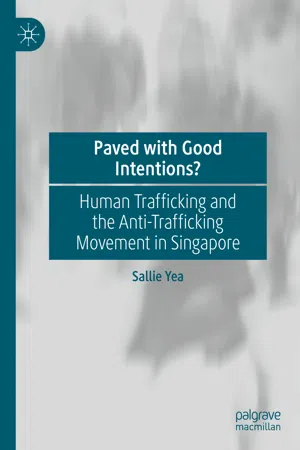
Paved with Good Intentions?
Human Trafficking and the Anti-trafficking Movement in Singapore
- English
- ePUB (mobile friendly)
- Available on iOS & Android
eBook - ePub
Paved with Good Intentions?
Human Trafficking and the Anti-trafficking Movement in Singapore
About this book
This book focuses on human trafficking and the anti-trafficking movement, particularly as it is expressed in Southeast Asia. The study is based on ethnographic research of the emerging anti-trafficking movement in Singapore, and in-depth interviews and observations with victims of human trafficking and others subject to labour exploitation in Singapore. Research in the book adds to the significant amount of work documenting human trafficking in Asia, by offering a critical academic perspective on the rise of the anti-trafficking movement. Readers will gain an understanding of how anti-trafficking operates as a new social movement and state practice, and how anti-trafficking often sits at odds with the experiences of trafficked and exploited persons themselves.
Information
© The Author(s) 2020
S. YeaPaved with Good Intentions?https://doi.org/10.1007/978-981-13-3239-5_11. Introduction
Sallie Yea1
(1)
Department of Social Inquiry, La Trobe University, Albury-Wodonga, Australia
Excerpt from Field Notes (22 April 2014):The title read, “Locked In, Tricked Out”. It was one of nineteen stories of ‘real’ trafficking victims—and the only one about trafficking in Singapore—exhibited on billboards in the centre of Singapore’s main thoroughfare of Orchard Road. The narrative read: “My job was to be an entertainer . But when I got to Singapore, they told me I have to entertain clients at this pub by providing sexual services. And I had to pass them all the money I made. After a few weeks, me and one friend tried to go home [to the Philippines ]. But they had our immigration cards and documents. So, we went to the police and made a report. There were three of them [traffickers] and they were all arrested. Two were fined and one went to jail for four months. For me it’s like a lifetime”. This awareness-raising project was initiated by Singapore’s newly established anti-trafficking NGO, Emancipasia , and was produced in partnership with the Singaporean NGOs HOME , UN Women Singapore, and World Vision Singapore, as well as the Singapore government’s TiP (Trafficking in Persons) Taskforce. Of the nineteen stories drawn from across the globe, ten were unequivocally about ‘ sex trafficking’ , two were about the fishing industry and domestic work respectively, and the type of exploitation for the others was unclear, since the abuse and punishments were made the focal point of the stories. Only one story (trafficking of a migrant fisher) was about a male victim.In discussing the exhibition with a migrant rights activist in Singapore, I discovered that the Director of Emancipasia had inquired as to whether the activist may have dealt with a labour trafficking case involving a male worker in Singapore, possibly in the construction sector. Certainly, there were no shortage of such cases the activist had reflected, and Emancipasia was provided with the story of one such worker. But the story was never included in the exhibition, since the TiP Taskforce had vetted all unsuitable content prior to its public launching. Emancipasia’s Director was simply told the case was “unsuitable” to exemplify trafficking in the Singapore context, and it was replaced with the Filipina entertainer’s story, provided by UN Women Singapore. The final and twentieth billboard confirmed the centrality of the child sex slave narrative as the most typical of human trafficking’s manifestations, both in Singapore and elsewhere. It read, “An estimated 250,000 women and children are trafficked for sex in Asia. With an unlimited demand for prostitutes, the numbers of humans enslaved in this activity is continuing to grow. Sex trafficking is arguably the cruellest form of human trafficking. Victims, some as young as three, suffer extreme psychological trauma and physical damage from enduring repeated rape, emotional manipulation and other physical abuse… It is not unusual for a girl trafficked into prostitution to be forced to service ten to twenty men a day”. With this exhibition, the rendering of human trafficking as (child) sex trafficking was now not only embedded in the social imaginary of the general public, NGOs and the state in Singapore as the most pervasive and barbarous of its forms globally, but the one to which Singaporeans needed to look in order to understand their own trafficking story.
Migrants, Victims, and the Anti-trafficking Movement in Singapore
The above vignette illustrates the key argument of this book, namely, that there is often a significant disconnect between the experiences of individuals who are trafficked and the discursive construction and programmatic and policy responses to human trafficking. Discussing a similar kind of disconnect in the Bosnian context, Edward Snajdr (2013) suggests that a ‘master narrative’ of human trafficking operates at the discursive level, often despite emerging counter-discourses that challenge the specific type of victim story that forms such a master narrative. The discursive rendering of trafficking by the Singaporean government’s Trafficking in Persons (TIP) Taskforce in the opening vignette illustrates the role that the state and non-governmental organisations (NGOs) can play in constructing master narratives about human trafficking. In the Singapore context, the government has effectively managed to reduce the numbers of prospective trafficking victims by narrowing the criteria for victim identification (the indicators of trafficking) to the most severe and unambiguous cases, particularly in the sex industry. Trafficking victims in Singapore are thus becoming constituted through essentialist gendered, aged, and sector-specific renderings that make visible only a small number and type of victims. Consequently, female minors in the sex industry have received the most media coverage and are drawn on repeatedly in the government’s public proclamations about its efforts to fight human trafficking in Singapore. The display of Singapore’s ‘entry’ in the public photo exhibition on human trafficking is but one illustration of this discursive rendering of trafficking victims through the female Third World child.
Although the interpretations of human trafficking in Singapore between NGOs and the government (and sometimes amongst NGOs themselves) are often at odds, they nonetheless engage with and respond to each other and, therefore, share a basic consensus over the discourse of (anti)human trafficking, as well as the framework by which it should be responded to. Further, both NGOs and the government engage in public performances and acts that demonstrate not just their ability to translate discourse into praxis and policy but also in managing the social realities of human trafficking and migrant exploitation in ways that do not significantly challenge these prevailing discursive formations. Such management enables organisations, including bureaucratic ones, to appear to be responding effectively to human trafficking, whilst simultaneously re-framing and, in the process, dismissing wider issues of migrant labour exploitation both within and beyond the sex industry.
A multidisciplinary body of scholarship in the social sciences has levelled various critiques at the emerging global architecture and discourse of anti-trafficking, much of which is directed at the discursive rendering and circulation of narrow images of victimhood, usually involving female Third World minors (Lainez 2010; Doezema 2010; Frederick 2004). Feminist scholar Jo Doezema (2010: 11), for example, argues that critical perspectives on trafficking need to expose, ‘the relationships among those who shape meanings of “trafficking of women” and between these discourse masters and the objects of their concern; the “sex slaves”’. Any discussion of mobile global representations in (anti)-human trafficking discourses and the strategies behind their production and circulation through human rights activism is incomplete without also and necessarily attending to the ways such endeavours are reproduced and mobilised at a local scale. Although geographers have attended to such concerns where children are invoked as political subjects in other human rights issues, including acquired immunodeficiency syndrome (AIDS) (Ansell 2010) and child soldiers (Hyndman 2010), geographical scholarship on human trafficking’s discursive rendering of the child victim has been surprisingly absent.
Critical scholarship on anti-trafficking engages with various aspects of trafficking policy and practice at state, inter-state, and non-governmental organisation scales, respectively, and provides perspectives on a range of interventions including rehabilitation and recovery (Frederick 2004; Gallagher and Pearson 2008), detection and identification of victims (Agustin 2007), repatriation and reintegration (Brunovoskis and Surtees 2012; Surtees 2017) and definitions of victims (O’Connell Davidson and Anderson 2002), amongst others. In this sense, there has been a discernible shift from the view of human trafficking itself as a human rights issue that needs to be recognised and responded to, to the emerging argument (though by no means consensus) that some anti-trafficking initiatives themselves can compromise the human rights of both victims and other vulnerably positioned migrants (GAATW 2007).
This book traces the emergence of the anti-trafficking movement in Singapore from its inception in the early 2010s, until the time of writing in 2017–2018. The scope of the movement is perceived widely to include NGOs, Civil Society Organisations (CSOs) and groups, such as university student clubs, and government agencies and personnel. It contrasts the key tenets of this movement as a discursive policy and programmatic formation with the actual experiences of exploited labour migrants in the city-state. This task is not an entirely novel one, with an emergence of some critical scholarship on human trafficking campaigns (Sharma 2003; Kimm and Sauer 2010; Nieuwenhuys and Pécoud 2007), the multiple arenas through which anti-trafficking policy and practice have compromised the human and labour rights of migrants (GAATW 2007; Hathaway 2008; Bradley and Szablewska 2016), the various guises under which states utilise anti-trafficking policy and migrant governance as a means of reasserting restrictive immigration policies and enacting regimes of differential rights for migrants vis-à-vis citizens (Aradau 2004; Lobasz 2009), and the roles discourses and representations play in bolstering some of the above (Andrijasevic 2007; De Shalit et al. 2014; Gulati 2012; Jahic and Finckenauer 2005; Small 2012; Andrijasevic and Mai 2017; Weitzer 2007). The purpose of this book is to document the anti-trafficking movement in a particular geographical and political-economic context from its inception to the present time, and in the process to draw out the precise ways anti-trafficking as movement and policy/praxis may be remotely situated in relation to its subjects—namely, trafficked persons themselves.
Singapore provides a novel context in which to undertake such an examination for two key reasons. Foremost, the anti-trafficking movement has a relatively recent history in the city-state, commencing only around nine years ago. This has enabled me to trace the movement from its inception until the present time. Because human trafficking as an issue does not have the protracted lineage that is evident in many neighbouring Southeast Asian countries, the last 9 years have seen a relatively intense and compact articulation of what has often spanned more than 20 years in many other contexts. But the recency and intensity of anti-human trafficking in Singapore is not the only, or even main, reason to cast a more critical in-depth gaze in its direction. Singapore is the major destination country for transient migrant workers, including sexual labourers, in Southeast Asia. Male and female transient workers in the construction, shipyard, landscaping, domestic service, and nightlife entertainment sectors together account for well over one-fifth of Singapore’s population of five and a half million at any one time. Singapore has come under international and local criticism for its treatment of transient migrant workers, including abuses of their labour and human rights (Yeoh 2006). This criticism has been reflected in Singapore’s ranking as a Tier 2 country in several of the US State Department’s Annual Trafficking in Person Report, including in 2017 (United States Department of State 2017: 355–357). Both the nature of these criticisms and the Singapore state’s responses to them and to human trafficking are discussed in more detail in this book.
Southeast Asia: Emergence of a Human Trafficking Epicentre
Southeast Asia is a region where human trafficking is prolific and the anti-trafficking movement equally as elaborate and complex in its responses. When the United Nations (UN) Protocol on Trafficking in Persons, Especially Women and Children (hereafter the Trafficking Protocol), was sign...
Table of contents
- Cover
- Front Matter
- 1. Introduction
- 2. Mobilising the Child Victim: The Emergence of a Trafficking Master Narrative
- 3. Girls on Film: Framing Human Trafficking Through Film and the Cinema
- 4. Elastic Victimhood: The State, NGOs, and Negotiating the Parameters of Anti-trafficking
- 5. (In)visible Women and (Anti)-trafficking
- 6. (Un)identified Men and Labour Exploitation
- 7. Spaces of Deflection and Deportability Beyond Anti-trafficking
- 8. Discretion and Obfuscation in Exclusions from Anti-trafficking
- 9. Conclusion: Paved with Good Intentions?
- Back Matter
Trusted by 375,005 students
Access to over 1.5 million titles for a fair monthly price.
Study more efficiently using our study tools.
Frequently asked questions
Yes, you can cancel anytime from the Subscription tab in your account settings on the Perlego website. Your subscription will stay active until the end of your current billing period. Learn how to cancel your subscription
No, books cannot be downloaded as external files, such as PDFs, for use outside of Perlego. However, you can download books within the Perlego app for offline reading on mobile or tablet. Learn how to download books offline
Perlego offers two plans: Essential and Complete
- Essential is ideal for learners and professionals who enjoy exploring a wide range of subjects. Access the Essential Library with 800,000+ trusted titles and best-sellers across business, personal growth, and the humanities. Includes unlimited reading time and Standard Read Aloud voice.
- Complete: Perfect for advanced learners and researchers needing full, unrestricted access. Unlock 1.5M+ books across hundreds of subjects, including academic and specialized titles. The Complete Plan also includes advanced features like Premium Read Aloud and Research Assistant.
We are an online textbook subscription service, where you can get access to an entire online library for less than the price of a single book per month. With over 1.5 million books across 990+ topics, we’ve got you covered! Learn about our mission
Look out for the read-aloud symbol on your next book to see if you can listen to it. The read-aloud tool reads text aloud for you, highlighting the text as it is being read. You can pause it, speed it up and slow it down. Learn more about Read Aloud
Yes! You can use the Perlego app on both iOS and Android devices to read anytime, anywhere — even offline. Perfect for commutes or when you’re on the go.
Please note we cannot support devices running on iOS 13 and Android 7 or earlier. Learn more about using the app
Please note we cannot support devices running on iOS 13 and Android 7 or earlier. Learn more about using the app
Yes, you can access Paved with Good Intentions? by Sallie Yea in PDF and/or ePUB format, as well as other popular books in Law & Civil Rights in Law. We have over 1.5 million books available in our catalogue for you to explore.