eBook - ePub
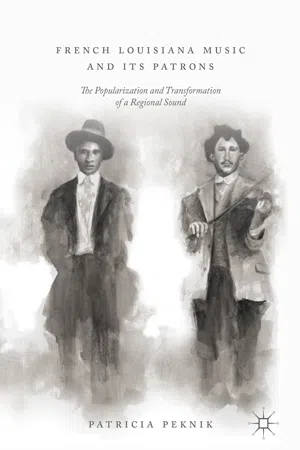
French Louisiana Music and Its Patrons
The Popularization and Transformation of a Regional Sound
- English
- ePUB (mobile friendly)
- Available on iOS & Android
eBook - ePub
French Louisiana Music and Its Patrons
The Popularization and Transformation of a Regional Sound
About this book
French Louisiana music emerged from the bayous and prairies of Southwest Louisiana in the late nineteenth and early twentieth centuries. Pioneered by impoverished Acadian and Afro-Caribbean settlers, the sound is marked by a high-pitched fiddle playing loud and fast above the bellow of a diatonic accordion. With lyrics about disaster and heartache sung cheerfully in a French dialect, the effect is dissonant and haunting. French Louisiana music was largely ignored in mainstream music culture, except by a handful of collectors, scholars, and commercial promoters who sought to popularize it. From the first recordings in the 1920s to the transformation of the genre by the 1970s, the spread of this regional sound was driven by local, national, and international elites who saw the music's traditions and performers in the context of larger social, political, and cultural developments, including the folk revival and the civil rights and ethnic revival movements. Patricia Peknik illuminates howthe music's history and meaning were interpreted by a variety of actors who brought the genre onto a national and global stage, revealing the many interests at work in the popularization of a regional music.
Information
© The Author(s) 2019
Patricia PeknikFrench Louisiana Music and Its Patronshttps://doi.org/10.1007/978-3-319-97424-8_11. Introduction: “A Wild and Ferocious Waltz”
Patricia Peknik1
(1)
Berklee College of Music, Boston, MA, USA
Patricia Peknik
This book about music is also a story about looking, observing, and perception. It tells the story of the manner in which the collectors, advocates, and patrons of French Louisiana music saw its traditions and performers in the context of social, political, and cultural debates in the United States from the mid-1920s to the early 1970s. It is about the outsider’s gaze as it fell on a regional culture, and the insights and misperceptions of ethnomusicologists and commercial promoters as they struggled to understand a regional music that appeared to exist on the outskirts of American musical culture and outside the traditional scope of folk and popular music scholarship. French Louisiana music, a harmonically simplistic, ballad-based music that developed on the bayous and prairies of Southwest Louisiana in the late nineteenth and early twentieth centuries, is dissonant, raucous, exuberant and haunting, and although Southwest Louisianans listened to and performed a whole range of musical genres and styles, including jazz, blues, and country, old-time French-language music was a unique cultural expression of the region and played a powerful and enduring role in rural community life. Folklorists who first documented and recorded it, following the trail of renowned ethnomusicologist John Lomax, painted a portrait of a Southwest Louisiana culture that was largely isolated and insulated from popular music well into the first few decades of the twentieth century, while recent accounts by Cajun music scholar Ryan Brasseaux and French anthropologist Sara Le Menestrel have emphasized the adaptation, innovation, and improvisation of Southwest Louisiana musicians tuned to the sounds of mainstream popular music culture. Yet, to whatever extent French Louisiana musicians were engaged with the larger national and international music culture, the larger music culture was not engaged with French Louisiana music. Then, at three moments of intense sociopolitical and cultural importance in America—the late years of the glimmering, frantic Jazz Age, the anxious, suburbanizing Cold War years that followed World War II, and the liberal, idealistic years that began with the Johnson presidency—distant listeners in Washington, DC, New York, and Paris cocked their ears to listen to an utterly strange and foreign sound: a high-pitched fiddle playing loud and fast above the vibrating bellow of a diatonic accordion, with lyrics about disaster and heartache sung cheerfully in a French dialect.
These early aficionados may have been captivated at first by the sound alone, but their individual aesthetic sensibilities do not account for the determination with which they sought to promote the sound to other outsiders. Political, social, and cultural forces drive and shape the popularization of a genre, and the actors driving popularization in this particular story were local, national, and international elites who succeeded remarkably well at bringing the music onto a larger stage, thereby changing it in fundamental ways. Historians have contextualized the rise to prominence of every other kind of southern music, chronicling the technical and artistic innovations and development of jazz, the blues, and country, and describing the commercial and cultural forces that generated national interest in what began as regional sounds. But French Louisiana music has been left out of histories of folk music, an odd cousin on the family tree of southern musical culture, like a distant relative whose ancestral connectedness to everyone else was somewhat murky, and who was always a little hard to talk to.
French Louisiana music tells the story of people who are constantly looking at each other or being observed. Old-time fiddle and accordion-based French Louisiana songs were passed from grandfather to father to son and, with the exception of the early twentieth-century musician Cleoma Breaux, narrated from the perspective of male suitors. The lyrics captured only the second half of every courtship narrative, the half in which the man laments that the woman who caught his eye has turned her back on him, or the part in which the woman who once looked at him so seductively has abandoned him to stroll around the dance hall on another man’s arm. Scenes in which a man waits impatiently for a woman to return his glance, or urges a woman to evade her parents’ surveillance, are punctuated with the phrases “regardez” [look] and “tu vois” [you see], as he implores her to take pity on him, to see things from his perspective, to disregard the neighbors’ point of view. Every Saturday night in Southwest Louisiana, communities gathered to drink and dance to songs about men who, scorned in love, stopped to take a good hard look at their prospects, and at their souls, as they contemplated their state of rejection, poverty, and hardship. Some of the songs described the chastising gaze of parents as they watched, and then forbade, the blossoming of a romance. We, as listeners, are locked in a voyeuristic gaze, hearing a singer describe in spare detail, in a lamentatious yell, and to an upbeat melody, the last place he saw the woman who caused his heartbreak. We see him as he watches the woman he loves glance over her shoulder and tell him she’s never coming back. We look at him as he sits in the window of his house watching her walk by, or as he takes in the sight of her when she returns to their home at dawn with her hair messed up and her clothes rumpled. To document what ethnomusicologists, folklorists, record collectors, and record label executives found so captivating in French Louisiana music complicates this voyeuristic dynamic by introducing yet another set of observers: readers of this book will be watching those folklorists and commercial promoters from an historical distance, tracking their movements and perceptions as they looked at a musical genre in which people were always—ruefully, skeptically, knowingly—watching each other.
French Louisiana music developed as the common musical genre of impoverished Acadian and Afro-Caribbean settlers in the prairie parishes of nineteenth-century Southwest Louisiana, and its regional practitioners thought of it simply as “French music.” The debate over what outsiders would call it—and what they would call it would determine its categorization in music history and its marketability as a cultural product—began in the early twentieth century when ethnomusicologists and folklore collectors began to look closely at the musicians who played it and the communities that danced to it. Collector Harry Oster called it “the music of the Louisiana Acadians”; ethnomusicologist Alan Lomax called it “Cajun and Creole music,” and both categorized it as folk music because the genre had developed through informal, face-to-face interaction between members of different generations in the same communities, with social, but not institutional or professional, oversight or support. The way the music was thereafter collected, studied and promoted, not only by scholars and commercial record labels but also by state, national and international government actors, reveals the many interests at work in its popularization. French Louisiana music wasn’t seen simply as an unfamiliar musical practice that outsiders recorded out of an aesthetic appreciation for the aural dynamics of the fiddle and accordion; it was used by those outsiders as an instrument that could be made to perform a kind of cultural or political work.
The academic and commercial patrons of French Louisiana music were looking for the oldest sounds they could find: the unaccompanied voice of a ballad singer or the unamplified sound of a couple of fiddles and an accordion. It was important to them that the songs had been passed down through generations (one of their primary inquiries when talking with musicians was how, when, and from whom a song had been learned) and that they were sung in French. They used the terms “folk” and “old-time” to describe the music they were listening to, documenting, recording, and promoting. As commercially ambitious French Louisiana bands broadened their instrumentation, style, and repertoire to get in tune with national pop and country sounds, the patrons of French Louisiana music continued to privilege any music played by musicians in Southwest Louisiana that still included a fiddle or two and an accordion, and was still sung (at least partly) in French. Although some of the ballads can be traced back to medieval France, the French Louisiana music tradition has not been included in most scholarship on American folk music and the folk revival.
Benjamin Filene chronicled the establishment of the American folk music canon in Romancing the Folk: Public Memory & American Roots Music, arguing that in their pursuit of folk-crafted American music, ethnomusicologists John and Alan Lomax created a “cult of authenticity” in which the highest fruit was the music of an isolated rural musician who had a sentimental, but not commercial, engagement with music. While this may not have been a true descriptor of the musicians they recorded, this was the sepia-tinged image of Southern musicians the Lomaxes presented to new audiences in their quest not simply to document traditions, but to perpetuate them. Record label talent scouts likewise had their eye on commercial prominence, and the separate categories they established for music—hillbilly and “race” records—concealed the musical interactions between white and black communities, Filene explains: “Even though blacks’ songs and whites’ songs were often recorded by the same people on the same trips in the same cities, every company in the twenties treated its race and hillbilly selections as completely independent series that had … separate markets.” French Louisiana music, on the other hand, was marketed to the totality of the Southwestern Louisiana market, as if it were a kind of hillbilly race music, with black and white musicians playing the same songs, and recording together.
Filene suggests that the term “vernacular” is better than “folk” to describe any musical genre that is “current, familiar, and manipulable by ordinary people” and “demands only minimal formal training and material resources to produce it,” and he employs “roots” as the ideal term for the genres out of which contemporary commercial pop music was generated.1 French Louisiana music cannot be called that sort of antecedent form. Its popularizers, who referred to it as folk music because it didn’t fit into the category of popular commercial music played by professional or institutionally trained musicians, didn’t want to know, or didn’t want to publicize as such, the fact that that some of the French Louisiana musicians they labeled as down-home amateurs playing age-old tunes were really semi-professional musicians who played as often as they could to supplement their wages, experimenting in a variety of genres, and imitating popular commercial styles. Because this book focuses on the patrons of traditional Southwest Louisiana music, I adopt Filene’s method of using the terms “folk,” and “old-time” as those terms were used by these actors at different historical moments to encompass the body of suppositions, values, and standards all of these patrons brought to their collecting, commercializing and promoting of the music. However contested the term has become as an umbrella category for all sorts of rural, ethnic, and traditional forms of music that developed far from the urban centers of music production and distribution, the phrase “folk music” meant something specific to the original patrons of French Louisiana music—Alan Lomax, Harry Oster, and Ralph Rinzler—and it meant the same thing to all of them. I employ the term to capture their perspective on what the music was (in its earliest stage, acoustic renditions of generations-old ballads) and did (communicate stories about the community). This study is therefore not an interrogation of the integrity of the categories “folk,” “roots,” or “vernacular” music as those terms are now used in the disciplines of anthropology and ethnomusicology, but an analysis of the perceptions and actions of French Louisiana music’s historical advocates, who, without exception, had far more than just music on their minds whenever they promoted that regional sound.
Anthropologists have written engaging studies on the origins and social and creative development of French Louisiana music. Brasseaux has documented the instrumental, stylistic, and perspective shifts that led to the development of the Cajun swing genre, which he calls “an American vernacular music,” in the 1940s and 1950s. Cajun musicians sought out and incorporated popular music into a traditional style, Brasseaux argues, innovating, improvising, and creating swinging new sounds from the synthesis. French cultural anthropologist Sara Le Menestrel has also emphasized the way in which Louisiana musicians’ adaptation to popular music styles continually and dynamically changed French Louisiana music, and the ways that local definitions of race, ethnicity, and social class have informed the Southwest Louisiana music scene since the late twentieth century. Both ethnographers rule out the use of terms like “folk” and “authentic” in order to create a portrait of the culture as it was understood by its actors and in order to explicate what tradition and innovation meant to cultural insiders who performed the music, and to their local audiences. The musicians themselves, and their regional listeners, would never have used the vocabularies of academics, collectors, and promoters. They called their music “French music” only when it became necessary to distinguish it from the English-language commercial music coming through the radio.
Given that the music’s patrons were interested in French Louisiana music precisely because they considered it a folk genre, and that recording label executives recorded it because they saw it as such, this study preserves the use of the term “folk” as a descriptor contemporaneous to the perspective of the genre’s patrons. They used the term with earnest intentions in order to generate interest, explain the music’s provenance and social function, secure grant funding for fieldwork and concerts, and sell records. To a Depression-era resident of Southwest Louisiana who had grown up listening to the music played by older relatives, dancing to the ballads at Saturday night dance hall socials, and listening to fiddle duets on the living room phono...
Table of contents
- Cover
- Front Matter
- 1. Introduction: “A Wild and Ferocious Waltz”
- 2. French Louisiana Music from Home and Dance Hall to Radio and Fred’s Lounge
- 3. From the War on French to the War in France: World War II and Cultural Identity
- 4. “It’s All French Music”: Patrons on the Trail
- 5. Brand New Old-Time Southern Americana: Harry Smith’s Anthology Brings French Louisiana Music into the Folk Canon
- 6. “I Want You to Be/Just like You Used to Be, Darling”: Choreographing the Newport Waltz
- 7. Utter Strangers: The English and French Language Movements
- 8. “Les metamorphoses”: Civil Rights, Ethnic Revival, and New Regional Sounds
- 9. Postscript
- Back Matter
Trusted by 375,005 students
Access to over 1.5 million titles for a fair monthly price.
Study more efficiently using our study tools.
Frequently asked questions
Yes, you can cancel anytime from the Subscription tab in your account settings on the Perlego website. Your subscription will stay active until the end of your current billing period. Learn how to cancel your subscription
No, books cannot be downloaded as external files, such as PDFs, for use outside of Perlego. However, you can download books within the Perlego app for offline reading on mobile or tablet. Learn how to download books offline
Perlego offers two plans: Essential and Complete
- Essential is ideal for learners and professionals who enjoy exploring a wide range of subjects. Access the Essential Library with 800,000+ trusted titles and best-sellers across business, personal growth, and the humanities. Includes unlimited reading time and Standard Read Aloud voice.
- Complete: Perfect for advanced learners and researchers needing full, unrestricted access. Unlock 1.5M+ books across hundreds of subjects, including academic and specialized titles. The Complete Plan also includes advanced features like Premium Read Aloud and Research Assistant.
We are an online textbook subscription service, where you can get access to an entire online library for less than the price of a single book per month. With over 1.5 million books across 990+ topics, we’ve got you covered! Learn about our mission
Look out for the read-aloud symbol on your next book to see if you can listen to it. The read-aloud tool reads text aloud for you, highlighting the text as it is being read. You can pause it, speed it up and slow it down. Learn more about Read Aloud
Yes! You can use the Perlego app on both iOS and Android devices to read anytime, anywhere — even offline. Perfect for commutes or when you’re on the go.
Please note we cannot support devices running on iOS 13 and Android 7 or earlier. Learn more about using the app
Please note we cannot support devices running on iOS 13 and Android 7 or earlier. Learn more about using the app
Yes, you can access French Louisiana Music and Its Patrons by Patricia Peknik in PDF and/or ePUB format, as well as other popular books in History & North American History. We have over 1.5 million books available in our catalogue for you to explore.