This book offers analysis of Australia's engagement with Africa, as well as the country's rather unique status as a 'new' actor and emerging country in Africa. With its empirical originality and comparative contribution, the book fills a gap in both the study of Africa's global engagement with emerging countries, and in connection with Australia's largely unknown engagement with African states.
Australia has presented itself as Africa's 'friend from the south,' without any colonial baggage, and is interested in a long-term partnership for trade and development. In this context, Australia is only one of many 'new' players seeking more intensive engagement with Africa since the end of the Cold War. At its core, the book argues that because of its largely unacknowledged 'flawed' historical engagement with Africa, as well as the political partisanship driving its fickle and volatile contemporary engagement with the continent, Australia suffers from an inability to assess its strategic and long-term interests – i.e., it doesn't know what it wants in or from Africa. This makes Australia a rather unique emerging player in Africa: while other 'new' actors' engagement with Africa is generally strategic, and driven to a large extent by a desire to secure resources and counter the influence of geopolitical rivals, Australia's efforts with regard to Africa are more episodic and not about acquiring resources or countering its rivals. Hence, while immigration, globalization, trade, terrorism, and climate change continue to bring Africa and Australia closer together, Australia's failure to understand its own interests continues to hamper its engagement with Africa.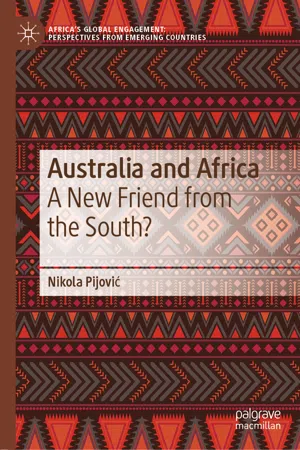
- English
- ePUB (mobile friendly)
- Available on iOS & Android
eBook - ePub
About this book
Information
© The Author(s) 2019
Nikola PijovićAustralia and AfricaAfrica's Global Engagement: Perspectives from Emerging Countrieshttps://doi.org/10.1007/978-981-13-3423-8_11. Introduction: A New Friend from the South?
Nikola Pijović1
(1)
Africa Research and Engagement Centre, University of Western Australia, Perth, WA, Australia
Nikola Pijović
Keywords
Australia and Africa‘New’ actorsEmerging countriesStructureAgencyIn January 2011, Australia’s foreign minister, Kevin Rudd , made a trip to Ethiopia , delivering his first-ever address to the Executive Council of the African Union (AU). In elaborating on his country’s approach to dealing with Africa, Rudd told the gathering that Australia’s perspective was that of ‘a developed country’, but one from the global ‘south’, and not the ‘north’; after all, Rudd had travelled to Ethiopia from the southern hemisphere (Rudd 2011). By pitching his country as one from the ‘south’ and without colonial baggage in Africa, and interested in mutually beneficial partnerships rather than traditional ‘donor–recipient’ relationships, the Australian foreign minister was highlighting Australia’s uniqueness when compared to other Western developed nations in North America and Europe. And, in summing up his remarks, Kevin Rudd made it clear that after years of neglect by previous Australian governments, his country was interested in a ‘new’ engagement with Africa. By the time Kevin Rudd ’s term in office was up in February 2012, he had become the Australian foreign minister with by far the most visits to Africa. Between October 2010 and February 2012, Rudd visited Africa seven times. By contrast, Australia’s longest-serving foreign minister, Alexander Downer , made only four visits to Africa in his 11 years in office between 1996 and 2007, and Australia’s current foreign minister, Julie Bishop , has only made one visit to mainland Africa since 2013. But why this explosion of interest in Africa in such a short time span? And, more importantly, why so little engagement with Africa before and after Kevin Rudd ’s time in office? This book will answer these and many more questions, and for the first time relate the largely unknown story of Australia’s engagement with Africa.
* * *
When one thinks of ‘new’ actors and emerging countries engaging with Africa, Australia does not normally spring to mind. Usually, such terms are reserved for a number of countries that have ramped up their engagement with Africa since the turn of the millennium, and do not fit into the category of traditional donors and ‘old’ colonial powers in Africa. But, as this book will show, Australia’s engagement with Africa is unique because the country straddles both the categories of traditional donor and emerging country engaging with Africa. However, it is also unique because it does not happily sit in any of those categories. The question mark in the title of this book—A New Friend from the South?—is there to highlight several contradictions inherent in Australia’s engagement with Africa. Is Australia a ‘new’ friend to Africa; that is, can it be called an emerging engager or ‘new’ actor in Africa? Yes and no. Yes, because like many other countries, Australia has since the turn of the millennium—and really in the past decade—tried to enhance, broaden, and generally re-invigorate its engagement with Africa. No, because Australia is an Organisation for Economic Co-operation and Development (OECD) member and ‘traditional’ donor, and actually has a long history of engagement with Africa, albeit a history that is largely—and one might add conveniently—forgotten because it involves a long period of supporting British colonialism, and sympathy for racism and apartheid .
Moreover, is Australia a friend from the ‘South’; that is, regardless of its geography in the southern hemisphere, can it be considered a country whose engagement with Africa is bereft of colonial baggage, and consistent with the shared experience of colonialism, shared respect for sovereignty and non-interference, and shared emphasis on ‘mutual development’ that at least rhetorically marks ‘south–south cooperation’, rather than the traditional ‘donor–recipient’ relationships characterizing OECD countries’ engagement with Africa? Again, yes and no. Yes, because Australia was never a foreign power directly administering an African colony, but was itself a colony of Britain . No, because Australia played its part in supporting Britain’s colonization of Africa, and the country’s domestic political tradition, and the values and objectives its foreign policy seeks to spread share many more commonalities with wealthy Western and previously imperial countries than they do with developing or ‘Southern’ countries—and its development assistance is very much characterized by traditional ‘donor–recipient’ relationships.
These contradictions highlight the richness of the topic of Australia’s engagement with Africa. In trying to untangle and explain such contradictions, this book offers a twofold purpose and contribution. On the one hand, this is a book about Australia’s engagement with Africa, and as such, its primary purpose is to tell the story of around 130 years of that engagement. In making such a long time period more easily understandable, Australia’s engagement with Africa is broken down into two periods: historical and contemporary. The former refers to Australia’s engagement with Africa from its earliest days to the end of the Cold War , while the latter examines the time period since then. On the other hand, the book also has comparative value, and its secondary purpose is to add further empirical detail to the literature on emerging countries ’ engagement with Africa. However, it does this by highlighting Australia’s uniqueness as compared to other emerging countries and the commonalities marking their engagement with Africa.
With these two contributions in mind, the book tries to answer two central questions, making several key arguments along the way. As the emphasis of the book is on investigating Australia’s contemporary engagement with Africa, the first central question this book seeks to answer is: What does Australia want in Africa? Answering this question involves examining the ‘why’ and ‘how’ Australia engages with Africa. The key arguments made here are that Australian decision-makers are unable to offer a politically bipartisan justification for why Australia should engage with Africa, and are therefore also unable to assess their country’s strategic and long-term interests in Africa—as such Australia does not know what it wants in Africa. For almost one century, from roughly the 1880s up until the early 1970s, Australia’s engagement with Africa was defined by support for colonialism and sympathy with racism and apartheid . This has left the country with a ‘flawed’ history that has for the most part been conveniently forgotten, but every now and then spring up in the attitudes and pronouncements of Australian politicians. While both of Australia’s two main political forces—the conservative Liberal-National Party coalition, and the centre-left Labor Party— have a history of displaying colonialist and racist attitudes towards engagement with Africa, since the 1970s, it has been mainly the conservative side that has displayed a (neo)colonialist and racist sentiment regarding engagement with African states and issues. On the other hand, while between the 1970s and 1990s there was a period of politically bipartisan focus on the fight against apartheid , that ended with apartheid’s ultimate demise in 1994. Since then, Australia’s contemporary engagement with Africa has become highly politically partisan, resulting in an episodic engagement, revolving around the country’s need to secure African support for its multilateral goals—such as United Nations Security Council (UNSC) membership—and exhibiting a parochial, superficial and cyclical short-term outlook.
The second central question the book seeks to answer is What kind of an emerging engager with Africa is Australia? Answering this question is only possible after answering the first question, and taking into account the commonalities shared by other emerging countries ’ engagement with Africa. The key arguments made here are that because Australia does not know what it wants in Africa, its engagement with the continent is not driven by the same motives and enacted in the same way as that of many other emerging countries—as such Australia is a unique emerging engager with Africa. Much of the literature on ‘new’ or emerging countries’ engagement with Africa focuses on countries like China , India , Japan , Russia, Brazil , Turkey , or the Republic of Korea , and at its core, suggests three main features common to most emerging countries’ engagement with Africa: an engagement motivated by (a) the desire to secure resources for domestic economies and (b) geopolitical strategies (such as offsetting and countering the influence of strategic rivals); and an engagement conducted through a significant degree of collusion between national governments and businesses (or in many cases, through state-owned companies) (Cheru and Obi 2010; Carmody 2013, 2016; Allan et al. 2013; Van der Merwe et al. 2016; Stolte 2015). All of that highlights the very strategic—if at times incoherent—nature of emerging countries’ engagement with Africa. Australia, on the other hand, is unique because its engagement with Africa features none of those commonalities: it is rarely, if ever, strategic, and is certainly not guided by the government’s desire to secure resources for the Australian economy, and even less by geopolitical strategies or offsetting and countering the influence of a strategic rival. And its engagement with Africa is not coordinated between the national government and Australian business companies—the latter operate completely independently of the government and generally only seek diplomatic support with host African government contacts in the hope of positively influencing the ease of doing business. Although Australian businesses operating in Africa are predominantly in the resources sector, their activities are not guided by the desires of the government of the day, or geostrategic and geopolitical considerations. Hence, Australia appears sui generis when compared to other emerging countries engaging with Africa, and highlights that not all emerging countries engage with Africa with the same motivations and in the same ways.
Australia and Africa: A Snapshot
The African continent is home to a very diverse set of 54 states. Although there are similarities between the historical experiences of (de)colonization and independence of many of them, there are also very vast socio-economic, cultural, linguistic, and religious differences across these states as well as within them. Australia, however, has a history of engaging with only a minority of African states, so that even talking about engagement with ‘Africa’ is something of a misnomer: one has to look very hard and will find very little to write about regarding Australia’s engagement with, for example, Senegal , Mauritania, Togo, Chad, or Angola. Australia’s contacts with the African continent have always been strongest at the extremes (Egypt and South Africa), and traditionally more focused on Commonwealth member states, and eastern African countries (given that they share Australia’s Indian Ocean geography).
However, this should not suggest that Australia’s contacts with African states do not have a long history. The country’s earliest official contacts with Africa served the interests of colonialism and British empire-building, and were bloody affairs. From the 1880s and the British war against Mahdist forces in the Sudan , up until the end of World War II , the experience of expeditionary war-making was central to Australia’s engagement with Africa. When the newly formed Commonwealth of Australia came into existence in 1901, one of the first items on its agenda was sending troops to fight alongside the British in the Boer War . Much pomp and heroism have been accorded to these earliest Australian imperial expeditions to Africa, even though the behaviour and service of some Australian soldiers in the Boer War were far from exemplary (Reynolds 2016, 191–195). Although Australia’s imperial expeditions in Africa are today presented as noble fights for freedom, these military engagements were not tasked with ‘liberating’ anyone; their purpose was upholding the status quo of colonization, and subjugating the indigenous populations.
But Australia’s troubled engagement with Africa is not only confined to the days before the ‘winds of change’ and decolonization. For reasons of colonial links, a common British cultural heritage, and sympathies for racially discriminatory immigration, Australia had for almost a ...
Table of contents
- Cover
- Front Matter
- 1. Introduction: A New Friend from the South?
- 2. From the Boer War to the End of Apartheid
- 3. Australia Tries to Forget Africa
- 4. Australia Re-discovers Africa…and Then Tries to Forget It Again
- 5. Political Partisanship and Australia’s Volatile Aid to Africa
- 6. Conclusion
- Back Matter
Trusted by 375,005 students
Access to over 1.5 million titles for a fair monthly price.
Study more efficiently using our study tools.
Frequently asked questions
Yes, you can cancel anytime from the Subscription tab in your account settings on the Perlego website. Your subscription will stay active until the end of your current billing period. Learn how to cancel your subscription
No, books cannot be downloaded as external files, such as PDFs, for use outside of Perlego. However, you can download books within the Perlego app for offline reading on mobile or tablet. Learn how to download books offline
Perlego offers two plans: Essential and Complete
- Essential is ideal for learners and professionals who enjoy exploring a wide range of subjects. Access the Essential Library with 800,000+ trusted titles and best-sellers across business, personal growth, and the humanities. Includes unlimited reading time and Standard Read Aloud voice.
- Complete: Perfect for advanced learners and researchers needing full, unrestricted access. Unlock 1.5M+ books across hundreds of subjects, including academic and specialized titles. The Complete Plan also includes advanced features like Premium Read Aloud and Research Assistant.
We are an online textbook subscription service, where you can get access to an entire online library for less than the price of a single book per month. With over 1.5 million books across 990+ topics, we’ve got you covered! Learn about our mission
Look out for the read-aloud symbol on your next book to see if you can listen to it. The read-aloud tool reads text aloud for you, highlighting the text as it is being read. You can pause it, speed it up and slow it down. Learn more about Read Aloud
Yes! You can use the Perlego app on both iOS and Android devices to read anytime, anywhere — even offline. Perfect for commutes or when you’re on the go.
Please note we cannot support devices running on iOS 13 and Android 7 or earlier. Learn more about using the app
Please note we cannot support devices running on iOS 13 and Android 7 or earlier. Learn more about using the app
Yes, you can access Australia and Africa by Nikola Pijović in PDF and/or ePUB format, as well as other popular books in Politics & International Relations & African Politics. We have over 1.5 million books available in our catalogue for you to explore.