- English
- ePUB (mobile friendly)
- Available on iOS & Android
eBook - ePub
About this book
Information
© The Author(s) 2019
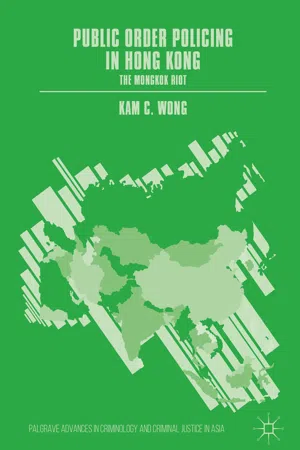
Kam C. WongPublic Order Policing in Hong KongPalgrave Advances in Criminology and Criminal Justice in Asiahttps://doi.org/10.1007/978-3-319-98672-2_11. Introduction: Setting the Stage
Kam C. Wong1
(1)
Xavier University (Emeritus), Cincinnati, OH, USA
Kam C. Wong
Introduction
Under the Chinese zodiac (生肖), 2016 is the Year of the Monkey. It is touted as a year fitting for the creative mind and daring spirit:
Year of the Monkey 2016 pushes us to gestures daring to draw attention to us because we want a bit more than usual to be in the spotlight, to … our peers … This year we look for identity and want to be recognized and respected as individuals. It is expected that each of us … assume opinions and to assert uniqueness … Year of the monkey will be a good year for new inventions, for taking risk, to be rebels, a year in which inventiveness, courage and bravado will win easily1
The above horoscope seemingly spoke to the young people in Hong Kong (HK). They needed to be recognized as unique individuals and to make a difference in HK society. They needed to do so with courage and audacity in the year to come. The message, taken at face value, had the effect of emboldening young political activists, such as Ray Wong Toi-yeung (黃台仰) (WTY) and Edward Leung Tin-kei (梁天琦) (LTK). These two promoted localism, radicalism and valiancy at the expense of liberalism, peace and love, which had been espoused by the failed Occupy Central (OC) movement.2 Conversely, they challenged the establishment and pan-democrats alike,3 defending their ideological leadership and methods of political struggle: 和理非非, which stands for 和平 (peace), 理性 (reason), 非暴力 (non-violence), 非粗口 (no foul language). In the background, an intergenerational cultural war was simmering, with the coming of age of 廢青 (Wasted Youth) (post 80s, 90s generations) and the struggling for survival of the 港豬 (Hong Kong Pig) (pre-70s generations).
Looking ahead, the Year of the Monkey promised to be a tumultuous year for the people of HK, with ideologies in conflict, generations at war, society without harmony and governance under siege from all quarters and at every turn. The future of HK was uncertain, with “yin and yang” hanging in the balance and ‘‘crisis and opportunity” at play.
The horoscope turned out to be uncannily accurate. On the first days of the Chinese Lunar New Year (February 8–9, 2016) HK was hit with one of the most violent disturbances/riots since 1967, namely the Mongkok Riot (MKR). For the next 12 hours (February 8, 8 p.m. to February 9, 8 a.m.), rioters raised havoc in the streets of Mongkok. According to Secretary for Security, Lai Tung-kwok: “At its height, there were 700 people assembling illegally in 14 streets. There were 2000 bricks removed from 15 locations for a total of 110 cubic meters pedestrian ways. This led to 90 police officers and a few reporters being injured.”4 The HK Fire Service Department (FSD) recorded 22 fire reports and 34 requests for assistance. The rioters set fires in the streets, with smoke reaching upward of 20 meters. They also obstructed the FSD officers in their firefighting efforts, and as a result the FSD was delayed in 11 cases, for anything from five minutes to 1 hour 12 minutes.5
HK has experienced many instances of social unrest, civil disturbance and violent riot in the past.6 The MKR is not the biggest, longest or most violent; that distinction goes to the 1967 leftist riot. However, on par with 1967 riot, the MKR is noteworthy in six respects. First, rioters openly challenged the legitimacy of the Hong Kong Government (HKG) and the authority of the Hong Kong Police (HKP) with few reservations and much success.7 Second, the protestors turned rioters called themselves 義士 (righteous fighters), who justified their (violent) actions as necessary in fighting HKG oppression and resisting HKP abuses. Third, a sizable minority of Legislative Council (LegCo) members and more than a few political pundits excused the use of force against the HKP, some even embracing collective violence as a means to effect change. Fourth, HKP officers were attacked in front of TV cameras, with little chance to defend themselves. Fifth, the HKP seem to have capitulated and conceded defeat at the hands of the rioters, beating a hasty retreat. Sixth, HKP, “Asia’s finest,” finally met its match, at the hands of a few post-1980s–1990s generation youth.
This chapter provides a brief overview of the book. It consists of six sections. Section I: “MKR” acquaints the reader with the facts and circumstances of the MKR. Section II: “Issues with MKR” lists some impact of and issues raised by the MKR requiring attention and investigation. Section III: “Narratives on MKR” sets forth two narratives accounting for the MKR, one from the progressives and the other from the establishment’s perspective. Section IV: “Independent Inquiry” observes the need to mount an investigation into what happened during the MKR, to inform the public and bring closure. Section V: “Distorted Reporting” makes the case for objective and reliable data collection into the MKR,8 with an example of distorted and biased news reporting from a foreign media source. Section VI: “A Study Proposal” sets forth the focus, contributions to and organization of this book.
I. MKR
The MKR originated from a purported HK Food and Environmental Hygiene Department (FEHD) law enforcement action concerning fishball hawkers at Portland Street in Mongkok (MK) on the end of Chinese year and first day of Chinese Lunar New Year (February 8–9, 2016). It later blossomed into full-scale confrontations between Hong Kong Indigenous (HK-I) activists and the HKP, with HK-I fighting for hawkers’ rights to ply their trade and LTK’s right to hold a LegCo election campaign demonstration without notifying the HKP.
Throughout the night, the rioters masks over faces and bricks in hand, charged the HKP, attacked police vehicles, wounded police officers, assaulted reporters, set fires in the streets, destroyed public property, burned taxis and intimidated people.9 In doing so, the rioters promoted public violence and fueled personal hatred amongst the youth.10 They also seared the consciences of many young people as their actions smeared the good name of HK for all: “The riot has dealt a blow to the city’s law and order and presented a grave challenge to the authority of the government and police. It has also rubbed salt on the wound of an already declining tourism industry and tarnished the reputation of Hong Kong.”11
The intensity of the riot and the ferocity of rioters could not be captured in words. By April 1, 2016, the HKP had arrested 82 people in connection with the MKR, with 51 persons being charged with various offenses, from riots to illegal assembly to obstruction of police to destruction of property. Of those who were arrested there were 20 HK-I members—a third of the budding organization.12 By April 7, 2016, ten had been released by the court for having no case to answer or because of a lack of evidence. Those remaining included former Scholarism member Derek Lam Shun-hin, who was later released without charge.
All told, as of June 17, 2018, “90 people were arrested, and 51 were charged. Charges were dropped against 20 due to lack of evidence, leaving 31 to prosecute. Of the 31 trials completed so far, 25 defendants have been convicted on 34 counts. These include 21 for ‘riot’.”13
As of March 9, 2016, there had been 31 formal complaints filed with the Independent Police Complaints Council against HKP conduct during the MKR.
II. Issues with MKR
The MKR witnessed the baptism by fire of a new generation of HK political activists. To many HK residents who are locally born and bred and older HK people who have built up HK, the MK incident was the untimely swansong of “Under Lion Rock” spirit (獅子山下精神),14 which has come to stand for HK people’s identity, culture, and core values, and in turn accounting for HK’s success, around the world. They condemned the young people (born in the 1980s or 1990s) at the riot for destroying HK’s core values (the rule of law and non-violence) and defining spirit (“Under Lion Rock”: harmony, solidarity, tolerance and perseverance) as rebel without a cause. There is no doubt that the activists amongst them want to change the status quo politically, socially and economically, to suit their tastes and aspirations. As Baggio Leung, a political activist and convener of Youngspiration, put it:
There are some differences between the elder generation and us—like in the discussion about whether we should call it the Umbrella Movement or the Umbrella Revolution. One reason why some people preferred the word movement was that they feared the Chinese Communist Party would send tanks to kill us … There’s this saying: “China needs Hong Kong, but it doesn’t need Hong Kong’s people.” It means that, because Hong Kong is still a financial center, they need our law and our banking system. But Hongkongers are asking for freedom and changes to their political system. I am a Hongkonger, and what I’m facing now is that China needs my homeland, but it doesn’t need me.15
To realize their dreams, members of the young generation are willing to fight for them, to explore self-help measures, such as radical social movem...
Table of contents
- Cover
- Front Matter
- 1. Introduction: Setting the Stage
- 2. Method and Data
- 3. What’s in a name? “Riot” versus “Disturbance”
- 4. What Happened?
- 5. Reactions
- 6. Public Survey
- 7. Independent Inquiry
- Back Matter
Trusted by 375,005 students
Access to over 1.5 million titles for a fair monthly price.
Study more efficiently using our study tools.
Frequently asked questions
Yes, you can cancel anytime from the Subscription tab in your account settings on the Perlego website. Your subscription will stay active until the end of your current billing period. Learn how to cancel your subscription
No, books cannot be downloaded as external files, such as PDFs, for use outside of Perlego. However, you can download books within the Perlego app for offline reading on mobile or tablet. Learn how to download books offline
Perlego offers two plans: Essential and Complete
- Essential is ideal for learners and professionals who enjoy exploring a wide range of subjects. Access the Essential Library with 800,000+ trusted titles and best-sellers across business, personal growth, and the humanities. Includes unlimited reading time and Standard Read Aloud voice.
- Complete: Perfect for advanced learners and researchers needing full, unrestricted access. Unlock 1.5M+ books across hundreds of subjects, including academic and specialized titles. The Complete Plan also includes advanced features like Premium Read Aloud and Research Assistant.
We are an online textbook subscription service, where you can get access to an entire online library for less than the price of a single book per month. With over 1.5 million books across 990+ topics, we’ve got you covered! Learn about our mission
Look out for the read-aloud symbol on your next book to see if you can listen to it. The read-aloud tool reads text aloud for you, highlighting the text as it is being read. You can pause it, speed it up and slow it down. Learn more about Read Aloud
Yes! You can use the Perlego app on both iOS and Android devices to read anytime, anywhere — even offline. Perfect for commutes or when you’re on the go.
Please note we cannot support devices running on iOS 13 and Android 7 or earlier. Learn more about using the app
Please note we cannot support devices running on iOS 13 and Android 7 or earlier. Learn more about using the app
Yes, you can access Public Order Policing in Hong Kong by Kam C. Wong in PDF and/or ePUB format, as well as other popular books in Social Sciences & Chinese History. We have over 1.5 million books available in our catalogue for you to explore.