- English
- ePUB (mobile friendly)
- Available on iOS & Android
eBook - ePub
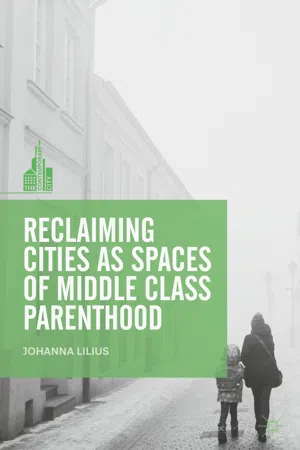
Reclaiming Cities as Spaces of Middle Class Parenthood
About this book
For nearly a century families have been out-migrating to suburbs and peri-urban areas. In this book, Johanna Lilius conceptualizes the relatively recent phenomenon of families choosing to live in the inner city. Drawing on a range of qualitative data, the book offers a holistic approach to simultaneously understanding changes within parenting practices and changes connected to city development. The book explains not only why families choose to stay in the inner city and how they use the city in their everyday lives, but also how families change the landscape of contemporary cities, and how the family is, and has been, perceived in urban planning and policy-making. The Nordic perspective provided by Lilius makes this book an important contribution in helping understand inner city change outside the Anglo-American context, and will appeal to an international audience.
Information
© The Author(s) 2019
Johanna LiliusReclaiming Cities as Spaces of Middle Class ParenthoodThe Contemporary Cityhttps://doi.org/10.1007/978-981-10-9010-3_11. Introduction
Johanna Lilius1
(1)
Aalto University, Helsinki, Finland
Change is part of city life. Across time, neighbourhoods are constantly produced and reworked by society and by the users of neighbourhood spaces and places and in relation to the surrounding world. Places are fluctuating, relational, contextual and multifold (Massey 2008, 142–148), like gender. Space and gender also interconnect, as gender roles are defined and reworked in the everyday use of space (Saarikangas 2006, 86; 85; 88–89; Short 2006, 127). As Short (2006, 129) has noted, “The city is an important stage for witnessing the unfolding drama of changes in gender relations”. The following citation in Helsingin Sanomat sets the agenda for this book: “When I first moved to Prenzlauer Berg 14 years ago there was partying and drugs. Now there’s diapers” (Baer 2012). This is the subjective perception of a young father, caring for his child in public, and reflecting on his Keiz, as neighbourhoods are called in Berlin, and it is at the same time a media representation of his Berlin neighbourhood as presented by the Finnish newspaper. Berlin, like many other inner cities in the Western world, has witnessed an increase in middle-class mothers, and very often fathers too, walking around inner cities with strollers. Very often, but not always, these parents are found in neighbourhoods that have gone through transformations, from working-class neighbourhoods, to the sights of the night-time economy, and finally to middle-class neighbourhoods inhabited by families. This book is about how space and gender are defined, produced and reworked in contemporary inner cities.
Although the increasing presence of parenting in inner cities has attracted plenty of media attention, research on inner-city families has remained scarce. It may not be so surprising when considered that families have traditionally out-migrated to suburban or peri-urban areas, very often motivated by what they think is best for the children. Oftentimes the media articles seem to revolve around the surprise of finding families in the inner city. Historically, the city has not been considered a good place to raise children. As Karsten (2008) put it, children in the city have been “defined as out-of-place” for nearly a century. Today, however, the number of children is growing in cities like New York, Amsterdam, Copenhagen, Stockholm and Helsinki, and this motivates the need to understand what this new trend is about. This book, then, is an attempt to conceptualize the phenomenon of families returning to inner cities: why families stay in the inner city and how they use the inner city in their everyday lives, but also how families change the landscape of the contemporary inner city, and how the family is, and has been, perceived in urban planning and policymaking.
The Renaissance of the Inner City
During the last 30–40 years, most cities in the Western world have gone through major restructuring. Typically, the city recognizes its own position and importance, but, oftentimes major cities have also become a crucial part of government strategies. Inner cities have claimed inevitable roles as sites of economic vitality, tourism, consumerism and housing. Simultaneously, however, income inequalities have grown worldwide and these disparities have a spatial dimension. Socio-economic differences between neighbourhoods in cities are today larger than they have been since the Second World War. Segregation processes as such are intricate, but the growth in income disparities has been explained through several theories (Tamaru et al. 2015). The global city thesis, put forward by Sassen (1991), emphasizes that multinational corporations, because of globalization and economic restructuring, have been concentrating their managements and service functions into major cities, creating a class of well-paid professional workers alongside a low-paid service class. This has been challenged by the professionalization thesis (Hamnett 1994), arguing that the changing composition of the working population, namely the rapid growth of educated specialists, is restructuring the social composition of cities. The ongoing restructuring of the housing sector in a variety of ways has also been identified as a cause of socio-economic segregation (Tamaru et al. 2015). But how has this turned out in the Nordic capitals, which are at the core of the book? The Nordic welfare model, with an active public sector emphasizing employment and housing polices, has governed with fewer measures of neo-liberalism than in other parts of the world (Wessel 2000). Today however, the Nordic capitals are becoming increasingly segregated. In Oslo, a link between the growth in advanced business services and income differences between affluent and poor households has been found, resulting in residents with very different incomes settling in different neighbourhoods (Wessel 2016). Likewise, Copenhagen has developed into a “growing entrepreneurial city”, and spatial segregation has increased between high-income and unemployment/poverty-driven neighbourhoods (Hornemann Möller and Elm Larsen 2015). Shifts in Swedish housing policy, and particularly the right to buy social housing has led to an increasing social polarization of neighbourhoods in the largest cities in Sweden (Hedin et al. 2012; Andersson and Magnusson-Turner 2014). As a result, higher income residents have populated inner-city neighbourhoods.
In Helsinki—the main focus of this book—the large municipal land ownership and municipality-led planning has advanced the development of a socially heterogeneous urban fabric (Vilkama et al. 2014). Concentrations of areas with either very rich or very poor residents have been avoided (Hyötyläinen and Haila 2017), and the goal of mixing different socio-economical groups has been well achieved in an international perspective (Puustinen 2010, 335). Today, however, studies show that neighbourhood segregation is growing. Low average incomes, low levels of education, high unemployment and high concentrations of ethnic groups are factors piling up in specific neighbourhoods (Vilkama et al. 2014), namely, the high-rise suburbs built in the 1960s and 1970s (Kemppainen 2016). The highest income levels in Helsinki can be found in the inner city and in the one-family-house urban neighbourhoods (Tikkanen 2016, 20). Highly educated and high-income residents predominate in districts with owner-occupation housing, while those with lower levels of education and lower income predominate in municipally owned rental housing (Helsinki by district 2015, 21). Due to the land ownership of the municipality, 80 per cent of the m...
Table of contents
- Cover
- Front Matter
- 1. Introduction
- 2. The Family and the City: A Historical Overview
- 3. The Contemporary Inner City and Families
- 4. Why Are Families Staying in the City?
- 5. Parenting Practices in the City
- 6. Urban Parents and the Changing Consumption Landscapes in Helsinki
- 7. New Urban Figures in Contemporary Urban Reality
- 8. Conclusion: The Domesticfication of Inner-City Neighbourhoods
- 9. Research Design
- Back Matter
Trusted by 375,005 students
Access to over 1.5 million titles for a fair monthly price.
Study more efficiently using our study tools.
Frequently asked questions
Yes, you can cancel anytime from the Subscription tab in your account settings on the Perlego website. Your subscription will stay active until the end of your current billing period. Learn how to cancel your subscription
No, books cannot be downloaded as external files, such as PDFs, for use outside of Perlego. However, you can download books within the Perlego app for offline reading on mobile or tablet. Learn how to download books offline
Perlego offers two plans: Essential and Complete
- Essential is ideal for learners and professionals who enjoy exploring a wide range of subjects. Access the Essential Library with 800,000+ trusted titles and best-sellers across business, personal growth, and the humanities. Includes unlimited reading time and Standard Read Aloud voice.
- Complete: Perfect for advanced learners and researchers needing full, unrestricted access. Unlock 1.5M+ books across hundreds of subjects, including academic and specialized titles. The Complete Plan also includes advanced features like Premium Read Aloud and Research Assistant.
We are an online textbook subscription service, where you can get access to an entire online library for less than the price of a single book per month. With over 1.5 million books across 990+ topics, we’ve got you covered! Learn about our mission
Look out for the read-aloud symbol on your next book to see if you can listen to it. The read-aloud tool reads text aloud for you, highlighting the text as it is being read. You can pause it, speed it up and slow it down. Learn more about Read Aloud
Yes! You can use the Perlego app on both iOS and Android devices to read anytime, anywhere — even offline. Perfect for commutes or when you’re on the go.
Please note we cannot support devices running on iOS 13 and Android 7 or earlier. Learn more about using the app
Please note we cannot support devices running on iOS 13 and Android 7 or earlier. Learn more about using the app
Yes, you can access Reclaiming Cities as Spaces of Middle Class Parenthood by Johanna Lilius in PDF and/or ePUB format, as well as other popular books in Social Sciences & Social Policy. We have over 1.5 million books available in our catalogue for you to explore.