eBook - ePub
Amsterdam's Sephardic Merchants and the Atlantic Sugar Trade in the Seventeenth Century
- English
- ePUB (mobile friendly)
- Available on iOS & Android
eBook - ePub
Amsterdam's Sephardic Merchants and the Atlantic Sugar Trade in the Seventeenth Century
About this book
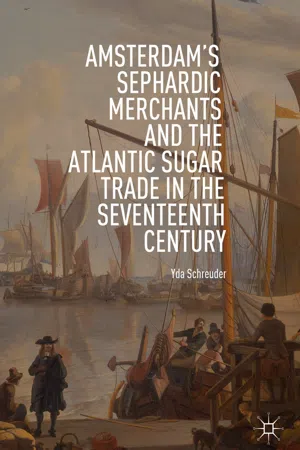
This book surveys the role of Amsterdam's Sephardic merchants in the westward expansion of sugar production and trade in the seventeenth-century Atlantic. It offers an historical-geographic perspective, linking Amsterdam as an emerging staple market to a network of merchants of the "Portuguese Nation," conducting trade from the Iberian Peninsula and Brazil. Examining the "Myth of the Dutch," the "Sephardic Moment," and the impact of the British Navigation Acts, Yda Schreuder focuses attention on Barbados and Jamaica and demonstrates how Amsterdam remained Europe's primary sugar refining center through most of the seventeenth century and how Sephardic merchants played a significant role in sustaining the sugar trade.
Information
Topic
HistoriaSubtopic
Historia europea© The Author(s) 2019
Yda SchreuderAmsterdam's Sephardic Merchants and the Atlantic Sugar Trade in the Seventeenth Centuryhttps://doi.org/10.1007/978-3-319-97061-5_11. The Atlantic Sugar Trade: Amsterdam’s Sephardic Merchants in the Seventeenth Century
Yda Schreuder1
(1)
Department of Geography, University of Delaware, Newark, DE, USA
Yda Schreuder
1.1 Introduction
Long-distance trade and merchant networks were important in the origins and development of particular metropolitan centers and specific staple colonies. In the geographic literature, we refer to the metropolitan urban system or merchant system describing how gateway or port cities connected areas of production (i.e. the staple producing colonies) with the major metropolitan centers in Europe in long-distance trade relationships.1 As these systems emerged and developed, merchant capital and profitable markets were essential.2 Merchant networks expanded westward across the Atlantic Ocean and sugar colonies developed serially with each new colony supplanting a predecessor and being replaced in turn. Increased economies of scale or new technological developments leading to greater efficiency of production and enhanced competition may have been the main reasons but other factors may have played a role as well such as shifting geopolitical circumstances, blockades, and embargoes, and mercantilist policies exercised by various colonial powers which provided differential access to commodities, labor, and markets. Soil depletion and overproduction may have been reasons for shifting production also.3
To understand the nature of overseas long-distance trade is to understand how exchange of goods is channeled through communities of immigrant merchants in port cities.4 These communities are often referred to as “merchant colonies” or “trading diasporas,” terms which connote mutual aid, kinship, solidarity, and resilience in what was sometimes a hostile environment.5 Immigrant merchants engaged in long-distance trade brought capital, credit, connections, and a commercial outlook on trade and exchange. Their significance in long-distance trade relates to their role as “cross-cultural” brokers, and they often functioned as diplomats in dispute between host societies and the home base negotiating the terms and conditions of trade.6 In the business world, trust and familiarity are key considerations and traders—such as merchants trading over long distances—count on family and ethnic networks to conduct their business.7 This was particularly important at a time when there was a limited financial infrastructure in place—as in frontier communities or newly established colonies—and when credit had to be provided to customers who had to be relied upon and counted on to repay. Under these circumstances, kin and ethnic connections were essential factors in business enterprise, and one could argue that specific merchant communities were important links in the development of specific production centers in various parts of the world.
In the context of colonial development in the Atlantic region, these vast and complex networks existed between Europe, the Caribbean region, North America, and West Africa.8 The network contacts affected the movements of people, trade goods, capital, and information and were channeled through commercial networks usually originating in Europe. Initially, the contacts were sporadic and intermittent, but in due time commercial outposts developed and more sophisticated commercial contacts were established. Transatlantic trade networks concentrated on European port cities, while tobacco and sugar plantations were developed in Brazil and the Caribbean. The need to expand the provisioning of ships and settlements led to import of supply goods and the development of local industries to outfit the frontier or colonial settlements. As trade became more organized, commercial companies developed provisioning and marketing systems and processing industries in European port or gateway cities. In West Africa, slave procurement systems and slave entrepots were established to provision plantations in the new colonies with labor. With the development of the Atlantic and Caribbean sugar plantation -slave economy and the development of Antwerp, Amsterdam, Hamburg, and London as entrepots or staple markets, immigrant merchants were key players in the emerging colonial trade system.
Recognition of the formation of trading communities and the role they played in the Atlantic economy in the seventeenth century is now generally accepted and numerous historians have adopted a network approach to study how people, commodities, and institutions moved within and across empires.9 In the transfer of goods and services in the early modern Atlantic economy, the demands of long-distance trade and shifting geopolitical alliances encouraged business strategies that required merchants to cooperate and align with multiple partners in a constantly changing environment. In this environment, Portuguese New Christian and alongside them their compatriot Sephardic merchants were exceptionally well adapted and moved from place to place where they established and reestablished new networks of contacts that were extremely fluid.10 The networks that developed during the seventeenth century form good examples of how sugar was traded and how this fueled the economy of the Dutch Republic in the seventeenth century and England a century later. By the mid-seventeenth century and during the second half of the seventeenth century, the Sephardic merchant network had a widespread geographical reach in the British, French, and Dutch sugar colonies in the Caribbean after it had first come into existence in the early seventeenth century in Northeast Brazil.
New Christian and Sephardic Jewish merchants were often granted special privileges to trade and were encouraged to take residence in gateway cities. Sometimes, aspiring imperial powers like the Dutch Republic in the first half of the seventeenth century in their war with Spain and Portugal , known as the Eighty Years’ War (1568–1648), or the English under Cromwell in the westward expansion in the Caribbean in the 1650s with the Trade and Navigation Act (1651) in effect, granted special “burghership ” or “denizen ” rights to Portuguese merchants. In this study, I will detail on the role the Portuguese merchant community or the Portuguese Nation played in the sugar trade in the Atlantic world and how they integrated with their host country’s interest.11 In the late sixteenth century and early seventeenth century, Portuguese merchants, including Old and New Christians, Crypto-Jews, and Sephardic Jews , engaged in trade through ports in Portugal, Brazil, Antwerp, Hamburg, and Amsterdam and were granted special rights and protection. When first Antwerp, then Amsterdam, and still later Hamburg became important entrepots and distribution centers for sugar in Northern and Central Europe and merchants established trading relations with Portugal and Brazil, it was clear that the Portuguese Nation was indispensable.12 Because of their widespread presence, Portuguese merchants could easily adjust to changing geopolitical circumstances and avoid or circumvent the impact of wars, blockades, and embargoes of European imperial powers and play off one against the other.13 And thus it is now generally recognized that the community of Portuguese merchants helped develop and sustain the Atlantic trade network in the sixteenth and early seventeenth centuries.14
Long-distance trade in sugar from Brazil in the sixteenth century was conducted mostly through Lisbon and the port of Antwerp. As Portugal became part of the Spanish Habsburg Empire in 1580, the port of Antwerp came directly under Spanish rule and thus more vulnerable as a target in the Eighty Years’ War (1568–1648) ...
Table of contents
- Cover
- Front Matter
- 1. The Atlantic Sugar Trade: Amsterdam’s Sephardic Merchants in the Seventeenth Century
- 2. The Development of the Sephardic Jewish Sugar Trade Network
- 3. The British Caribbean World: Barbados
- 4. Amsterdam’s Dutch and Sephardic Merchants in the Atlantic Supply Trade and the Sugar Trade in the Seventeenth Century
- 5. The Mission of Menasseh Ben Israel and Cromwell’s Western Design
- 6. Sephardic Merchants and the Second Barbados: Jamaica
- 7. The Atlantic Sugar Trade at the End of the Seventeenth Century
- Back Matter
Trusted by 375,005 students
Access to over 1.5 million titles for a fair monthly price.
Study more efficiently using our study tools.
Frequently asked questions
Yes, you can cancel anytime from the Subscription tab in your account settings on the Perlego website. Your subscription will stay active until the end of your current billing period. Learn how to cancel your subscription
No, books cannot be downloaded as external files, such as PDFs, for use outside of Perlego. However, you can download books within the Perlego app for offline reading on mobile or tablet. Learn how to download books offline
Perlego offers two plans: Essential and Complete
- Essential is ideal for learners and professionals who enjoy exploring a wide range of subjects. Access the Essential Library with 800,000+ trusted titles and best-sellers across business, personal growth, and the humanities. Includes unlimited reading time and Standard Read Aloud voice.
- Complete: Perfect for advanced learners and researchers needing full, unrestricted access. Unlock 1.5M+ books across hundreds of subjects, including academic and specialized titles. The Complete Plan also includes advanced features like Premium Read Aloud and Research Assistant.
We are an online textbook subscription service, where you can get access to an entire online library for less than the price of a single book per month. With over 1.5 million books across 990+ topics, we’ve got you covered! Learn about our mission
Look out for the read-aloud symbol on your next book to see if you can listen to it. The read-aloud tool reads text aloud for you, highlighting the text as it is being read. You can pause it, speed it up and slow it down. Learn more about Read Aloud
Yes! You can use the Perlego app on both iOS and Android devices to read anytime, anywhere — even offline. Perfect for commutes or when you’re on the go.
Please note we cannot support devices running on iOS 13 and Android 7 or earlier. Learn more about using the app
Please note we cannot support devices running on iOS 13 and Android 7 or earlier. Learn more about using the app
Yes, you can access Amsterdam's Sephardic Merchants and the Atlantic Sugar Trade in the Seventeenth Century by Yda Schreuder in PDF and/or ePUB format, as well as other popular books in Historia & Historia europea. We have over 1.5 million books available in our catalogue for you to explore.