eBook - ePub
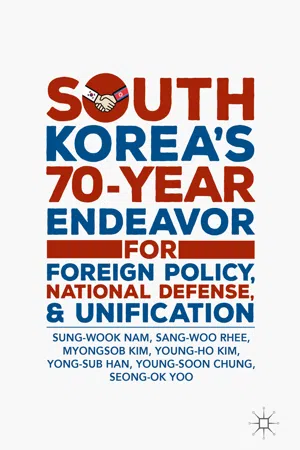
South Korea’s 70-Year Endeavor for Foreign Policy, National Defense, and Unification
- English
- ePUB (mobile friendly)
- Available on iOS & Android
eBook - ePub
South Korea’s 70-Year Endeavor for Foreign Policy, National Defense, and Unification
About this book
This book brings Korea's finest foreign policy minds together in contemplating the risks and rewards of finally ending the 70 year stalemate between North and South Korea through reunification. While North Korea is in conflict with the United States over denuclearization and regime security, the South Korean government is focusing on economic development preparing for the day when the two Koreas are unified. This book will help scholars, activists and policy-makers from all over the world systematically understand the current diplomatic and security issues in the Korean peninsula.
Information
© The Author(s) 2019
Sung-Wook Nam, Sang-Woo Rhee, Myongsob Kim, Young-Ho Kim, Yong-Sub Han, Young-Soon Chung and Seong-Ok YooSouth Korea’s 70-Year Endeavor for Foreign Policy, National Defense, and Unificationhttps://doi.org/10.1007/978-981-13-1990-7_11. Introduction: South Korea’s 70-Year Endeavor in the Areas of Foreign Policy, National Defense, and National Unification—Retrospect and Vision for the Future
Sang-Woo Rhee1
(1)
New Asia Research Institute, Seoul, South Korea
The author of Our Republic of Korea: Proposals for a Brighter Future, International Politics, Security and Unification of South Korea, and many other books.
End AbstractFor the past 70 years since 1945, the Republic of Korea has been built, maintained, developed, and turned into a proud democratic republic by the people of Korea. This chapter provides an introduction to this book and takes a general view of our achievements, particularly in the fields of foreign policy, national defense, and efforts for unification made along the journey toward “nation building”.
1.1 From the Fledgling Nation to an Advanced Nation: Diplomatic Achievement
Seventy years ago, there was no sovereign country representing the Korean people in the international community. For 35 years after the collapse of the Empire of Korea in 1910 when the entire territory and the population were annexed by the Empire of Japan, and for the subsequent three years during which US and the Soviet Union occupation armies administered the whole Korean Peninsula, the Koreans were deprived of citizenship of a sovereign state since Korea was not recognized as a state actor in the international community. Only after the establishment of the Republic of Korea (ROK) in 1948, Koreans could again participate in the international community as sovereign actors.
Endeavors to Establish ROK’s Sovereign Status in the International Community
The primary task of the newly independent ROK’s foreign policy was to obtain the approval of the existing members of the society of states as an equal member. It was an imperative task because the ROK could not build a global cooperative network without international recognition of its equal sovereignty by other member nations including superpowers like the United States, which led the global order and the members of the United Nations (UN).
In 1948 when the ROK was established, the world was divided into two opposing blocs: the liberal democratic bloc composed of the United States and the western European countries and the communist bloc dominated by the Soviet Union, which confronted the democratic bloc ideologically and militarily. Under these circumstances, the attempt of the ROK—which was established as a democratic republic, which embodied free and democratic ideology as its national policy—to secure its status in the international community faced a strong head wind, because the members of the communist bloc refused to recognize the ROK as a sovereign state.1 The ROK focused on winning the support of members of the Western bloc that shared the same ideological values with the ROK, by claiming that the ROK is the nation where basic human rights and freedom of its people are protected, and the nation where the sovereignty rests with its people. As a result, the ROK could be recognized as a sovereign state by the UN at the third General Assembly on December 12, 1948, by a vote of 48 in favor, 6 against, and 1 abstained. The UN General Assembly passed the resolution to recognize the ROK as the only such government in Korea established by its electorate and advised each member state of the UN to grant state recognition to ROK. After the adoption of the resolution by the General Assembly, the ROK exerted its diplomatic efforts to obtain the approvals by the individual member states. In one year after the UN resolution, it earned the support of 22 UN member states including four out of five permanent members of the UN Security Council: the United States of America (January 1, 1949), the Republic of China (January 4, 1949), the United Kingdom (January 18, 1949), and France (February 15, 1949).2
This diplomatic achievement of winning the approval of the UN member states in support of the ROK as a sovereign state played a significant part in drawing support from the international community for the ROK when the Korean War broke out. The Korean War began on June 25, 1950, when North Korea invaded the Republic of South Korea. On the same day, the UN Security Council convened in a special session and passed the resolution condemning North Korea’s aggression by a vote of 9 to 0. On June 27, 1950, just two days after communist North Korean forces invaded South Korea, the UN approved the resolution calling for the members of the UN furnish such assistance to the ROK as may be necessary to repel the armed attack and to restore peace and security in the area. Mandated by the resolution, the UN Command was established on July 7, 1950, and 16 UN member states dispatched their combat forces and fought alongside South Korea to repel the attacks of Chinese military that came to the aid of North Korea.3 After signing the armistice agreement in July 1953, which brought an end to the Korean War, the ROK’s foreign policy was focused on securing aid from the international community for rebuilding the war-torn nation and building sufficient military power necessary to deter similar aggression. As a result of successful diplomatic efforts, the ROK government secured 1 billion US$ from the United States and other allies until 1960 for national reconstruction. The amount of grant the ROK received from the international community during the 15-year period from its establishment to the post-war reconstruction period was as much as US$3 billion.4
The ROK also actively joined a variety of international organizations in an effort to expand its presence in the international community. For over half a century since its establishment, the ROK became the member of 40 UN affiliated organizations and 80 inter-governmental organizations to broaden its engagement with the international community. On the back of such diplomatic efforts, the ROK was admitted as a member state of the UN in 1992. By forging diplomatic ties with the Soviet Union’s satellite states and new countries that became independent after the end of the Cold War, the number of states with which the ROK established diplomatic ties amounted to 188 out of 192 UN member states, which includes virtually all nations in the world. As of 2015, the ROK is standing tall as a member of the Group of Twenty (G20), the leaders of global politics, and a South Korean national is currently serving as the UN Secretary-General.
The ROK has now become a military powerhouse with the world’s ninth largest defense budget and sixth largest armed forces. And the ROK has actively participated in UN peacekeeping and multi-national peacekeeping operations (PKO) with approximately 1440 service personnel deployed in over 15 countries.5 Sixty years ago the ROK was not recognized by the international community as a state actor, but now it has become one of the global leaders.
Diplomatic Efforts to Survive in Cold War
To secure sovereign status, a nation should possess its own population, territory, and capabilities to defend its national identity. Unfortunately, newly born ROK faced multidimensional difficulties to keep its sovereignty. The ROK was put to contend with North Korea to secure the governing authority over its territory and the people on it. When the new republic was established, the Cold War was in its early stage. Against this backdrop, the ROK had to put priority on establishing a security cooperation network with the Free World led by the United States in order to overcome the threat from North Korea backed by the Soviet Union and China.
Though Korea broke free of the shackles of Japanese colonial rule in the process of post-war settlement by the victorious countries of World War II, it immediately fell a victim to the Cold War. It was divided into two Koreas along the 38th parallel. The United States controlled the portion south of the 38th parallel, while the Soviet Union occupied the land north of the line. The territorial division turned into a political division when the Soviets installed a communist regime in the north. And this led to a national division as Koreans were divided into pro-communist group and those who supported the defense of their homeland during the Korean War which lasted for three years after the territorial division. The 38th parallel was not just a line dividing the Korean community but an ideological line dividing the world into the Free World and the Communist World during the Cold War era, which made the division harder to overcome by the Koreans alone.
The Korean War initiated by North Korea was brought to an end with the aid of the UN forces. Fighting was stopped by the cease-fire agreement signed in July 1953. The ROK signed the Mutual Defense Treaty with the United States to deter another aggression by the China-backed North Korea. The US-ROK Mutual Defense Treaty signed on October 1, 1953, was supplemented and amended several times and has been in place for 60 years. The treaty allowed the United States to station its military forces in South Korea forming ROK/US combined forces to prepare against North Korea’s possible provocations.6 The UN Command created at the outbreak of the Korean War is still functional, and the ROK engages in close coordination with its neighboring countries to check the North, which has been developing nuclear weapons since the beginning of 1990.
The North has pursued its clandestine nuclear weapons development program, violating the Joint Declaration on the Denuclearization of the Korean Peninsula agreed in February 1992. North Korea’s revelation of weapon-grade plutonium production at its Yongbyon nuclear facility attracted keen attention not only from South Korea but from surrounding East Asian countries. North Korea argues that its nuclear development program is only for the peaceful use of nuclear energy and that it has been operating nuclear reactors at places like Yongbyon, North Pyongan Province. To deter the North’s nuclear development program, ROK, United States, Japan, and European Union (EU) agreed to build light water reactor nuclear power plant that cannot be used for enriching plutonium under the so-called the Korean Peninsula Energy Development Organization (KEDO) program. However, North Korea deceived the international community, resumed its nuclear weapon development program, and built a new uranium enrichment plant, from which ensued the so-called Second North Korean Nuclear Crisis. The North violated a series of UN resolutions and went on to conduct three nuclear explosion tests. The ROK has been leading the six-party talks participated by United States, Japan, China, Russia, and North Korea to promote the so-called North Korea’s Denuclearization by persuading the North to abandon its nuclear development program and dismantle its nuclear weapons. Moreover, the ROK is exerting various diplomatic efforts for the UN to take the initiative to impose sanctions against North Korea’s nuclear weapons development program.
Surrounded by superpowers, the ROK has to build up its own military and self-defense capabilities over the past six decades. While strengthening its military powers, the ROK has also been actively engaging in foreign policy to ensure its national security. The ROK’s economic growth and stability are the outcomes of the government’s diplomatic efforts to maintain its national security.
Diplomacy to Build Foundation for Industrialization
After the armistice agreement, the ROK completed its post-war reconstruction to the year of 1960, and after that, the government ambitiously pushed ahead with industrialization projects. The government envisioned an ambitious plan to transform the backward agricultural country into industrialized nation. Yet, securing necessary capital for industrialization remained a problem. The economic development plan implemented by the second Republic of South Korea launched after the “April 19 Revolution” was successful and developed into the five-year economic development plan by the third Republic of South Korea which was inaugurated after the “May 16 Coup”. However, it was not easy to secure enough foreign capital necessary for industrialization. In this regard, the negotiation for establishing diplomatic ties between ROK and Japan served as a catalyst for Korea’s following economic development.
On June 22, 1965, Seoul and Tokyo signed the “Treaty on Basic Relations Between Japan and the Republic of Korea”, and the treaty became effective after its ratification on January 17, 1966. By signing this treaty, Japan recognized the ROK government as the only legitimate government on the Korean Peninsula and provided South Korea with US$300 million grant in economic aid and US$200 million in long-term loans together with US$300 million in loans for private trust as economic cooperation. The treaty provided a foundation for Japan to contribute to further economic development of the ROK. In 1960, ROK’s GNP was a mere US$1.9 billion, with a per capita income of US$79. Up until the early 1960s, 35 percent of government’s budget and 73 percent of its defense budget was covered by US aid.
To realize its vision to emerge from abject poverty and become a rich nation competing with other advanced nations, the Korean government designed and implemented four Five-Year Economic Development Plans consecutively. Starting with its First Five-Year Economic Development Plan (1962–1966), the government poured all its resources on the execution of these plans.7 Back then, the ROK had virtually no resources, capital, and social and economic bases to support industrialization. Given these circumstances, the government of Korea had to secure foreign capital necessary for economic development and pursue a labor-intensive, export-oriented industrialization. The government’s diplomatic efforts played an important role in the course of Korea’s industrialization. Economic diplomacy to seek cooperation from the international community, such as attracting foreign capital, securing overseas resources, and expanding export markets, became the backbone of successful implementation of the economic development plans.
Securing loans from the international financial market only through normal commercial negotiations was, however, almost impossible for the country like ROK, which had a low international credit rating. As a means to secure necessary commercial loans for the First Five-Year Economic Development Plan, the government of Korea dispatched a group of Korean miners and nurses to West Germany and offered their wages as collateral in exchange for receiving a financial aid of 150 million Deutsche Marks (40 million US$ equivalent) from West Germany. Likewise, the Treaty on Basic Relations between Japan and the ROK was part of the ROK government’s economic diplomacy to secure necessary loans. The ROK government dispatched Korean Armed Forces to Vietnam in 1965 to help South Vietnam’s defense. The military engagement was made on the military and national security policy consideration. As a result, however, it brought economic gains to Korea, too. The dispatch of the Korean soldiers paved the way for Korean business firms and civilians to make inroads into Vietnam. Thanks to the special demands created by the Vietnam War, the Korean government could secure US$680 billion loans for five years between 1965 and 1970.
Under the Second Five-Year Economic Development Plan (1967–1971), the ROK government focused on expanding its global market by nurturing conglomerates and shifting its focus to the promotion of heavy and chemical industries. The Third Five-Year Economic Development Plan (1972–1976) and the Fourth Five-Year Plan (1977–1981) focused more on consolidating the heavy and chemical industries, winning overseas construction contracts driven by large businesses firms and developing overseas resources. Accordingly, the economic policy of the government was shifted to improving ties with resource-rich nations and exploring export markets across the globe.
The ROK government went on to expand its sphere of economic policy by joining the Organization for Economic Cooperation and Development (OECD), an organization created in 1996 for the purpose of promoting economic progress and world trade and by signing free trade agreement (FTA) with major economies. The ROK joined the ranks of advanced nations by becoming a member of the Group of Twenty (G20) in 1999 when the G7 was expanded into G20, with the addition of 12 emerging nations (G12) and the EU. Moreover, the ROK hosted the 2010 G20 Seoul Summit. The ROK, which grew into an advanced trading nation, has been actively pursuing FTAs with major countries since 2005 in a bid to improve its trade environment and to secure eng...
Table of contents
- Cover
- Front Matter
- 1. Introduction: South Korea’s 70-Year Endeavor in the Areas of Foreign Policy, National Defense, and National Unification—Retrospect and Vision for the Future
- 2. Two Koreas in International History
- 3. Diplomatic Achievement of the Republic of Korea and Challenges in the Twenty-First Century
- 4. Seventy Years of Independence and Inter-Korean Relations
- 5. ROK’s Unification Policy to Overcome National Division
- 6. Robust Defense Policy of ROK
- 7. Challenges and Vision for Advanced and Unified Korea
Trusted by 375,005 students
Access to over 1.5 million titles for a fair monthly price.
Study more efficiently using our study tools.
Frequently asked questions
Yes, you can cancel anytime from the Subscription tab in your account settings on the Perlego website. Your subscription will stay active until the end of your current billing period. Learn how to cancel your subscription
No, books cannot be downloaded as external files, such as PDFs, for use outside of Perlego. However, you can download books within the Perlego app for offline reading on mobile or tablet. Learn how to download books offline
Perlego offers two plans: Essential and Complete
- Essential is ideal for learners and professionals who enjoy exploring a wide range of subjects. Access the Essential Library with 800,000+ trusted titles and best-sellers across business, personal growth, and the humanities. Includes unlimited reading time and Standard Read Aloud voice.
- Complete: Perfect for advanced learners and researchers needing full, unrestricted access. Unlock 1.5M+ books across hundreds of subjects, including academic and specialized titles. The Complete Plan also includes advanced features like Premium Read Aloud and Research Assistant.
We are an online textbook subscription service, where you can get access to an entire online library for less than the price of a single book per month. With over 1.5 million books across 990+ topics, we’ve got you covered! Learn about our mission
Look out for the read-aloud symbol on your next book to see if you can listen to it. The read-aloud tool reads text aloud for you, highlighting the text as it is being read. You can pause it, speed it up and slow it down. Learn more about Read Aloud
Yes! You can use the Perlego app on both iOS and Android devices to read anytime, anywhere — even offline. Perfect for commutes or when you’re on the go.
Please note we cannot support devices running on iOS 13 and Android 7 or earlier. Learn more about using the app
Please note we cannot support devices running on iOS 13 and Android 7 or earlier. Learn more about using the app
Yes, you can access South Korea’s 70-Year Endeavor for Foreign Policy, National Defense, and Unification by Sung-Wook Nam,Sang-Woo Rhee,Myongsob Kim,Young-Ho Kim,Yong-Sub Han,Young-Soon Chung,Seong-Ok Yoo, Academy of Korean Studies Press AKS in PDF and/or ePUB format, as well as other popular books in Politics & International Relations & Korean History. We have over 1.5 million books available in our catalogue for you to explore.