- First book to draw together the infancy of published work on sports events and emerging states.
- Situates the debate within key, mainstream literature in contemporary international relations, sociology, political science and sports studies.
- Offers readers a truly global comparison (drawing on evidence from South America, Eurasia, Asia and the Middle East).
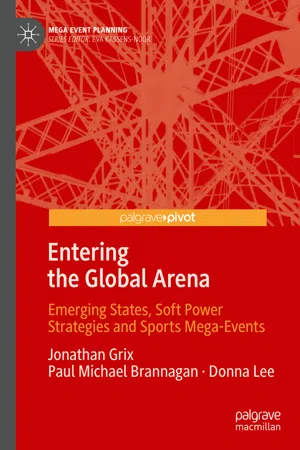
eBook - ePub
Entering the Global Arena
Emerging States, Soft Power Strategies and Sports Mega-Events
- English
- ePUB (mobile friendly)
- Available on iOS & Android
eBook - ePub
Entering the Global Arena
Emerging States, Soft Power Strategies and Sports Mega-Events
About this book
Information
© The Author(s) 2019
Jonathan Grix, Paul Michael Brannagan and Donna LeeEntering the Global ArenaMega Event Planninghttps://doi.org/10.1007/978-981-13-7952-9_11. Introduction
Jonathan Grix1 , Paul Michael Brannagan1 and Donna Lee1
(1)
Business and Law Faculty, Manchester Metropolitan University, Manchester, UK
Abstract
Against the backdrop of a perceived changing world order, the following introduces a study of states’ use of sports mega-events in their soft power strategies. The focus is on emerging states, which complements the myriad studies on advanced capitalist states. The chapter discusses the rationale behind bidding for and the hosting of sports mega-events and how this volume contributes to those debates.
Keywords
Soft powerEmerging statesSports mega-events and legaciesThe discussion of ‘soft power’ and sports mega-events (SMEs) that follows does so against a backdrop of concerns about the potential break-up or radical change to the global world order. The inexorable rise of China, the protectionist policies of President Donald Trump in the US and the rise of ‘fake news’ are just some of the factors thought to be contributing to the current disquiet (Muggah 2018). Equally, the key institutions involved in maintaining a relatively stable world order, namely, the United Nations, the World Trade Organization and the North Atlantic Treaty Organisation, have all come under strain in this new era. While populist politics is spreading globally—in Italy, Hungary, Poland, Brazil and the Philippines, to name but a few—there is widespread agreement that states are increasingly seeking ways to acquire ‘soft power’ to negotiate their positions on the international stage. According to Joseph Nye (1990, 167), who coined the term ‘soft power’, the changing nature of international relations after the end of the Cold War and the risk attached to deploying traditional military forms of power (or ‘hard power’) have led to ‘intangible power resources such as culture, ideology, and institutions’ becoming more important in interstate relations. Progressively more states have added sport to their soft power strategies, in the form of state-sponsored elite sport success (e.g. the UK, Australia, China and Russia) or, more often, in the form of hosting sports mega-events (e.g. the US, China, Japan, South Korea and Russia).
It is at this point that the current study starts. The following represents the first attempt at a sustained analysis and conceptualisation of the role of sports mega-events in the soft power strategies of emerging states (see Chap. 2 for more on the term ‘emerging’ state and the rise of the ‘BRICS’ countries). The work is the result of many years of thinking about the politics of SMEs, their use by states, the rationale behind bidding for and hosting them and the impact such events have on the host state and their status in international politics. Our work builds upon the work of other academics and other case studies, of which there are many. In the context of the Olympic Games alone some of the most important studies of the events and their legacies include: Sydney’s hosting of the 2000 Games (Faulkner et al. 2000; Stewart et al. 2004; Cashman 2006; Lenskyj 2012; Veal et al. 2012); the beleaguered 2004 Games in Athens (Tziralis et al. 2006; Hede 2005; Boukas et al. 2013); the ‘communist-consumerist’ 2008 Games in Beijing (Xu 2006; Jinxia and Mangan 2008; Manzenreiter 2010; Zhang and Zhao 2009; Preuss and Alfs 2011; Giulianotti 2015); the London 2012 Games (Girginov and Hills 2008; Girginov 2011; Bloyce and Lovett 2012; Green 2012; Weed et al. 2012; Weed 2014; Devine 2013); Sochi’s staging of the 2014 Winter Olympics (Alekseyeva 2014; Orttung and Zhemukhov 2014; Grix and Kramareva 2017; Müller 2015; Golubchikov 2017); and Rio’s organisation of the 2016 Games (Almeida et al. 2014; Osorio and Versiani 2014; Rocha 2015, 2017; Bizarro et al. 2016).
The list is far from exhaustive, but simply indicative of the wealth of research by commentators working in a wide range of different academic disciplines. We maintain that there is still a lack of academic research by the very people one would assume would be at the forefront of sport politics analyses: political scientists and international relations scholars. The majority of work focussing on the political role of SMEs is undertaken by sociologists, historians, management and tourism experts, geographers, urban studies specialists and those broadly termed ‘sports studies’ scholars. We attempt to redress this through an analysis that is a mixture of international relations, political science and political sociology, reflecting the authors’ academic backgrounds and interests.
This volume complements the work that has been carried out on advanced capitalist states. We are interested in understanding whether there are differences in the soft power strategies used by ‘great powers’, ‘middle ranking powers’ and ‘emerging states’. The focus on exclusively non-Western states also goes some way to counter the argument that much of SME research is Western biased. Thus, we present five case studies of emerging states, four of which belong to the so-called BRICS (Brazil, Russia, India, China and South Africa) countries. India is not included because it has not hosted a ‘first-order’ SME (Black 2008; see Chap. 3 for an explanation of the categories of SMEs); all of our other BRICS countries have: Brazil (2014 FIFA World Cup; 2016 Summer Olympics/Paralympics), Russia (2014 Winter Olympics; 2018 FIFA World Cup), China (2008 Summer Olympics/Paralympics; 2022 Winter Olympics) and South Africa (2010 FIFA World Cup). Our fifth case study, Qatar, is a slight outlier in the sense that it is far richer per capita than all other ‘emerging’ states and it has yet to host a first-order SME (2022 FIFA World Cup). The justification for including Qatar is, in part, due to the clear and important role that sport plays in this state’s quest for international recognition and long-term economic survival.
The case study chapters follow a similar lay-out for a number of reasons. First, this adds to the cohesiveness of the text; second, it allows for easier comparison between our cases; and, finally, it enables the comparison with further states bidding for and hosting SMEs. Each case study begins with an abstract that summarises the chapter’s contents; we then offer a short section outlining the specificities of the country under study and their use of SMEs. This is followed by the key socio-economic data relating to the case, which provides a good basis for comparison between cases and other would-be SME hosts. Key demographic and economic data are essential to contextualise cases among other states (e.g. Qatar has only 2.7 million citizens—with Qataris making up only about 15 per cent of this figure, while China’s population is a staggering 1.4 billion) (CIA World Factbook 2018). A third section turns to a potted history of sport in the particular country and its meaning and use politically. We also list the key SMEs bid for and hosted by our cases. A fourth section analyses the case study and the main event or events they have hosted and the strategies developed to leverage the event to maximise its political and economic potential. We do this by operationalising an ideal type of soft power acquisition developed by Grix and Brannagan (2016). The ideal type—discussed in more detail in Chap. 3—thereby acts as an organising principle for the book as a whole. Five dimensions of soft power acquisition are put forward under the broad, and overlapping, headings of: culture, tourism, branding, diplomacy and trade. Each of our case studies finishes with a section ‘concluding remarks’ which flags up any case-specific issues or points the reader towards any particular learning from that case.
One of the aims of this volume is to add empirical findings with which to populate this relatively ‘static’ ideal type for assessing states’ soft power strategies—whether they use sport or not. This is important because the conceptualisation we advance is not just for SME hosts; we use sport as the focus of study in this volume because large-scale sports events are clearly seen by states as an essential part of their soft power packages and in growing their international prestige. This is evidenced by the fact that all so-called Great Powers and all of the BRICS countries have hosted a major sporting event in the twenty-first century. Our resulting model, however, ought to be of use to non-sports examples of states seeking to acquire soft power. In the conclusion we set out an adapted version of this ideal type, based on the results of the work in this volume, for use in future research. This represents a first attempt to develop a model of soft power that can be employed across regime types and states at varying levels of development. This is not to suggest, however, that all regime types adopt the same soft power strategy; rather, the model can help in assessing which type of strategy a state is pursuing. We ac...
Table of contents
- Cover
- Front Matter
- 1. Introduction
- 2. Emerging States and the Shifting Balance of Global Power
- 3. Sports Mega-Events and the Concept of Soft Power
- 4. Brazil’s Double Host Status
- 5. Russia’s Unique Soft Power Strategy
- 6. China’s Coming Out Party? The Beijing Olympics, 2008
- 7. South Africa and the 2010 FIFA World Cup
- 8. Qatar’s Global Sports Strategy: Soft Power and the 2022 World Cup
- 9. Conclusion
Trusted by 375,005 students
Access to over 1.5 million titles for a fair monthly price.
Study more efficiently using our study tools.
Frequently asked questions
Yes, you can cancel anytime from the Subscription tab in your account settings on the Perlego website. Your subscription will stay active until the end of your current billing period. Learn how to cancel your subscription
No, books cannot be downloaded as external files, such as PDFs, for use outside of Perlego. However, you can download books within the Perlego app for offline reading on mobile or tablet. Learn how to download books offline
Perlego offers two plans: Essential and Complete
- Essential is ideal for learners and professionals who enjoy exploring a wide range of subjects. Access the Essential Library with 800,000+ trusted titles and best-sellers across business, personal growth, and the humanities. Includes unlimited reading time and Standard Read Aloud voice.
- Complete: Perfect for advanced learners and researchers needing full, unrestricted access. Unlock 1.5M+ books across hundreds of subjects, including academic and specialized titles. The Complete Plan also includes advanced features like Premium Read Aloud and Research Assistant.
We are an online textbook subscription service, where you can get access to an entire online library for less than the price of a single book per month. With over 1.5 million books across 990+ topics, we’ve got you covered! Learn about our mission
Look out for the read-aloud symbol on your next book to see if you can listen to it. The read-aloud tool reads text aloud for you, highlighting the text as it is being read. You can pause it, speed it up and slow it down. Learn more about Read Aloud
Yes! You can use the Perlego app on both iOS and Android devices to read anytime, anywhere — even offline. Perfect for commutes or when you’re on the go.
Please note we cannot support devices running on iOS 13 and Android 7 or earlier. Learn more about using the app
Please note we cannot support devices running on iOS 13 and Android 7 or earlier. Learn more about using the app
Yes, you can access Entering the Global Arena by Jonathan Grix,Paul Michael Brannagan,Donna Lee in PDF and/or ePUB format, as well as other popular books in Social Sciences & Politics. We have over 1.5 million books available in our catalogue for you to explore.