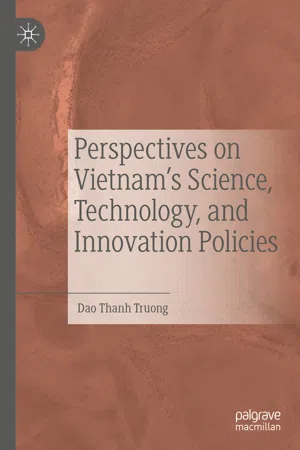
This book provides an overview of the science, technology, and innovation (STI) policies in Vietnam in a globalized world. Science, technology and innovation policies play important roles in boosting research and development, promoting entrepreneurship and building national innovation systems, especially in developing countries. The author offers in-depth analyses and insights on the STI system of Vietnam and provides comparisons with the major STI development trends around the world. Each chapter of the book includes intensive studies and analyses of the STI system and policies in Vietnam, providing valuable arguments and essential tools for students, researchers, and policy makers in the field of science and technology management, political science, public policy and business studies. The author then addresses potential challenges and proposes policy recommendations to overcome them to improve the performance of the Vietnam's STI system in the context of globalized economies andinternational integration of science and technology.
- English
- ePUB (mobile friendly)
- Available on iOS & Android
eBook - ePub
Perspectives on Vietnam’s Science, Technology, and Innovation Policies
About this book
Information
© The Author(s) 2019
D. T. TruongPerspectives on Vietnam’s Science, Technology, and Innovation Policieshttps://doi.org/10.1007/978-981-15-0571-3_11. Some Theoretical Issues About STI and STI Research in the Trend of International S&T Integration
Dao Thanh Truong1
(1)
VNU University of Social Sciences and Humanities Vietnam National University, Hanoi, Hanoi, Vietnam
Dao Thanh Truong
1.1 Overview of Research on STI in International S&T Integration Tendency
1.1.1 Foreign Research on STI System
Research on innovation was pioneered in 1903 by Gabriel Tarde, who first drew the S-shaped diffusion curve diagram. Tarde determined the innovation decision with the following steps: initial knowledge, forming an attitude, decision to approve or disapprove, implementation and use, and confirmation of the decision.
From the early years of the twentieth century, economist Joseph Schumpeter had conducted research on innovation by distinguishing the boundaries between the formation of product ideas or processes and the use of such ideas in economic development, which was published in his book in 1911. Initially, the STI system was mentioned in studies of innovation and the national innovation system (NIS ) by Freeman et al. (1982), Lundvall (1992), Nelson and Rosenberg (1993), Carlsson and Stankiewicz (1991), and Edquist (1997). Innovation was understood as a broad concept that covered processes employed by businesses and included the design of new products and processes of construction for businesses, regardless of whether they were new locally or internationally. The concept of innovation was not only about new technology, but also the spreading of that technology. This meant that innovation was considered primarily as a result of interactive learning processes. Knowledge interacted in new ways to create new knowledge, processes, and products. Such interactions not only pertained to R&D, but also to production and business activities. Interactions occurred within a business, between businesses and consumers, among businesses, or among businesses and public organizations.
Scholars have focused on theoretical research and methods of forming innovative systems at different levels: countries (macro), regional (mezo), and businesses (micro), as well as the relationships between these levels. Studies show that the innovation system is the best way to overcome the shortcomings of the developed market model under the free-market mechanism. The national and regional innovation system is a systematic linkage of institutions used to create competitive new products in the market, where enterprises play a central role and the government plays a supportive role (by legal corridor). This is a prerequisite for forming an innovation system. One commonality among these studies on innovation systems is that innovation is recognized as a multifaceted phenomenon that cannot be easily included in a particular industry. Fagerberg et al. (2005) pointed out important elements of that system, including businesses, innovators, innovation process, organization, and innovation assessment. Researchers also argue that innovation is seldom held in an independent manner, but interacts with other aspects—such as R&D, policy, education, finance, economic growth, employment, intellectual property, and the differences of regions, industries and multinational organizations—that affect innovation. In addition, the study acknowledges technological quality as the basis for the penetration of innovation into all economies. It also concludes that low- and medium-tech industries are less innovative than high-tech industries.
NIS studies by Charles Edquist (2001) presented different approaches to the innovation system: economic differences between countries account for differences between innovation systems and showed the way for promoting faster and more effective technological innovation. Franco Malerba (2002) posited that the major factors affecting innovation are knowledge and technology, agents and networks, and institutions.
J. Hauknes and O. Wicken (STEP Group) (1999a) reviewed some basic characteristics of innovation policy, stages of innovation policy, and regulatory tools for industrial development. Studies by Edquist (Linköping University, Sweden) in 1999 and 2001 mentioned innovation policy as well as the design and implementation of innovation policies within the framework of an innovative system approach. The study conducted by the Charles River Association (Asia Pacific) (2003) looked into Singapore’s innovation policy in terms of foreign investment, venture capital, R&D policy, cluster policy, and links. The Swedish Institute for Growth Policy Studies (ITPS) (2004), in collaboration with the Swedish embassy in Tokyo, focused on current issues in Japanese research and innovation policies as well as government funding trends for R&D.
In addition to programs associated with the national technology innovation, a number of regional technology research and innovation programs are also offered in some countries. For instance, the Belgian RIT program aims to encourage Wallonia small and medium-size enterprises (SMEs ) to conduct R&D activities and technological innovation through recruiting special innovation managers. Hungary’s Baross Gábor program supports technological innovation in the Dél-Alföld region to enhance knowledge transfer between R&D institutes and businesses to promote the commercialization of research results. These are done through support measures that cover developing products and technologies for small businesses, facilitate cooperation between businesses and other organizations in innovation activities and knowledge exchange, and strengthen the commercialization of results of innovation activities in enterprises.
Bengt-Ake Lundvall et al. (2006) presented four very specific, profound case studies on the innovation system of Asia, specifically those of Thailand, Hong Kong, Indonesia, and Korea. These four Asian countries have experienced and are still facing some common and major issues. This shows that the government plays a very important role in establishing prerequisites for the transition. It is referred to as a “gardener” that supports innovators by providing proper financing and other measures, as well as removing cumbersome paper procedures, institutional and competition barriers to innovation, and increasing investment-based knowledge in education and research. The study also indicates the opportunities and challenges caused by social, economic, and political division as well as ethnic issues.
In the innovation system, enterprises are considered to be central actors in the innovation process. They are responsible for bringing in new things, as well as implementing and creating values. In competitive theory, Michael Porter (1990) acknowledged the competitive advantage established through innovation. The “innovative machine” is needed to produce new things that help businesses gain a competitive advantage to step into the future.
The issue of what enterprises must do to execute the innovation process was acknowledged very early on and mentioned in Richard Foster’s 1986 work, Innovation: The Attacker’s Advantage. He referred to innovation as an advantage for those who actively create change. This view was shared by Fagerberg et al. (2005). When exploring the nature of innovation, they considered enterprises as important factors that are loc...
Table of contents
- Cover
- Front Matter
- 1. Some Theoretical Issues About STI and STI Research in the Trend of International S&T Integration
- 2. Experience in Developing STI System in Some Countries in the Context of International S&T Integration
- 3. Vietnam’s STI System in the International S&T Integration Context
- 4. An Analysis of Vietnam’s STI Policies in the Context of International S&T Integration
- 5. Policy Recommendations to Promote Vietnam’s STI System in the Era of International Integration
- 6. Conclusion
- Back Matter
Trusted by 375,005 students
Access to over 1.5 million titles for a fair monthly price.
Study more efficiently using our study tools.
Frequently asked questions
Yes, you can cancel anytime from the Subscription tab in your account settings on the Perlego website. Your subscription will stay active until the end of your current billing period. Learn how to cancel your subscription
No, books cannot be downloaded as external files, such as PDFs, for use outside of Perlego. However, you can download books within the Perlego app for offline reading on mobile or tablet. Learn how to download books offline
Perlego offers two plans: Essential and Complete
- Essential is ideal for learners and professionals who enjoy exploring a wide range of subjects. Access the Essential Library with 800,000+ trusted titles and best-sellers across business, personal growth, and the humanities. Includes unlimited reading time and Standard Read Aloud voice.
- Complete: Perfect for advanced learners and researchers needing full, unrestricted access. Unlock 1.5M+ books across hundreds of subjects, including academic and specialized titles. The Complete Plan also includes advanced features like Premium Read Aloud and Research Assistant.
We are an online textbook subscription service, where you can get access to an entire online library for less than the price of a single book per month. With over 1.5 million books across 990+ topics, we’ve got you covered! Learn about our mission
Look out for the read-aloud symbol on your next book to see if you can listen to it. The read-aloud tool reads text aloud for you, highlighting the text as it is being read. You can pause it, speed it up and slow it down. Learn more about Read Aloud
Yes! You can use the Perlego app on both iOS and Android devices to read anytime, anywhere — even offline. Perfect for commutes or when you’re on the go.
Please note we cannot support devices running on iOS 13 and Android 7 or earlier. Learn more about using the app
Please note we cannot support devices running on iOS 13 and Android 7 or earlier. Learn more about using the app
Yes, you can access Perspectives on Vietnam’s Science, Technology, and Innovation Policies by Dao Thanh Truong in PDF and/or ePUB format, as well as other popular books in Economics & Management. We have over 1.5 million books available in our catalogue for you to explore.