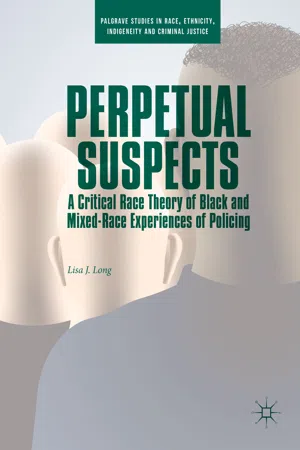
Grounded in Critical Race Theory (CRT), this book examines black and mixed-race men and women's experiences of policing in the UK. Through an intersectional analysis of race, class and gender it analyses the construction of the suspect, illuminating the ways in which race and racism(s) shape police contact. This counter-story to the dominant narrative challenges the erasure of race through the contemporary 'diversity' agenda. Overall, this book proposes that making racism visible can disrupt power structures and make change possible. It makes a timely contribution to this significantly under-researched area and will be of interest to students, educators and scholars of Criminology, Social Sciences, Law and Humanities. It will also be of interest to criminal justice practitioners, communities and activists.
eBook - ePub
Perpetual Suspects
A Critical Race Theory of Black and Mixed-Race Experiences of Policing
- English
- ePUB (mobile friendly)
- Available on iOS & Android
eBook - ePub
Perpetual Suspects
A Critical Race Theory of Black and Mixed-Race Experiences of Policing
About this book
Information
Topic
Ciencias socialesSubtopic
Criminología© The Author(s) 2018
Lisa J. LongPerpetual SuspectsPalgrave Studies in Race, Ethnicity, Indigeneity and Criminal Justicehttps://doi.org/10.1007/978-3-319-98240-3_11. Introduction
Stop and search has long been a source of contention for Black communities in the UK. Disproportionality in stop and search is eight times higher for those who are Black and more than two times higher for those who are ‘mixed’ (this includes ethnicities other than Black-mixed-race) (Home Office 2017). Ethnic profiling is a common police practice in several countries within the EU; Ethnicity, religion, race, or national origin are the criteria for police decision making around identity checks and stop and search (Open Society Justice Initiative 2009). Similar patterns are evident in the US where stop and search, or ‘stop and frisk’ has become a key part of Zero Tolerance Policing (see Fagan and Davies 2000; Camp and Heatherton 2016), and car stops are disproportionately experienced by Black drivers, for the offence of ‘driving while Black’ (Lundman and Kaufman 2003). This draws ethnic minority populations, in particular Black people, into the criminal justice system in disproportionate numbers. Kelley, argues that broken windows policing and its zero tolerance for minor infringements, such as walking in the middle of the street, serves to punish black communities, transforming them ‘from citizens to thugs’ (Kelley 2016). This is acutely evident in mass incarceration in the US context. African Americans are more than five times more likely to be incarcerated than their White peers (Nellis 2016). Comparably, there is increasing disproportionality in the UK prison population; 13.1% of UK prison population is Black compared with 2.7% of the general population. This is particularly pronounced in the UK’s youth justice estate, where 41% of young people (under 18 years of age) in custody are from an ethnic minority background (Lammy 2017).
The disproportionate use of force by police officers when dealing with Black ‘suspects’ and deaths in custody (or otherwise at the hands of the police) are a significant concern for Black communities, impacting upon trust and confidence in the police (see Chapters 3 and 4). Black people are more likely to be subject to police use of force during detention and custody (Dearden 2017; Gayle 2015) and are more likely to die in restraint related circumstances (Angiolini 2017). The Institute of Race Relations (2015) shows that between 1991 and 2014 there were 509 ‘BME’ deaths in custody, 348 in prison 137 in police custody and 24 in immigration detention (p. 4). In the US context, in 2017 alone, 1129 people died at the hands of the police, 27% were black (two times their representation in the general population and of the 1129 who were not armed when they were killed, 37% were Black. Only 12 police officers were charged with an offence following these deaths (Harriot 2018). Whilst police powers for the use of force and the routine nature of arming police officers varies between national jurisdictions, the UK and the US have in common that Black people are disproportionately represented amongst those who die at the hands of the police. Further, neither individual police officers, or the police as an institution, are held accountable for their use of lethal force.
In Australia, a similar picture emerges in the context of the police treatment of ethnic minorities, in particular the indigenous Aboriginal population. The aboriginal population are over-represented at all stages of the Australian criminal justice system and are incarcerated at 12 times the rate of the non-Aboriginal Australian population, despite making up less than 3% of the Australian population (Australian Institute of Criminology 2015). Further, there are ongoing concerns pertaining to Aboriginal deaths in police custody, similar to those of Black communities in the US and the UK and across Europe. The history of settler colonisation and the Australian police services role in the enforcement of legislation permitting the dispossession of land, and suppressing Aboriginal resistance to European settlement, paves the way for their ongoing marginalisation (Bowling et al. 2004). The impact of colonial histories upon Aboriginal communities was acknowledged by the Royal Commission in to Aboriginal Deaths in Custody , the Commission concluded that, in the 99 cases examined, Aboriginal ethnicity played an instrumental part in the victim’s death (Johnston 1991). Recommendation 60, that the police work towards eliminating racist and degrading treatment of Aboriginal communities, led to a programme of reform, however its effectiveness at eliminating racist treatment of Aboriginal populations has been limited. Aboriginal populations still face economic and social marginalisation, high rates of victimisation and have a disproportionate presence in the Australian criminal justice system (Cunneen and Tauri 2016).
Similarly to the Australian context, widescale reform to policing in the UK, in the wake of the publication of the Stephen Lawrence Inquiry Report (Macpherson 1999), has not been successful in eliminating racism from the police (see Rollock 2009). This is borne out in the disproportionate representation of Black and Black mixed-race people in all areas of policing, as discussed above. This book will address the question, how do Black and Black mixed-race people experience policing contemporarily? A Critical Race Theory (CRT) framework informs the lens through which the enduring presence of racism within policing is analysed. As argued by Mills (1997: 1) ‘White supremacy is the unnamed political system that has made the modern world what it is today’. Within this system of racial categorisation, premised on ‘White supremacy’, Blackness is a marker for a particular form of Otherness that symbolises threat. This book will consider how, through processes of racialisation, race has become meaningful (Garner 2010) in the context of crime. This has particular significance for the contact between Black communities and the police who are tasked with monitoring and controlling the Black other. From the perspective of racialised subjects of policing, the book develops a counter story to dominant racialised narratives. It chooses to draw upon the specificities of being racialised as Black, as opposed to the broader experiences of ethnic minority communities which are oftentimes homogenised in relation to issues of race and policing. Whilst the data is UK specific, the findings have some relevance in the international contexts discussed above because of the legacy of their imperial histories, and the endurance of ‘White supremacy’ as a system of global ordering.
This chapter will go on to discuss the CRT framework and method, and its utility in criminological research. It will then outline the chapters to follow.
The Research
Critical Race Theory as Framework
Developed in North America through the work of black scholars—notably Derrick Bell (1991, 1992), Marie Matsuda (1987, 1989), Kimberle Crenshaw (1989, 1995), and Richard Delgado (1994, 1996)—the origins of CRT can be found in Critical Legal Studies. Its core principles were developed through challenges to the US legal system and in particular racial inequalities in jurisprudence. The foundational standpoint of CRT is one of ‘racial realism’ (Bell 1991). This proposes that racism is an ‘endemic’ and ‘deeply ingrained’ (Tate 1997) system of inequality which directly shapes systems of power. Whilst essentialist notions of race, premised on biological categorisation, are broadly discredited in scholarly works (Warmington 2009: 282), the salience of race as a key organising principle within society is the fundamental starting point for Critical Race scholars (Omi and Winant 1993: 5). Within this system of racially predicated social organisation, Whiteness is the norm (Dyer 1997: 10) and the non-White is othered for the purpose of maintaining ‘White privilege’ (Mills 1997). Therefore, as Fanon (1986) argues, ‘not only must the Black man be Black, he must be Black in relation to the White man’ (p. 110). By extension, the Black body must also be Black in relation to the White institution for the maintenance of White power. This is a useful approach to understanding the operation of race within the police/citizen encounter and criminal justice processes more broadly.
Criminology has hitherto understood the relationship between police and black communities in dichotomous terms—either as a problem of race or as a problem of class. It is dominated by attempts to explain the over-representation of ethnic minority groups in the Criminal Justice System through an assumption that some groups have a greater propensity for criminality than others—Black people in particu...
Table of contents
- Cover
- Front Matter
- Part I. Contextualising the Race-Crime Nexus
- Part II. Erasing Race: Policing Diversity
- Part III. Theoretical Implications and Conclusions
- Back Matter
Trusted by 375,005 students
Access to over 1.5 million titles for a fair monthly price.
Study more efficiently using our study tools.
Frequently asked questions
Yes, you can cancel anytime from the Subscription tab in your account settings on the Perlego website. Your subscription will stay active until the end of your current billing period. Learn how to cancel your subscription
No, books cannot be downloaded as external files, such as PDFs, for use outside of Perlego. However, you can download books within the Perlego app for offline reading on mobile or tablet. Learn how to download books offline
Perlego offers two plans: Essential and Complete
- Essential is ideal for learners and professionals who enjoy exploring a wide range of subjects. Access the Essential Library with 800,000+ trusted titles and best-sellers across business, personal growth, and the humanities. Includes unlimited reading time and Standard Read Aloud voice.
- Complete: Perfect for advanced learners and researchers needing full, unrestricted access. Unlock 1.5M+ books across hundreds of subjects, including academic and specialized titles. The Complete Plan also includes advanced features like Premium Read Aloud and Research Assistant.
We are an online textbook subscription service, where you can get access to an entire online library for less than the price of a single book per month. With over 1.5 million books across 990+ topics, we’ve got you covered! Learn about our mission
Look out for the read-aloud symbol on your next book to see if you can listen to it. The read-aloud tool reads text aloud for you, highlighting the text as it is being read. You can pause it, speed it up and slow it down. Learn more about Read Aloud
Yes! You can use the Perlego app on both iOS and Android devices to read anytime, anywhere — even offline. Perfect for commutes or when you’re on the go.
Please note we cannot support devices running on iOS 13 and Android 7 or earlier. Learn more about using the app
Please note we cannot support devices running on iOS 13 and Android 7 or earlier. Learn more about using the app
Yes, you can access Perpetual Suspects by Lisa J. Long in PDF and/or ePUB format, as well as other popular books in Ciencias sociales & Criminología. We have over 1.5 million books available in our catalogue for you to explore.