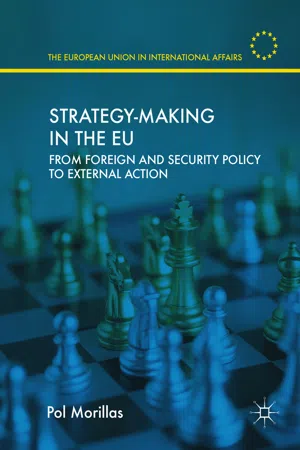
This book provides a detailed analysis of the policy-making processes of EU strategies in foreign and security policy and external action. It uses the European Security Strategy and the EU Global Strategy to assess their policy-making dynamics both before and after the Lisbon Treaty. Inter-institutional relations in strategy-making are put into the context of current debates in European integration, questioning the assumption that the EU is a body increasingly ruled by intergovernmentalism - as reflected by the new intergovernmentalism literature. The book also provides a categorisation of EU strategies and considers them as policy-inspiration documents, acting as frameworks for policy-making. This reading of strategies lies behind the analysis of the policy-making processes of the ESS and the EUGS, unpacked into four phases: agenda-setting, policy formulation, policy output and implementation. By looking at the shifting policy-making dynamics from foreign and security policy to external action, the author sheds light on the current shape of EU integration.
eBook - ePub
Strategy-Making in the EU
From Foreign and Security Policy to External Action
- English
- ePUB (mobile friendly)
- Available on iOS & Android
eBook - ePub
About this book
Information
Subtopic
Politica europea© The Author(s) 2019
Pol MorillasStrategy-Making in the EUThe European Union in International Affairshttps://doi.org/10.1007/978-3-319-98627-2_11. Introduction: Strategy-Making in the Era of Intergovernmentalism
Pol Morillas1
(1)
Barcelona Centre for International Affairs (CIDOB), Barcelona, Spain
1.1 Introduction
It has become a truism that the European Union (EU) is a body increasingly ruled by intergovernmentalism . Member states are often portrayed as the winners of a power contest with supranational institutions, which have been marginalised in critical decisions of European politics. Some trace the predominance of intergovernmentalism to the Maastricht Treaty , well before the re-nationalisation dynamics and sense of disunion currently inhabiting the EU. Fabbrini (2015: 125) has written:
post-Maastricht intergovernmentalism has recognized that integration should proceed without (…) going in the supranational direction. On the contrary, integration should consist in pooling national sovereignties within intergovernmental institutions. The decision-making power should not be in the hands of each member state, but in those of the institutions that coordinate the action of the member state governments (the European Council and the Council ).
The trend towards an intergovernmental Union has been reinforced with the dynamics of a crisis-ridden EU. Member states have taken the reigns of crisis management, in particular since the Euro crisis . Decision-making centred on the Council has turned the European Commission into “little more than a secretariat ” and side-lined the European Parliament (Schmidt 2013: 2; see also Dinan 2011). Member states have established dynamics based on “hard intergovernmental bargaining and brinkmanship”, where positive-sum outcomes have often disappeared (Schimmelfennig 2015; see also Fabbrini 2015).
This has come to the advantage of the most powerful member states, particularly Germany , who is now at the centre of European power dynamics. Together with Berlin, the rest of EU capitals have adapted to the renationalisation dynamics and reasserted the “supremacy” of the nation-state in European politics (Schimmelfennig 2015; Grygiel 2016). This has created a power asymmetry, not only between creditor and debtor countries but also between states and institutions, which are not the main agent of European politics anymore (Torreblanca 2014: 96–105).
External action has supposedly been no stranger to these dynamics. The crisis in the Eurozone has had implications for both the foreign policy of the EU and its member states (Youngs 2014; Kundnani 2016). The current EU governance has reinforced the intergovernmental dynamics of an intergovernmental policy par excellence—the Common Foreign and Security Policy (CFSP) . The prioritisation of national interests has also reduced the states’ willingness to coordinate their foreign policies (Youngs 2014: 40) and enhanced the lead of the “big three ”—thus making some member states “more equal than others” in a system ruled by unanimity (Lehne 2012). Following this logic, the power of the intergovernmental institutions of the EU, in particular the European Council and the Council , where foreign policy is designed, debated and decided, is assumed to have expanded (Lehne 2015).
Yet against this background, a closer look at recent external action developments seems to suggest different dynamics. This book aims to demonstrate that the shift towards intergovernmentalism is not so straightforward when analysing the policy-making process of the most decisive external action document since the Lisbon Treaty and the implementation policies that unfold from it. The European Union Global Strategy (EUGS) , presented in June 2016 European External Action Service (EEAS 2016), reveals a strengthened centrality of Brussels-based bodies, particularly the office of the EU High Representative/Vice-president of the European Commission (HR/VP) and the EEAS during the inception, drafting, output and implementation phases of this document.
In order to assess the changes brought about by the Lisbon Treaty in the field of external action , the policy-making process of the EUGS is compared to the one of the European Security Strategy (ESS) , adopted in 2003, before the Lisbon era. This comparative analysis enables the assessment of the empowered role of Brussels-based institutions when devising a new strategy for the whole of the Union . It will be argued that the increased leadership and initiative capacities of the HR/VP and the EEAS are key to understand the turning point that the Lisbon Treaty represents in the field of external action policy-making.
In addition to the empirical study at the policy level, this book also has a strong interest in understanding the evolution of current dynamics of European integration . The academic literature is currently experiencing a revival of studies on the path of European integration , after decades of scrutiny of particular EU policies. The “pragmatic turn” of the late 1970s led to a progressive shifting from “ontological questions about the nature of the EU to studying individual institutions and policy areas” (Bickerton 2012). Studies on the “nature of the beast” were substituted by specific accounts on particular EU policies, leaving aside rich discussions on the theories of European integration , to the point that “a policy-making focus [became] a coward’s way out of a theoretical dilemma” (Webb 1977, in Bickerton 2012).
However, a series of developments have renewed the interest in theorising European integration . On the one hand, institutional reform from Maastricht to Lisbon has witnessed a progressive refinement of the working methods of EU institutions and member states that requires a new appraisal on how decisions are made. As this book argues, this is particular relevant for the international relations of the EU and the shift from the Maastricht pillar structure (which put foreign policy and external relations in different pillars) to the Lisbon’s external action . On the other hand, the recent crises suffered by the EU have also increased the interest of EU scholars to “return theories of European integration to the debate about EU’s future” (Moravcsik 2016). 1
As Tortola (2015) argues, “the euro crisis has brought integration theory back to the top of the scholarly agenda” (see also Fabbrini 2015). A series of academic works aim today to analyse particular policy developments, shedding light into recent developments in EU integration and the crises of the European project. These works range from the study of the “incomplete nature of European integration ” as revealed by the euro crisis (Jones et al. 2015) to the theoretical debates behind the EU’s immigration and asylum policies (Andersson 2015), to name just two areas particularly affected by recent crises.
These debates join long-standing discussions regarding the equilibrium between member states and supranational institutions in -but not limited to- the policy-making dynamics of foreign policy and external action . Over time, the debate has produced concepts such as “Brussels-based intergovernmentalism ” (Allen 1998), “brusselization” (Koops 2011), “rationalised intergovernmentalism ” (Wessels and Bopp 2008), “institutionalised intergovernmentalism ” (Christiansen 2001), “supranational intergovernmentalism ” (Howorth 2010) or “intensive transgovernmentalism” (Wallace 2010), to name a few. This rich terminology derives from the fact that the Treaties have always preserved the intergovernmental nature of the CFSP but that policy practices have gained, over time, some suprana...
Table of contents
- Cover
- Front Matter
- 1. Introduction: Strategy-Making in the Era of Intergovernmentalism
- 2. An Ever More Intergovernmental EU? From Foreign and Security Policy to External Action
- 3. EU Strategies and Their Purposes
- 4. The Policy-Making of the European Security Strategy (2003)
- 5. The Policy-Making of the European Union Global Strategy (2016)
- 6. Conclusions
- Back Matter
Trusted by 375,005 students
Access to over 1.5 million titles for a fair monthly price.
Study more efficiently using our study tools.
Frequently asked questions
Yes, you can cancel anytime from the Subscription tab in your account settings on the Perlego website. Your subscription will stay active until the end of your current billing period. Learn how to cancel your subscription
No, books cannot be downloaded as external files, such as PDFs, for use outside of Perlego. However, you can download books within the Perlego app for offline reading on mobile or tablet. Learn how to download books offline
Perlego offers two plans: Essential and Complete
- Essential is ideal for learners and professionals who enjoy exploring a wide range of subjects. Access the Essential Library with 800,000+ trusted titles and best-sellers across business, personal growth, and the humanities. Includes unlimited reading time and Standard Read Aloud voice.
- Complete: Perfect for advanced learners and researchers needing full, unrestricted access. Unlock 1.5M+ books across hundreds of subjects, including academic and specialized titles. The Complete Plan also includes advanced features like Premium Read Aloud and Research Assistant.
We are an online textbook subscription service, where you can get access to an entire online library for less than the price of a single book per month. With over 1.5 million books across 990+ topics, we’ve got you covered! Learn about our mission
Look out for the read-aloud symbol on your next book to see if you can listen to it. The read-aloud tool reads text aloud for you, highlighting the text as it is being read. You can pause it, speed it up and slow it down. Learn more about Read Aloud
Yes! You can use the Perlego app on both iOS and Android devices to read anytime, anywhere — even offline. Perfect for commutes or when you’re on the go.
Please note we cannot support devices running on iOS 13 and Android 7 or earlier. Learn more about using the app
Please note we cannot support devices running on iOS 13 and Android 7 or earlier. Learn more about using the app
Yes, you can access Strategy-Making in the EU by Pol Morillas in PDF and/or ePUB format, as well as other popular books in Politica e relazioni internazionali & Politica europea. We have over 1.5 million books available in our catalogue for you to explore.