1.1 Introduction
“For thousands of years, the Silk Road spirit of peace and cooperation, openness and inclusiveness, mutual learning and mutual benefit has been passed from generation to generation, promoting the progress of human civilization, and contributing greatly to the prosperity and development of the countries along the Silk Road” (NDRC, MFA and MC 2015). The Belt and Road initiative also follows the same principles as the ancient Silk Road and thus keeps the heritage in a new way. The “Belt” is the Silk Road Economic Belt , which stretches through Eurasia and mirrors the route of the ancient Silk Road. Just as in ancient times, this road is seen as the belt that joins China and Europe, and is a favored route of exchange. The “Road” is the 21st-Century Maritime Silk Road , which links China to the Mediterranean Sea. This road will be one of the most important international trade routes and will connect important developing markets to Chinese production and investments. The initiative aims to create economic corridors and economic, political, and cultural cooperation with win–win outcomes for all countries, with free trade agreements and opportunities for the excess production of each country to be sold, and free circulation of local currencies.
The Belt and Road initiative was put forward when China’s influence in commercial and geostrategic matters grew. The initiative involves more than 60 countries, which represent more than one third of the world global economy and the half of the world population. Therefore, the magnitude of the Belt and Road approach is global and not only regional. The countries along the Belt and Road have different mindsets and agendas, and their images of China are varied. What is the best way to communicate effectively and efficiently with the dozens of relevant countries, who have diversified cultures, political system s, and social conditions? This chapter tries to provide some suggestions based on a cross-cultural study of the perceptions of this initiative in these countries.
1.2 Public Opinion, National Image , and Media
The success of the Belt and Road initiative depends on the successful collaboration of numerous countries. For these countries, the perception of this initiative is related to their image of China and public opinion on whether their governments should join the initiative or not.
Public opinion can be described as the dominating opinion, which compels compliance of attitude and behavior in that it threatens the dissenting individual with isolation (Noelle-Neumann 1974). It is “the aggregate of public attitudes or beliefs about government or politics” (Bianco and Canon 2013). The concept of public opinion is often introduced with a process of democracy or in democratic theory. The opinion should be educated, so that it can be shared and expressed (Bianco and Canon 2013). How is public opinion formed? According to the theories of Paul Lazarsfeld, Elihu Katz, and colleagues (Katz and Lazarsfeld 1955; Lazarsfeld et al. 1968), a small minority of “opinion leaders” act as intermediaries between the mass media and most of society. The internet has accelerated the gain in power of these opinion leaders. In this chapter, the opinions of experts and politicians have been collected to obtain the voice of opinion leaders.
The image of a country or nation is also a kind of public opinion , which can influence opinions on the affairs of the country and determine the way in which the world sees it and treats it (Anholt 2005). According to the results of the Global BAV survey, Ramo (2007) thought “China’s problem is more complex than whether or not its national image is ‘good’ or ‘bad,’ but hinges on a more difficult puzzle: China’s image of herself and other nations’ views of her are out of alignment.” The Belt and Road initiative is a long-term, global plan launched by China. Its perception is part of the image of China ’s policy. China’s initiative of building the Silk Road Economic Belt and the 21st-Century Maritime Silk Road highlights its concept of peaceful development and will contribute to the win–win cooperation between China and Eurasian countries . But, as Joshua Cooper Ramo (2007) stated, whether China can change its national image will determine the country’s future, and the future of the initiative.
Viewing China as a threat is not new in some countries. China has tried to communicate to the world its disinclination to expand and dominate. Although there are still some Samuel Huntington supporters who warn against possible Chinese triumphalism in the twenty-first century in view of the country’s huge population, considerable territory, and rapid technological advancement. As the world is varied, so the images of one country and the ways that country has been treated are also varied.
To shape the images of certain nations, however right or wrong they might be, is a very complex communication process that involves various information sources. Radio and TV transmissions of international programs, newspapers, books, news services, and so on are probably the strongest shapers of the image of a country (Kunczik 1997).
The growing prominence of the World Wide Web makes online resources a new and powerful image shaper. The internet is transforming the processes of news and information production and reading (Beam et al. 2016), influencing the content and structure of knowledge about public affairs (Eveland et al. 2004).
More and more traditional newspapers have opened websites with an electronic edition for online reading. Recent studies suggest that more and more people are looking online for their news (e.g., Eveland et al. 2004). Compared with printed news, a benefit of online news is the possibility for online comments, which bring interaction between the news and the readers. Therefore, both online news and online comments have been collected in this study.
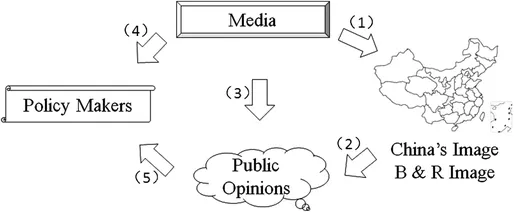
In theory, the relationship between
public opinion , national image, media, and policy-making can be expressed by the arrows in Fig.
1.1. The following five relationships are shown:
- 1.
Media is the shaper of China’s image
- 2.
China’s image influences the way in which the world sees it and treats it (public opinion )
- 3.
Media provides the resources for forming public opinion
- 4.
Members of the governmental policy-making system and diplomats rely on mass media to make a map of the world (Cohen 2015)
- 5.
Public opinion is a proximate cause of policy (Page and Shapiro 1983)
1.3 Method
In May 2015, 60 international students of Tongji University from more than 50 countries cooperated with Chinese students from the same university to conduct team studies on the
Belt and Road initiative . Each team was set up to target different countries on the Belt or Road. They collaborated in a “1 + 1” approach, which consisted of at least one Chinese student and one international student from the target country. Each team had access to a large number of online documents, online questionnaires, video interviews, and so on. Teams were under the guidance of eight professors, majored in transportation engineering, intercultural communication, and politics and international relations. Each of the 51 studies completed had the following outline:
- 1.
General view of the economy, international trade, foreign affairs, finance, and infrastructure of the target country
- 2.
Analysis of online news and comments and of surveys to show the local people’s awareness and view of the initiative
- 3.
Suggestions for the government, enterprises, and other stakeholders on how to participate in the initiative
From September 2016, studies on the second batch of 14 countries were conducted by 14 Chinese students majoring in foreign languages and about 50 international students registered in the course China Today. They set up 14 research teams to analyze opinions from governments, online newspapers, academic circles, and the public.
The main research methods adopted by these teams were (1) literature research, (2) analysis of online opinions, and (3) survey. By January 2016, 65 studies had been finished. The results are summarized in Sect. 1.4 and the conclusions discussed in Sect. 1.5.
1.4 Results
1.4.1 Overview of Opinions
The Belt and Road initiative was often mentioned in the news about President Xi Jiping’s visits. In addition to such news, which mainly reports facts rather than opinions, opinions from deeper analysis mostly concerned the benefits and risks of this initiative.
The major benefit for countries along the Belt or the Road is the establishment of new and modern infrastructure in the form of ports, roads, railways, and pipelines. This will not only enhance trade and commerce along the route but also greatly improve the economy of the partnering countries. The newly founded Asian Infrastructure Investment Bank (AIIB) agreed to support parent countries financially in setting up new infrastructure. Countries that lack the required financial resources to improve the domestic infrastructure could take the opportunity to benefit from this support. This is yet another accelerator to boost the economy of all countries taking part in this initiative. Several countries announced that they would act as hubs of the Road or the Belt. Competition to be the hub has even appeared in some regions. The increased exchange and flow of information and knowledge is also likely to improve innovation and the development and diffusion of modern technologies to areas where they are needed and can be applied effectively. Modernized infrastructure also facilitates the flow of tourists and students along the route. This not only benefits the local tourism industry of many countries but also offers the chance of an easier and more convenient way of traveling and exploring new cultures and countries, thereby exploiting another form of opportunity of this initiative. More and more countries have begun to view China as one of the most important tourist resource countries. The Belt and Road routes can therefore increase global and regional connectivity and benefit all partners along the way.
Even though opinions reflect awareness of the opportunities offered by this initiative, the opinion leaders also considered the risks it bears. The Belt and Road initiative was initiated by China and it is assumed that China aims to acquire, in addition to economic benefit, a stronger political position in the world and in the regions along the Belt and Roa...