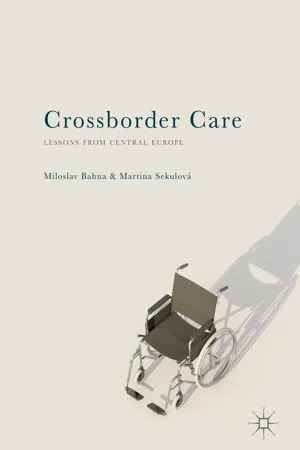
This book analyses the circular migration of care workers in Central Europe using the example of Slovak carers in 24-hour care provision for the elderly in Austria. Challenging analyses that focus primarily on care drain and care regimes, Bahna and Sekulová supplement quantitative methodology with qualitative fieldwork to demonstrate the importance of the sending country's economic context. The authors discuss the dynamics of economic differences between Austria and its post-communist neighbors as preconditions of the crossborder care provision, bridging analyses of policy and legal frameworks with approaches from labor migration study. Even as they scrutinize the relevance of care drain-based analyses, Bahna and Sekulová bring to the fore the interplay of economic differences, social policies, gender and migration regimes with geographic proximity to study long-term impacts of care work, including an analysis of employment after care work.
- English
- ePUB (mobile friendly)
- Available on iOS & Android
eBook - ePub
About this book
Information
© The Author(s) 2019
Miloslav Bahna and Martina SekulováCrossborder Carehttps://doi.org/10.1007/978-3-319-97028-8_11. Introduction
Miloslav Bahna1 and Martina Sekulová2
(1)
Institute for Sociology, Slovak Academy of Sciences, Bratislava, Slovakia
(2)
Independent Researcher, Bratislava, Slovakia
Miloslav Bahna (Corresponding author)
Martina Sekulová
I have not employed anyone illegally—neither has my wife. My sister-in-law took the initiative after her mother’s complicated surgery. She approached a charity which was recommended by the hospital—they provided the care worker. We paid 1600 to 1700 Euro a month….
Wolfgang Schüssel, the head of the Government of Austria, 23 August 2006
End AbstractIn contrast to the situation when the Austrian Prime Minister had to explain the employment of a care worker from Slovakia during the campaign for the 2006 national election (Kindermann, 2006), the topic of this book is already a well-established area in academic literature. The phenomenon of the elderly in affluent and aging Western countries being cared for by migrant care workers has been studied and written about extensively, particularly in the last decade. Despite this circumstance, our book is able to offer many insights into new or under-researched areas of this field. To understand why certain aspects of migrant care workers have been neglected, we shall briefly outline the history of the development of academic thought on the subject. While conceptually closely related to research on domestic work—being the last of the three “Cs”: the cooking, cleaning, and carrying triad (Anderson, 2000)—there are two research traditions, in particular, which had the biggest influence on the ways in which the arrangement of care provision by a migrant has been portrayed and analyzed in academic literature so far.
The first tradition, the “care chains framework,” is related to early research on “transnational motherhood” in the 1990s, which later inspired the popular care drain metaphor. Authors such as Hondagneu-Sotelo and Avila (1997) and Parreñas (2001) focused on young women from Latin America, or from the Philippines, who traveled to the US to earn money, which they used to provide for their kids and families in their home countries. While providing care in the Global North, these women often left their kids behind in the care of other women, creating what has been later coined the “global care chain” by Hochschild (2000). When migrant care providers left their home countries, care drain, another influential concept termed by Hochschild (2004), was born. Given the third-world source countries and the US as a destination, parallels to colonialist exploitation of the countries of the “Global South” are drawn, comparing love—accompanying the care provision—to raw materials once imported from these countries (Hochschild, 2004).
Whereas the authors and objects of studies in the first tradition can be located in North America, the second research tradition influential in research on migrant care workers has European roots. In the vein of the seminal welfare state analysis by Esping-Andersen (1990), new typologies focusing particularly on welfare policies in the area of care provisions were born. A Europe-wide typology of “care regimes” classifying the various approaches of European countries to care provision to children and the elderly was introduced by Bettio and Plantenga (2004). Two years later, Bettio and her colleagues made the link between a care regime (or care model) and the reliance on migrants in the care provision for the young or the elderly (Bettio, Simonazzi, & Villa, 2006). To account for the highly gendered nature of care provision, Lutz (2008) suggested an amendment of care and migration regimes investigation with an analysis of the “gender regime.”
The conceptual apparatus of both perspectives almost inevitably drives their attention to particular aspects of care provision by migrants. With its focus on care provided by female migrants, the first perspective tends to explore the emergence of care gaps and how they are tackled via global care chains. Related issues of transnational mothering or transnational partnering focus on the maintenance of relationships from a distance (see Madianou & Miller, 2011, 2012). On the other hand, when care regimes are explored, the focus is on how the respective policy mix creates an environment facilitating the employment of migrant carers. A detailed mapping of the policies introduced and their use is characteristic of these approaches. If care drain is the most typical concept in the first approach, cash-for-care benefits—allowing to shop for care, coming from anywhere in the world (also)informally—form the notorious focus point of the second perspective.
In many regards, these two research traditions are not interested in the agency of care workers themselves.1 We can say that in both cases, they are, rather, an object of welfare policies or global inequalities than an active subject in search of a better life. Care drain is something that just happened to the care workers and forces them to react.2 Focusing on welfare policies explains why it is affordable for families to tackle their care needs through migrant care providers. Why this employment is attractive for the migrants is not relevant. The question of why the carers do arrive and who they are seems to be satisfactorily covered in both approaches by the fact that they live in countries that are generally poorer than the countries of their employers. It can be observed that the bulk of research in both traditions is done by academics from the receiving countries using explanation factors present in the destinations of the migrant care workers. We can exemplify this neglect of the source countries in the fact that approaches developed from interviews with workers coming from third-world countries to the US have been directly applied to intra-European migration occurring between two bordering countries in Europe. These features of the current research have left large, unexplored gaps in the topic of migrant care workers in Europe. The care drain perspective has nothing to say about seven out of eight carers from Slovakia not having young children of their own to look after. It also struggles to explain the high level of satisfaction of Slovak care workers. The policy explanation fails to answer the question why 24-hour care work in Austria attracts carers from Slovakia, but not from other post-communist Austrian neighbors with the same wage levels. Also, policy-related approaches do not explain why the employment of migrant care workers occurs also in countries that provide high levels of residential care provision for the elderly. Indeed, it seems from works exploring migrant care workers or those with migrant backgrounds, that the main distinction provided by the care regime is the distinction between countries importing migrant live-in carers and countries employing second-generation migrants in long-term care facilities. This points toward the generally unappealing image of this kind of work (see Pfau-Effinger & Rostgaard, 2011).
Focusing on the policy-driven demand for care work and tackling the care-related problems of the (mostly) female carers, research on the topic has so far created a body of literature that does not engage with approaches typical in studies of labor migration. Questions such as why there are Slovak care workers in Austria but almost no Hungarian ones, what determines whether someone decides to become a care worker, what explains work satisfaction or the income levels in this labor market, and what happens after leaving care work are omitted as uninteresting. Perhaps the best example of the disconnection between research on migration related to care provision and labor migration is the approach to the dual labor market concept. Since the early 1970s, economists have observed particular features of certain sectors of economy often dominated by migrant workers (Bonacich, Light, & Wong, 1977; Piore, 1973). While seemingly well suited for describing the employment of workers in private households, such as that of the elder care providers, until recently, we did not find a single scholarly work recognizing the potential of this concept in the research on migrant care workers.
There is another particularity of the dominant approaches to the topic of our study. It is the almost exclusive reliance on qualitative interview data. This is not only a characteristic of studies focusing on care workers in Europe, the tendency for using small-scale qualitative research is dominant in the global academic production on the subject as well. Although this is an understandable feature, given the mostly informal work arrangements studied, it is clearly a limiting circumstance when exploring the phenomenon.
For the reasons mentioned earlier, we claim that the current academic writing covers only a particular section of the topic “v...
Table of contents
- Cover
- Front Matter
- 1. Introduction
- 2. Slovak Care Workers in Austria: An Overview
- 3. Care Workers as Economic Migrants
- 4. Does the Family Suffer?
- 5. Crossborder Care in the Long Term: Intersections of Age, Gender, and Circularity
- 6. Leaving Care Work: Career Prospects in a Secondary Labor Market
- 7. Conclusion: Labor Migration After All?
- Back Matter
Trusted by 375,005 students
Access to over 1.5 million titles for a fair monthly price.
Study more efficiently using our study tools.
Frequently asked questions
Yes, you can cancel anytime from the Subscription tab in your account settings on the Perlego website. Your subscription will stay active until the end of your current billing period. Learn how to cancel your subscription
No, books cannot be downloaded as external files, such as PDFs, for use outside of Perlego. However, you can download books within the Perlego app for offline reading on mobile or tablet. Learn how to download books offline
Perlego offers two plans: Essential and Complete
- Essential is ideal for learners and professionals who enjoy exploring a wide range of subjects. Access the Essential Library with 800,000+ trusted titles and best-sellers across business, personal growth, and the humanities. Includes unlimited reading time and Standard Read Aloud voice.
- Complete: Perfect for advanced learners and researchers needing full, unrestricted access. Unlock 1.5M+ books across hundreds of subjects, including academic and specialized titles. The Complete Plan also includes advanced features like Premium Read Aloud and Research Assistant.
We are an online textbook subscription service, where you can get access to an entire online library for less than the price of a single book per month. With over 1.5 million books across 990+ topics, we’ve got you covered! Learn about our mission
Look out for the read-aloud symbol on your next book to see if you can listen to it. The read-aloud tool reads text aloud for you, highlighting the text as it is being read. You can pause it, speed it up and slow it down. Learn more about Read Aloud
Yes! You can use the Perlego app on both iOS and Android devices to read anytime, anywhere — even offline. Perfect for commutes or when you’re on the go.
Please note we cannot support devices running on iOS 13 and Android 7 or earlier. Learn more about using the app
Please note we cannot support devices running on iOS 13 and Android 7 or earlier. Learn more about using the app
Yes, you can access Crossborder Care by Miloslav Bahna,Martina Sekulová in PDF and/or ePUB format, as well as other popular books in Social Sciences & Labour Economics. We have over 1.5 million books available in our catalogue for you to explore.