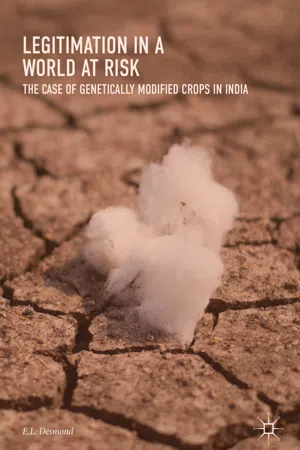
This book provides a sociological analysis of the controversy surrounding GM crops in Telangana, India. There is much debate as to whether GM technology holds the key to improving the welfare of poor farmers globally or serves primarily to increase the profits of multinational corporations while enhancing cultivator risk. Desmond's study is located in the economically vulnerable and politically volatile district of Warangal in Telangana, a context associated with high numbers of farmer suicides. Uniquely foregrounding the perspectives of cultivators and the landless, Desmond explores how GM crops are variously legitimated and delegitimated in three Warangal villages by those whose livelihoods are at stake in the debate, but whose voices are rarely heard within it. This book will be significant for those with an interest in GM crops, power and knowledge and their relation to understandings of development, democracy and risk management worldwide.
eBook - ePub
Legitimation in a World at Risk
The Case of Genetically Modified Crops in India
- English
- ePUB (mobile friendly)
- Available on iOS & Android
eBook - ePub
Legitimation in a World at Risk
The Case of Genetically Modified Crops in India
About this book
Information
© The Author(s) 2018
E.L. DesmondLegitimation in a World at Riskhttps://doi.org/10.1007/978-981-10-6065-6_11. Introduction: Legitimation and Genetically Modified Crops in a World at Risk
E. L. Desmond1
(1)
School of Sociology and Philosophy, University College Cork, Cork, Ireland
This book explores the conflict surrounding genetically modified (GM) crops in three Indian villages using the concept of legitimation. It focusses on Bt cotton, currently India’s only GM crop, and examines how power relations in the villages impact upon the way in which Bt cotton is variously legitimated or delegitimated by cultivators themselves. The book argues that the findings from the villages provide significant insights for the global legitimation struggle which the negotiation of a world at risk entails and within which the conflict surrounding GM crops is embedded.
GM Crops, Risk Society and the Struggle for Legitimation
The issue of GM crops in India provides an invaluable insight into the contestation regarding scientific knowledge in global society. This unrest relates to fears that the power relations which define the construction of scientific knowledge and its applications are contributing to significant ontological risk in the form of scientific innovation itself (Knorr-Cetina and Mulkay 1983; Latour 1983; Shiva 1988). The resulting uncertainty has led to ‘a crisis of public confidence in science’ (Wynne 2001: 445), a situation which, this book argues, has given rise to a central concern with legitimation in contemporary society.
Hurrelmann et al. (2007: 12–13) claim that legitimacy is a multifaceted concept. They (ibid.: 8) highlight the distinction between legitimation as a process of evaluation and legitimacy as the attribute which is being assessed [italics in the original]. This book explores legitimation in association with the concept of risk society as defined by Ulrich Beck . The theory of risk society provides the theoretical framework for the book given the congruity of Beck’s exploration of risk with the uncertainty associated with GM crops explored here.
Beck (1992: 19) claims that the incorporation of science and technology into attempts to secure economic growth has meant that the ‘social production of wealth is systematically accompanied by the social production of risks.’ Beck (1992, 1999) argues that this has given rise to a ‘risk society.’ This book claims that the risks associated with wealth production are subject to a process of legitimation.
According to Beck (1992: 23), the risks produced by technological innovation in risk society are characterised by the fact that they ‘induce systematic and often irreversible harm, generally remain invisible, are based on causal interpretations, and thus initially only exist in terms of the (scientific or anti-scientific) knowledge about them’ [italics in the original]. GM crops are identified by Beck (2009: 74–6) as one aspect of risk society.
Within Beck’s (1992: 39) theorisation of risk, he argues that the Marxist focus on class arising from the distribution of wealth in industrial society is replaced by a concern with ‘risk positions’ in risk society. Beck (ibid.: 23) claims that, in risk society, the relevant power relations are not the relations of production which define class but rather the individualised ‘social risk positions’ which differentiate ‘the affected’ from the ‘not yet affected’ (ibid.: 40).
This book argues that the categories of affected and not yet affected are differentiated according to pre-existing dimensions of stratification. These pre-existing dimensions determine the most vulnerable or those who will be affected by risk first. While Beck (1992: 35) argues that ‘wealth accumulates at the top, risks at the bottom,’ he does not suggest, in the absence of class, how this stratification occurs. As Chap. 2 explores, this book suggests that land-holding, caste and gender represent pre-existing dimensions of differentiation in the context of the Indian village.
The lack of inclusion of class as a determinant of social risk positions in this book does not suggest that class is not an aspect of Indian society. However, it takes the view, along with Weber ([1968], 1978: 36), that assessments of legitimacy draw from pre-capitalist conventions, such as those defined by tradition and affect. As such, the ongoing influence of caste and gender on the legitimation and differentiation of risk in the Indian context predates capitalist class relations and, in many ways, defines them.
The limited relevance of class to an analysis of Indian society is noted by Jangam (2016: 25) who argues that Marxist theory is rooted in a ‘Western epistemic model’ which is ‘incomplete both as a theoretical and analytical category in the Indian context’ (ibid.). In terms of the current analysis, it is argued that class positions are themselves legitimated in the Indian context according to pre-existing cultural beliefs surrounding caste and gender. Private ownership of land, as a means of production, can be regarded as an aspect of class in the rural context. However, it is explored here not only in terms of its economic impact on the individualised distribution of risk related to the performance of Bt cotton; it is also examined in terms of the intersection of access to land and the other means of production in agriculture with the stratification associated with caste and gender. This highlights the way in which class positions associated with access to the means of production are themselves mediated through pre-existing dimensions of caste and gender.
The analysis of legitimation and risk undertaken here, therefore, involves a blending of Weber’s emphasis on pre-capitalist social markers of authority (here, as defined by gender and caste in India) with Marxist understandings of class (as defined by access to the means of production—most notably, access to land ). This seeks to explore the way in which the individualised distribution and negotiation of risk is legitimated as a social concern.
This book argues that the dimensions of land-holding, caste and gender are central determinants not only of the way in which risk is distributed but also of the ability of particular individuals and groups to influence its epistemic construction. Giddens (2003: 22) defines risks as ‘hazards that are actively assessed in relation to future possibilities.’ They are, therefore, subject to probability assessments given the ‘epistemic gap’ (Desmond 2014: 13) and ‘non-knowing’ (Beck 2009: 115) with which they are associated.
The epistemic gap which risk represents means that, until risk materialises as a reality, its conceptualisation remains a social construction which is intersubjectively defined through discourse. Thus, Strydom (2002: 114) notes that ‘[t]he discursive construction of risk is a social process in which different social actors or collective agents compete and conflict with one another in the medium of public communication and discourse.’ This book argues that both the materialisation of risk in particular contexts, and its ideological construction, are subject to legitimation struggles which are mediated through power relations at local, national and global levels.
Renn (2008: 180) claims that GM crops fall within the category of risk classified as ‘ambiguous’ given that they are linked to ‘unresolved uncertainty’ (ibid.: 179). Stone (2007: 71) argues that, not only is there a lack of knowledge in relation to the risk of the technology itself, the cultivation of GM crops is itself expanding the epistemic gap associated with such risk given the phenomenon he describes as ‘agricultural deskilling .’
Within his concept of agricultural deskilling , Stone (2007: 72) claims that the indigenous knowledge associated with the treatment of pests and disease in agriculture is being replaced by a regime of pesticides and fertilisers in which cultivators have been reduced to ‘passive customers of seed firms.’ At a time, therefore, when detailed knowledge is crucial to ascertain the risks of Bt technology, the basis for such knowledge is being eroded through the use of the technology itself.
Stone (2011a) claims that this process of deskilling among agriculturalists is ongoing through E-agriculture where cultivators receive not only the latest weather reports and crop prices but also advice from experts on the cultivation of their crops. Such deskilling limits the ability of cultivators to bridge the epistemic gap associated with risk through reliance on their own autonomous knowledge gained from a hands-on cultivation of the land.
Stone (2007: 71) highlights that agricultural deskilling means that knowledge concerning agriculture is increasingly defined through social relations rather than environmental cues. In such a situation, the existence of powerful influencers with regard to risk negotiation becomes key. This book claims that, given this, the legitimation of influencers, and their position within the power structure of the local context, is central. It asserts that environmental learning does occur in such a context, but that this learning ...
Table of contents
- Cover
- Frontmatter
- 1. Introduction: Legitimation and Genetically Modified Crops in a World at Risk
- 2. The Legitimation of Risk in the Villages
- 3. Bt Cotton and the Legitimation of Democracy
- 4. The Legitimation of Risk and Democracy in Telangana
- 5. Methodology: Legitimation and Ethics in Risk Research
- 6. Analysis I: Risk, Power and Bt Cotton in the Villages
- 7. Analysis II: Democracy and State Legitimacy in the Villages
- 8. Legitimation in a World at Risk: Lessons from the Villages
- 9. Conclusion: Science, Power and the Struggle for Legitimation
- Backmatter
Trusted by 375,005 students
Access to over 1.5 million titles for a fair monthly price.
Study more efficiently using our study tools.
Frequently asked questions
Yes, you can cancel anytime from the Subscription tab in your account settings on the Perlego website. Your subscription will stay active until the end of your current billing period. Learn how to cancel your subscription
No, books cannot be downloaded as external files, such as PDFs, for use outside of Perlego. However, you can download books within the Perlego app for offline reading on mobile or tablet. Learn how to download books offline
Perlego offers two plans: Essential and Complete
- Essential is ideal for learners and professionals who enjoy exploring a wide range of subjects. Access the Essential Library with 800,000+ trusted titles and best-sellers across business, personal growth, and the humanities. Includes unlimited reading time and Standard Read Aloud voice.
- Complete: Perfect for advanced learners and researchers needing full, unrestricted access. Unlock 1.5M+ books across hundreds of subjects, including academic and specialized titles. The Complete Plan also includes advanced features like Premium Read Aloud and Research Assistant.
We are an online textbook subscription service, where you can get access to an entire online library for less than the price of a single book per month. With over 1.5 million books across 990+ topics, we’ve got you covered! Learn about our mission
Look out for the read-aloud symbol on your next book to see if you can listen to it. The read-aloud tool reads text aloud for you, highlighting the text as it is being read. You can pause it, speed it up and slow it down. Learn more about Read Aloud
Yes! You can use the Perlego app on both iOS and Android devices to read anytime, anywhere — even offline. Perfect for commutes or when you’re on the go.
Please note we cannot support devices running on iOS 13 and Android 7 or earlier. Learn more about using the app
Please note we cannot support devices running on iOS 13 and Android 7 or earlier. Learn more about using the app
Yes, you can access Legitimation in a World at Risk by E.L. Desmond,E. L. Desmond in PDF and/or ePUB format, as well as other popular books in Social Sciences & Environmental Science. We have over 1.5 million books available in our catalogue for you to explore.