- English
- ePUB (mobile friendly)
- Available on iOS & Android
eBook - ePub
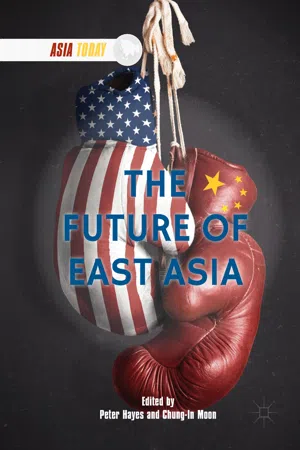
The Future of East Asia
About this book
This book collects some of the most influential scholars in international relations who focus on Asia globally in exploring the challenges of diplomacy faced in Asia as US policy drastically changes. The president-elect has suggested policies which, if implemented, would radically transform the way that the region functions; what will this mean in practice? China's government is also retrenching nationalist positions; what is the future of China, and what does that mean for the region? A wide range of distinguished scholars, concerned about the future, have contributed their thoughts in an attempt to spark a global dialogue.
Information
© The Author(s) 2018
Peter Hayes and Chung-In Moon (eds.)The Future of East AsiaAsia Todayhttps://doi.org/10.1007/978-981-10-4977-4_11. Circling the Square: The Imagining of an East Asian Community
Peter Hayes1 and Chung-In Moon2
(1)
Nautilus Institute, Berkeley, CA, USA
(2)
Yonsei University, Seoul, South Korea
Introduction
This book presents the imagining of an East Asian Community (EAC) by a number of senior scholars with diverse backgrounds—each informed by their life experience grounded in different parts of Asia and, at various times, in different sectors, be it in government, in the market, or in civil society. Although an East Asian Community is clearly more of an ideal image than real today, it already exists in some respects, is prefigured in aspirational ways in others, but is denied absolutely in still other aspects of how states and people conduct their affairs. Moreover, we recognize the glimpses described in this book of a hypothetical EAC are just that—the capturing of one aspect, from one angle, from one life experience, of a possible EAC. These ideas are worth considering, nonetheless, because ideas may be hugely influential, sometimes almost instantly, if incorporated into individual, community, and national identities.
Also, we note upfront that while the core insights offered by the authors of this book are deep and broad in their respective areas, they do not reflect the full diversity of views in the region . There are important voices that are not found in this book—those of indigenous peoples, islanders, youth, refugees, and many border-crossing individuals who live in the region, but also elsewhere, often at the same time. We do not apologize for these limitations. We simply draw the reader’s attention to them because these voices must be heard, too, if the EAC is to ever grip the imaginations of all the necessary players in this region and become a social, cultural, and institutional reality.
That said we believe the core issues analyzed in this book are those that will shape the form, content, and structure of a full-blown EAC, no matter what configuration it takes in the long run. But before we turn to this prefigured ideal image of the EAC—or rather, the multiple images of it presented in this book—we must first deal with the issue of “region .”
One Asia Region and Sub-Region Concepts
First and foremost, we admit—as Nayan Chanda explains in Chap. 2—that “Asia” is not an Asian construct. Ironically, “Asia” is a Western concept. Thus, “Asia” is actually an extraordinarily diverse set of states, communities, and cultures that have interacted for millennia via trade, migration, cultural transmission, religion, as well as harsher means such as military conquest and political subjugation at various times, with more or less unified control of territory and people given the technologies and communications of the era. At times of system crisis—whether in reaction to western or Japanese imperialism, the demise of colonial occupations, or, in the course of national revolutions—locals have claimed “Asia” as their own to propagate a wider concept of “Asia for Asians .” Thus, the notion of “One Asia ” is not new. It has progressive and regressive antecedents. The same applies to the concept of “East Asian Community.” Indeed, scholars and policy practitioners have been talking about it for decades and, depending on who is doing the talking, the meaning of the term shifts dramatically.
Today, discussions of an EAC are in the midst of globalization with attendant displacement of local communities, demolition of local cultures, and the obliteration of distance and dissolution of borders by trade, information flow, and—to some extent—migration and travel. Thus, rather than EAC, the notion of “Global Asia ” has emerged. Here, “Asia” is held to play a central role in almost all global issues. No global issues can be understood, and no global problem can be solved, without comprehending the Asian dimension. But Global Asia does not refer to a region or sub-region with a shared identity any more than its predecessor, One Asia .
In contrast, South Asia, for all its division and conflict, has its regional institutions such as the South Asian Association for Regional Cooperation (SAARC) that have begun to take deep root, even if the major states in the region can bypass them at will. And Southeast Asia has its own sub-regional organizations led by the Association of Southeast Asian Nations, or ASEAN. But Northeast Asia does not have such a regional entity in spite of a burgeoning set of regional meetings, communication, and coordination activities between national officials; a profound con-joining of the economies of China, Japan, and the ROK, as well as with the global economy; and limited but important common security agendas and even political-diplomatic coordination, as has occurred in response to the DPRK’s nuclear threat. And, as Chung-In Moon points out in Chap. 10, an East Asian community is inconceivable until Northeast Asia brings regional political institutions into being on par with SAARC and ASEAN. Equally, he suggests, trends within East Asia as a whole may stimulate and induce Northeast Asian states to innovate and then formalize sub-regional institutions in a dialectical process.
Regional Social and Economic Integration
Of all the potential bridges that might enable a Northeast Asian sub-regional community to emerge alongside a full-blown EAC, perhaps the most promising is to facilitate cross-border trade, investment, and finance along with related infrastructural and network expansion. Already China, South Korea, and Japan (or CKJ) have a combined population of 1.54 billion (21% of the world’s population), a combined gross domestic product of $16.4 trillion in 2014 (likewise, 21% of the world’s gross domestic product), and a combined trade volume of $7 trillion in 2014 (or 18% of world trade). At first glance, such numbers suggest that the region should have an overwhelming economic incentive to create institutions that exploit this economic prowess.
But, as Choong Yong Ahn points out in Chap. 6, two competing frameworks for regional economic integration collide today in the region. These are the US-led Trans-Pacific Partnership (TPP) embedded in the already existing World Bank-International Monetary Fund and Asian Development Bank structures on the one hand, and the China-led Regional Comprehensive Economic Partnership (RCEP) —underpinned by China’s newly established Asian Infrastructure Investment Bank (AIIB)—on the other. These two mega-frameworks and supporting institutions have competing visions and missions. Both are likely to gain traction in coming years although TPP may prove more vulnerable to domestic factors such as electoral politics in democratic states.
What hangs in the balance is whether what Ahn calls the “intersection economies ,” that is, those that have joined both the TPP and RCEP, can prevent these two trade blocs from colliding. To do so, and avoid global economic chaos, these two trading regimes need to converge by realigning their respective trade, investment liberalization, and other arrangements on economic and technical cooperation, intellectual property, competition, and dispute settlement, etc. Creating a complementary set of free trade agreements would lay the foundation for an East Asian-wide Economic Community, in turn, the underpinning for an EAC. In this regard, the ROK, by virtue of its location between the great powers in Northeast Asia, might, alongside ASEAN states, play a leading role in brokering such an outcome.
In the short term, however, there is little reason to expect that a distinctively Northeast Asian regional identity is likely to emerge due to the economic interdependence that has grown so large between the CKJ bloc . These three states may meet regularly to discuss and coordinate on key global and regional economic issues in the future, and to set standards on integrated infrastructure and nodal links at airports, shipping ports, pipelines, power lines, and railways, etc. But these activities will be subsumed in larger regional and global frameworks that govern trade, investment, and financial relations between economies.
Other early signs of sub-regional institutional innovation in Northeast Asia exist, including extensive civilian contact and, in some instances, prolonged contact, communication, and coordination of joint activities on specific issues by civilian organizations and local governments in Northeast Asia, as described in Chap. 8 by Seung-Youn Oh.
Power Transition and Rise of China
Nonetheless, the single most important trend that unites or divides states and people in Northeast Asia is China’s rise , to the degree that it can challenge and, in some cases, match, and, in a few cases, exceed the power capacities of the United States to exercise military control of the geo-political landscape of Northeast Asia.
In the security dimension , states retreat quickly into hardened, militarized postures established during the Cold War, and adorned with huge amounts of conventional and, in some instances, nuclear weapons . In particular, China’s rapidly expanding military and regional military reach beyond its coastal zone into the Pacific and which now overlaps the zone of US military forward deployment, especially of its naval forces, as well as that of Washington’s leading security allies, the ROK and Japan, and its security partner, Taiwan.
But as Muthiah Alagappa explains in Chap. 7, even in the aspect of community-building that is most resistant to cross-border transactions that soften and eventually corrode away the edges of hard power, that is, military force, the critical issue is not the existence of these capabilities, risky as they may be at the two primary axes of possible inter-state conflict in the region , the Taiwan Straits and the Korean Peninsula. Rather, he suggests, the rigid “knowledge structure” or strategic orientation of the political and military leaders who control these forces is uniformly “realist” in nature. This worldview is informed by shared but radically different exposure to the application of military force in brutal wars, ranging from those fought over colonial occupation and liberation during imperial adventures by Japan and its demolition by the United States and its allies, along with China and Russia in World War II, followed by the Cold War between the superpowers punctuated by one hot war in Korea on a massive scale, a war put on hold since 1953 by the Korean Armistice Agreement, but ready to break out at a moment’s notice across the Demilitarized Zone.
Overcoming this ideational obstacle , according to Alagappa in Chap. 7, entails above all rethinking the concept of nation state, and instituting a more flexible one that admits of the exercise of autonomous governance, the validity of trans-governmental zones of coordination and collaboration by local governments and agencies, especially in border zones, and that jettisons ideologically defined and rigid concepts of singular, even ethnically-based, citizenship.
However, this cross-border process that softens or supplants the hard edges of territorially-based states will take time, possibly generational time. Meanwhile, great and medium-sized states continue to exercise power in the region . As John Ikenberry explains in Chap. 4, while the post-World War II liberal international order is weakening, it is also not disappearing. Short of a new framework based on a hegemonic and dominant power, it is likely to remain the framework in which states conduct their affairs, both security and economic, and thereby remain constrained by it even if they contest elements of it, or confront each other over specific security or economic issues. With no other option, states will start to conduct multilateral governance over issues that divide in this region because the costs of not doing so will exceed the costs of jettisoning the old order. How they do this will make the region more or less stable, more or less orderly, more or less prosperous, and more or less secure. There are many possible regional futures in which the liberal international order may and likely will be sustained. In short, Ikenberry anticipates that some form of multilateral muddling through will predominate.
What is clear is the notion that China will somehow become a regionally dominant state and threaten this order due to its growing military and economic power is false, both factually and in conception. As Zhang Ruizhuang demonstrates irrefutably in Chap. 3, China’s primary concern is the consolidation of its domestic order, both political and economic, while ensuring that its external security environment remains conducive to this process. Of course, where its vital security interests, most critically in the Korean Peninsula and the Taiwan Straits, are threatened, China will muster all its military capabilities to deter or compel its adversaries and third parties from acting in ways that put this domestic transition at risk. Zhang holds that the future of the entire region , including the possibility of creating an EAC, is determined by the unfolding logic of power politics, not the effects of shared ideas, beliefs, norms, and institutions.
Conversely, Zhang asserts that enduring poverty, misleading statistics about Chinese economic growth rate, its military expenditure, mistaking quantitative for qualitative growth, ecological degradation, and social and political inequality, all suggest that China is not as strong and powerful as it may appear. Moreover, much of China’s military capability is invested in strengthening domestic security, and it confronts daunting domestic social, economic, and ecological threats that will consume much of its growth potential in the coming decades. These latter concerns also threaten the legitimacy of the leadership, which in turn may exploit popular perceptions of external threats to displace discontent and disenchantment with the one party ruling system. For all these reasons, China will remain a distant second power to the United States, which will remain dominant, albeit a declining hegemon forced to share more power with its allies and willing to accommodate China where its new capabilities cannot be blocked—as in coastal regions or infrastructural investment. How the United States manages this adjustment to China, and how China manages its relations with neighboring states, in turn, will shape the perceptions of the need for regional institutions such as the EAC, based on shared interest rather than division of the spoils arising from dominance.
Dimensions of Clashing National Identities
Such perceptions are crucial to how the national identity of each country in the region evolves. In Chap. 5, Gilbert Rozman describes how five dimensions of national identity in China, Japan, and the ROK, namely, conformist national ideology, selective historical memory of key events and periods, sectoral confidence that is cultivated to contrast with other cultures, vertical identity that subordinates minorities or civil society to a single homogenous population, and the intensity whereby these factors shape how people think, have affected, one might say, afflicted bilateral relations between these three states that would form the northern foundation stone for an EAC.
Interestingly, Rozman finds that South Korea exhibits the least ideologically defined national identity of the CJK bloc, with the domestic polarization between progressive and conservative political forces offsetting the effects of prolonged national division and anti-Japanese (and to some extent, anti-Chinese) sentiment. The resulting pragmatism may endow Korea with the ability to move flexibly and adroitly and avoid being trapped between China’s conservative communist project and Japan’s revisionist project on the one hand and between American and Chinese strategic confrontation on the other. But even if the ROK succeeds in avoiding such traps, these regressive identities appear to be hardening, not softening, and there is little reason to think that a regional identity is forming based on underlying integration, or even that the gaps in each of the dimensions of identity are narrowing between China, Japan, and the ROK.
Regional Insecurity and Institution Building
At the other end of the spectrum of national identity as reflected in the acquisition of power resources by the state, nuclear weapons represent the most congealed and absolute means of coercion, representing the ability of one state to annihilate the military and entire population of other states beyond recovery. Peter Hayes outlines in Chap. 9 the increased role that nuclear weapons play in the relation...
Table of contents
- Cover
- Frontmatter
- 1. Circling the Square: The Imagining of an East Asian Community
- 2. One Asia in History: Recasting and Forecasting
- 3. The Future of Power Politics in East Asia
- 4. The Future of Liberal Order in East Asia
- 5. National Identities and Bilateral Relations in East Asia Over the Next Decade: Will the Downward Spiral Continue?
- 6. Toward an East Asian Economic Community: Opportunities and Challenges
- 7. Is a Northeast Asia Security Community Possible and Probable?
- 8. Quiet Transformation from the Bottom: Emerging Transnational Networks Among Non-State Actors in Northeast Asia Community-Building
- 9. The Future of a Nuclear Weapons-Free Northeast Asia
- 10. Barriers to Community-Building in Northeast Asia: Geopolitics, Nationalism, and Domestic Politics
- Backmatter
Trusted by 375,005 students
Access to over 1.5 million titles for a fair monthly price.
Study more efficiently using our study tools.
Frequently asked questions
Yes, you can cancel anytime from the Subscription tab in your account settings on the Perlego website. Your subscription will stay active until the end of your current billing period. Learn how to cancel your subscription
No, books cannot be downloaded as external files, such as PDFs, for use outside of Perlego. However, you can download books within the Perlego app for offline reading on mobile or tablet. Learn how to download books offline
Perlego offers two plans: Essential and Complete
- Essential is ideal for learners and professionals who enjoy exploring a wide range of subjects. Access the Essential Library with 800,000+ trusted titles and best-sellers across business, personal growth, and the humanities. Includes unlimited reading time and Standard Read Aloud voice.
- Complete: Perfect for advanced learners and researchers needing full, unrestricted access. Unlock 1.5M+ books across hundreds of subjects, including academic and specialized titles. The Complete Plan also includes advanced features like Premium Read Aloud and Research Assistant.
We are an online textbook subscription service, where you can get access to an entire online library for less than the price of a single book per month. With over 1.5 million books across 990+ topics, we’ve got you covered! Learn about our mission
Look out for the read-aloud symbol on your next book to see if you can listen to it. The read-aloud tool reads text aloud for you, highlighting the text as it is being read. You can pause it, speed it up and slow it down. Learn more about Read Aloud
Yes! You can use the Perlego app on both iOS and Android devices to read anytime, anywhere — even offline. Perfect for commutes or when you’re on the go.
Please note we cannot support devices running on iOS 13 and Android 7 or earlier. Learn more about using the app
Please note we cannot support devices running on iOS 13 and Android 7 or earlier. Learn more about using the app
Yes, you can access The Future of East Asia by Peter Hayes, Chung-In Moon, Peter Hayes,Chung-In Moon in PDF and/or ePUB format, as well as other popular books in Politik & Internationale Beziehungen & Asiatische Politik. We have over 1.5 million books available in our catalogue for you to explore.