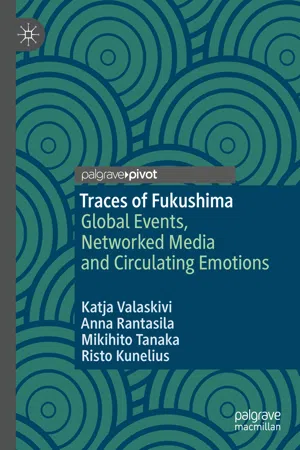
eBook - ePub
Traces of Fukushima
Global Events, Networked Media and Circulating Emotions
- English
- ePUB (mobile friendly)
- Available on iOS & Android
eBook - ePub
Traces of Fukushima
Global Events, Networked Media and Circulating Emotions
About this book
Information
© The Author(s) 2019
Katja Valaskivi, Anna Rantasila, Mikihito Tanaka and Risto KuneliusTraces of Fukushimahttps://doi.org/10.1007/978-981-13-6864-6_11. Introduction: Tracing the Meanings of Fukushima
Katja Valaskivi1 , Anna Rantasila1 , Mikihito Tanaka2 and Risto Kunelius1
(1)
Tampere University, Tampere, Finland
(2)
Waseda University, Tokyo, Japan
Abstract
This chapter presents the background for the book. Our point of departure is a distinction between occurrences (contingent things that take place in the world) and events (discursive constructions that make sense of occurrences). This chapter opens the central trajectories that come together in our attempt to explain how the triple disaster on 11 March 2011 in Japan was made sense of. This chapter suggests that the meanings, affects and articulations are linked to four intersecting discussions, looking at the event (1) as a dramatic example of processing cultural trauma, (2) as a disruptive global media event that unfolds in (3) a new kind of hybrid media environment, and that carries with it the exceptional political and cultural tensions related to (4) nuclear politics.
Keywords
FukushimaGlobal media eventsHybrid media systemCultural traumaNuclear politicsSocial mediaDigitalizationThis book has a point of beginning, a time and a place. At 14:46 (Japan Standard Time [JST]) on 11 March 2011, a magnitude 9.0 earthquake and a subsequent tsunami struck the North Eastern coast of Japan’s main island Honshu. Together, the quake and tsunami caused a major crisis at the Fukushima Daiichi nuclear power plant, 240 kilometres north of Tokyo. The effects of this triple disaster are still felt today. The Higashi Nihon Daishinsai or Great East Japan Earthquake is often referred to as ‘3.11’, after the date of the disaster.
The disaster resulted in around 20,000 deaths and missing persons. Some 170,000 people had to evacuate their homes. Three prefectures were particularly severely affected: Miyagi, Iwate and Fukushima. In Miyagi alone, there were more than 10,000 fatalities. The tsunami flattened hundreds of kilometres of coastline, and whole towns and villages were reduced to rubble. Over 90 per cent of the people who died drowned in the tsunami. Most of the victims were vulnerable people: 65 per cent of them were over 60 years old. The communities that suffered were mostly traditional, often poor farming and fishing towns.
In June 2011, the Japanese government estimated the material losses from the disaster at 16.9 trillion yen (USD 152.2 billion). Over 25 million tonnes of rubble and general waste were left behind. The slow work of rebuilding the infrastructure, cleaning up the environment and the constant monitoring of the unstable nuclear reactors will require years of sustained investment. There is no way of measuring the stress and trauma caused to the victims of the disaster. It is impossible to put a price tag on their struggle for compensation from the state and the nuclear company Tokyo Electric Power Company (TEPCO). How could one assess the discrimination and stigma that the disaster brought to the people of the area?
No research can ever fully capture the human loss and suffering, the pain of people still living with the consequences of the events. A book that purports to trace the meanings and affects and the communication flows surrounding the event may thus be seen as yet another example of ‘feasting on the apocalyptic image of the nuclear disaster’ and the associated human tragedy, as some commentators have argued.1 It seems pertinent, then, to begin this book with an apology. There is something indecent about our point of departure, about exploiting this historic triple disaster and all the human cost and suffering it involved as an opportunity to research the dynamics of contemporary media and communication. We can only say that we are and throughout the process have been painfully aware of this.
Having said that, we must stress that the natural ‘occurrence’ of the earthquake and its consequences to human societies and their endeavours offer exceptional material for an exploration of the contemporary global media landscape. From the critical hours of evacuation and rescue efforts to the political debates in Japan and abroad, and all the way to people hoarding iodide pills in the USA, events took place in relation to means, forms and manners of communication and media technologies. This still continues in the remembering of the events and in attempts to use the triple disaster for economic and political gain.
1.1 From an Occurrence to Varieties of Media Events
Occurrences happen; events are told, narrated and represented. One baseline definition of journalism has called it the discursive production of events (Ekecrantz 1997). Media representations select slices from the flow of occurrences, mark relative beginnings and ends of what has ‘happened’, and by doing so suggest causal links. There is an abundant literature on news as ‘storytelling’, and most of it testifies to the increasing role of the mass media in constructing what has ‘just happened’. In concert with various modern expert bureaucracies and institutions (e.g. Lippmann 1920; Tuchman 1978; Schudson 2008, pp. 108–125), the ‘news’ has taken distance from the material, eyewitness and chronological observation of what happened and started to offer more abstract stories that shaped the social imagination (Barnhurst and Mutz 1997; Barnhurst 2016). This is the fundamental issue that lies behind the original notion of media events. For Dayan and Katz (1992), the original point of talking about media events was to show how mass media institutions were able—in a historically new and powerful way—to collect large, mostly national audiences to witness well-orchestrated symbolic moments. In their analysis, media events were not stories only shaped by journalists but giant rituals jointly scripted by established social institutions to highlight and celebrate the order and values of these societies. If routine news stories constructed events out the anarchic flow of occurrences, media events were occurrences created for the media in ways that already anticipated the story formats, production routines and reception schedules of twentieth century mass media systems. As Couldry (2003) pointedly clarifies, such rituals were in the business of constantly reproducing the myth of the ‘mediated centre’, a core around which society integrated. The three original ideal scripts of media events presented by Dayan and Katz—contests, conquests and coronations—articulated different types of power and authority: the rules-based legal rationality of contests, the heroic charismatic connotations of conquests and the traditional ritual authority of coronations. While explicitly drawing these links from a Weberian vocabulary, Dayan and Katz emphasized a Durkheimian sense for the functionality of such moments (state visits, leader summits and sports events). These were ‘liminal moments’ where the organizers of the events and the mass media system as a whole could ‘resonate together’ and ‘merge into one’, producing ‘social integration of the highest order’ (Dayan and Katz 1992, p. 15; see Hepp and Couldry 2010; Rothenbuhler 2010).
In retrospect, by the time that Dayan and Katz’s book came out in 1992, both the media and political realities had already quietly begun to question the explanatory power of this original notion of media events. The proliferation of channels and media outlets and the increasing targeting of audiences had begun to erode the national reach of broadcasters. The relative monopoly of established institutions to script big media events had been challenged by various kinds of ‘contesting’ actors (ranging from terrorism to Greenpeace and YesMen). Management of news events and public attention has since exploded and diversified: think of the 9/11 spectacle, the social media ‘production’ of Islamic State of Iraq and Syria (ISIS) or state-sponsored communication campaigns across borders (Liebes and Blondheim 2005; Cottle 2006; Couldry 2003; Fiske 1994; Kellner 2003). At the same time the role of media events as ‘cohesive’ rituals has been challenged—not replaced—by variety of ‘disruptive’ mediated events and strategies (cf. Katz and Liebes 2007). Disruptive events (at least momentarily) explicitly challenge and erode social order, destabilizing the sense of security ...
Table of contents
- Cover
- Front Matter
- 1. Introduction: Tracing the Meanings of Fukushima
- Part I. Time
- Part II. Space
- Part III. Emotion
- Back Matter
Trusted by 375,005 students
Access to over 1.5 million titles for a fair monthly price.
Study more efficiently using our study tools.
Frequently asked questions
Yes, you can cancel anytime from the Subscription tab in your account settings on the Perlego website. Your subscription will stay active until the end of your current billing period. Learn how to cancel your subscription
No, books cannot be downloaded as external files, such as PDFs, for use outside of Perlego. However, you can download books within the Perlego app for offline reading on mobile or tablet. Learn how to download books offline
Perlego offers two plans: Essential and Complete
- Essential is ideal for learners and professionals who enjoy exploring a wide range of subjects. Access the Essential Library with 800,000+ trusted titles and best-sellers across business, personal growth, and the humanities. Includes unlimited reading time and Standard Read Aloud voice.
- Complete: Perfect for advanced learners and researchers needing full, unrestricted access. Unlock 1.5M+ books across hundreds of subjects, including academic and specialized titles. The Complete Plan also includes advanced features like Premium Read Aloud and Research Assistant.
We are an online textbook subscription service, where you can get access to an entire online library for less than the price of a single book per month. With over 1.5 million books across 990+ topics, we’ve got you covered! Learn about our mission
Look out for the read-aloud symbol on your next book to see if you can listen to it. The read-aloud tool reads text aloud for you, highlighting the text as it is being read. You can pause it, speed it up and slow it down. Learn more about Read Aloud
Yes! You can use the Perlego app on both iOS and Android devices to read anytime, anywhere — even offline. Perfect for commutes or when you’re on the go.
Please note we cannot support devices running on iOS 13 and Android 7 or earlier. Learn more about using the app
Please note we cannot support devices running on iOS 13 and Android 7 or earlier. Learn more about using the app
Yes, you can access Traces of Fukushima by Katja Valaskivi,Anna Rantasila,Mikihito Tanaka,Risto Kunelius in PDF and/or ePUB format, as well as other popular books in Social Sciences & Globalisation. We have over 1.5 million books available in our catalogue for you to explore.