eBook - ePub
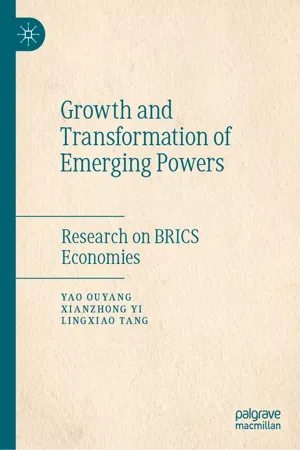
Growth and Transformation of Emerging Powers
Research on BRICS Economies
- English
- ePUB (mobile friendly)
- Available on iOS & Android
eBook - ePub
Growth and Transformation of Emerging Powers
Research on BRICS Economies
About this book
This book offers a quantitative and qualitative look at the much-discussed BRICS—Brazil, Russia, India, China and South Africa—and explores how their economic ascent might cause global economic realignments in the 21st century. Providing a Chinese perspective on how the global realignment might impact strategic choices and a data-driven approach to the similarities and differences within the so-called BRICS group, this book will be of great interest to economists, international banking professionals, and political forecasters.
Information
© The Author(s) 2019
Y. Ouyang et al.Growth and Transformation of Emerging Powershttps://doi.org/10.1007/978-981-32-9744-9_11. Introduction
Yao Ouyang1 , Xianzhong Yi2 and Lingxiao Tang3
(1)
Changsha, Hunan, China
(2)
Changsha, Hunan, China
(3)
Changsha, Hunan, China
1.1 International Background
With the start of the twenty-first century, emerging economies represented by the Brics countries have shown a trend of rising as a group and become a new engine of global economic growth. As major emerging market countries, China, India, Russia, Brazil and South Africa demonstrated sustained and rapid economic growth. Their shares in global GDP increased from 17% in 2000 to 50% in 2010, and reached around 60% in 2012. According to the Global Economic Prospects published by the International Monetary Fund (IMF) in early 2012, the economic growth rate of China, India and Russia in 2011 was 9.2, 7.4 and 4.1% respectively, far higher than the average global economic growth rate. The economic growth rate of Brazil and South Africa was also far higher than the average level of developed countries. With the rapid economic growth, the Brics countries have gradually enhanced their international competitiveness and their rankings in the world have kept on rising. According to the World Competitiveness Report (2010–2011) issued by the Fudan University, in 2010–2011, in the ranking of the total international competitiveness index of countries all over the world, China, Russia, Brazil, India and South Africa ranked respectively in the 2nd, 4th, 20th, 29th and 50th places, with four countries in the world top 30, ranking at the front in the world.
The rise of the Brics countries has attracted worldwide attention. Many scholars are exploring and discussing the conditions and reasons for this phenomenon. However, the evaluation of economic growth should include two basic aspects: quantity and quality. In terms of quality, the economic growth of the Brics countries is achieved by relying on high input of resources and capital, and it is generally extensive economic growth. The main problems are: first, economy grows rapidly, but the efficiency is not high enough, in particular, the efficiency of resource utilization is low and the cost of economic growth is high; second, the excessive exploitation of resources aggravates the pollution of the environment, and the quality of the ecological environment generally declines, which not only calls into question the sustainability of economic growth, but also brings negative effects on people’s survival and development; third, the overall welfare level of residents is not good, the quality of life has not been improved accordingly, also, the gap between the rich and the poor is in a trend of widening, and the income of workers has not been increased fast. According to a report published by Fudan University, the “economic performance index” of China, India, Brazil, South Africa and Russia from 2010 to 2011 was 4.38, 2.91, 2.51, 2.50 and 2.23 respectively, ranking at the 1st, 22nd, 44th, 47th and 59th places in the world; the “internal energy index” was 3.31, 2.46, 3.13, 2.42 and 3.36 respectively, ranking at the 26th, 67th, 36th, 68th and 22nd places in the world; and the “environmental index” was 3.60, 2.35, 3.23, 3.55 and 3.43 respectively, ranking at the 46th, 70th, 56th, 47th and 52nd places in the world. It can be seen that the “internal energy index” and “environmental index” of the Brics countries are both significantly lower than their “economic performance index”. As for the connotation of each index, the “economic performance index” mainly covers macroeconomic stability, economic growth, openness and financial development; the “internal energy index” mainly covers importance attached to work, innovation, labor participation and labor quality, and the “environmental index” mainly covers social culture, education, international space, social and political stability, institutional system and government administration. The above shows that the Brics countries have made outstanding achievements in economic growth and opening up, but there are still large gaps in their innovation capability and labor quality, as well as in institutional mechanisms and government administration.
The rapid economic growth of the Brics countries has also gradually exposed the defects in endogenous capability and institutional environment, and this extensive economic growth pattern will bring a series of consequences, which has given rise to question on the quality and sustainability of their growth. Therefore, the governments and scholars of the emerging large countries should think calmly: first, is this kind of extensive economic growth what we need? In the contemporary world, development has taken on a new connotation. What the people are expecting is people-oriented and all-round development, and it includes economic growth, people’s well-being and ecological environment improvement, education development and human quality improvement and so on, rather than merely growth for the sake of growth. Second, is this kind of extensive economic growth sustainable? Economic growth pushed by high input of resources and capital requires huge consumption of all kinds of growth factors, and with the overexploitation of natural resources, ecological environment destruction, the disappearance of the demographic dividend and the arrival of Lewis turning point, the conditions we rely on to promote economic growth will also be lost, and then it will not be able to achieve sustainable economic development. Based on this background, this book will conduct a systematic study on the economic growth and transformation of the “BRICS”: First, deeply analyzing the dynamic mechanism of the transformation of economic growth pattern in large developed countries and grasp the basic conditions for the transition from quantity-oriented growth to quality-oriented growth; second, measuring in detail the industrial structure, economic stability, income distribution mechanism and total factor energy efficiency of the Brics countries, to make a scientific assessment of the quality of economic growth of the Brics countries; third, comprehensively analyzing the contradictions and problems faced by the economic growth in the Brics countries, and propose ideas and countermeasures for transformation from promoting industrial upgrading through technological progress and adjusting economic structure through expanding domestic demand.
1.2 Overview of Literatures
1.2.1 Technological Progress, Economic Growth and Transformation of Economic Growth Pattern
Economists have long recognized the important role of technological progress in production. Solow (1956) and Swan (1956), on the basis of the Harrod–Thomas Model, abandoned the assumption of production function with fixed proportions, and introduced technological progress as a variable into a total production function in which factors could be replaced by each other, establishing the neoclassical economic growth theory. Economic growth requires not only capital and labor force, but also push by technological progress. Compared with the Harrod–Thomas Model, Solow–Swan Model has taken a big step forward in the study of the relationship between technological progress and economic growth, and established the basic criteria for the study of economic growth theoretical model. After that, the mainstream growth models are all developed on the basis of this model.
In the Solow–Swan Model, although technological progress is a variable of the production function, the model itself cannot deal with the economic phenomenon of technological progress. Technological progress is an exogenous variable, irrelevant with labor and capital in the economic system, so this model is also regarded as an exogenous economic growth model. In modern society, the generation of technological progress requires a large amount of human and capital investment, which in turn will have a significant impact on the quality and quantity of capital and labor. Therefore, technological progress should be correlated with other variables in the growth model in some way. Along this line of thinking, Romer (1986) learned from the idea of Arrow (1962) “learning by doing”, introduced externalities into the production function, and explored the external influence of knowledge spillover effect related to technological progress on production. Lucas (1988) combined Arrow model and human capital model of Uzawa (1965), and explained technological progress with the spillover effect of human capital, indicating that economic growth is the result of continuous accumulation of human capital. The work of Romer and Lucas marked the formal birth of a new economic growth theory that internalized technological progress, namely the endogenous economic growth theory. After that, the new economic growth theory developed vigorously with the further push by Barro (1990), Romer (1990), Grossman and Helpman (1991) and Aghion and Howitt (1992). The endogenous economic growth model of the new economic growth theory is the improvement and revision of the neoclassical economic growth theory, with the common feature of emphasizing the decisive role of endogenous technological progress in economic growth. In the accumulation of knowledge (AK) model, technological progress is an important variable that boosts economic growth (Arrow 1962; Romer 1986; Lucas 1994); in the model based on research and development (R&D), technological progress depends on human capital investment, and the difference in human capital investment is mainly attributed to the difference in investment in R&D department, which is the reason for the significant difference in economic growth rate among different countries (Romer 1990; Lucas 1998); the evolvement of division of labor (ED) model studies economic growth mainly on the evolution of specialization and division of labor (Yang and Borland 1991). The new economic growth theory indicates that the increase of factor input can promote the sustained economic growth only under the condition that it can bring about scientific and technological progress, and technological progress must follow the internal realization mechanism.
Solow (1957) took the lead in introducing the factor of technological progress into the production function and explained the “surplus value”. He obtained the famous Solow model of technological progress, and believed that the output growth rate can be decomposed into the weight of the growth rate of capital and labor factors plus the rate of technological progress. Denison (1960) mainly used statistical analysis method to decompose the “residual value” and make factor analysis. Through statistical analysis of the economic growth of the United States from 1929 to 1957, he proposed his own growth factor analysis method, expanded the scope of input factors, studied the relationship between some special input and output growth rate, and further decomposed the “surplus value”. Denison (1985) applied the growth factor analysis method proposed by himself to analyze the causes of the decline of economic growth rate in the 1970s in the United States. Of the 3% decline in economic growth, 73% was caused by a “decline in the advanced level of knowledge”, which is the main factor in the economic downturn; in addition, the impact of declining resource allocation is 12.8%, and the impact caused by age and gender is 10%. After that, many scholars used Dension’s method to calculate the promotion effect of technological progress on economic growth, providing ideas and methods for subsequent researches.
There are also quite rich researches by domestic scholars on the economic growth pattern, with many relevant literatures. Ma Kai (2004) made a comprehensive analysis of the main problems existing in the current economic growth pattern in China, and classified them into six aspects: high input, high consumption, high emission, uncoordinated, difficult to recycle and low efficiency. In the ways and measures to promote the fundamental transformation of the economic growth pattern, he mentioned the need to abandon traditional concepts, improve the GDP accounting system, readjust the economic structure, develop recycling economy, improve the quality of the nationals, and carry out institutional and mechanism innovation. Zhang Zhuoyuan (2005) studied and analyzed the drawbacks of the current fiscal and taxation system that focuses on output value and the price system controlled by the government, and proposed to deepen reform and promote the transformation of China’s economic growth pattern. Wu Jinglian (2006) stated that, the reason why the extensive economic growth pattern could not be fundamentally changed is that the institutional obstacles to the transformation of economic growth pattern have not been completely removed. He made summary on four aspects: governments at all levels still retain the power to allocate important economic resources; the administrative performance criteria mainly based on GDP growth; a fiscal and taxation system mainly based on production-oriented value-added tax; and the distortion of the prices of labor, natural resources, capital and othe...
Table of contents
- Cover
- Front Matter
- 1. Introduction
- 2. Analysis of Dynamic Mechanism of Economic Growth in Large Developed Countries
- 3. Assessment of the Quality of Economic Growth in Brics Countries
- 4. Economic Growth and Transformation Path of the Brics Countries
- 5. Shared Growth of Foreign Trade of the Brics Countries
- 6. Construction of Brics Financial Cooperation Platform
- Back Matter
Trusted by 375,005 students
Access to over 1.5 million titles for a fair monthly price.
Study more efficiently using our study tools.
Frequently asked questions
Yes, you can cancel anytime from the Subscription tab in your account settings on the Perlego website. Your subscription will stay active until the end of your current billing period. Learn how to cancel your subscription
No, books cannot be downloaded as external files, such as PDFs, for use outside of Perlego. However, you can download books within the Perlego app for offline reading on mobile or tablet. Learn how to download books offline
Perlego offers two plans: Essential and Complete
- Essential is ideal for learners and professionals who enjoy exploring a wide range of subjects. Access the Essential Library with 800,000+ trusted titles and best-sellers across business, personal growth, and the humanities. Includes unlimited reading time and Standard Read Aloud voice.
- Complete: Perfect for advanced learners and researchers needing full, unrestricted access. Unlock 1.5M+ books across hundreds of subjects, including academic and specialized titles. The Complete Plan also includes advanced features like Premium Read Aloud and Research Assistant.
We are an online textbook subscription service, where you can get access to an entire online library for less than the price of a single book per month. With over 1.5 million books across 990+ topics, we’ve got you covered! Learn about our mission
Look out for the read-aloud symbol on your next book to see if you can listen to it. The read-aloud tool reads text aloud for you, highlighting the text as it is being read. You can pause it, speed it up and slow it down. Learn more about Read Aloud
Yes! You can use the Perlego app on both iOS and Android devices to read anytime, anywhere — even offline. Perfect for commutes or when you’re on the go.
Please note we cannot support devices running on iOS 13 and Android 7 or earlier. Learn more about using the app
Please note we cannot support devices running on iOS 13 and Android 7 or earlier. Learn more about using the app
Yes, you can access Growth and Transformation of Emerging Powers by Yao Ouyang,Xianzhong Yi,Lingxiao Tang in PDF and/or ePUB format, as well as other popular books in Business & Business General. We have over 1.5 million books available in our catalogue for you to explore.