- English
- ePUB (mobile friendly)
- Available on iOS & Android
eBook - ePub
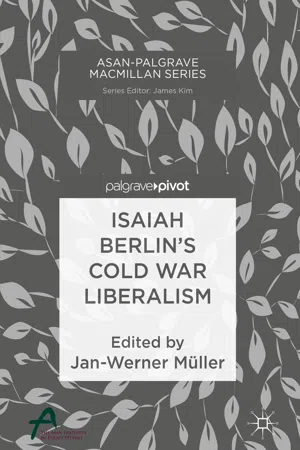
Isaiah Berlin’s Cold War Liberalism
About this book
This book offers a succinct re-examination of Berlin's Cold War liberalism, at a time when many observers worry about the emergence of a new Cold War. Two chapters look closely at Berlin's liberalism in a Cold War context, one carefully analyses whether Berlin was offering a universal political theory – and argues that he did indeed (already at the time of the Cold War there were worries that Berlin was a kind of relativist). It will be of value for scholars of the cold war and of security issues in contemporary Asia, as well as students of history and philosophy.
Information
© The Author(s) 2019
Jan-Werner Müller (ed.)Isaiah Berlin’s Cold War LiberalismAsan-Palgrave Macmillan Serieshttps://doi.org/10.1007/978-981-13-2793-3_11. Introduction: Concepts, Character, and the Specter of New Cold Wars
Jan-Werner Müller1
(1)
Princeton University, Princeton, NJ, USA
Abstract
The introduction discusses the complex ways in which Isaiah Berlin’s intellectual legacy has been contested. There is basic uncertainty as to where to place him on the political spectrum; and there are questions about the depth of his political thought, as well as his conduct as an intellectual during the Cold War. I argue that Berlin’s ideas and stance cannot simply be copied in the context of what some observers take to be a new Cold War, but that they merit renewed attention and do indeed hold important lessons for the present. The introduction also briefly summarizes the three chapters of the volume.
Keywords
Isaiah BerlinCold WarThere’s something puzzling about the legacy of Isaiah Berlin. On the one hand, his name continues to be regularly invoked in political writings of very different genres. Despite the fact that many political theorists have long urged us to move beyond Berlin’s distinction between negative and positive liberty, his analysis of freedom often gets re-validated or at least taken as a starting point for reflections on freedom.5 The hedgehog and the fox (Berlin’s metaphors for classifying two types of political theorists) keep wandering into policy papers and popular articles on philosophy.6 Rather astonishingly, an Irish minister of finance has identified Berlin as a source of guidance when dealing with ‘the demands of corporation tax policy, crafting a budget or the vagaries of industrial relations’.7 And since many observers have begun to speak of a new Cold War in the wake of Vladimir Putin’s annexation of Crimea and Russian interference in the 2016 US presidential elections, Berlin, as a seemingly archetypal Cold War liberal, is receiving new attention. Of course, one can debate whether a Cold War paradigm is actually at all plausible to understand our age, or whether it is not a lazy analogy. What seems beyond dispute, however, is that political forces—and sentiments—which preoccupied Berlin virtually during his entire lifetime have become much more important again: nationalism, populism, and varieties of authoritarianism, some of which can be said broadly to have been inspired by Counter-Enlightenment thinkers.8 Berlin was passionately interested in the doctrines that justified these ‘-isms’—but he also always emphasized that their psychological appeal had to be understood properly. With his famous capacity for empathy, Berlin tried to convey a sense of how one could completely reject the ideas of Counter-Enlightenment figures like Joseph de Maistre and J. G. Hamman—and yet come to appreciate how their thought had responded to genuine human needs (such as the need for belonging that the life-long Zionist Berlin always particularly emphasized). Berlin knew better than most observers during the Cold War how resentment and alienation—or what he sometimes called ‘a state of wounded consciousness’—could lead what by all accounts seemed reasonable people to endorse deeply illiberal precepts.…I have always said to myself that I preferred Jesuits to muddled men of good will. At least one knows what one is fighting for and against, and the weapons are kept sharp.Isaiah Berlin1Can one be a liberal and anti-pluralist, can one be a fanatical liberal and seek to eliminate all alternative forms of government?Isaiah Berlin2…nothing is more frightful than an anti-Communist crusade…Isaiah Berlin3…the Cold War and the obvious cruelties of communism made us all tend to defend our system as a system. And it is undeniable that the system as such tolerates a continuing set of injustices and evils.4Arthur M. Schlesinger, Jr.
Yet Berlin’s legacy is not confined to offering acute political and psychological insights into the moral universe of those slighted by a cosmopolitan liberal culture (what today is often maligned as ‘globalism’). His admirers view him as nothing less than a model for intellectual-political conduct during times of intense ideological conflict. Understanding Berlin’s stance, so the reasoning here goes, might help us to resist an attitude where one positively revels in a sense of moral certainty—along the lines of ‘now we know where the enemy stands!’ and ‘now we know what we stand for!’ Instead, followers of Berlin would say, liberals should take a firm stance, but remain mindful of their own fallibility and not react to the challenge of a different political ‘faith’ by desperately trying to create a fervent ‘counter-faith’ of their own. Hence Joseph Schumpeter’s view—famously endorsed by Berlin at the end of his lecture on ‘Two Concepts of Liberty’—remains as difficult as ever, and yet as necessary as ever: ‘“To realize the relative validity of one’s convictions”’, Berlin quoted Schumpeter, ‘“and yet stand for them unflinchingly is what distinguishes a civilized man from a barbarian”’. Berlin went on: ‘To demand more than this is perhaps a deep and incurable metaphysical need; but to allow it to determine one’s practice is a symptom of an equally deep, and more dangerous, moral and political immaturity’. What does this mean concretely? Berlin thought the answer could be summed up rather breezily as follows: ‘it is all a matter of compromise and balance and adjustment and empirical Popperism etc.’.9
However, apart from this story of Berlin as model liberal character and a seemingly inexhaustible source of political wisdom, there’s also another, far less flattering view of Berlin’s legacy. Berlin’s reputation as a political theorist is not secure in the way that the status of a John Rawls or even that of other more or less officially recognized ‘Cold War liberals’—such as Karl Popper—is. Of course, Berlin himself always thought that his contemporaries vastly overrated him (while conceding that such a state was by no means unpleasant). His self-doubt was not merely a pose, easily recognizable as part of the venerable tradition of more or less fake British (and more particularly Oxford) self-deprecation. For some observers, Berlin’s thought is precisely too much bound up with Cold War liberalism—with the latter notion functioning as a kind of intellectual, and perhaps also political, put-down.10 Here Berlin is said to have weaponized liberal thought in the Cold War, rendering liberalism more ‘conservative’ in the process or perhaps also paving the way for neoliberalism.11 Rather than actually defending liberalism, he supposedly ‘deformed’ it.12 This is of course very much contrary to his own image as ultimately a man of the non-Communist left or at least a man among what he at one point called ‘the miserable centrists, the contemptible moderates, the crypto-reactionary skeptical intellectuals’ (alternatively—and not that this makes things any more straightforward—Berlin also described himself as occupying ‘the extreme Right Wing edge of the Left Wing movement, both philosophically and politically’).13 It is worth pointing out that Berlin, for instance in a long letter to a historian of political thought, Fred Rosen, vehemently rejected the notion that his approach could be accurately characterized by the term ‘cold-war rhetoric’ (sic!).14
For others, the problem with Berlin’s political thought lies elsewhere. Berlin’s imperative to keep one’s liberal thinking flexible, almost loose, seems an invitation—or excuse—not to think too deeply or not to think ‘rigorously’ or even ‘consecutively’ at all15: surely a terrible thing from the perspective of analytic political philosophy.16 A successor of Berlin to the Chichele Chair of Social and Political Theory at All Souls College, Oxford, has accused him of offering not much more than ‘airy talk of freedom and openness’ or, even worse, merely looking at ‘broad zeitgeist issues’ and offering at best a ‘big-picture diagnosis’; he supposedly failed to see that political theory meant hard and precise thinking about political institutions (adding that Berlin’s ‘lack of interest in institutions and constitutions has turned out to be contagious and it has contaminated the theory of politics as we see it and know it today’—a rather astonishing achievement, one would have thought, for a single individual, whose ‘airy talk’ had little influence on curricula even at Oxford).17 For others again, it is the moderate, half-hearted, perhaps half-baked stance that proves irritating: a self-consciously lukewarm liberalism—the anti-liberal philosopher Raymond Geuss once talked about the ‘the tepid and slimy puddle created by Locke, J. S. Mill, and Isaiah Berlin’—seems inimical to proper political theory, whether the latter is thought of as desirable in the form of cold realism or as red-hot radicalism.18 Only the muddled or the meek are moderates. Or so it seems.
Quite apart from skepticism about Berlin as a political thinker, there are real, and sometimes related, questions about character. The charge against Berlin here is that he either was not clear on what his own political position really amounted to (a reproach very much in line with the one by philosophers who accused him of muddled thinking), or, even worse: he might often have been dissimulating, or, perhaps worse still, he was always adapting to what a particular audience might have wanted to hear. Rather than openly fighting his political corner, the famed Oxford don—who did indeed describe himself as deeply averse to ‘public altercations’—is said to h...
Table of contents
- Cover
- Front Matter
- 1. Introduction: Concepts, Character, and the Specter of New Cold Wars
- 2. Isaiah Berlin and Reinhold Niebuhr: Cold War Liberalism as an Intellectual Ethos
- 3. The Contours of Cold War Liberalism (Berlin’s in Particular)
- 4. Liberal Pluralism and Common Decency
- Back Matter
Trusted by 375,005 students
Access to over 1.5 million titles for a fair monthly price.
Study more efficiently using our study tools.
Frequently asked questions
Yes, you can cancel anytime from the Subscription tab in your account settings on the Perlego website. Your subscription will stay active until the end of your current billing period. Learn how to cancel your subscription
No, books cannot be downloaded as external files, such as PDFs, for use outside of Perlego. However, you can download books within the Perlego app for offline reading on mobile or tablet. Learn how to download books offline
Perlego offers two plans: Essential and Complete
- Essential is ideal for learners and professionals who enjoy exploring a wide range of subjects. Access the Essential Library with 800,000+ trusted titles and best-sellers across business, personal growth, and the humanities. Includes unlimited reading time and Standard Read Aloud voice.
- Complete: Perfect for advanced learners and researchers needing full, unrestricted access. Unlock 1.5M+ books across hundreds of subjects, including academic and specialized titles. The Complete Plan also includes advanced features like Premium Read Aloud and Research Assistant.
We are an online textbook subscription service, where you can get access to an entire online library for less than the price of a single book per month. With over 1.5 million books across 990+ topics, we’ve got you covered! Learn about our mission
Look out for the read-aloud symbol on your next book to see if you can listen to it. The read-aloud tool reads text aloud for you, highlighting the text as it is being read. You can pause it, speed it up and slow it down. Learn more about Read Aloud
Yes! You can use the Perlego app on both iOS and Android devices to read anytime, anywhere — even offline. Perfect for commutes or when you’re on the go.
Please note we cannot support devices running on iOS 13 and Android 7 or earlier. Learn more about using the app
Please note we cannot support devices running on iOS 13 and Android 7 or earlier. Learn more about using the app
Yes, you can access Isaiah Berlin’s Cold War Liberalism by Jan-Werner Müller in PDF and/or ePUB format, as well as other popular books in Politics & International Relations & Political Philosophy. We have over 1.5 million books available in our catalogue for you to explore.