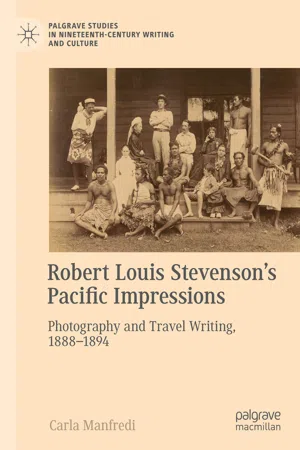
This book tackles photography's role during Robert Louis Stevenson's travels throughout the Pacific Island region and is the first study of his family's previously unpublished photographs. Cutting across disciplinary boundaries, the book integrates photographs with letters, non-fiction, and poetry, and includes much unpublished material. The original readings of photographs and non-fiction highlight Stevenson's engagement with colonial ideology and reality and advance new arguments about Victorian travel, settlement, and colonialisms in the Pacific. Like the Stevensons, the book moves from the Marquesas to the atolls of the Gilbert Islands in Micronesia; from the Kingdom of Hawai'i's political ambitions to Samoan plantations and the Stevensons' settlement at Vailima. Central to this study is the notion that Pacific history and Pacific Island cultures matter to the interpretation of Stevenson's work, and a rigorous historical and cultural contextualization ensures that local details structure literary and photographic interpretation. The book's historical grounding is key to its insightful conclusions regarding travel, settlement, photography, and colonialism.
eBook - ePub
Robert Louis Stevenson’s Pacific Impressions
Photography and Travel Writing, 1888–1894
- English
- ePUB (mobile friendly)
- Available on iOS & Android
eBook - ePub
Robert Louis Stevenson’s Pacific Impressions
Photography and Travel Writing, 1888–1894
About this book
Information
© The Author(s) 2018
Carla ManfrediRobert Louis Stevenson’s Pacific ImpressionsPalgrave Studies in Nineteenth-Century Writing and Culturehttps://doi.org/10.1007/978-3-319-98313-4_11. Introduction: Stevenson and Early Photography in the Pacific Islands
Carla Manfredi1
(1)
University of Winnipeg, Winnipeg, MB, Canada
Carla Manfredi
The equatorial sun beat down on the atoll of Penrhyn in the central-south Pacific as Robert Louis Stevenson and his stepson Lloyd Osbourne struggled to find the right angle to photograph a group of Pacific Islanders. On that day, 9 May 1890, the two men were observed by a bemused Fanny Van de Grift Stevenson who watched the scene unfold as she sat on a nearby log. She would later describe the event in her travel diary:
[T]hey planted their camera stand in the centre of the village, and walked about to look for good points of view. While they were away a serious-looking man delivered a lecture upon the apparatus, to the evident edification and wonder of the crowd. During his explanation he mimicked both Louis’s and Lloyd’s walk, showing how Lloyd carried the camera, while Louis walked about looking round him. I sat down on a log to wait, when immediately all the women and girls seated themselves on the ground, making me the centre of a half circle and gazing at me with hard, round eyes. (JN, 98)
In Fanny’s remarkable anecdote, the act of photography structures the interaction between foreigners and Islanders. Unexpectedly, the two photographers find that they have become spectacles for those whom they wished to photograph. The Islanders’ parody of foreign curiosity undermines the photographers’ seeming authority at the same time as the playful Islander appropriates the device for the “edification and wonder” (98) of his friends and makes the apparatus, which is designed to look and record, the object of ridicule; likewise, the photographers’ idiosyncratic gestures are cause for amusement. Fanny too does not escape this scrutiny. As she sits on a nearby log as an audience to the unfolding scene, women surround her and gaze at her with “hard and round” (98) eyes—unflinching and camera-like. This tantalizing scene of Stevenson grafted to cumbersome photographic apparatus raises seemingly straightforward questions: what motivated Stevenson’s Pacific photography and what were the circumstances of his family’s practice? In seeking to answer these questions, this book foregrounds the relationship between Stevenson’s photographic and textual “impressions” in the extant records of his Pacific travel and residence and argues that individual photographs offer unique opportunities to elucidate the author’s place within the knotted histories of colonialism and photography in the Islands.
Since the 1980s, studies of Stevenson’s Pacific fiction have been inflected, to varying degrees, by postcolonial literary criticism. Recent scholarship argues, explicitly or implicitly, that Stevenson anticipated twentieth-century postcolonial interventions (Edmond 1997; Smith 1998; Colley 2004; Reid 2006; Buckton 2007; Jolly 2009; Dryden 2011; Phillips 2012; Largeaud-Ortéga 2013; Hill 2017). Reid observes that Stevenson’s writing prefigures “many issues now facing a postcolonial world, and thus seem[s] to be in tune with current critical and political interests” (2006, 5). The anthropologist Nicholas Thomas (2012) also contends that Stevenson’s interest in “cultural hybridity” looked forward to late-twentieth-century postcolonial theory (48). Amid this postcolonial reappraisal of Stevenson’s oeuvre, Colley (2004) was the first to offer an extensive engagement with the literary–photographic nexus in Stevenson’s Pacific work.
Colley’s interest in Stevenson’s aesthetic fascination with the play of light, darkness, and shadows informs her approach to his photography. “By exposing dark plates to the sun,” writes Colley, “the medium afforded Stevenson the opportunity to watch emerging shadows materialize before him” (112). Colley does not limit her discussion to photography’s role in Stevenson’s literary imagination, but instead anticipates Hill’s observation that Stevenson used the technology to “create a strong visual record of the Pacific to document his writings” (Hill 2017, 154). As Colley points out, “[t]he photographs were to be used as illustrations for Stevenson’s writings about the South Seas” (114) since they were “a means of legitimizing or illuminating his words and of giving his readers a more particularized image to consider” (117). Colley’s work draws attention to Stevenson’s aesthetic interest in photography but also provides a sound narrative of his “scattered and generally overlooked” (99) writing concerning his photo collection.
Recently, Hill (2017) discusses Stevenson’s photography within the broader context of the author’s lifelong interest in illustrated novels. Hill tackles Island Nights’ Entertainments (1893) as “a valuable case-study in the complexities of publishing Pacific-Stevenson in the nineteenth century” (174). The artists who produced the 27 illustrations featured in the 1893 volume faced, for instance, the challenge of depicting ethnic specificity: while “The Isle of Voices” and “The Bottle Imp” both feature Hawaiian characters, “The Beach of Falesá” is set on a fictional island that is loosely based on Sāmoa. Stevenson, therefore, wanted to ensure that his illustrators would distinguish adequately between Hawaiian and Samoan styles of dress (178). Hill’s analysis of the illustrations that accompanied Stevenson’s Pacific fiction echoes Colley’s remark that Stevenson’s aversion to generic ethnographic depictions prompted him to mail photographs to his illustrators as “reliable depictions of Pacific subjects” (2004, 155). In fact, Stevenson was adamant that his characters should possess “idiosyncrasies of facial features and physical characteristics” (Hill 2017, 164). When it came to The Ebb-Tide (1893), Stevenson was keen on having Browne provide the illustrations and went so far as to specify to Sidney Colvin that Browne “will find some photographs of an old marine curiosity shop in my collection, which may help him” (qtd. in Hill 2017, 188). As Hill stresses, Stevenson always possessed a very precise “mental picture of his scenery and his characters” and he “trust[ed] Browne’s artistic talents as long as they [were] guided by his photographs” (188–89).
Both Colley and Hill agree that photography was at the center of Stevenson’s Pacific work: not only did the medium stimulate Stevenson’s aesthetic sensibility, but it was also a convenient and seemingly reliable method of recording specific Pacific environments and Islanders’ appearances. While my book contributes to the vibrant conversation about Stevenson’s Pacific oeuvre, it also breaks away from its precedents. My analysis of Stevenson and his family’s photographic practice under colonialism draws together theoretical perspectives from the fields of photography history and Pacific studies.
The impetus for this book—a comprehensive examination of Stevenson’s Pacific photo archive—was broadly inspired by the material culture of, or object-centered approach to, the study of family photo albums (Edwards 2001; Langford 2001; Peterson and Pinney 2003; Di Bello 2007; Batchen 2004; Rose 2010; Sandbye 2014). Although I make passing references to the Stevenson family’s exchanging and collecting of photographs and the eventual compilation of those photographs within albums, I do not provide a systematic history of the nineteenth-century photograph album, nor do I address material issues such as album compilation (i.e., what photos show signs of having been taken out and replaced by others) and format (i.e., the size of prints and their quality). Rather, my specific theoretical perspective is indebted to studies of colonial photography and to the work of Pacific historians. Starting with a pool of 549 images, I have narrowed my selection down to 34 and instead of “reading” their materiality, I approach them as moments of social encounter. Many of the photographs challenge the now-familiar associations of colonialism and photography, rather than merely represent, or reinforce asymmetrical power relations. This book illuminates how, by accounting for the different colonial histories that unfolded in the Pacific, alternative (sometimes contradictory) narratives emerge.
Stevenson’s four photo albums (see the Appendix for a detailed description) were compiled by the family during their residence in Sāmoa. The albums bear ample signs of use and age in the rubbings in their spines and in their shriveled corners. Furthermore, many of the photos are ripped, cropped, and faded, and some have evidently been removed and repasted. Scrawled album marginalia leave little doubt of the intimacy between Stevenson’s literary project and photographic endeavors; photography was integral to Stevenson’s working method. Dozens of annotations—penciled in arrows, “Xs,” and references to page numbers—seemingly indicate which photographs were being considered as illustrations or as aide-memoires. Two extant manuscripts offer solid evidence that particular photographs were being organized, commented on, and considered for publication.
Beinecke MS. 6717 is an 11-page notebook composed in Sāmoa by Stevenson and Fanny. The notebook consists of a catalog of approximately 300 photographs (taken during the cruise of the Casco, Equator, and the Janet Nicoll) that are listed alphabetically according to their captions. Fanny’s writing appears on the left side, Stevenson’s on the right. Fanny lists the captions of individual photographs and Stevenson pencils in, somewhat randomly, thoughts on suggested pages (in an unknown manuscript) for the photographs, additional photographs to add, and other miscellany. Fanny also assigns each photograph a letter—either “A,” “B,” or “C”—and a number. Colley (2004) correctly stresses that this manuscript reveals the “intensity of Stevenson’s commitment to the photographic image as a supplement to his text” (118). By cross-referencing this manuscript with the photograph albums, I have found that “A” corresponds with LSH 149/91, “B” with LSH 151/91, and “C” with LS...
Table of contents
- Cover
- Front Matter
- 1. Introduction: Stevenson and Early Photography in the Pacific Islands
- 2. “We Savages”: Cannibal Performances in the Marquesas
- 3. “An Extraordinary State of Affairs”: The Hawaiian Embassy to Sāmoa
- 4. “Incongruities of Scale”: Encountering the Atolls of Kiribati
- 5. “Native Movement”: Islanders and the Janet Nicoll
- 6. “Little House in the Bush”: Specters of Vailima
- 7. Conclusion
- Back Matter
Trusted by 375,005 students
Access to over 1.5 million titles for a fair monthly price.
Study more efficiently using our study tools.
Frequently asked questions
Yes, you can cancel anytime from the Subscription tab in your account settings on the Perlego website. Your subscription will stay active until the end of your current billing period. Learn how to cancel your subscription
No, books cannot be downloaded as external files, such as PDFs, for use outside of Perlego. However, you can download books within the Perlego app for offline reading on mobile or tablet. Learn how to download books offline
Perlego offers two plans: Essential and Complete
- Essential is ideal for learners and professionals who enjoy exploring a wide range of subjects. Access the Essential Library with 800,000+ trusted titles and best-sellers across business, personal growth, and the humanities. Includes unlimited reading time and Standard Read Aloud voice.
- Complete: Perfect for advanced learners and researchers needing full, unrestricted access. Unlock 1.5M+ books across hundreds of subjects, including academic and specialized titles. The Complete Plan also includes advanced features like Premium Read Aloud and Research Assistant.
We are an online textbook subscription service, where you can get access to an entire online library for less than the price of a single book per month. With over 1.5 million books across 990+ topics, we’ve got you covered! Learn about our mission
Look out for the read-aloud symbol on your next book to see if you can listen to it. The read-aloud tool reads text aloud for you, highlighting the text as it is being read. You can pause it, speed it up and slow it down. Learn more about Read Aloud
Yes! You can use the Perlego app on both iOS and Android devices to read anytime, anywhere — even offline. Perfect for commutes or when you’re on the go.
Please note we cannot support devices running on iOS 13 and Android 7 or earlier. Learn more about using the app
Please note we cannot support devices running on iOS 13 and Android 7 or earlier. Learn more about using the app
Yes, you can access Robert Louis Stevenson’s Pacific Impressions by Carla Manfredi in PDF and/or ePUB format, as well as other popular books in Literature & Modern Literary Criticism. We have over 1.5 million books available in our catalogue for you to explore.